

📌 Key Takeaways
Repeatable paper bag sourcing replaces firefighting with a documented workflow built on versioned specs, clear ownership, and sampling gates.
- Artifacts Over Memory: Three reusable documents—spec sheets, scorecard, and decision memo—enable consistent cycles without staff dependency.
- Ownership Prevents Bottlenecks: RACI clarity assigns procurement, operations, and marketing distinct gates, so reliability requirements precede brand preferences.
- Sampling Validates Reality: Pilot orders under real handling conditions prevent scale-up failures that unit price alone cannot predict.
- Trigger Rules Replace Urgency: Predefined responses for lead-time slips, defect trends, and spec changes activate backup suppliers without meetings.
- Quarterly Reviews Prevent Drift: A 30-to-45-minute agenda covering quality, delivery, cost-to-serve, and risk maintains leverage without lock-in.
Documented workflow = defensible supplier decisions.
Procurement and operations teams managing wholesale paper bag programs will gain immediate implementation tools here, preparing them for the detailed 7-step framework and copy-paste checklists that follow.
A wholesale paper bag sourcing process becomes repeatable when built around a few reusable artifacts, clear ownership, and simple gates. Use this 7-step framework, one-page RACI, and copy-paste checklist to replace scattered quotes with a defensible workflow. If time is short, prioritize two actions: standardize bag families with spec sheets, and add a sampling gate before committing to any supplier.
What is a wholesale paper bag sourcing process?
A wholesale paper bag sourcing process is a documented, repeatable method for defining finished bag requirements, collecting comparable supplier quotes, validating performance, and reviewing suppliers over time.
- Set bag families and a spec sheet library
- Forecast demand and write reorder triggers
- Build an RFQ pack that reduces back-and-forth
- Discover suppliers (longlist)
- Qualify and shortlist with a simple scorecard
- Sample and run a pilot (plus a logistics sanity check)
- Decide, document, and run a quarterly review cadence
What makes a sourcing process ‘stick’ for paper bags?
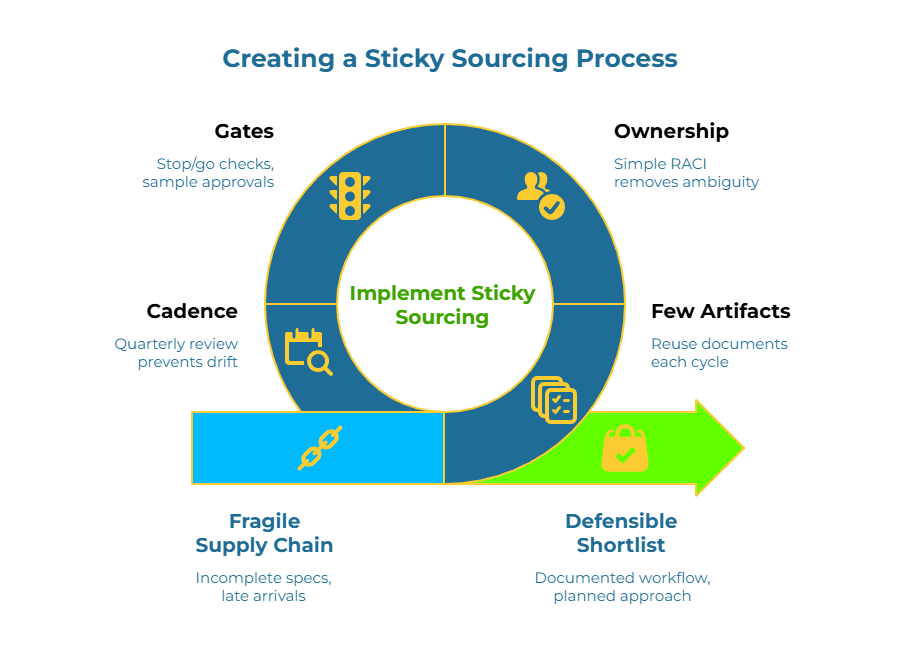
Sourcing processes often fail—not because teams forget the steps, but because ownership and artifacts are unclear. Without a shared framework, procurement requests quotes based on incomplete specs, operations scrambles when bags arrive late or fail during handling, and marketing intervenes with last-minute design changes that trigger rework. This supply chain fragility compounds during peak seasons. The result is firefighting rather than planning.
A “sticky” sourcing process addresses these failure modes by designing around four elements: few artifacts (the same documents get reused each cycle), ownership (a simple RACI removes ambiguity), gates (stop/go checks like sample approvals and version control), and cadence (a light quarterly review prevents drift).
Think of this process as a flight plan for your paper bag program. Rather than reacting to each quote or supplier pitch, the team follows a documented workflow that turns fragmented options into a defensible shortlist. This guide focuses exclusively on wholesale finished paper bags—sourcing raw kraft paper or other base materials involves different considerations.
When bags tear during delivery or quotes vary wildly due to different Incoterms and freight assumptions, the root cause is often misaligned specifications or incomplete cost comparisons.. For more on how specification gaps create hidden costs, see why ‘cheap’ paper bag quotes get expensive.
What are the 7 steps in a simple wholesale paper bag sourcing process?
The following workflow moves from requirements through supplier selection to ongoing management. Each step includes an objective, owner, inputs, output artifact, and a “done definition” so the team knows when to proceed.
Step 1: Standardize bag families and spec sheets
Objective: Translate business requirements into specifications that drive supplier selection and enable suppliers to quote against them consistently.
Owner: Procurement (accountable, responsible for version control); Operations (responsible for performance fields); Marketing (consulted for print fields).
Inputs: Current bag usage by product type, weight ranges, handling conditions, and brand guidelines.
Output: Three to six “bag families” plus a one-page spec sheet per family.
Done when: Technical specifications are signed off by Operations and locked in version control by Procurement.
Reference: From specs to sourcing: how paper bag requirements drive wholesale supplier selection.
Step 2: Forecast demand and set reorder triggers
Objective: Prevent emergency purchases by knowing how many bags are needed and when.
Owner: Operations (accountable, responsible); Procurement (consulted for supplier lead time data).
Inputs: Historical usage data, seasonal patterns, and upcoming promotions.
Output: A simple volume forecast by bag family plus reorder points.
Done when: The team can explain “how many, when, and why” before requesting quotes—reorders trigger without last-minute scrambling.
Reference: See inventory management 101: preventing paper bag stockouts during peak retail seasons.
Step 3: Build an RFQ pack
Objective: Enable suppliers to respond in a comparable format, reducing time spent normalizing quotes.
Owner: Procurement (accountable, responsible); Operations and Marketing (consulted).
Inputs: Spec sheets from Step 1, volume forecasts from Step 2, destination details, and quality expectations. Spec sheets should include measurable parameters like GSM and burst factor to prevent specification disputes.
Output: One RFQ pack that includes specifications, volumes, delivery destinations and Incoterms, quality expectations, sample requirements, and version control rule.
Done when: Suppliers can respond without requesting additional information—supplier quotes are comparable.
RFQ mini-template (copy/paste):
Subject: RFQ — Paper bags (Spec v__ / Volume __ / Deliver to __)
Attach spec version(s); request unit price + lead-time assumptions + change conditions; include packing/labeling, artwork workflow, and sample plan.
Step 4: Discover suppliers (build a longlist)
Objective: Identify a manageable set of potential suppliers before deeper qualification.
Owner: Procurement (accountable, responsible); Operations (consulted).
Inputs: RFQ pack, existing supplier relationships, and discovery platforms.
Output: A longlist of eight to fifteen candidates, logged with contact information, stated capabilities, and next steps.
Done when: The longlist is documented and sized to the team’s capacity for qualification—options exist before emergencies.
Use PaperIndex to broaden discovery across global suppliers, then apply this international supplier verification checklist to filter credible candidates. The platform serves as a research and comparison input—the scorecard and sampling gate determine which suppliers are credible.
Want a faster way to build a longlist? Browse paper bag suppliers on PaperIndex, then apply your internal scorecard and sampling gates before committing.
Step 5: Qualify and shortlist with a simple scorecard
Objective: Narrow the longlist to suppliers who meet capability and risk thresholds.
Owner: Procurement (accountable); Operations (responsible for performance gates); Marketing (responsible for print approvals).
Inputs: Supplier responses to RFQ, initial documentation, and references.
Output: A shortlist of two to four suppliers, each supported by a completed scorecard.
Done when: Selection accounts for the hidden costs of unverified suppliers and can be justified beyond unit price using total-cost analysis.
Qualification support: Verify supplier credentials using a structured audit of ISO certifications and physical sample testing.
External verification pathways (when relevant): FSC Certificate Search, PEFC Find Certified, ISO 9001 overview, and food-grade certification standards for delivery packaging.
Step 6: Sample, pilot, and verify logistics
Objective: Confirm that the bag performs in real handling conditions before committing volume.
Owner: Operations (accountable, responsible for testing); Procurement (consulted for coordination); Marketing (consulted; responsible for print/finish approval).
Inputs: Samples from shortlisted suppliers, pilot order criteria, and logistics requirements.
Output: Sample evaluation notes, pilot order results, and documented defect expectations.
Done when: Evidence exists that the bag works under expected stress—handling risks are known before scale.
Reference: Diagnosing why paper bags tear during delivery—a 5-step diagnostic process.
Step 7: Decide, document, and establish review cadence
Objective: Lock in supplier roles and create a repeatable system that survives staff turnover.
Owner: Procurement (accountable for decision memo and agenda); Operations (responsible for trigger rules and performance inputs); cross-functional (quarterly review).
Inputs: Pilot results, scorecard data, and commercial terms.
Commercial terms should address payment term negotiation for cash flow management, particularly for buyers managing multiple supplier relationships.
Output: A decision memo, assigned supplier roles (primary and backup), documented trigger rules, and a quarterly review agenda.
Done when: A new team member could run the next cycle—reorders follow the same workflow.
Reference: Understanding the hidden risks of single-source procurement and building backup supplier options.
How to design a sourcing process your team will follow
- Publish versioned bag-family specs (Operations accountable; output: spec sheets).
- Write reorder triggers by bag family (Operations accountable; output: forecast + triggers).
- Send one RFQ pack with a quote template (Procurement accountable; output: comparable quotes).
- Shortlist with scorecard + pilot gate (Procurement/Operations; output: shortlist + acceptance record).
- Issue a decision memo and run quarterly reviews (Procurement accountable; output: cadence).
Who owns which step (procurement vs operations vs marketing)?
Operations reliability gates must be met before brand upgrades are prioritized.
| Activity | Procurement | Operations | Marketing |
| Bag families / spec sheets | A / R (version control) | R (performance fields) | C (print fields) |
| Demand forecast / reorder triggers | C | A / R | I |
| RFQ pack ownership | A / R | C | C |
| Supplier shortlist decision | A | R | C |
| Sample testing | C | A / R | C |
| Artwork / version approvals | I | C | A |
| Quarterly review ownership | A (agenda/actions) | R (performance inputs) | C / I |
Legend: R = Responsible (does the work), A = Accountable (final decision), C = Consulted (provides input), I = Informed (kept updated).
Conflict resolution: When priorities clash, apply the “must-have versus nice-to-have” rule. Operations reliability gates (strength, lead time, defect thresholds) must be met before brand upgrades.
How do you keep the process lightweight without increasing risk?
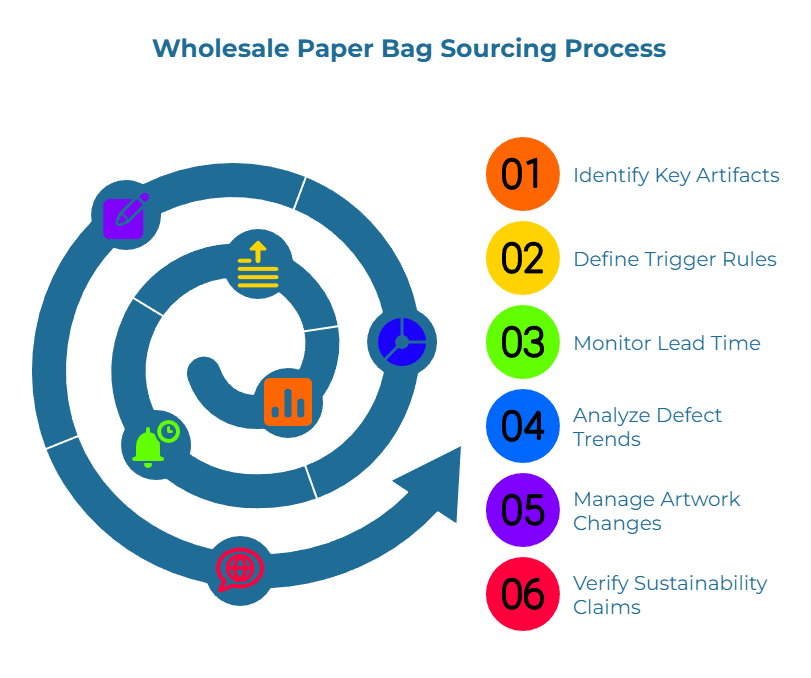
Adding structure does not require bureaucracy. Limit artifacts to those that get reused and define trigger rules that prevent problems without constant meetings.
If the team can only maintain three artifacts, choose these: the spec sheet (defines what “acceptable” looks like), the scorecard (documents why a supplier was selected), and the decision memo (records roles, triggers, and review dates).
Trigger rules replace reactive firefighting with predefined responses:
- Lead time slips beyond tolerance → activate backup supplier.
- Defect trends persist across multiple shipments → pause orders and re-qualify.
- Artwork or spec change requested → new version number plus fresh sample gate.
When sustainability certifications matter, verify supplier sustainability claims independently via FSC Certificate Search or PEFC Find Certified to avoid greenwashing risks.
How should you review and improve the process over time?
A quarterly review prevents process drift without extensive meetings. The agenda should take 30 to 45 minutes and cover:
- Quality consistency: returns, complaints, and defect rates by supplier.
- Delivery performance: lead time variance and missed commitments.
- Cost-to-serve: rush charges, rework costs, storage fees.
- Risk signals: single-source exposure and upcoming peak seasons.
- Spec sheet updates: what changed based on failures or new requirements.
Refreshing the supplier longlist periodically—even when current suppliers perform well—prevents vendor lock-in, maintains pricing leverage, and ensures the team remains aware of market innovations in paper weight and adhesive technologies.
A copy/paste checklist your team can adopt next week
7-Step Process Checklist
- [ ] Step 1 — Bag families + specs (Owner: Procurement) → Output: versioned spec sheets → Done: quote-critical fields are unambiguous
- [ ] Step 2 — Demand + triggers (Owner: Operations) → Output: forecast + trigger rules → Done: reorders are predictable, not reactive
- [ ] Step 3 — RFQ pack (Owner: Procurement) → Output: RFQ pack + quote template → Done: supplier quotes are comparable
- [ ] Step 4 — Longlist (Owner: Procurement) → Output: longlist with evidence notes → Done: options exist before emergencies
- [ ] Step 5 — Shortlist (Owner: Procurement) → Output: scorecard + shortlist → Done: selection is defensible beyond unit price
- [ ] Step 6 — Pilot gate (Owner: Operations) → Output: pilot acceptance record → Done: handling risks are known before scale
- [ ] Step 7 — Cadence (Owner: Procurement) → Output: decision memo + quarterly agenda → Done: reorders follow the same workflow
Supplier Scorecard Template
| Category | Evidence to record |
| Spec fit | Quote matches the controlled spec version; gaps noted |
| Repeatability | Sample/pilot consistency; change-control approach |
| Print capability (if needed) | Proofing workflow; approval steps |
| Lead-time reliability | Assumptions stated; communication during slippage |
| Logistics readiness | Packing/labeling clarity; delivery documentation readiness |
| Risk posture | Backup readiness; single-point-of-failure signals |
First 30 Days: Rollout Plan
- Week 1: Document current bag types; create spec sheets for top two or three families.
- Week 2: Pull usage data; draft demand forecast with reorder points.
- Week 3: Build RFQ pack template; identify eight to ten suppliers for the longlist.
- Week 4: Send RFQs; begin scorecard evaluations; schedule first quarterly review.
Ready to start building your longlist? Submit an RFQ for paper bags to connect with verified suppliers, or explore paper bag supplier listings to research available options before sending your RFQ.
Frequently Asked Questions
What is the simplest procurement process for wholesale paper bags?
A simple process uses 5–7 steps and relies on three artifacts: a versioned spec sheet, an RFQ pack for comparable quotes, and a scorecard beyond unit price.
How do you write an RFQ for paper bags?
Include spec version(s), volume band/cadence, destinations, packing/labeling expectations, quality expectations in plain language, a sample plan, and version-control rules for changes. Provide a quote template so responses are comparable.
Who should own paper bag sourcing—procurement or operations?
Shared ownership is common: procurement owns the commercial workflow and documentation discipline; operations owns performance gates and acceptance criteria; marketing owns brand/print approvals and versioned artwork sign-off.
How do you prevent paper bag stockouts?
Forecast by bag family, set reorder triggers in advance, and maintain a primary + backup approach sized to risk. For material selection guidance, see choosing between virgin and recycled kraft paper grades based on your load requirements. For converters manufacturing their own bags, strategic kraft paper grade selection should precede finished bag sourcing—match sack kraft for industrial loads (20-50 kg) versus general kraft for retail applications (1-5 kg).
How do you compare paper bag suppliers beyond unit price?
Use a scorecard that records evidence for spec fit, repeatability, lead-time reliability, logistics readiness, and risk posture.
Disclaimer: This article is for educational purposes only.
Our Editorial Process:
Our expert team uses AI tools to help organize and structure our initial drafts. Every piece is then extensively rewritten, fact-checked, and enriched with first-hand insights and experiences by expert humans on our Insights Team to ensure accuracy and clarity.
About the PaperIndex Insights Team:
The PaperIndex Insights Team is our dedicated engine for synthesizing complex topics into clear, helpful guides. While our content is thoroughly reviewed for clarity and accuracy, it is for informational purposes and should not replace professional advice.