

📌 Key Takeaways
Legal terms like “recyclable” and “compliant” cannot be pasted into supplier specifications—they must be translated into measurable fields with clear evidence requirements.
- Vague Words Break Quotes: When specifications say “sustainable” without numbers, every supplier interprets it differently, making price comparisons meaningless.
- Four Steps Fix the Gap: Strip the regulation to its real rule, find what must be true in the carton, turn that into a named spec field, then define exactly how suppliers must respond.
- Certificates Are Snapshots: A compliance certificate shows what passed testing once—it does not automatically update when suppliers change materials or factories.
- Standardize the Response Format: Require suppliers to fill in fixed fields (percentages, certificate numbers, expiry dates) instead of writing open-ended narratives.
- Test Before Sending: Run the spec through legal, packaging, procurement, and sustainability lenses—if any team cannot clearly answer their checklist questions, the spec is not ready.
Translate the mandate, or suppliers will translate it for you.
Procurement managers, packaging engineers, and compliance leads working on folding carton sourcing will find a ready-to-use translation workflow here, preparing them for comparable supplier quotes and audit-ready documentation.
~ ~ ~ ~ ~ ~ ~ ~ ~ ~ ~ ~ ~ ~ ~ ~ ~ ~
A 40-page regulatory document arrives from legal. The EU’s Packaging and Packaging Waste Regulation requirements need to be reflected in supplier specifications by the end of the quarter. The procurement team needs numbers and evidence fields. Legal has provided policy language. These two worlds do not naturally connect.
The document references “recyclability,” “responsible sourcing,” and “compliance with applicable environmental laws.” None of these phrases translate directly into a specification field that a folding carton supplier can quote against. The gap between regulatory intent and procurement execution is where compliance programs quietly fail—not from negligence, but from a missing translation step that connects policy language to actionable supplier requirements.
“Legal Environmental Jargon cannot be directly copied into Technical Procurement Documents.”
This article provides a repeatable workflow for converting environmental mandates into measurable folding carton specifications. The goal is operational: help cross-functional teams issue supplier-ready documents that satisfy both regulators and sourcing criteria.
The Real Problem: Why Legal Language Breaks at the Specification Level
Environmental regulations serve policy objectives. They establish outcomes governments want to achieve. Procurement specifications serve operational objectives. They establish inputs suppliers must deliver. The vocabulary of one does not map cleanly onto the other.This matters more now because the European Union’s Packaging and Packaging Waste Regulation (PPWR) —formally adopted by the European Parliament and Council—will generally begin to apply 18 months after its official entry into force, tracking toward an estimated mid-2026 rollout.
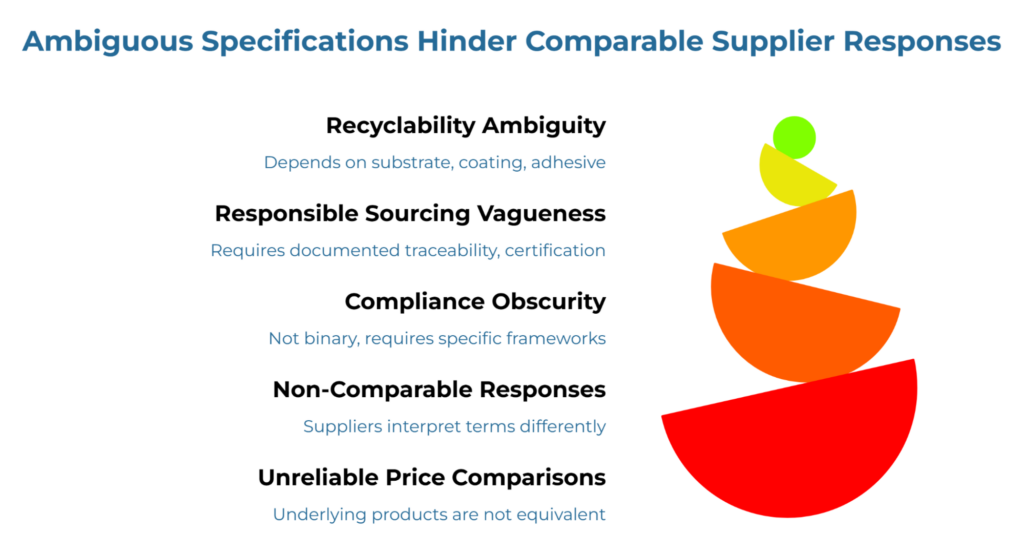
Why “Recyclable,” “Responsibly Sourced,” and “Compliant” Are Not Specification Fields
Consider the term “recyclable.” A folding carton’s recyclability depends on substrate composition, coating chemistry, adhesive selection, and the recycling infrastructure available in the end market. Without specifying which of these variables the buyer is controlling—and to what tolerance—”recyclable” becomes an undefined claim that each supplier interprets differently.
“Responsibly sourced” presents similar problems. Under the Forest Stewardship Council’s chain-of-custody framework, responsible sourcing requires documented traceability from a certified forest, controlled source, or verified reclaimed material stream to the finished product. Under a supplier’s internal marketing guidelines, the same phrase might mean nothing more than a general preference. If a specification does not name the certification scheme, the required claim type, and the documentary evidence, then “responsibly sourced” is not a specification—it is an invitation to interpret.
“Compliant” is the most functionally obstructive term. Compliance is not a binary state but a verifiable alignment with specific frameworks (e.g., EU 2023/1230). Verified at which point in the supply chain? By whom? A requirement stating “folding cartons must be compliant with applicable environmental laws” provides no actionable instruction to a supplier preparing a quote.
How Ambiguity Creates Non-Comparable Supplier Responses
When specification fields remain undefined, suppliers fill the gaps with their own interpretations. One supplier quotes FSC Mix 70% with a valid chain-of-custody certificate. Another quotes “sustainable board” with no third-party documentation. A third assumes the buyer meant recyclable and ignores fiber sourcing entirely.
As a general procurement principle, assume that any undefined environmental term will be interpreted differently across suppliers. The procurement team now faces quotes that answer different questions. Price comparisons become unreliable because the underlying products are not equivalent. The lowest-cost bid may be the least compliant option—or simply the one that interpreted ambiguous language most loosely. This is not a supplier problem. It is a specification problem.
A Simple Translation Workflow: From Clause to Folding Carton Requirement
Converting regulatory language into supplier-ready specifications follows a four-step process. Each step moves the requirement from policy abstraction toward measurable, quotable fields.
1. Isolate the mandate’s actual obligation. Strip away preamble, aspirational framing, and policy rationale. Identify what your organization must demonstrably do or provide. The OECD’s framework for Extended Producer Responsibility describes EPR as shifting end-of-life responsibility toward producers across the product lifecycle, including the post-consumer stage. For procurement, this necessitates a breakdown of material recovery data. It translates into a set of requirements around recyclability design, material disclosure, evidence retention, and claim traceability.
2. Identify what must be true in the folding carton or its documentation. Is the clause about substrate composition? Chain-of-custody status? Recyclability design? Labeling and disclosure? Evidence retention? The proof point determines which category of specification field the mandate requires.
3. Convert that proof point into a named specification field or evidence requirement. Instead of “folding cartons should contain recycled content,” write: Minimum post-consumer recycled fiber content: [X]%, declared per ISO 14021 or equivalent standard. Instead of “sourcing must be responsible,” write: “Chain-of-custody certification: FSC [STD-40-004] or PEFC [ST 2002], including valid certificate number and scope verification for the specific SKU.
4. Define how suppliers must respond. Standardize the response format so all quotes are directly comparable. Specify whether the response requires a percentage value, a certificate copy, a test report reference, or a signed declaration. Name the field, name the evidence, and name the submission deadline.
The Mandate-to-Specification Translation Matrix
The following matrix illustrates how common environmental mandate themes translate into specification fields and supplier evidence requirements.
| Mandate Theme | What It Really Requires | Specification Field to Add | Evidence Required | Failure Mode if Vague |
| Recycled content requirement | Minimum % of post-consumer or post-industrial recycled fiber | “Recycled fiber content: min [X]% post-consumer, per ISO 14021” | Mill certificate or third-party test report | Suppliers quote “contains recycled material” without quantifying |
| Certified fiber sourcing | Unbroken chain-of-custody from forest to folding carton | “CoC certification: FSC or PEFC; certificate # and scope must cover product” | Valid CoC certificate with scope confirmation | Certificate expired or out of scope for quoted product |
| Recyclability / recoverability | Folding carton design must not impede recycling | “Material disclosure: substrate, coatings, adhesives, inks” | Written declaration of materials affecting recyclability | “Fully recyclable” claims despite non-recyclable coatings |
| EPR reporting data | Data for producer fee calculations | “Supplier provides: net weight/unit, material category” | Weight and material data per SKU | Buyer lacks data for EPR filings after launch |
| Disclosure / audit-readiness duty | Retrievable, reviewable documentation for compliance verification | “Required evidence pack and document-retention field” | Controlled attachment set with dates and document identities | Proof exists somewhere but cannot be matched to the folding carton specification |
For step-by-step guidance on validating chain-of-custody documentation, see our guide on chain-of-custody for paper: make certified claims survive the supply chain.
For guidance on ensuring claim wording appears correctly across all transaction documents, see claim wording on quotes, POs, and invoices: what buyers should require for FSC/PEFC.
For deeper guidance on certification verification, see the buyer’s guide to paper certifications: FSC, PEFC, and beyond on PaperIndex Academy.
Bad Legal Specifications vs. Good Engineered Specifications
The difference between a weak specification and an enforceable one is precision. The table below contrasts vague legal language with engineered specification language that suppliers can quote against.
| Weak Requirement | Enforceable Requirement |
| “Folding cartons must be sustainable and compliant with all applicable environmental regulations.” | “Recycled fiber: min 30% post-consumer, verified by mill certificate. CoC: FSC Mix or PEFC Certified. Material disclosure: substrate, coatings, adhesives itemized.” |
| “Suppliers must demonstrate responsible sourcing.” | “FSC or PEFC CoC certificate required, scope covering quoted SKU. Valid at shipment; buyer may verify via public registry.” |
| “Packaging should be recyclable.” | “No PE lamination. Water-based coatings only. Adhesive type disclosed. Supplier confirms recyclability in [target markets].” |
The weak requirement invites interpretation. The engineered requirement defines exactly what suppliers must demonstrate. This specification discipline mirrors the approach detailed in the quality blueprint: defining and enforcing corrugated box specs, where test method-named tolerances replace ambiguous language.
How to Standardize Supplier Responses So You Can Compare Like-for-Like
Standardized response protocols ensure bid comparability and mitigate the risk of ‘green-washing’ through ambiguous data entries.
For each compliance-related specification, create a dedicated response field in the quote template. Where a value is required, require a value—not a narrative description. Where a certificate is required, require the certificate number, issuing body, and expiration date.
A chain-of-custody claim should be treated as a documentation workflow, not as a badge—a principle explored in depth in the article: stop treating FSC/PEFC as a badge: a buyer workflow to verify paper claims. The FSC chain-of-custody framework supports traceability across the supply chain, while PEFC’s chain-of-custody standard establishes the link from forest to market. For clarity on what these labels actually prove, see FSC vs PEFC claims in plain English: what the labels do (and don’t) prove. In practice, that means verifying certificate scope, claim wording, and transaction-level documentation—not accepting a logo as proof. For a practical registry verification test method, see how to run a quick registry check for FSC/PEFC certificates.
Define the evidence pack suppliers must submit with their quote: mill certificates, chain-of-custody certificates, material composition declarations, and relevant test reports. Specify file formats and naming conventions if the procurement team processes high volumes.
Reject incomplete responses. If a supplier cannot provide the required evidence, they have not met the specification. For methodology on scoring and filtering supplier responses systematically, see how to score and rank kraft paper supplier PQQ responses—the rubric principles apply across paper grades. Attempting to normalize non-comparable bids after the fact introduces risk into the evaluation. For related guidance on structuring supplier evidence requirements, see structuring your compliance audit checklist for packaging suppliers.
What to Verify Before You Circulate the Specification Internally
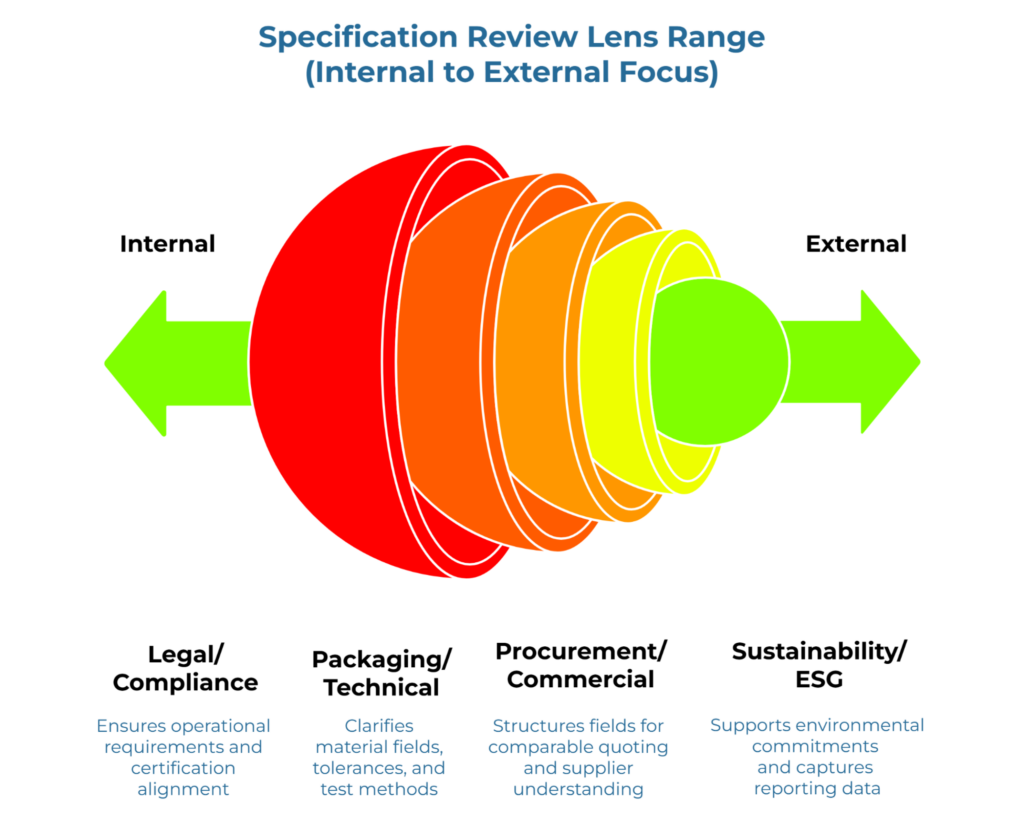
Before issuing the translated specification to suppliers, run it through a four-lens checkpoint to reduce rework and ensure cross-functional alignment.
Legal/Compliance: Has each clause been translated into an operational requirement rather than copied as rhetoric? Are claim wordings consistent with certification body requirements? Verifying certificate scope alignment prevents out-of-scope claims from entering your supply chain. Have you avoided language that overstates compliance certainty?
Packaging/Technical: Are the material fields, tolerances, and test method references clear enough to prevent interpretation drift? Do tolerances align with industry norms? Have technical references been consulted where appropriate?
Procurement/Commercial: Are the fields structured for comparable quoting? Will suppliers understand what to submit and when? Is the evidence burden proportionate to the contract value?
Sustainability/ESG: Does the specification support broader organizational environmental commitments? Are you capturing the data needed for internal and external reporting? Are claims connected to evidence rather than branding language?
If the answer is no on any one of those, the specification is not ready yet. For additional methodology on moving from specification discipline to supplier evaluation, see from specs to sourcing: a strategic roadmap for resilient procurement.
The translation workflow in this article—clause to obligation, obligation to proof point, proof point to specification field, specification field to supplier evidence—provides a repeatable method for converting regulatory pressure into operational specification discipline.
Once specifications are defined, explore folding carton suppliers to begin the sourcing process, browse folding carton buyers to understand current market demand, or continue building compliance methodology through the PaperIndex Academy. For additional context on certification claim verification, see stop treating FSC/PEFC as a badge.
Disclaimer: This article is for educational purposes only and does not constitute legal advice.
Our Editorial Process:
Our expert team uses AI tools to help organize and structure our initial drafts. Every piece is then extensively rewritten, fact-checked, and enriched with first-hand insights and experiences by expert humans on our Insights Team to ensure accuracy and clarity.
About the PaperIndex Insights Team:
The PaperIndex Insights Team is our dedicated engine for synthesizing complex topics into clear, helpful guides. While our content is thoroughly reviewed for clarity and accuracy, it is for informational purposes and should not replace professional advice.