
Assess suppliers systematically and make confident sourcing decisions.

Beyond the Box: A Guide to High-Performance Cushioning Systems for Electronics
📌 Key Takeaways Cushioning failures cause electronics breakage even when corrugated boxes arrive intact because the protection system inside—not the container—absorbs shocks, vibration, and compression loads. Engineered cushioning systems prevent mystery breakage when specifications define geometry, retention, and validation before material costs. Procurement managers and packaging engineers sourcing electronics protection ... Read More
Aligning Procurement and Engineering: A Shared Checklist for Corrugated Box RFQs
📌 Key Takeaways Quote variance stems from incomplete RFQs where Engineering and Procurement solve different problems in parallel, forcing suppliers to fill specification gaps with incompatible assumptions. Ambiguity creates the quote variance teams blame on suppliers; clarity creates enforceable accountability. Procurement managers and packaging engineers coordinating corrugated sourcing will gain ... Read More
Stop Buying on Price: Why ‘Cheap’ Boxes Cost More in the Long Run
📌 Key Takeaways Unit price comparisons create a false economy when damage costs scatter across budgets that procurement never sees. Consistent data beats perfect data when all suppliers face the same evaluation standard. Procurement and engineering teams managing high-value electronics or appliances will gain a defensible framework here, preparing them ... Read More
From Commodity to Assurance: A Strategic Framework for Corrugated Box Sourcing
📌 Key Takeaways Corrugated box sourcing failures trace back to system gaps—not supplier defects—and demand spec discipline, evidence verification, and staged qualification to prevent costly QC rejects. System thinking transforms commodity purchasing into repeatable assurance. Procurement managers and packaging engineers responsible for corrugated box sourcing will gain a proven five-control ... Read More
Seven Questions to Ask a New Supplier (That Scammers Can’t Answer)
📌 Key Takeaways Specific questions requiring verifiable proof disqualify fraudulent suppliers in minutes while legitimate partners answer confidently. Proof-first supplier vetting protects working capital and prevents costly restarts. Procurement managers qualifying international packaging suppliers will gain a ready-to-send verification script here, preparing them for the risk-mitigation frameworks that follow. You ... Read More
Fake FSC, PEFC, ISO Certificates vs. Real Ones: A Visual Spotter’s Guide
📌 Key Takeaways Professional-looking certificates can be expired, out of scope, or belong to different entities than the supplier sending them. Visual screening plus registry verification separates confident procurement from hopeful guessing. Procurement professionals and quality managers sourcing certified materials will gain actionable verification steps here, preparing them for the ... Read More
Understanding Corrugated Box Flute & Wall Types: A Plain English Guide for Food & Beverage Owners
📌 Key Takeaways Flute describes the wave-shaped cushioning layer inside corrugated board; wall type describes how many of these layers share the load—together they determine whether boxes protect glass jars through transit or leave you cleaning up broken products. Match construction to actual shipping stress, not maximum theoretical protection. Food ... Read More
The ‘Relay Baton’ Test for Chain-of-Custody Verification
📌 Key Takeaways Certificates confirm an entity holds certification, but paperwork proves the specific material carries that claim through every handoff. Documentation gaps cost more than requesting proof. Procurement professionals sourcing certified paper products will gain immediate verification protocols here, preparing them for the detailed implementation playbook that follows. The ... Read More
Why ‘Cheap’ Boxes Cost More: The Hidden Economics of Damage Rates
📌 Key Takeaways Damage rates drive total packaging costs more powerfully than unit price, because each percentage point triggers replacement product, reshipping, returns handling, labor, and customer credits that multiply across every incident. Measure damage rate first, then write specifications that make it controllable. Procurement managers and operations leaders in ... Read More
The Zero-Trust Sourcing Model: How to Verify Overseas Suppliers Without Travel
📌 Key Takeaways Remote supplier verification uses systematic evidence gates to confirm identity, capability, and compliance before deposits move—making travel optional for most sourcing decisions. Verification discipline makes travel an escalation tool, not a default requirement. Procurement managers sourcing internationally without factory visit budgets will gain systematic protocols here, preparing ... Read More
Stop Panic Buying: A 4-Step System for Strategic Corrugated Box Sourcing
📌 Key Takeaways Decouple ordering from verifying—pre-qualify suppliers before urgency forces rushed decisions that cost 15-25% more in expedited freight and hidden failures. Verification before emergency = speed without gambling. Procurement managers and operations leads in food, beverage, and e-commerce will eliminate panic-buying cycles here, setting up the detailed four-step ... Read More
Sourcing Safety Checklist: When to Audit vs. When to Trust
📌 Key Takeaways Supplier verification should match transaction risk using a three-tier ladder—digital checks, remote validation, or third-party audit—determined by scoring four risk levers in under two minutes. Repeatable frameworks transform 7:00 AM urgency decisions into documented, defensible processes. Procurement leads and operations managers sourcing corrugated packaging will gain an ... Read More
Next Steps Checklist: From FSC/PEFC Claim Checks to Chain-of-Custody Proof on Invoices
📌 Key Takeaways FSC/PEFC certificate verification is necessary but insufficient—invoice-ready proof requires unbroken claim wording continuity from quote through delivery documents to final invoice. Invoice-ready proof is a consistent story reconstructed from aligned documents, not a single certificate file. Procurement and operations teams managing FSC/PEFC certified paper purchases will gain ... Read More
Four Myths About Chain-of-Custody for Paper (and the Real Rule on Invoices)
📌 Key Takeaways Chain-of-custody proof lives or dies on the invoice—certificate status matters less than documentation continuity. Status, scope, continuity—three repeatable checks replace confusion with process. Procurement teams and supplier documentation managers navigating FSC/PEFC requirements will gain actionable verification frameworks here, preparing them for the implementation workflows and registry check ... Read More
Common Chain-of-Custody Failure Modes: Invoice/Label Mismatches and How to Prevent Them
📌 Key Takeaways Chain-of-custody claims fail when paperwork doesn’t match physical goods—not at the forest or audit, but at the receiving dock handoff. No clean document chain, no clean claim booking. Procurement teams managing certified paper imports will find actionable prevention controls here, preparing them for the five-gate workflow and ... Read More
The “Relay Baton” Test: Can Your Supplier Pass a Certified Claim Through Traders?
📌 Key Takeaways Certification claims count only when they appear on the final invoice, not just in supplier promises or certificate PDFs. Claims survive supply chains when status, scope, and document continuity align from quote through invoice. Procurement teams managing certified paper sourcing through international traders will gain rapid verification ... Read More
Chain-of-Custody vs Forest Management: The Difference That Breaks Proof Requests
📌 Key Takeaways FM certification proves forest management practices; CoC certification authorizes invoice claims on commercial documents. Verified entity + active status + appropriate scope = defensible claim. Procurement managers sourcing certified paper will gain verification clarity here, preparing them for the entity-matching workflow that follows. The auditor’s question is ... Read More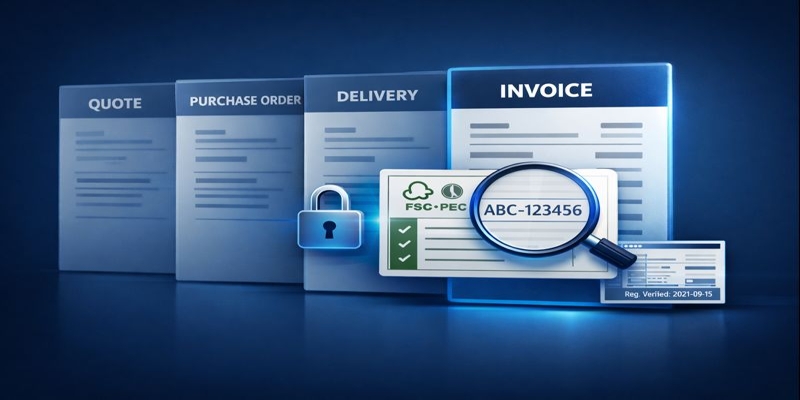
Chain-of-Custody for Paper: Make Certified Claims Survive the Supply Chain (Quote to Invoice)
📌 Key Takeaways Certified paper claims fail when documentation loses continuity between quote and invoice, not because suppliers lack valid certificates. Four document handoffs, four opportunities to catch problems before they become proof failures. Procurement managers and quality teams verifying certified paper suppliers will gain practical controls here, preparing them ... Read More
Five Costly Myths About “FSC/PEFC Certified Paper” Buyers Still Believe
📌 Key Takeaways Badge ≠ proof: FSC/PEFC certification claims protect buyers only when verified through three checks—status, scope, and document continuity. Three checks, fifteen minutes per supplier, proof folder ready before audits ask. Procurement managers sourcing certified paper will gain immediately actionable verification workflows here, preparing them for the copy-ready ... Read More