

📌 Key Takeaways
Standardising scattered paper bag SKUs into 3–6 governed families—defined by use-case stress and quote-critical fields—produces comparable RFQs, fewer failures, and faster supplier quoting.
- Map Use Cases, Not SKUs: Group bags by delivery stress profiles (weight, moisture, handling intensity) rather than product categories to reveal natural clustering.
- Lock Quote-Critical Fields: Specify dimensions with tolerances, construction details, and method-named material requirements (ISO 2758 for burst) to eliminate supplier interpretation gaps.
- Allow Controlled Variants: Permit size bands and artwork changes within families while requiring evidence and version control for structural modifications to prevent specification drift.
- Validate with Multiple Suppliers: Confirm that 2–3 manufacturers can produce each family specification to avoid single-source traps and maintain competitive tension.
- Govern Family Stability: Establish clear change triggers, versioning discipline, and quarterly reviews to prevent the “small adjustments” that erode standardisation within 18 months.
Family discipline transforms procurement leverage—suppliers quote faster against stable specifications whilst operations manage fewer, more predictable inventory variants.
Procurement and operations managers at growth-stage businesses struggling with fragmented bag catalogues will gain immediate implementation tools here, preparing them for the copy-ready templates and 2-week rollout plan that follows.
The spreadsheet has 47 rows. Each row describes a paper bag that someone, at some point, thought the business needed. Some differ by five millimetres. Others by a single Pantone shade. A few exist because a supplier offered a deal three years ago on a specification nobody remembers approving.
Sound familiar?
When packaging decisions accumulate without structure, sourcing becomes a game of translation—explaining each variation to every new supplier, fielding clarification emails, and watching quote timelines stretch. Operations carry the weight differently: unpredictable lead times, storage headaches, and the occasional bag failure that sends everyone scrambling during real handling, not in a meeting room.
A highly effective method for standardization is mapping legacy SKUs and delivery scenarios to a limited library of ‘Bag Families.’ This framework converts scattered specifications into a procurement-ready matrix for consistent supplier quoting.
What a “Paper Bag Family” Actually Means (and What It Does Not)
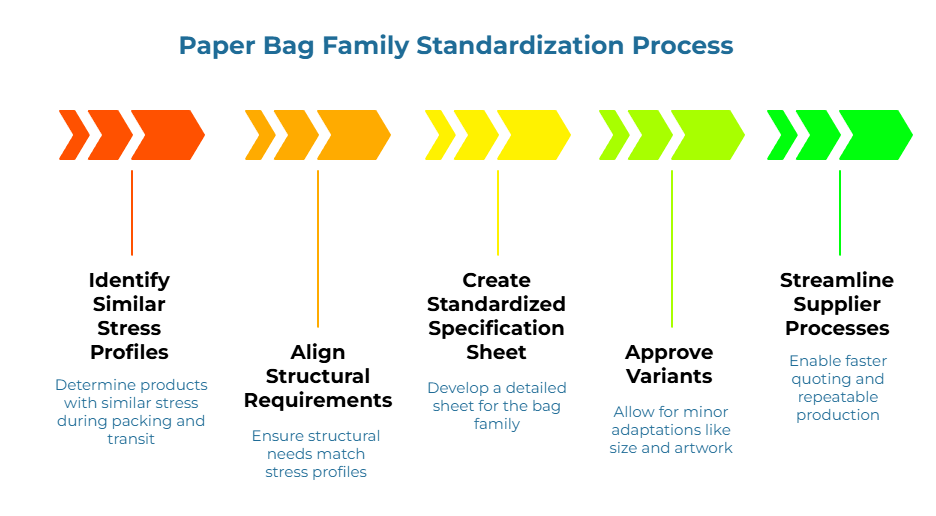
A bag family is not a single SKU. It is not a marketing-driven one-off created for a seasonal campaign. And it is certainly not a mandate to find the “strongest bag for everything” and deploy it across every use case.
Instead, a bag family represents a standardised specification sheet tied to a defined use case, with a set of approved variants (sizes, artwork, minor adaptations) that can flex without requiring a new specification from scratch.
The concept is operational, not aesthetic. A family exists because certain products share similar stress profiles during packing, transit, and customer handling. When those stress profiles align, the structural requirements align—and that alignment creates the foundation for comparable quotes, predictable quality.
For suppliers, this clarity matters just as much. A well-defined family means faster quoting, fewer revision loops, and demand signals that translate into repeatable production runs rather than constant one-off adjustments.
Diagnostic Assessment: Family Classification Indicators
Before restructuring anything, a quick assessment helps determine whether the current approach is working or quietly causing friction. The following symptoms typically indicate that standardisation would deliver value:
Too many SKUs with marginal differences. If the catalogue contains bags that vary by small dimensional increments or minor construction details without clear performance reasons, complexity is likely an outpacing benefit.
Repeated supplier clarification loops. When new suppliers consistently ask follow-up questions about specifications—or when different suppliers interpret the same spec sheet differently—the specifications themselves may lack the precision needed for consistent quoting.
Bags failing during actual handling. Failures that cluster around particular delivery scenarios (long transit times, moisture exposure, heavy products) often signal a mismatch between the bag’s design and the actual stresses it faces.
Brand and operations disagreements on “good enough.” If internal conversations about bag quality feel circular—brand pushing for premium feel while operations pushes for cost control—the absence of objective, use-case-driven criteria is usually the underlying issue.
Two or more of these symptoms suggest the catalogue would benefit from a more structured approach.
From Catalogue Chaos to 3–6 Bag Families: A Step-by-Step Workflow
Establishing a consolidated library of families—often ranging between three and six for typical retail operations—reflects a practical balance: enough granularity to match real-world use cases, but not so many that the benefits of standardisation disappear. This range serves as a starting framework rather than a universal rule—some businesses may land at four families, others at seven, depending on product diversity and delivery complexity.
Step 1: Inventory Use Cases, Not Just SKUs
The instinct is often to start with the existing bag list and look for consolidation opportunities. A more effective approach begins one level up: mapping the actual use cases those bags serve.
Key variables to document for each product category or delivery scenario include:
- Weight bands: Light (under 1 kg), medium (1–3 kg), heavy (3–5 kg), or very heavy (above 5 kg)
- Product geometry: Flat items, bulky items, items with sharp edges or corners
- Temperature sensitivity: Ambient, chilled, or hot (for food delivery)
- Moisture and grease exposure: Dry goods versus items that may release moisture or oils
- Handling intensity: Gentle in-store handoff versus multi-touch last-mile delivery
- Drop and compression risk: Stacking during transit, doorstep drops, or customer carrying distance
Distinguishing between in-store carry bags, last-mile delivery packaging, food delivery containers, and bulk pickup scenarios often reveals that what appeared to be a single “medium bag” need actually spans two or three distinct stress profiles.
Step 2: Cluster by Failure Modes and Stress Drivers
With use cases mapped, the next step asks a direct question: if a bag fails in this scenario, how does it fail?
Common failure modes include:
- Handle detachment or tearing: Typically driven by weight exceeding handle attachment strength or sharp internal edges cutting through
- Base blowout: Often caused by concentrated weight, inadequate base reinforcement, or moisture weakening the paper
- Side burst: Usually indicates insufficient burst strength relative to internal pressure from packed contents
- Moisture sag or structural collapse: Results from high humidity, condensation, or direct liquid contact without appropriate barrier properties
Grouping use cases by their dominant failure risks creates natural clusters. Products that share the same failure vulnerability—regardless of brand or category—likely belong in the same bag family. For teams seeking deeper diagnostic frameworks, diagnosing packaging failures: why paper bags tear during delivery provides additional technical context.
Step 3: Convert Clusters into Candidate Families
Each cluster now becomes a candidate bag family. The naming convention matters more than it might seem—names should be functional and supplier-quotable rather than internal shorthand that requires explanation.
Effective family names describe the use case directly:
- “Light retail carry” (under 1 kg, minimal handling stress)
- “Standard delivery” (1–3 kg, multi-touch last-mile transit)
- “Moisture-risk food delivery” (grease and condensation exposure, moderate weight)
- “Heavy load with handle reinforcement” (3–5 kg, significant carry distance)
Avoid names tied to specific products (“the candle bag”) or aesthetic descriptions (“premium kraft”). These create confusion when the product mix evolves or when communicating with suppliers unfamiliar with internal terminology.
Step 4: Define Quote-Critical Fields for Each Family
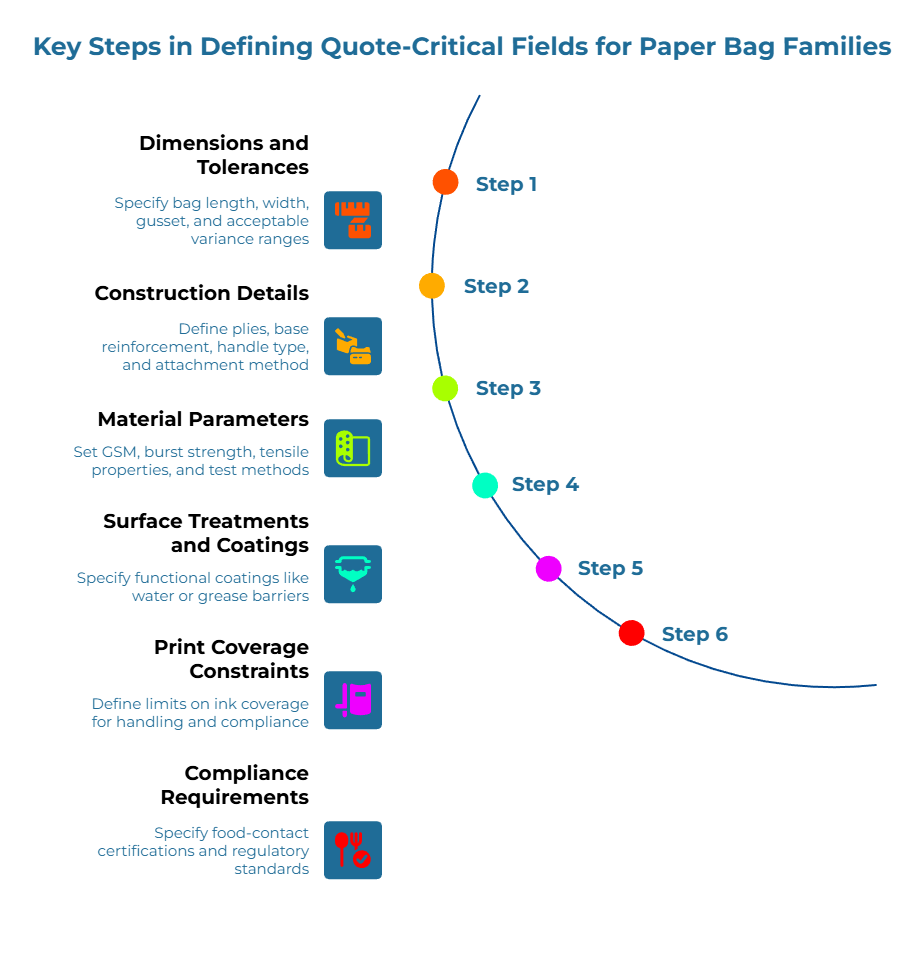
This step transforms a family concept into a specification suppliers can quote against consistently. The goal is a stable “spec spine”—the fields that must remain fixed for a bag to qualify as part of the family.
Quote-critical fields typically include:
Dimensions and tolerances. Length, width, gusset depth, and acceptable variance ranges. Without tolerances, suppliers interpret “300mm” differently, leading to inconsistent quotes and deliveries.
Construction details. Number of plies, base reinforcement method (if any), handle type (flat, twisted, die-cut), and handle attachment approach (glued, reinforced, integrated).
Material parameters. Grammage (GSM) with acceptable tolerance bands. Where strength is critical, specifying burst strength or tensile properties with reference to test methods (ISO 2758 for burst, TAPPI T 403 for burst) removes ambiguity. Objective thresholds, such as ‘minimum 90 GSM, burst index ≥2.5 kPa·m²/g (ISO 2758),’ eliminate the interpretative variance inherent in subjective terms like ‘strong kraft.
Surface treatments and coatings. Only where they affect performance—water resistance, grease barrier properties, or print adhesion. Aesthetic coatings that do not change functional performance belong in the “allowed variants” category rather than the spec spine.
Print coverage constraints. If heavy ink coverage affects bag handling, drying time, or recycling compliance, this becomes a quote-critical field.
Compliance requirements. For food-contact applications, specifying required certifications (FDA 21 CFR 176, EU Regulation 1935/2004) ensures suppliers understand the regulatory scope. The food-grade certification standards for delivery packaging bags guide provides detailed context for delivery packaging applications.
Step 5: Define What Can Vary Safely (Approved Variants)
Not every difference requires a new family. Approved variants allow flexibility within a standardised framework—accommodating business needs without fragmenting the specification library.
Size banding. A family might include small, medium, and large size variants that share the same construction, material, and handle approach but differ in dimensions. The spec sheet defines each size band’s dimensions while maintaining all other parameters.
Artwork variants. Different brand applications, seasonal graphics, or promotional prints that do not alter the bag’s structural specification. These are explicitly separated from structural variants to prevent brand requests from inadvertently changing performance characteristics.
Seasonal demand variants. Inventory planning may call for different order quantities or timing, but the underlying specification remains stable. Linking families to demand forecasting helps prevent the stockout cycles that often drive emergency custom orders—which then become permanent catalogue additions.
Step 6: Validate with Suppliers and Controlled Pilots
A specification that looks coherent internally may encounter manufacturing realities that require adjustment. Validation serves two purposes: confirming that families are manufacturable and ensuring more than one supplier can produce them.
Supplier feedback during quoting often reveals:
- Dimension combinations that create production inefficiencies
- Material specifications that limit supplier options unnecessarily
- Tolerance ranges that are tighter than necessary or looser than practical
The principle is to create specifications multiple suppliers can meet—avoiding the over-customisation trap where only one manufacturer can produce the bag, eliminating competitive tension and backup options.
Pilot orders before full rollout allow real-world validation. Spec sheets are living documents; pilot results may indicate adjustments to tolerances, construction details, or material parameters that improve performance or reduce cost without changing the family’s core purpose.
Step 7: Governance—Prevent “Family Drift”
Without governance, standardisation erodes. A procurement manager approves a “small adjustment” for one order. An operations request adds a variant that subtly changes the specification. Within eighteen months, the clean family library resembles the original chaos.
Effective governance requires:
Change control clarity. Define who can request specification changes, what evidence supports a change request (failure data, customer feedback, route modifications), and who holds approval authority.
Versioning discipline. Each specification update receives a version number, effective date, summary of changes, and rationale. This creates an audit trail and prevents confusion when suppliers hold outdated spec sheets.
Review cadence. Quarterly or semi-annual reviews assess whether families remain aligned with actual use cases, whether new product categories require new families, and whether any families have drifted from their original specifications.
The Supplier Perspective: Why Standardised Families Improve Quoting and Quality
From the supplier side, standardised families transform the quoting process. Instead of interpreting vague or inconsistent specifications, suppliers receive clear parameters they can price accurately. Clarification loops shrink. Acceptance criteria become unambiguous.
Predictability benefits extend beyond quoting. Repeatable specifications create repeatable production runs. Quality consistency improves because machine settings, material sourcing, and quality checkpoints stabilise around known parameters rather than shifting with each order.
For suppliers evaluating whether to quote on new business, well-structured families signal a professional procurement operation—the kind of buyer worth prioritising because orders will be clear, payments predictable, and relationships less prone to specification disputes.
The Toolkit: Templates for Implementation
The following frameworks support a practical rollout, typically achievable within two weeks for teams with existing catalogue data.
Week 1: Complete the Bag Family Mapping Table for all current SKUs, conduct internal alignment sessions to agree on candidate families, and draft initial spec sheets.
Week 2: Share draft specifications with two to three current or prospective suppliers for feedback, refine based on manufacturability input, finalise governance roles, and publish version 1.0 of the family library.
Bag Family Mapping Table
| Column | Purpose |
| Product/SKU Group | Current catalogue grouping for reference |
| Use Case (Route + Handling) | Delivery scenario and handling intensity |
| Weight Band + Packed Dimensions | Typical weight range and product size |
| Failure Mode Risks | Primary failure vulnerabilities (handle/base/side/moisture) |
| Candidate Bag Family | Proposed family assignment |
| Quote-Critical Fields | Bullet list of fixed specification parameters |
| Allowed Variants | Size bands, artwork options, seasonal variants |
| Required Evidence | Samples, pilot results, test certificates needed |
| Owner + Review Cadence | Responsible role and review frequency |
Bag Family Spec Sheet (One-Pager Skeleton)
Family Name and Use Case Definition Clear description of the delivery scenario, product types, and stress profile this family addresses.
Structural Spec Spine
- Dimensions (with tolerances): [specify]
- Construction: [ply count, base reinforcement, handle type and attachment]
- Material: [GSM with tolerance, strength requirements with test method references]
Performance Requirements Method-named specifications where applicable (e.g., burst strength per ISO 2758, Water absorptiveness (Cobb value) per ISO 535.
Compliance Requirements Applicable certifications for food contact, recyclability claims, or regional regulations.
Packaging and Packing Assumptions How bags will be packed for shipment, storage conditions, and handling expectations.
Acceptance and QA Checkpoints Incoming inspection criteria, sample retention requirements, and escalation triggers.
Approved Variants Size bands, artwork specifications, and seasonal adaptations permitted within this family.
Version History Version number, effective date, changes made, rationale, and approver.
Governance Mini-Policy (RACI Framework)
| Activity | Responsible | Accountable | Consulted | Informed |
| Request specification change | Operations / Brand | Procurement Lead | Supplier (if needed) | Finance |
| Approve specification change | Procurement Lead | Category Owner | Quality / Compliance | Suppliers |
| Maintain spec library | Procurement Coordinator | Procurement Lead | All stakeholders | — |
| Conduct quarterly review | Category Owner | Procurement Lead | Operations, Brand, Suppliers | Executive Sponsor |
Change triggers requiring formal review: Documented failures exceeding threshold, route or product changes affecting stress profile, supplier feedback indicating manufacturability issues, regulatory updates affecting compliance requirements.
Versioning rules: All changes documented with effective date, change summary, evidence basis, and approval record. Superseded versions archived but retained for reference.
Put Your Families to Work
With standardised families defined, the next step is connecting specifications to suppliers who can manufacture against them. PaperIndex’s supplier directory provides access to verified paper bag manufacturers and converters globally, while the RFQ submission tool allows buyers to share specifications directly with multiple suppliers and receive comparable quotes.
The platform operates as a neutral connector designed to facilitate direct negotiations between buyers and suppliers, removing the need for traditional brokerage intermediaries. For teams building or refining their sourcing programmes, from specs to sourcing: how paper bag requirements drive wholesale supplier selection provides additional context on moving from specification to supplier selection.
Disclaimer:
This content is for educational purposes only.
Our Editorial Process:
Our expert team uses AI tools to help organize and structure our initial drafts. Every piece is then extensively rewritten, fact-checked, and enriched with first-hand insights and experiences by expert humans on our Insights Team to ensure accuracy and clarity.
About the PaperIndex Insights Team:
The PaperIndex Insights Team is our dedicated engine for synthesizing complex topics into clear, helpful guides. While our content is thoroughly reviewed for clarity and accuracy, it is for informational purposes and should not replace professional advice.