

📌 Key Takeaways
Enforceable corrugated specifications prevent “meets spec” disputes by defining performance requirements, naming test methods with conditioning protocols, and establishing documented acceptance criteria before problems occur.
- Layer C Determines Enforceability: Naming exact test methods (ISO 3037:2022 for ECT, ASTM D642 for BCT), specifying conditioning requirements (23°C/50% RH), and defining units eliminates supplier interpretation gaps that create disputes.
- Match Metrics to Failure Modes: Stacking collapse requires ECT and BCT verification; transit impacts need drop testing and distribution protocols; humidity sensitivity demands conditioning specifications and safety factors.
- Sampling Beats Full Inspection: Defensible acceptance uses ISO 2859-1 sampling tables with tiered AQL thresholds—critical defects get tight limits (0.0), major defects moderate levels (1.0–2.5), minor defects permissive bands (4.0–6.5).
- Drift Monitoring Maintains Integrity: Tracking actual measured values over time catches gradual degradation before field failures—trigger re-qualification when results trend toward tolerance limits, not after individual tests fail.
- Change Control Prevents Silent Degradation: Requiring written approval and updated test reports before any material, process, or source substitution stops suppliers from swapping “equivalent” components that shift performance.
Specification discipline transforms vague board-grade callouts into enforceable governance systems.
Procurement managers and operations leaders sourcing corrugated packaging will gain copy-ready RFQ clauses and inspection frameworks here, preparing them for the detailed implementation guidance that follows.
Twelve pallets of finished goods sit buckled at the corners, cartons crushed under their own weight. The warehouse team sends photos. Operations wants answers. And then the email arrives from your supplier: “Per our test report, the boxes meet specification.”
You pull up the original spec. It reads “32 ECT, C-flute, RSC.” Nothing more. No test method. No conditioning requirements. No acceptance criteria. The supplier tested their way; your warehouse revealed a different reality. Now you’re stuck in a dispute with no contractual ground to stand on.
Corrugated box specifications written as board-grade shorthand create a fundamental problem: they invite interpretation. When every supplier reads “heavy-duty” differently, quotes become incomparable, quality becomes inconsistent, and “meets spec” becomes a phrase that ends arguments rather than prevents failures.
A corrugated specification becomes enforceable only when it defines three elements: what performance is required, how that performance is measured, and how acceptance decisions are made. This guide provides the 4-layer blueprint that transforms vague spec language into a test-method-defined system—one that produces comparable quotes, prevents disputes, and gives procurement defensible acceptance criteria.
Why “Meets Spec” Disputes Happen
The root cause is deceptively simple: specs written without test methods leave measurement to interpretation.
Consider a procurement manager who sends an RFQ for “heavy-duty corrugated boxes” to three suppliers. The quotes return with a 30% price spread. One supplier assumes you want a high ECT board. Another interprets “heavy-duty” as thicker caliper. The third quotes burst-tested material. Each believes they’re meeting the requirement—because the requirement never specified which performance characteristic mattered or how to verify it.
This interpretation gap creates three primary technical risks.
Quote incomparability. When suppliers optimize to different readings of the same spec, price differences stop reflecting value and start reflecting assumptions. You cannot meaningfully compare a quote based on ECT to one based on burst strength to one based on caliper thickness.
Enforcement failure. When boxes fail in the field and you challenge the supplier, they produce a test report showing passing results—using a test method you never specified, conditioning you never required, and sampling you never defined. Technically, they met your spec. Practically, you have no grounds to reject.
Quality drift over time. Without defined measurement methods, suppliers have room to optimize costs by adjusting variables you never locked down. Board composition shifts. Adhesive application changes. The boxes still technically meet the grade callout, but performance degrades until failures become visible.
The distinction between a sketch spec and a blueprint spec clarifies what separates enforceable specifications from dispute-prone ones:
| Sketch Spec | Blueprint Spec |
| “32 ECT, C-flute” | ECT ≥ 5.6 kN/m (approx. 32 lb/in) per ISO 3037:2022, tested at 23°C/50% RH |
| “Heavy-duty construction” | BCT minimum per ASTM D642, conditioned per applicable standard |
| “Must withstand stacking” | Defined safety factor vs. calculated static load at specified humidity |
| No acceptance criteria | AQL levels for defect categories, sampling per ISO 2859-1 |
The sketch invites the dispute. The blueprint prevents it.
For guidance on aligning procurement and engineering teams before RFQs go out, see aligning procurement and engineering: a shared checklist for corrugated box RFQs.
What Makes a Corrugated Spec Enforceable?
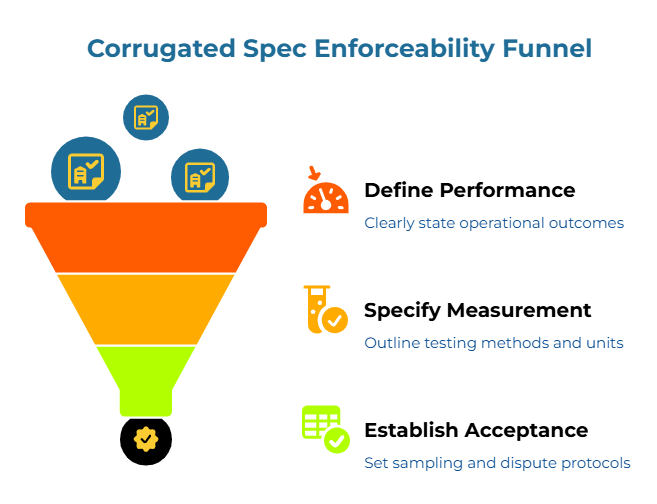
An enforceable corrugated specification answers three questions with precision:
- What performance is required? Define the operational outcome in terms the warehouse and operations teams recognize—storage duration, stack height, transit mode, environmental exposure, and failure criteria.
- How is performance measured? Name the test method (ISO, ASTM, or TAPPI standard), specify conditioning requirements, and define units and reporting format.
- How is acceptance decided? Establish sampling plans, defect classifications, evidence documentation requirements, and dispute resolution protocols.
When any of these elements is missing, the spec contains gaps that suppliers can—intentionally or not—interpret to their advantage. The 4-layer framework that follows addresses each question systematically.
I. The Failure-First Methodology
Before selecting metrics, answer one question: How will this box fail?
Different distribution environments stress corrugated packaging in different ways. A box destined for warehouse stacking faces different hazards than one entering a parcel carrier network. Specifying the wrong metric means testing for threats that won’t occur while ignoring those that will.
The Three Common Corrugated Box Failure Modes
Stacking collapse occurs when boxes cannot support the weight above them over time. This dominates for palletized goods in distribution centers, especially under high humidity or extended storage. The box doesn’t fail immediately—it creeps, buckles, and eventually collapses as the corrugated structure fatigues.
Transit impacts occur when boxes experience drops, vibration, or compression cycling during transportation. Parcel carriers, less-than-truckload shipments, and last-mile delivery introduce impact stresses that static warehouse storage doesn’t. Failures manifest as corner crush, panel puncture, or seam separation.
Humidity and conditioning sensitivity occurs when environmental conditions degrade board strength faster than expected. Corrugated boards lose significant compressive strength as moisture content increases. A box that tests well in standardized conditions may fail when environmental moisture content exceeds the board’s hygroscopic limit during transit.
Metric Selection Guide
Match your primary failure mode to the appropriate performance metric:
For stacking collapse: Prioritize Edge Crush Test (ECT) for board qualification and Box Compression Test (BCT) for finished container performance. ECT measures the board’s resistance to vertical compression—the load-bearing property that prevents stacking failure. BCT measures the actual box’s ability to resist top-to-bottom crushing. ISO 3037:2022 defines ECT methodology; ASTM D642 covers box compression testing; ISO 12048 addresses compression and stacking tests for complete, filled transport packages.
For transit impacts: Prioritize drop testing and vibration testing as qualification methods. Burst strength may be relevant in contexts where puncture or rough handling is a known issue—especially where legacy specifications exist—but it should not be treated as interchangeable with ECT or compression performance. For transit-heavy applications, consider specifying performance-based qualification using established distribution test protocols such as ISTA procedures rather than relying solely on board-level metrics.
For humidity sensitivity: Specify conditioning requirements and safety factors that account for moisture-induced strength loss. A box achieving a given BCT at standard lab conditions (23°C, 50% RH) may deliver substantially less in a warehouse running at higher humidity. Your spec must define the conditions under which performance claims apply—and build in margin for real-world degradation.
For detailed guidance on specifying impact protection, see specifying G-force protection in corrugated box packaging RFQ.
The 4-Layer Corrugated Box Spec Template
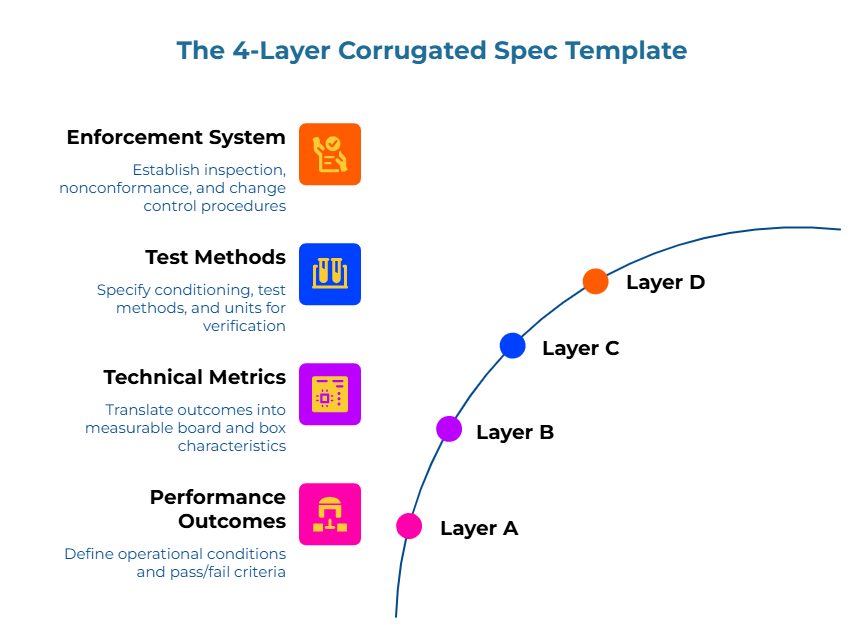
An enforceable corrugated box specification requires four layers, each building on the previous. Skip a layer, and you create gaps.
Layer A: Performance Outcomes
Start with what the box must survive, not what it must be made of.
Define the operational conditions: storage duration, pallet pattern, maximum stack height, transit mode, and environmental exposure. Then define pass/fail in terms the warehouse and operations teams will recognize.
Example performance outcome language:
“Boxes must maintain structural integrity through the specified storage duration at defined stack heights and ambient conditions, with no visible panel buckling, corner crush, or deformation that prevents automated case handling.”
This outcome statement accomplishes three things. It defines the time horizon. It defines the load scenario. It defines the failure criteria. Now every subsequent technical requirement traces back to an operational need.
Layer B: Technical Metrics and Tolerances
Translate performance outcomes into measurable board and box characteristics. At minimum, a corrugated box specification should address:
| Spec Field | What to Define | Why It Matters |
| Board construction | Wall type (single, double, triple), flute profile | Determines cushioning, stacking strength, and caliper |
| Board caliper | Target caliper with tolerance band | Affects compression strength and die-cutting consistency |
| Strength metric | ECT or BCT target with minimum threshold | Primary load-bearing specification |
| Dimensional tolerances | Internal dimensions, squareness tolerance | Ensures product fit and automation compatibility |
| Moisture content | Acceptable range at time of delivery | Affects immediate and long-term strength |
| Bond/adhesion | Flute-to-liner bond integrity expectations | Prevents delamination under stress |
| Print/finish | Ink adhesion, coating, scuff resistance (if applicable) | Affects brand presentation and handling marks |
| Joint/closure | Joint type, sealing method, seam integrity requirements | Many failures occur at seams and closures, not mid-panel |
| Conditioning controls | How conditioning is handled for acceptance and dispute resolution | Eliminates hidden variables that invalidate comparisons |
| Defect categories | Critical/major/minor defect definitions tied to function | Makes sampling decisions meaningful |
| Documentation requirements | Lot ID rules, evidence pack content, spec revision references | Makes acceptance decisions auditable |
| Change control | Written approval rules for substitutions and requalification triggers | Prevents slow “equivalent” drift |
Appropriate tolerance bands depend on your product’s fragility, your automation requirements, and your internal risk tolerance. A pharmaceutical shipper may require tighter dimensional tolerances than a general merchandise distributor. Define tolerances based on operational needs, not assumed industry convention.
Layer C: Test Methods and Conditioning
Layer C is where enforceability is usually won or lost.
Name the test method. Specify the conditioning. Define the units.
This layer eliminates the interpretation gap. When your spec states “ECT per ISO 3037:2022, specimens conditioned at 23°C ± 1°C and 50% ± 2% RH for minimum 24 hours, results reported in kN/m,” the supplier knows exactly how compliance will be verified.
Test method anchors for common metrics:
- ECT (Edge Crush Test): ISO 3037:2022 or TAPPI T 811
- BCT (Box Compression Test): ASTM D642 or ISO 12048 for complete, filled packages
- Burst Strength: ISO 2759 or TAPPI T 810
- Moisture Content: TAPPI T 412 or ISO 287
Use Flat Crush Test (FCT) carefully. Flat crush resistance can be relevant in some contexts—especially where flute stability matters—but it should be treated as a contextual control, not a universal proxy for box performance. Where FCT is specified, ISO 3035 provides a recognized testing anchor.
Conditioning matters more than most buyers realize. Corrugated strength varies significantly with moisture content. A board tested at 50% RH will show different results than the same board tested at 65% RH. If your spec doesn’t define conditioning, suppliers can optimize test results by controlling when and how they test—producing passing reports that don’t reflect real-world performance.
Layer D: Enforcement System
Specs without enforcement mechanisms are suggestions.
Layer D defines how compliance is verified, how evidence is documented, and how nonconformances are handled. This layer transforms your spec from a purchasing document into a governance system.
Evidence pack requirements. Define what documentation must accompany each shipment or qualification. At minimum:
- Certificate of Analysis (COA) or test report with method identification
- Conditioning protocol followed
- Sample size and selection method
- Test date and laboratory identification
- Actual measured values (not just pass/fail)
Incoming inspection protocol. Define your sampling plan, defect categories, and acceptance criteria. Use established frameworks like ISO 2859-1 to set Acceptable Quality Levels (AQL) for different defect types. The NIST Engineering Statistics Handbook provides accessible guidance on lot acceptance sampling plans.
Nonconformance workflow. Define what happens when material fails inspection: hold procedures, retest protocols, disposition options, and escalation path.
Change control clause. Require written approval before any material, process, or source substitution. Suppliers cannot swap “equivalent” materials without re-qualification. This clause prevents silent quality drift and ties directly to a governance mindset—treating spec maintenance as an ongoing discipline rather than a one-time document.
Proposed RFQ Provision:
“Supplier shall provide, with each quote, a test report demonstrating compliance with all technical metrics specified. Test reports must identify the test method (ISO/ASTM/TAPPI standard reference), conditioning protocol, sample size, test date, and testing laboratory. Reports older than 90 days or lacking method identification will not be accepted for qualification purposes.”
Copy-paste PO acceptance clause:
“Acceptance of shipments is subject to incoming inspection per the sampling plan specified in the purchase agreement. Lots failing AQL criteria will be placed on hold pending supplier disposition. Buyer reserves the right to require replacement or credit for nonconforming lots.”
Copy-paste change control clause:
“No material, process, or source substitutions are permitted without prior written approval from Buyer. Substitution requests must include updated test reports demonstrating equivalent or superior performance to originally qualified material. Unapproved substitutions constitute grounds for lot rejection.”
II. Scalable Enforcement Frameworks
Most operations cannot inspect every unit. The goal is defensible sampling—a system that catches quality problems early while remaining operationally feasible.
Incoming Inspection That Procurement Can Defend
Effective incoming inspection rests on three definitions: lot, sample, and defect classification.
Define the lot. A lot is the population from which you draw samples. Typically, this is a single shipment or production run. Define lot boundaries clearly—mixing shipments undermines sampling validity.
Define sample size and selection. Use acceptance sampling tables (ISO 2859-1 provides indexed AQL tables) to determine how many units to inspect based on lot size and acceptable quality level. Random selection from the lot is essential; convenience sampling biases results.
Define defect categories. Not all defects carry equal weight:
- Critical: Defects causing safety issues or complete product loss (structural failure, contamination)
- Major: Defects significantly reducing usability without safety risk (significant dimensional deviation, strength below minimum)
- Minor: Noticeable defects not affecting function (minor print defects, slight scuffing)
Establish stratified AQL thresholds for each category. Critical defects warrant tight acceptance levels; minor defects can tolerate more permissive thresholds. This tiered approach enables scalable governance without requiring 100% inspection.
For a broader framework on building defensible sourcing systems, see from commodity to assurance: a strategic framework for corrugated box sourcing.
What Evidence Must Appear in a Corrugated Test Report
A test report proves compliance only if it answers these questions:
- What was tested? Product identification, lot/batch number, production date
- How was it tested? Test method with standard reference, test equipment identification
- Under what conditions? Conditioning protocol, temperature, humidity, duration
- What was the sample? Sample size, selection method, specimen preparation
- What were the results? Actual measured values with units, not just pass/fail
- Who tested it? Laboratory identification, test date, authorization
If any field is missing, the report cannot reliably verify compliance. Build this checklist into your supplier qualification process. The principle is straightforward: comparable reports, or the test didn’t happen in a way you can use.
For detailed guidance on interpreting drop test reports, see how to read corrugated box drop test reports: a guide for procurement managers.
Drift Monitoring: Keeping Specs True Over Time
Initial qualification is not permanent qualification.
Suppliers change raw material sources. Equipment ages. Personnel turns over. Process parameters drift. A box that met spec six months ago may not meet spec today—even if nothing was formally changed. Drift monitoring catches these gradual degradations before they become field failures.
Establish a verification cadence. For high-volume, high-criticality items, periodic re-verification testing may be appropriate at intervals that match your risk profile. For lower-volume items, less frequent verification combined with triggered testing (after any supplier change notification) may suffice.
Track trends, not just pass/fail. A result that passes but trends downward over consecutive tests signals emerging drift—even if no individual test fails. Log actual measured values, not just compliance status, and review trends at defined intervals. Key data to capture includes lot IDs, test results, and any nonconformance records.
Define drift triggers. Specify what observations require investigation or re-qualification: measured values approaching tolerance limits, supplier notifications of process changes, field failure reports, or customer complaints.
Treat drift as governance, not just quality. Drift isn’t always supplier error—sometimes it reflects buyer oversight. If you haven’t verified performance in an extended period, you’ve implicitly accepted whatever the supplier is currently shipping. Systematic drift monitoring is a governance discipline that protects both parties and maintains the integrity of your specification system.
III. Strategic Synthesis
“A spec without a test method is a suggestion, not a contract.”
The 4-layer blueprint transforms vague board-grade callouts into an enforceable specification system:
- Layer A defines what must survive and how failure is recognized
- Layer B translates outcomes into measurable metrics with tolerances
- Layer C names the test methods and conditioning that verify compliance
- Layer D establishes the enforcement system—evidence packs, sampling, and change control
With this framework, quotes become comparable because suppliers optimize to the same requirements. Disputes become resolvable because acceptance criteria were defined before problems occurred.
The difference between procurement teams that fight constant “meets spec” arguments and those that don’t often comes down to specification discipline. That discipline requires templates, clause language, and inspection frameworks ready for immediate implementation.
When you’re ready to source corrugated packaging from qualified suppliers, PaperIndex connects buyers with verified corrugated box suppliers worldwide—functioning as a neutral connector.
For perspective on why unit cost alone fails as a selection criterion, see stop buying on price: why “cheap” boxes cost more in the long run.
Disclaimer:
This article provides educational guidance on corrugated packaging specifications and quality assurance practices. Specific tolerance values, test frequencies, and acceptance criteria should be determined based on your product requirements, distribution environment, and risk tolerance.
Our Editorial Process:
Our expert team uses AI tools to help organize and structure our initial drafts. Every piece is then extensively rewritten, fact-checked, and enriched with first-hand insights and experiences by expert humans on our Insights Team to ensure accuracy and clarity.
About the PaperIndex Insights Team:
The PaperIndex Insights Team is our dedicated engine for synthesizing complex topics into clear, helpful guides. While our content is thoroughly reviewed for clarity and accuracy, it is for informational purposes and should not replace professional advice.