
📌 Key Takeaways
Your working capital limit for kraft paper isn’t a guessing game—it’s a calculation you can do in three steps using numbers you already have.
- The Cash Gap Determines Your Limit: The number of days between paying kraft paper suppliers and collecting from customers directly dictates how much working capital you need—longer gaps require proportionally larger credit lines.
- Monthly Spend Times Gap Fraction Gives Your Number: Multiply your average monthly kraft paper spend by your cash gap in days divided by 30 to get a defensible limit estimate that makes sense to both you and your banker.
- Banks Finance 70-75%, You Fund the Rest: While your calculation shows total working capital needs, expect banks to finance three-quarters of that amount, with your business contributing the remaining margin from internal funds.
- Payment Term Changes Are Your Best Lever: Even a five-day improvement in supplier credit or customer collections meaningfully reduces your cash gap and lowers the working capital limit you need.
- Present Logic, Not Desperation: Walking into bank meetings with this three-step calculation positions you as a disciplined manager who understands cash cycles rather than a reactive borrower asking for vague increases.
Prepared discussions lead to appropriate limits and calmer banking relationships. Small and mid-sized packaging converters will find a practical calculation method here, preparing them for the step-by-step breakdown that follows.
The phone call comes at 4 PM on the last Thursday of the month. Your kraft paper supplier’s accounts team, polite but firm, reminds you that payment is due tomorrow. You check your bank balance. The number is smaller than you’d like. Your customers—the ones you supplied finished boxes to three weeks ago—haven’t paid yet. They’re still within their 60-day credit window, but your supplier wants money in 30 days or less. You’ve been here before, watching your working capital limit creep toward its ceiling while cash sits locked in inventory and unpaid invoices.
This isn’t a crisis of poor planning. It’s the arithmetic of payment terms. Your suppliers want their money faster than your customers pay you, and kraft paper—often your single largest raw material cost—sits right in the middle of that cash flow gap. The question isn’t whether you need a working capital limit. The question is: how much do you actually need, and how do you explain that number to your banker without sounding desperate or vague?
This guide walks you through a simple, three-step method to estimate the working capital limit you need specifically for kraft paper purchases. You’ll finish with a defensible number and a short script for your next bank conversation—no spreadsheet wizardry or financial modeling required.
What This Estimate Is—and Isn’t
This working capital limit calculation focuses narrowly on one thing: the cash you need to bridge the gap between paying your kraft paper suppliers and collecting payment from your customers. It’s not a complete business finance model, and it doesn’t account for wages, overhead, equipment purchases, or other working capital needs. Think of it as a building block—one piece of the total credit facility you might discuss with your bank.
The method gives you a reasonable, defensible range rather than a precise number. Banks understand that working capital needs fluctuate with order volumes, seasonal demand, and price changes. What matters is showing you’ve thought through your cash cycle logically rather than asking for a round number pulled from thin air. You can estimate a sensible working capital limit for kraft paper using average monthly kraft paper spend and the cash gap in days.
This calculation doesn’t replace the formal financial statements or CMA data your bank will require for compliance and credit assessment. Instead, it provides a powerful commercial logic to justify those numbers during your negotiation discussions. It translates working capital strain from payment terms into a language both you and your banker can use to size the facility appropriately.
A few quick caveats before we begin. This is general guidance for small and mid-sized packaging converters, not financial advice. Your actual limit will depend on your company’s financial health, banking relationship, and other factors your banker will assess. Treat this as a starting point for a conversation with your accountant or bank manager, not a guarantee of approval.
If you need a refresher on working capital as a general concept before diving into kraft paper specifics, this working capital guide from Investopedia provides a solid foundation. The rest of this article focuses specifically on calculating how much working capital limit you need for kraft paper.
Step 1: Estimate Your Average Monthly Kraft Paper Spend
Start by calculating how much cash typically leaves your account each month for kraft paper purchases. This includes the base price you pay per ton, multiplied by the volume you buy, net of any significant rebates or discounts you consistently receive. If freight is invoiced separately and paid on different terms, exclude it for now to keep the calculation clean.
Use the past six to twelve months as your reference period to smooth out seasonal spikes or one-off large orders. However, if kraft paper prices have risen recently, use the average of only the last three months instead. This ensures your requested limit covers current market prices rather than historical lows that no longer reflect your actual cash outflow.
For example, if you bought 40 tons in January at a representative market price of ₹45,000 ($530) per ton (using hypothetical figures), 35 tons in February at ₹46,000 ($540) per ton, and 50 tons in March at ₹44,000 ($515) per ton, your average monthly spend might look like ₹1,800,000 ($21,200) in January, ₹1,610,000 ($18,900) in February, and ₹2,200,000 ($25750) in March. Add those up, divide by three months, and you land around ₹1,870,000 ($21,950) per month on average.
If your purchasing pattern is more stable, a simpler approach works just as well. Take your typical monthly tonnage—say, 40 tons—and multiply by your current average price per ton. Either way, the goal is a single number that represents your normal kraft paper outflow in a typical 30-day period. Write that number down. You’ll use it in Step 3.
Step 2: Calculate Your Kraft Paper Cash Gap in Days
The cash gap is the number of days your money stays tied up between the moment you pay for kraft paper and the moment you collect payment from your customers. This gap determines how many days’ worth of kraft paper spend you need financed at any given time. A longer cash gap between paying kraft paper suppliers and collecting from customers directly increases the working capital limit you need for kraft paper. That’s because your cash stays locked in paper and receivables for more days before coming back as usable bank balance.
Three components create your gap:
Supplier payment terms tell you how quickly cash leaves your account after you receive kraft paper. If your mill expects payment within 15 days of delivery, that’s your supplier credit period. Some kraft paper mills offer 30 days; others insist on advance payment or cash against documents. Use the actual terms you operate under today, not what you wish they were.
Customer collection days represent how long it takes for your kraft paper buyers to pay you after you deliver finished goods. If your standard terms are 60 days and most customers pay close to that deadline, use 60 days. If you’re consistently waiting 75 days for payment because of approval delays or processing lags, use the longer number. Honest accounting matters here.
Inventory days capture the total cycle time: how long kraft paper sits as Raw Material (RM) plus the time it spends as Work-In-Progress (WIP). While we group these together for this quick estimate, be aware that banks may assess different margin percentages for RM and WIP during a formal credit appraisal. This isn’t just warehouse storage—it’s the complete cycle from paper arrival to finished product shipment. A well-run converter might complete this cycle in 10 to 15 days. A smaller operation with lumpy order patterns might need 20 or 30 days. Count from the day the paper arrives at your facility to the day the finished product leaves.

The formula is straightforward:
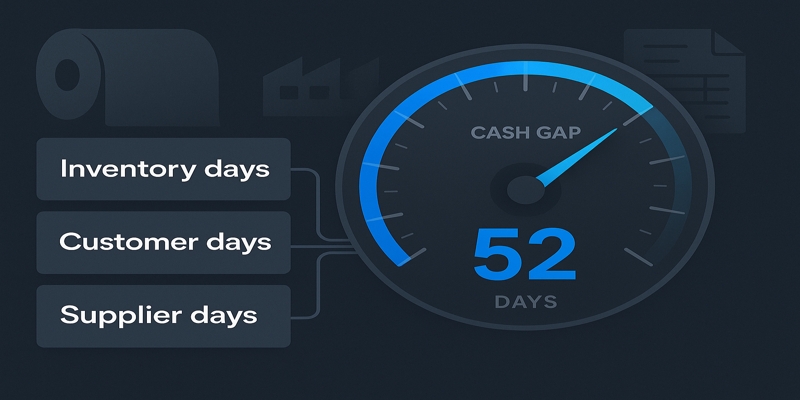
Cash gap (days) = Inventory days + Customer collection days – Supplier payment days
Let’s walk through an example. Suppose you hold kraft paper and work-in-progress for 15 days on average. Your customers pay in 60 days. Your kraft paper supplier expects payment 20 days after delivery. Your cash gap is 15 + 60 – 20 = 55 days. For nearly two months, your cash is tied up in paper and receivables before it cycles back.
Change any one of these variables and the gap shifts. If you negotiate 30-day terms with your supplier instead of 20, your gap drops to 45 days. If your customers stretch payment to 75 days, your gap expands to 70 days. This sensitivity is why understanding the gap matters—it shows you exactly where cash pressure builds and where you have leverage to ease it.
Step 3: Convert the Cash Gap Into a Working Capital Limit Number

Now you combine the two numbers you’ve calculated—your average monthly kraft paper spend and your cash gap in days—into a working capital limit estimate. The logic is simple: if your cash stays tied up for a certain number of days, you need enough credit to cover that many days’ worth of spending.
The formula looks like this:
Required working capital limit for kraft paper ≈ Average monthly kraft paper spend × (Cash gap days ÷ 30)
We divide by 30 to convert your gap in days into a fraction of a month. If your gap is 60 days, that’s two months’ worth of spending. If it’s 45 days, that’s 1.5 months. The math scales proportionally.
Let’s say your average monthly kraft paper spend is ₹1,870,000 ($21,950) and your cash gap is 55 days. Plug those numbers in:
₹1,870,000 ($21,950) × (55 ÷ 30) ≈ ₹1,870,000 ($21,950) × 1.833 ≈ ₹3,428,000 ($40,000) (rounded for simplicity).
Your estimated working capital limit for kraft paper is roughly ₹3.4 million ($40,000). A clear, simple estimate builds credibility with banks even if the exact number changes later.
One important note: under standard working capital norms (such as the MPBF method common in India and other Commonwealth jurisdictions), banks typically finance 70 to 75 percent of this requirement. Your business must fund the remaining ‘margin’—roughly 25 to 30 percent—from its own cash reserves, though this percentage can vary based on your credit rating and specific banking region. So in this example, while the total working capital need is ₹3.4 million ($40,000), you’d be requesting approximately ₹2.4 ($28,000) to ₹2.6 million ($30,000) as a bank facility, with your business contributing the balance. This distinction matters when you present your request and when you plan your overall liquidity.
Keep in mind that this estimate assumes stable, average conditions. Rapid growth, unexpected price spikes, or seasonal demand peaks might require a higher limit temporarily. Conversely, if you negotiate better supplier terms or accelerate customer collections, your actual need could be lower. We’ll touch on these adjustments in a moment.
Worked Example: From Real Numbers to a Banker-Ready Estimate
Let’s put all three steps together with a concrete scenario. Imagine you run a small packaging converter that produces corrugated boxes. You buy kraft linerboard and medium paper from two mills. Your purchasing pattern over the past year shows you spend an average of ₹2,100,000 ($24K) per month on kraft paper at current prices.
Your suppliers give you 25 days to pay from the date of delivery. Your inventory cycle—from raw material receipt through work-in-progress to finished goods dispatch—runs about 12 days. Your B2B customers, mostly FMCG brands and industrial manufacturers, pay you on 65-day terms on average, though a few stretch to 70 days.
Calculate the cash gap: 12 days (inventory) + 65 days (customer payment) – 25 days (supplier payment) = 52 days.
Now apply the formula: ₹2,100,000 ($24K) × (52 ÷ 30) = ₹2,100,000 ($24K) × 1.73 ≈ ₹3,633,000 ($43K).
You need a working capital limit around ₹3.6 million ($43K) specifically for kraft paper. If you’re preparing for a bank review, you might round that to ₹3.5 ($41K) million or ₹4 million ($47K) depending on whether you expect growth or prefer a small buffer. Either way, you now have a number grounded in your actual cash cycle rather than a guess.
Remember to adjust this total figure when presenting to your bank. Since banks typically finance 70 to 75 percent of working capital needs, your facility request would be approximately ₹2.5 million ($29K) to ₹2.7 million ($32K), with your company contributing ₹900,000 ($10K) to ₹1.1 million ($13K) from internal funds.
How to Explain This Estimate to Your Banker
Walking into a bank meeting with this calculation gives you two advantages: it shows you understand your own cash flow, and it frames the limit request around business fundamentals rather than panic. Here’s a simple way to present your logic.
Start with the facts. “Our average monthly kraft paper spend is approximately ₹2.1 million ($24K) based on the past year’s purchasing pattern. This represents roughly 40 tons per month at current market prices.”
Then explain the cash gap. “We pay our kraft paper suppliers within 25 days of delivery. Our kraft paper moves through raw material storage and work-in-progress for about 12 days before dispatch. Our customers pay us on 65-day terms. That creates a cash gap of 52 days between when we pay for kraft paper and when we collect payment.”
Finally, connect the dots. “Based on that 52-day gap, the total working capital requirement for kraft paper is approximately ₹3.6 million ($43K). Following standard banking practices, we’re requesting a facility of ₹2.7 million ($32K), with our company contributing the margin from internal funds. This estimate assumes stable volumes and terms. If we grow faster than expected or face a price surge, we may need to revisit this number.”
This approach signals discipline. You’re not asking for money because you’re in trouble. You’re asking for a limit sized appropriately to your business cycle. Sizing the limit around real working capital strain from payment terms reduces dependence on last-minute overdraft extensions, which is exactly what banks prefer to see.
Common Tweaks and Caveats
This formula gives you a baseline, but real businesses rarely run at perfect average conditions every month. A few situations might push your actual need higher or lower than the estimate.
Your estimate might be too low if you’re in a growth phase and monthly volumes are climbing steadily. A 20% increase in orders means a 20% increase in kraft paper spending, and your limit should scale with it. Price spikes create similar pressure. If kraft paper prices jump 15% due to pulp shortages or freight surges, your cash outflow rises even if tonnage stays flat. Seasonal peaks also matter. If you do 40% more business in two quarters and the rest of the year is quiet, you might need a higher limit during peak months and can dial it back afterward.
Conversely, your estimate might be too high if you successfully negotiate better supplier terms. Moving from 25-day payment to 35-day payment shrinks your cash gap by 10 days and reduces the required limit proportionally. Faster customer collections have the same effect. If you can incentivize early payment or tighten credit terms with slower payers, each day you shave off the collection period lowers your working capital need.
Remember that this estimate covers only kraft paper. Your total working capital limit will include other raw materials, wages, rent, utilities, and any other recurring expenses that require funding before revenue arrives. Kraft paper is often the largest single line item for packaging converters, so isolating it helps clarify where the biggest cash strain sits. But when you talk to your banker about your overall facility, this kraft paper limit should be presented as one component of a broader working capital plan.
What to Do Next Once You Have Your Number
Now that you’ve calculated your kraft paper working capital limit, take a few practical steps before your next bank meeting. First, review your payment terms with your suppliers and customers. Are there opportunities to negotiate more favorable credit periods? Even a five-day shift can meaningfully reduce your cash gap and lower the limit you need. Some mills offer early payment discounts that might offset the cost of tighter terms.
Second, sit down with your finance head or accountant and validate your numbers. Make sure your average monthly spend calculation is accurate and that your inventory turnover and collection days reflect current reality rather than outdated assumptions. If your business has changed significantly in the past year—new product lines, different customer segments, faster or slower order cycles—adjust your inputs accordingly.
Third, prepare a brief written summary of your calculation to bring to your banker. You don’t need a formal report, but a one-page outline showing your monthly spend, cash gap components, and resulting limit estimate makes the conversation easier. Bankers appreciate clients who think ahead and present clear, logical requests. It positions you as a reliable partner rather than a reactive borrower.
Use the cash gap formula to test scenarios and identify opportunities:
- “What if we improve supplier credit terms from 25 to 40 days?”
- “What if we can reduce average inventory days from 15 to 10 through better planning?”
- “What if customer collections slip from 60 to 75 days during economic uncertainty?”
Running these what-if calculations helps you understand which levers have the most impact on your working capital needs and where to focus your negotiation efforts.
Finally, recognize that this working capital limit isn’t static. As your business evolves—volumes grow, terms shift, prices fluctuate—your cash gap and limit needs will change too. Revisit this calculation every six to twelve months or whenever a significant shift occurs in your purchasing pattern, supplier terms, or customer mix. Proactive adjustments are always easier than emergency requests when you’ve already maxed out your existing facility.
For more insights on managing kraft paper procurement and working capital effectively, explore additional guides on PaperIndex Academy. Understanding the full cash cycle—from pricing volatility to payment structures—helps you build a more resilient operation. When you’re ready to connect with kraft paper suppliers and explore sourcing options, visit PaperIndex to access a global network of kraft paper mills and kraft paper exporters/traders.
Disclaimer: This guide is for general information for SME packaging converters. It is not financial or legal advice. Please discuss your exact numbers with your accountant or banker.
Our Editorial Process
Our expert team uses AI tools to help organize and structure our initial drafts. Every piece is then extensively rewritten, fact-checked, and enriched with first-hand insights and experiences by expert humans on our Insights Team to ensure accuracy and clarity.
About the PaperIndex Insights Team
The PaperIndex Insights Team is our dedicated engine for synthesizing complex topics into clear, helpful guides. While our content is thoroughly reviewed for clarity and accuracy, it is for informational purposes and should not replace professional advice.