

Corrugated Box Storage SOPs for Packaging, Warehouse, and Quality Teams
📌 Key Takeaways Corrugated box storage works best when packaging, warehouse, and quality teams share ownership instead of leaving it all to the warehouse. Shared visibility beats shared blame. Warehouse, quality, and procurement teams managing corrugated box inventory will find a ready-to-adapt responsibility framework here, preparing them for the detailed ... Read More
Corrugated Box Storage Audit Questions for SMB Packaging and Warehouse Teams
📌 Key Takeaways Most corrugated box damage starts with missing handoffs between procurement, warehouse, and quality — not one bad decision. Shared visibility across teams catches storage problems before they reach the customer. SMB packaging buyers, warehouse leads, and quality managers will find ready-to-use audit questions and escalation frameworks here, ... Read More
A Cross-Functional SOP Framework for Corrugated Box Storage and Escalation
📌 Key Takeaways Corrugated box storage problems usually start because no one defines who owns which part of the process — not because teams lack skill. Defined roles + condition checks + a shared issue log = boxes that actually perform on the packing line. Packaging, warehouse, and quality teams ... Read More
What Packaging Buyers Should Document About Warehouse Conditions Before Reordering Corrugated Boxes
📌 Key Takeaways Most corrugated box problems trace back to what happened after delivery — and documenting warehouse conditions before reordering turns guesswork into a fact-based conversation with suppliers. Document first, decide second — a one-page warehouse record turns reactive complaints into productive supplier conversations. Procurement teams and warehouse managers ... Read More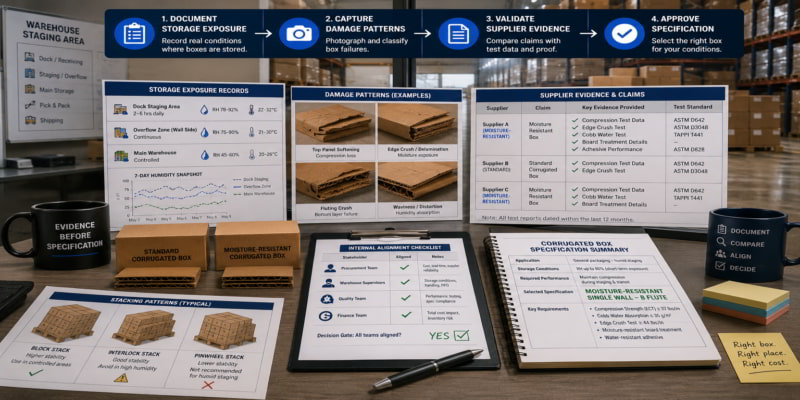
How to Compare Standard and Moisture-Resistant Corrugated Boxes Without Overbuying
📌 Key Takeaways Choosing between standard and moisture-resistant corrugated boxes starts with documenting what your boxes actually face — not assuming “stronger” means better. Specification decisions backed by evidence prevent both overbuying and repeated damage. Procurement managers, warehouse supervisors, and quality teams evaluating corrugated packaging for humidity-sensitive storage will gain ... Read More
Supplier Questions to Ask Before Buying Corrugated Boxes for Humid Storage Conditions
📌 Key Takeaways Telling your supplier exactly what your warehouse environment looks like prevents new boxes from collapsing during humid storage. Clear and honest communication with your packaging supplier stops seasonal warehouse humidity from silently destroying your expensive containers. Procurement and warehouse managers will gain highly practical sourcing strategies here, ... Read More
Why Corrugated Boxes May Look Usable in Storage but Fail During Packing or Shipping
📌 Key Takeaways Boxes that look perfect on the shelf often fail during shipping because quiet storage hides invisible moisture and structural fatigue. Physical testing before packing stops expensive failures during shipping. Warehouse and quality teams will gain practical inspection skills here, preparing them for the detailed overview that follows. ... Read More
How Humidity Changes Corrugated Box Stack Planning in SMB Warehouses
📌 Key Takeaways High humidity slowly weakens dry-looking corrugated boxes, forcing you to adjust your stack heights, pallet quality, and storage times. Smart support and shorter storage times stop invisible humidity from quietly crushing your valuable inventory. Small business warehouse teams will learn how to protect their stock, setting up ... Read More
Corrugated Box Storage for Slow-Moving Packaging Stock in SMB Warehouses
📌 Key Takeaways Slow-moving corrugated boxes lose strength based on where they sit, not just how long they’ve been stored. Condition-aware storage beats calendar-based rotation every time. SMB warehouse managers and packaging procurement teams coordinating on storage and reorder decisions will gain a practical inspection framework here, guiding them into ... Read More
Corrugated Box Storage Zones: How Warehouse Teams Can Spot Humidity Risk Areas
📌 Key Takeaways The same warehouse can have safe zones and risky zones — and where boxes sit matters more than how dry the building feels overall. Where the box sits changes the outcome more than what the box is made of. Warehouse supervisors and quality teams managing corrugated stock ... Read More
When Corrugated Box Damage Comes From Storage, Suppliers, or Handling: A Practical Triage Guide
📌 Key Takeaways When corrugated boxes fail after delivery, matching the damage pattern to records — not gut reactions — reveals the real cause. Evidence turns difficult supplier calls into productive ones. Packaging buyers, warehouse managers, and QA teams dealing with post-delivery box failures will find a ready-to-use triage framework ... Read More
How to Check Corrugated Box Deliveries for Humidity Exposure Before Warehouse Storage
📌 Key Takeaways A simple dock checklist turns a humidity-suspect corrugated box delivery into a structured, documented decision — no lab equipment needed. Document early, separate fast, and let evidence — not assumptions — guide the next step. Warehouse teams, packaging buyers, and quality managers handling corrugated box deliveries will ... Read More
Aligning Operations and Procurement Priorities for Corrugated Boxes: A Shared Framework to Ensure Fulfillment Reliability
📌 Key Takeaways Operations and procurement share the same goal—fulfillment reliability—but reach it through different decision lenses that must be aligned before RFQs go out. Forty-five minutes of structured alignment prevents months of inherited failures. Operations managers and procurement officers navigating corrugated box sourcing will gain a shared decision framework ... Read More
Matching Corrugated Box Flute Profiles to Product Weight: A Technical Checklist for E-commerce
📌 Key Takeaways Packed weight alone misleads flute selection—footprint, height, and damage history determine whether boxes survive real distribution. Specifications matched to failure modes protect margins; specifications matched only to weight invite surprises. E-commerce operations managers and procurement professionals sourcing corrugated packaging will gain a decision framework here, preparing them ... Read More
Why Unit-Price Thinking Fails: The Hidden Impact of Corrugated Box Structural Integrity
📌 Key Takeaways A five-cent per-box saving disappears when damage rates rise by as little as 0.12%, because failure costs scatter across departments that never see the original purchase order. Spend accurately, not cheaply—structural integrity matched to load stress lowers total landed cost. Procurement managers and operations leaders responsible for ... Read More
The Engineering of Efficiency: A Thesis on Corrugated Box Cost Optimization
📌 Key Takeaways Corrugated box cost optimization is an engineering discipline that matches structural integrity to actual load stress—preventing systemic failure costs— rather than chasing unit price reductions. Specification discipline prevents the failures that price negotiation cannot fix. Procurement managers, operations leaders, and packaging engineers responsible for corrugated box sourcing ... Read More
Corrugated Box Cost Optimization in Industrial Packaging Is an Engineering Discipline—Not a Negotiation Tactic
📌 Key Takeaways Corrugated box cost optimization means engineering the minimum viable structural performance for the actual load case, then negotiating within that engineered envelope. Engineer the spec. Verify the claims. Govern the drift. Procurement managers, packaging engineers, and operations leaders balancing cost pressure against supply chain reliability will gain ... Read More
Sourcing Strategy vs. Heavy-Duty Specifications in Corrugated Box Selection: A Comparative Decision Matrix
📌 Key Takeaways The fastest way to end the strategy-versus-specs debate is to treat it as a sequencing problem—specs define “what,” strategy defines “who and how,” and neither should advance without the other. Alignment is the outcome; sequencing is the method. Industrial packaging engineers and procurement managers facing heavy-duty corrugated ... Read More
The “Remote Audit” Paradox in Corrugated Boxes: Verifying Heavy-Duty Capabilities Without Travel
📌 Key Takeaways Remote supplier verification works when buyers request traceable evidence—method-named test reports, live demonstrations, and lot-linked documentation—rather than collecting polished presentations and generic certificates. A consistent evidence trail is more defensible than a perfect presentation. Procurement managers and operations leaders evaluating heavy-duty corrugated box suppliers without travel budgets ... Read More