

📌 Key Takeaways
“Food safe” labels tell you nothing about whether paper will survive hot, greasy food—only specifications reveal actual performance.
- Labels Hide, Specs Reveal: A “food safe” stamp means the paper won’t poison anyone, but it doesn’t promise the wrapper will hold up against heat, grease, or moisture.
- Know Your Three Numbers: GSM measures weight and strength, Kit Level measures grease resistance, and certification scope confirms the paperwork matches your actual order.
- Ask Before You Order: Seven simple questions—covering exact construction, use conditions, grease targets, and proof documents—separate real answers from marketing promises.
- Start With Your Riskiest Item: Pick your greasiest, hottest menu item, figure out what it does to paper, then build your spec requirements around that worst-case scenario.
- Templates Beat Guesswork: A one-page spec template makes every supplier quote comparable, so you stop evaluating marketing against marketing.
Food service operators and procurement managers sourcing packaging materials will find actionable frameworks here, preparing them for supplier conversations that produce comparable, verifiable quotes.
~ ~ ~ ~ ~ ~ ~ ~ ~ ~ ~ ~ ~ ~ ~ ~ ~ ~
The wrapper dissolves.
Grease seeps through the paper, spreading across the customer’s lap. They look down at the dark stain on their khakis, then up at your counter—phone already in hand. This is going online.
Generic sourcing creates compliance risk because it treats a marketing claim as a performance guarantee. The label promised safety. The paper failed anyway. The difference between what “food safe” communicates and what specifications (specs) actually measure is where brand damage lives.
Specifications are the DNA of your food packaging paper—they reveal what labels hide.
The Specification-First Protocol exists to close this gap. Rather than accepting supplier claims at face value, it requires verifiable performance metrics before any comparison begins. This isn’t about making sourcing more complicated. It’s about making supplier evaluation actually possible.
The Dangerous Comfort of Generic Labels
A familiar scenario: your current supplier misses a delivery. You need replacement paper by Thursday. The instinct is reasonable—find someone who can ship fast, confirm the paper says “food safe,” move on.
This is how most operators source food packaging materials. It’s also how most packaging failures originate.
The problem isn’t supplier dishonesty. The problem is that “food safe” communicates almost nothing about how paper will actually perform when it contacts hot, greasy food.
What “Food Safe” Actually Means (And Doesn’t Mean)
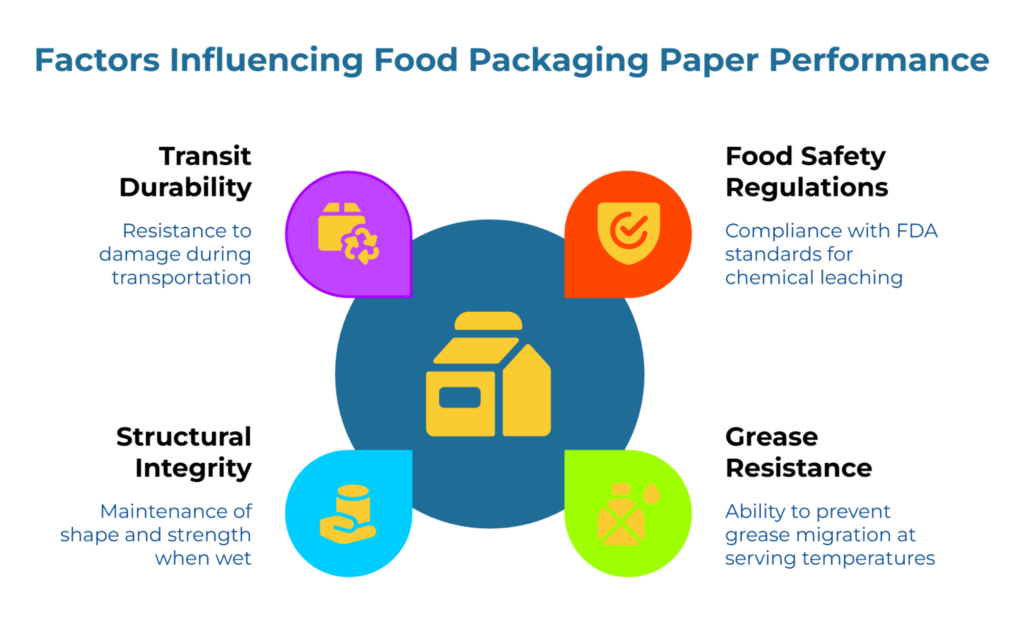
A “food safe” designation typically indicates that materials will not leach harmful chemicals into food under certain test conditions. That’s the regulatory floor—not a performance ceiling.
The designation says nothing about whether paper will:
- Resist grease migration at serving temperature
- Maintain structural integrity when wet
- Survive the transit duration between the kitchen and the final point of consumption
Buying food packaging paper based on generic labels is like purchasing tires knowing only your car’s color. Technically possible. Dangerously uninformed.
The FDA regulates food contact substances to ensure they don’t pose health risks under specified conditions. For paper and paperboard specifically, regulations distinguish between contact with dry foods (21 CFR 176.180) and contact with aqueous or fatty foods (21 CFR 176.170)—a distinction that matters enormously for hot, greasy menu items. But FDA compliance addresses safety—not performance. A paper that’s perfectly safe for food contact can still fail catastrophically when that food is a 160°F sandwich dripping with grease.
This is why “food safe” functions as a meaningless label for practical sourcing decisions. The label isn’t wrong. It’s simply incomplete. Performance information lives in specifications, and specifications rarely appear on standard quotes.
The Gap Between Label Claims and Real-World Performance
Consider what happens when wax paper encounters high-heat applications. Standard wax coatings often begin to soften and migrate between 120°F (~49°C) and 140°F (~60°C), depending on the blend. The wax transfers to food. Barrier properties disappear precisely when barrier properties matter most.
Yet wax paper routinely carries “food safe” labels. The claim is accurate—wax paper is safe for food contact. The claim is also irrelevant to whether it will survive contact with hot fried chicken.
A common pitfall here is assuming that all papers marketed for food service perform equivalently. Two wrappers can both carry identical marketing language while behaving completely differently under identical conditions. Without specifications, you cannot know which is which until failure occurs.
This illustrates the fundamental flaw in generic procurement: mistaking regulatory compliance for operational fitness. When that incomplete information meets real-world kitchen conditions, your brand absorbs the consequences.
Five Assumptions That Lead to Wrapper Failures
The pattern behind most food packaging paper surprises during a supplier switch follows predictable lines. These assumptions feel reasonable until the first busy service reveals the truth.
| Assumption | Reality | What to Do Instead |
| “Food safe” is a universal standard | “Food safe” is often a marketing shortcut unless it maps to defined regulations and specific conditions of use | Ask what regulation the material meets and whether that scope matches your food type and service conditions |
| Wax paper equals greaseproof | Wax treatments vary and can underperform with high heat, high fat, or long hold times | Specify the grease barrier requirement and the use conditions—heat level, hold time, fat exposure |
| Higher GSM always means better quality | GSM affects feel and strength, but barrier performance depends on coatings and how they behave under heat and grease | Treat GSM as one lever and pair it with a barrier requirement |
| A certificate proves your exact use case | Certificates can be legitimate and still be incomplete if scope doesn’t match the exact material construction, inks, and conditions | Request the certificate plus a scope statement naming the exact product and intended conditions |
| If it worked once, it will work again | Small changes in coating, pulp mix, supplier process, or print system can change outcomes | Lock performance-critical specifications and require lot traceability where practical |
Why Specifications Are the DNA of Safe Sourcing
Specifications measure. Labels market. That distinction matters.
While packaging terminology is specialized, its application is a matter of practical measurement rather than abstract science. But reading specifications effectively doesn’t require engineering expertise. It requires understanding a few core metrics and what each protects against.
Specifications reveal performance truth that labels obscure. They quantify the physical properties that marketing jargon tends to gloss over. Learning to read them transforms every supplier conversation from a comparison of claims into a comparison of capabilities.
GSM: The Foundation of Physical Performance
GSM—grams per square meter—measures paper weight. It’s the first specification most buyers encounter and the first one commonly misunderstood.
Higher GSM does not automatically mean better quality. It means heavier paper. For operators who need to specify both GSM and Kit Level together to prevent soggy food, these two metrics work in tandem—GSM controls structural feel while Kit Level controls grease blocking. Whether heavier paper serves your application depends entirely on what that application demands.
A 40 GSM tissue and an 80 GSM kraft serve completely different purposes. Doubling the GSM doesn’t make tissue suitable for wrapping a cheesesteak. Base material, fiber composition, and surface treatment matter as much as weight—sometimes more.
What GSM does communicate: structural expectations under handling stress. A 50 GSM wrapper behaves differently than a 70 GSM wrapper when folded, when dampened, when crumpled into a takeout bag. If your current supplier ships 60 GSM paper and a replacement quotes “similar food-safe paper” without specifying weight, you’re comparing unknowns against unknowns.
For practical guidance on matching paper weight to specific menu applications, the Food Packaging Paper GSM guide breaks down weight ranges by food type and service format.
Coating and Kit Levels: The Grease Barrier Truth
Grease resistance exists on a spectrum. Paper doesn’t simply resist grease or fail to resist grease—it resists grease to a measurable degree, for a measurable duration, under specific conditions.
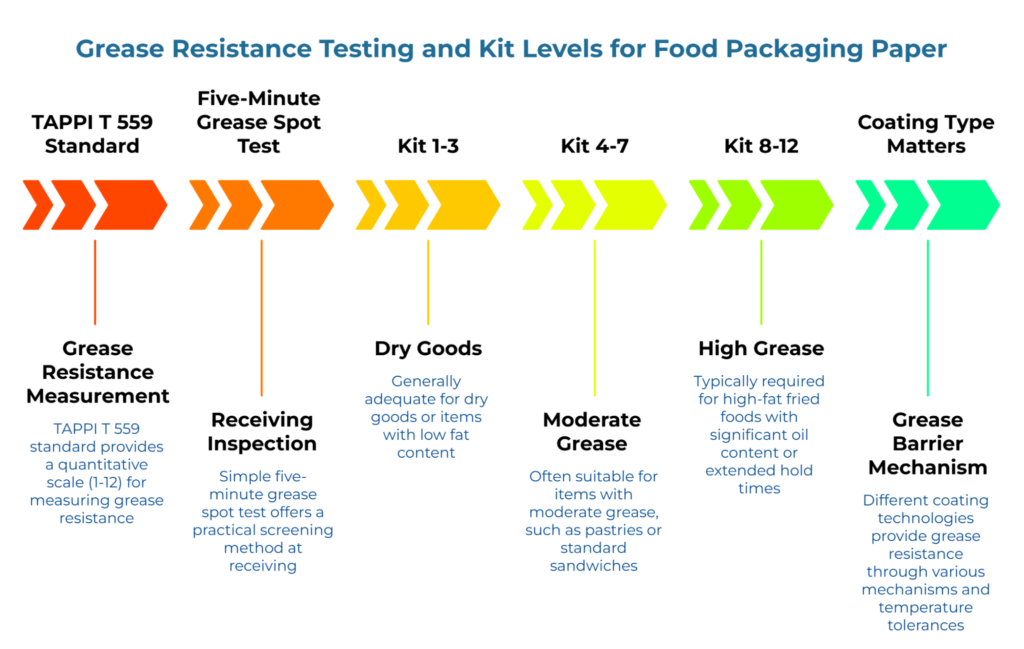
Kit level testing (using the TAPPI T 559 standard) rates grease resistance on a scale from 1 to 12. For operators who want to validate grease barrier performance at receiving, a simple five-minute grease spot test provides a practical screening method before committing inventory to service. Higher numbers indicate greater resistance:
- Kit 1-3: Generally adequate for dry goods or items with low fat content
- Kit 4-7: Often suitable for items with moderate grease, such as pastries or standard sandwiches
- Kit 8-12: Typically required for high-fat fried foods with significant oil content or extended hold times
A wrapper marketed as “greaseproof” might test at Kit 4—workable for a croissant, inadequate for fried fish. The label communicates capability in general terms. The specification quantifies it precisely.
Coating type matters equally. Different coating technologies—fluorochemical, wax-based, natural polymer—provide grease resistance through different mechanisms with different temperature tolerances. Some coatings that perform well in laboratory conditions degrade under sustained heat. Others maintain performance but raise regulatory questions depending on jurisdiction.
The Kit levels guide provides a practical framework for matching ratings to specific food types based on fat content and expected hold time.
Certifications: What the Acronyms Actually Verify
FDA. ISEGA. ISO. These acronyms appear on supplier materials constantly. Understanding what they certify—and what they don’t—prevents misplaced confidence.
FDA compliance (in the U.S. context) means materials meet food contact regulations under the Code of Federal Regulations. It addresses chemical safety, not mechanical performance.
ISEGA certification verifies compliance with specific standards, most notably the German BfR XXXVI recommendation, which is widely accepted as the de facto benchmark for paper safety across Europe. While this supports EU market access under Framework Regulation (EC) No 1935/2004, it represents different test conditions and migration limits than FDA requirements.
ISO standards address quality management systems and specific test methodologies. They verify process consistency, not product performance for your particular application.
The practical question isn’t whether a supplier holds certifications. It’s whether those certifications cover:
- The specific product grade being quoted
- The specific facility shipping to you
- Test conditions that match your actual use case
A supplier might hold FDA compliance for one product line while the paper they’re quoting comes from a different line, different mill, or different country. The certificate exists. It may not apply to your order. This is precisely why food packaging paper suppliers fail compliance verification—the documentation exists but doesn’t trace to the actual shipment.
For detailed guidance on verifying that certification scope matches actual orders, see the guide on FDA vs. ISEGA certifications.
The Specification-First Protocol: A Framework for Brand Protection
The Specification-First Protocol inverts typical sourcing sequence. Instead of identifying suppliers first and checking specifications later (or never), it establishes specification requirements before any supplier conversation begins.
This approach makes supplier comparison actually meaningful. Specifications are the only apples-to-apples way to compare quotes accurately—without them, you’re evaluating marketing against marketing with no common baseline. The food packaging paper sourcing matrix provides a framework for plotting both safety certification and performance specs together, surfacing trade-offs before you award a supplier.
Anatomy of a Safe Wrapper
Every food wrapper consists of functional layers working together. Understanding what each layer contributes clarifies what you’re actually buying.
Base Paper Layer (GSM) Determines fundamental physical properties: tear resistance, fold endurance, structural rigidity. Match to your handling requirements—a wrapper destined for a crumpled bag needs different properties than one sitting flat on a serving tray.
Barrier Coating (Kit Level) Determines grease and moisture resistance. Match to your food’s fat content and temperature profile. A breakfast wrap has different demands than a fish-and-chips basket.
Grease Resistance Target Grease resistance is a performance target, not a binary pass/fail. Industry testing approaches exist, and suppliers often refer to kit levels or similar indicators when discussing grease resistance. If grease is the visible problem, align on a measurable grease resistance requirement rather than relying on “greaseproof” language.
Printing and Inks (When Applicable) If the wrapper is printed, there’s an additional dimension: rub and scuff performance, ink set, and whether the ink system is appropriate for food-contact conditions. Printed systems should be treated as part of the construction, not a decorative afterthought.
Compliance Documentation (Certifications) Determines regulatory acceptability and audit readiness. Match to your operating jurisdiction and any customer-facing claims you make about food packaging paper. A supplier’s certification only protects you if its scope covers what you’re ordering.
When these elements align with your actual operational needs, wrapper failure becomes a solvable engineering problem rather than an unpredictable brand risk. For organizations seeking to formalize this alignment, the integrated safety model provides a six-stage framework and 30/60/90-day rollout plan.
The Three-Question Supplier Comparison Test
Before requesting any quote, establish your specification baseline. The output of these three questions becomes your Minimum Viable Spec—the essential requirements that make quotes comparable.
Evaluate Menu-Induced Stressors:
Q1. What does your food do to paper?
Document the specific stressors your menu creates. Temperature range at serving. Fat content by item. Moisture level. Expected hold time between preparation and consumption. A basket of fries creates a completely different paper environment than a slice of pie.
Define Functional Performance Thresholds:
Q2. What must the paper do in response?
Translate stressors into performance requirements. Grease resistance at a specific temperature for a specific duration. Structural integrity when folded or compressed. Moisture barrier adequate for your service window. These become your minimum specification thresholds.
Validate Compliance and Verification Data:
Q3. What evidence proves the paper meets those requirements?
Identify documentation you’ll require from any supplier. Test reports with methodology specified. Certificates with scope confirmed for your specific order. Samples for validation against your actual menu items.
Now contact suppliers. Every quote you receive can be evaluated against identical criteria. Suppliers who cannot provide specification data aren’t necessarily poor suppliers—they’re simply incomparable suppliers. You cannot evaluate what you cannot measure.
This method works because it separates what you need from what suppliers offer. Generic sourcing merges these conversations, allowing supplier marketing to define your requirements. The Specification-First Protocol keeps them distinct.
Seven Questions to Ask Suppliers Before Ordering
When time is tight, these questions help separate generic reassurance from usable proof. They also signal seriousness without being adversarial.
- What exact product construction are you quoting? Name it clearly—avoid “similar to” language.
- What use conditions does it support? Hot, fatty foods; hold time; steam exposure.
- What is the GSM and the barrier or coating approach?
- What is the grease resistance target or test reference used to support the claim?
- What documentation supports food-contact suitability for these conditions? Does it match the quoted construction?
- If printed: what ink or print system is used and what rub and scuff performance is expected?
- What traceability information is available per lot or batch?
These questions don’t guarantee perfection. They do something more valuable during a switch: they reduce ambiguity so the sampling process becomes efficient. For a broader supplier verification framework that extends beyond food packaging, the seven questions scammers can’t answer provides additional verification depth.
A Minimum Viable Specification Template for Your Next RFQ
This template creates comparability across suppliers without over-engineering. Adapt it to your operation, but keep every supplier seeing the same lanes—GSM, barrier, grease resistance target, and evidence requirements—so responses stop drifting.
Use case: [e.g., hot, greasy sandwiches / sauced wraps / fried items]
Contact conditions: hot service + [delivery hold time] + [steam exposure level]
Primary failure mode to prevent: [grease bleed / sogginess / tearing / scuffing]
Required specifications:
- Base paper GSM: [range or target]
- Barrier/coating requirement: [describe the outcome needed: resist grease at hot temp; manage steam; maintain fold strength]
- Grease resistance target: [state required performance target or supplier’s test reference]
- If printed: [single/multi-color], rub resistance expectations, and food-contact appropriate print system
- Compliance evidence required: documentation that clearly applies to the quoted construction and intended food-contact conditions, plus any supporting test summaries
- Traceability: lot/batch identification available upon request
Sample request: Provide [number] samples from the quoted construction for in-kitchen testing under stated conditions.
From Specification Paralysis to Sourcing Confidence
The technical vocabulary exists for precision, not exclusion. Every term points to something measurable. Every measurement protects against something specific.
Specification paralysis—that overwhelmed feeling when technical requirements accumulate—typically stems from attempting to master everything simultaneously. You don’t need comprehensive paper science knowledge. You need to match your menu’s specific demands to measurable paper properties.
A practical balance looks like this: specify what controls the failure mode. Keep GSM as a range unless a precise feel or strength is essential. Require documentation scope clarity, not a pile of unrelated certificates. Test the most stressful real scenario first—the worst-day menu item, the longest hold.
This approach protects speed. It also protects credibility: procurement conversations become engineering-light but evidence-forward.
Start with your highest-risk item. What’s the greasiest thing you serve? What generates the most packaging complaints? What would cause the most visible damage if the wrapper failed publicly?
Document what that specific food does to paper. Identify the specification numbers addressing those specific stressors. Build supplier requirements around those specific metrics.
That’s the Specification-First Protocol in practice. Not comprehensive paper engineering—targeted specification matching that protects your brand where protection matters most.
Resources
- Why “Food Safe” Is a Meaningless Label for Food Packaging Paper
- The Wax Paper Trap: Why Generic Wraps Fail High-Heat Tests
- Food Packaging Paper GSM Explained
- Food Packaging Paper Kit Levels 1-12: A Guide to Grease Resistance
- FDA vs. ISEGA: What the Acronyms Really Mean
- The Compliance Shield: How to Audit Your Food Packaging Paper Suppliers
- 21 CFR 176.170 – Paper for Aqueous and Fatty Foods
- 21 CFR 176.180 – Paper for Dry Foods
- EU Regulation (EC) No 1935/2004 – Food Contact Materials Framework
Your Packaging Tells the Truth Eventually
Generic sourcing works until it doesn’t. When it fails, the failure is public—a stained garment, a disintegrating wrapper, a health inspection question without a documented answer, a photograph circulating beyond your control.
The Specification-First Protocol exists because specifications don’t have marketing budgets. They measure what paper actually does, under conditions that actually matter, with precision that labels cannot provide.
The three-question method gives you a starting point. The seven-question supplier script gives you verification depth. The Minimum Viable Specification template gives you immediate comparability. Your highest-risk menu item gives you a testing ground. And every supplier who answers specification questions with test data—not claims—becomes a supplier you can actually evaluate.
Brand safety isn’t built on trust in labels. It’s built on verification of performance. Specifications make that verification possible.
Disclaimer:
This guide provides general educational information about food packaging specifications and sourcing practices. Regulatory requirements vary by jurisdiction and application. Consult with qualified food safety professionals and regulatory authorities for guidance specific to your situation.
Our Editorial Process:
Our expert team uses AI tools to help organize and structure our initial drafts. Every piece is then extensively rewritten, fact-checked, and enriched with first-hand insights and experiences by expert humans on our Insights Team to ensure accuracy and clarity.
About the PaperIndex Insights Team:
The PaperIndex Insights Team is our dedicated engine for synthesizing complex topics into clear, helpful guides. While our content is thoroughly reviewed for clarity and accuracy, it is for informational purposes and should not replace professional advice.