

📌 Key Takeaways
Shortlisting paper bag suppliers requires structured criteria that reveal performance differences hidden beneath similar-looking quotes.
- Must-Haves Eliminate Non-Starters: Pass/fail gates for MOQ, lead time, and compliance remove suppliers before scoring begins.
- Consistency Beats Perfect Samples: Quality control systems across production runs matter more than one flawless prototype.
- Quote Normalization Prevents False Comparisons: Holding bag specs, print coverage, and delivery terms constant reveals true cost differences.
- Simple 1-5 Scoring Creates Defensible Decisions: Rating suppliers on evidence-based criteria generates explainable shortlists stakeholders can align on.
- Discovery Platforms Start, Verification Finishes: Supplier directories surface options; structured criteria and pilots confirm which ones perform.
Structured criteria transform scattered quotes into defensible supplier choices.
Procurement managers sourcing custom paper bags will gain practical filtering methods here, preparing them for the detailed supplier evaluation framework that follows.
Three quotes sit open on the screen. The prices look close enough. The lead times seem reasonable. But something feels off—which supplier will actually perform when the holiday rush hits?
This is where most paper bag sourcing decisions go sideways. Buyers compare unit prices, pick the lowest number, and hope for the best. Six months later, a missed shipment derails a product launch, or inconsistent print quality forces an emergency rebrand. The cheapest quote rarely stays cheap once hidden costs surface.
Smart shortlisting works differently. It uses structured criteria to turn scattered options into a defensible supplier shortlist—one that accounts for lead time reliability, quality consistency, and compliance fit alongside price. Sourcing efficiency requires a binary filter: distinct ‘Pass/Fail’ gates for operational viability followed by a weighted score for strategic fit.
Why Shortlisting Paper Bag Suppliers Is Harder Than It Looks
The difficulty isn’t finding suppliers. Directories, trade shows, and referrals generate plenty of names. The challenge is distinguishing between them when quotes look superficially similar. A structured approach to wholesale paper bag sourcing transforms fragmented quotes into a defensible procurement program through systematic specification, normalization, and verification.
Consider a common scenario: a procurement manager receives four quotes for custom kraft paper bags. Unit prices range from $0.16 to $0.22, depending on paper weight and regional labor costs. All suppliers claim 21-day lead times. All mention ‘food-grade’ capability. On paper, the decision seems obvious—go with the lowest price.
But unit price comparisons alone increase hidden cost and long-term sourcing risk. Common sources of hidden variance include:
- Lead-time reliability vs. stated lead time. A supplier can quote 20 days and still miss critical windows if capacity planning is weak.
- Consistency vs. one-off samples. A sample often represents a best-case run; the operational reality is repeatability.
- Quote comparability. Quotes frequently differ on assumptions (dimensions, print coverage, packing, delivery terms), making “cheapest” an illusion.
A 21-day ‘quoted’ lead time often excludes the 7-10 day artwork approval cycle. Similarly, a supplier may provide a raw material compliance statement (e.g., FDA or BfR clearance for the pulp) instead of a facility-level hygiene certification like BRCGS or FSSC 22000 for their specific conversion line. A third has minimum order quantities that would lock up three months of working capital.
These differences only emerge through structured comparison. Without clear criteria, buyers either over-analyze (paralysis) or under-analyze (regret).
What a Shortlist Should Do (and What It Shouldn’t)
A shortlist reduces options to two to four credible suppliers that match specifications and risk tolerance. That’s it. The goal is not to identify the single winner—that comes after samples, pilots, and negotiation. The goal is to eliminate suppliers who clearly don’t fit and advance those worth deeper evaluation.
What a shortlist is not:
- A final contract decision
- A race to the lowest per-bag price
- A comprehensive due diligence report
Think of shortlisting as filtering. Must-have criteria eliminate non-starters. Scoring criteria rank the survivors. The output is an explainable decision that procurement, operations, and brand stakeholders can align on before committing further time.
Set Up Your Criteria: Must-Haves vs. Nice-to-Haves
Criteria sprawl kills efficiency. When everything matters equally, nothing gets decided. The solution begins with defining clear specifications that drive supplier selection—see from specs to sourcing for guidance on translating technical requirements into qualification criteria, then separating those requirements into two categories before evaluating any supplier. The solution is separating requirements into two categories before evaluating any supplier.
Must-haves function as pass/fail gates. If a supplier fails any must-have, they’re out—regardless of how strong they appear elsewhere. Typical must-haves for paper bag sourcing include:
| Must-Have Category | Example Threshold |
| MOQ compatibility | ≤ 150% of projected monthly usage (or < 90 days of total cover) |
| Lead time ceiling | Maximum acceptable production + transit time |
| Critical certification | Specific compliance required for end use |
| Geographic coverage | Ability to deliver to required destinations |
Nice-to-haves become scoring dimensions. These are attributes where “more is better” or “less is acceptable”—flexibility, additional print capabilities, backup capacity, payment term options. Suppliers aren’t eliminated for weakness here; they simply score lower.
This two-layer model clarifies the decision structure:
| Decision Layer | Purpose | How to Use |
| Must-haves | Prevent unacceptable risk | Pass/Fail gates (disqualifiers) |
| Nice-to-haves | Compare credible options | 1–5 scoring with short rationale |
This split reduces decision noise and prevents over-complicating what should be a filtering exercise.
The Criteria That Actually Separate Paper Bag Suppliers
Each criterion below follows a consistent structure: why it matters, how to assess it, typical trade-offs, and red flags that should prompt caution.
Minimum Order Quantities (MOQs) and Flexibility
Why it matters: MOQ directly affects cash flow, inventory risk, and ability to run pilots. A supplier requiring 50,000 units per SKU works for established retailers but crushes a startup testing three bag designs.
How to assess: Request MOQ per SKU, mixed-SKU flexibility within a single order, and whether trial orders at reduced quantities are possible (often at a price premium). Clarify MOQ per SKU and per design (not just “per order”), ability to mix SKUs or sizes in one production run, trial order or pilot MOQ if offered, and reorder MOQ and lead-time difference between first order versus repeat.
Trade-offs: Higher MOQs typically yield better unit economics and more stable production planning. Lower MOQs (e.g., < 5,000 units) increase agility but typically carry a 30−50% unit price premium. This is driven by the fact that setup waste and plate costs (which generally range from $150 to $600 per color depending on size and polymer type) represent a much higher percentage of the total cost on small runs compared to high-volume flexographic production. Additionally, these runs are frequently deprioritized in production schedules behind high-volume orders. Neither is inherently better—fit depends on order patterns and cash position.
Red flags: Vague MOQ answers (“depends on the order”), unwillingness to discuss trial quantities, or MOQs that would consume more than 90 days of projected usage. Watch for MOQ statements that change when specs are finalized, or no clarity on whether MOQ is per size, per print design, or per material/finish combination.
Lead Times and On-Time Reliability
Why it matters: Late bags mean stockouts, missed promotions, or expedited shipping costs that dwarf any unit price savings. Planning tolerance depends on lead time predictability.
How to assess: Ask for standard lead time (order confirmation to dispatch), peak-season lead time, and—if available—historical on-time delivery rates. Clarify whether quoted lead times include transit or end at the factory gate. Confirm capacity commitments (how far ahead production slots must be booked), how changes affect timelines (artwork edits, proof approvals, spec tweaks), and whether partial shipments are possible.
Trade-offs: Suppliers with shorter lead times may have less customization flexibility. Those with longer lead times may offer more finishing options or better pricing. Very short lead times enable faster reaction to demand shifts but can be a sales promise rather than an operational reality if not backed by real capacity. Longer but reliable lead times make planning easier and reduce surprises. The key is matching lead time to planning cycles.
Red flags: Significant discrepancy between quoted lead time and references’ experience, inability to provide peak-season estimates, or lead times quoted without specifying start and end points. Watch for lead-time promises without any explanation of production capacity, or vague responses about peak periods or change management.
Quality Consistency (Not Just a Good First Sample)
Why it matters: A perfect sample proves capability. It doesn’t prove repeatability. Incoming quality variance causes production delays, customer complaints, and brand damage that costs far more than the bags themselves. Many problems appear only after scale: handle failures, glue issues, print misregistration, scuffing, inconsistent color, or dimensional drift.
How to assess: Request the supplier’s specification sheet format, ask how tolerances are controlled, and inquire about their incoming QC expectations. Ask how quality is controlled across runs (incoming checks, in-process checks, final checks) and request a simple specification sheet with version control confirmation (what happens when specs change). Clarify tolerances that matter for the use-case (dimensions, handle strength expectations, print alignment expectations). For critical applications, ask whether third-party inspection is accommodated.
Trade-offs: Tighter quality control often means higher prices and longer lead times but delivers fewer surprises and clearer root-cause analysis when something goes wrong. Looser tolerances may be acceptable for non-branded applications where minor variation doesn’t affect function but can introduce more downstream issues.
Red flags: No written specifications, resistance to discussing tolerance ranges, or inability to explain how consistency is verified between batches. Watch for suppliers who treat quality as “sample approved = done” or show no willingness to document specs, tolerances, or corrective actions.
Print and Finishing Capabilities (and Their Constraints)
Why it matters: Paper bags often carry brand identity. Print registration, color matching, handle attachment, and finishing quality directly affect customer perception. Real-world issues include ink rub-off, cracking on folds, poor coverage on textured surfaces, or inconsistent color across batches.
How to assess: Confirm print method (flexo, offset, digital), maximum colors, Pantone matching capability, available handle types, and any finishing limitations (lamination, spot UV, embossing). Clarify maximum print coverage assumptions (full-coverage designs can behave differently than minimal logos), proofing steps available (digital proof, plate proof, production proof), and finishing options that affect performance (lamination/coating, handle types, reinforcement methods). Request printed samples matching intended specifications or that resemble your target design.
Trade-offs: More capability introduces more complexity and potential failure points. A supplier excellent at two-color flexo may struggle with six-color offset. Simpler specifications often improve consistency. Broader capabilities provide more design freedom and SKU variety but introduce more failure points and longer approval cycles.
Red flags: Printed samples that don’t match stated capabilities, unwillingness to provide capability limits in writing, or significant quality difference between sample and production references. Watch for “any design is fine” claims with no constraints, or no clarity on how print changes affect lead time and cost.
Certifications and Compliance Fit
Why it matters: End-use requirements determine which certifications matter. Food-contact applications may require specific regulatory compliance such as FDA 21 CFR 176 or EU 1935/2004 standards. For comprehensive guidance on food-grade certification standards for delivery packaging bags, including declaration of compliance requirements and test temperature matching, see our dedicated guide. Sustainability claims may require chain-of-custody certification.
How to assess: Identify required certifications for the specific use case, then verify certificate scope. A supplier’s ISO 9001 certification confirms that a quality management system (QMS) is in place, but it does not inherently guarantee the quality of the finished product or that the specific factory location producing your bags is within the audited scope. You must verify the Scope of Registration and the Site Address on the certificate to ensure it aligns with the production line in question. Ask which certifications apply to the specific product line and facility, verify certificate scope and validity directly with issuing bodies when possible, and where chain-of-custody is relevant, confirm whether it covers the finished product and the supplier’s role in the chain. Use verification databases like the FSC certificate search to confirm scope and validity. For additional guidance on supplier verification from the buyer’s perspective, see how to vet wholesale paper bag suppliers.
Trade-offs: Certified suppliers often command price premiums. The value depends on whether certification is truly required or merely preferred. Certifications ease stakeholder approval and improve documentation clarity but can reduce the pool of viable suppliers and add documentation steps.
Red flags: Certificates that don’t name the relevant facility or product line, expired certifications, or reluctance to provide certificate numbers for independent verification. Watch for certificates that cannot be verified, or certificates that cover a different entity/site than the one producing your bags. Suppliers who avoid questions about scope, dates, and certificate IDs raise concerns.
For quality management verification, suppliers may reference ISO 9001 certification—confirm the certificate scope covers relevant production facilities.
Quote Comparability: What Must Be Held Constant
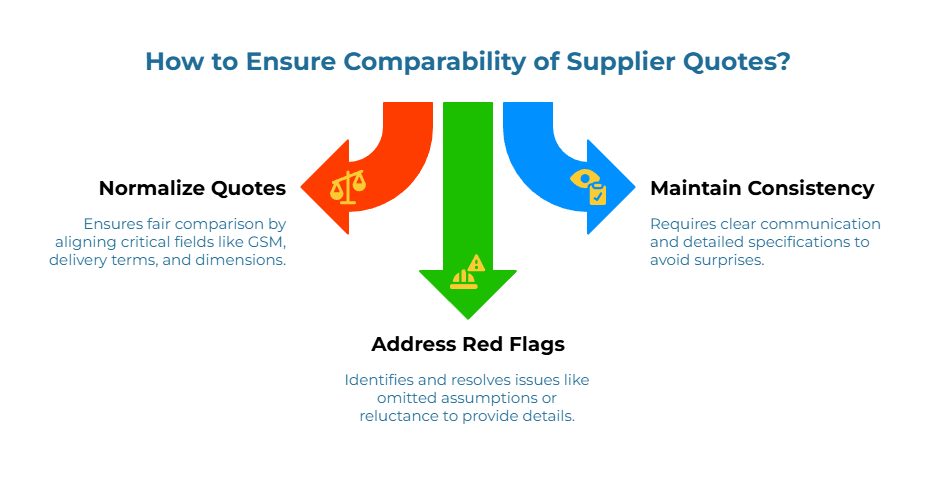
Supplier quotes can’t be compared unless quote-critical fields are consistent. A $0.12 quote for 80 GSM bags delivered DDP is not comparable to a $0.11 quote for 70 GSM bags quoted FOB. For detailed guidance on normalizing supplier quotes to a comparable landed-cost basis, see how to calculate landed cost for paper bags.
Fields to normalize before comparison:
- Bag dimensions and construction (gusset, handle type)
- Paper weight (GSM) and grade
- Print coverage and colors
- Delivery terms (Incoterms)
- Order quantity
- Bag type and construction (including handle type and reinforcement)
- Dimensions and tolerances
- Material/finish assumptions (including coatings/lamination if used)
- Print assumptions (colors, coverage, finishing steps)
- Packing assumptions (carton counts, palletization where relevant)
Trade-offs: Strict comparability enables cleaner decision-making and fewer surprises but requires more disciplined supplier communication and spec clarity.
Red flags: Quotes that omit key assumptions or suppliers reluctant to provide itemized quote fields.
A Simple Scoring Method to Rank Suppliers
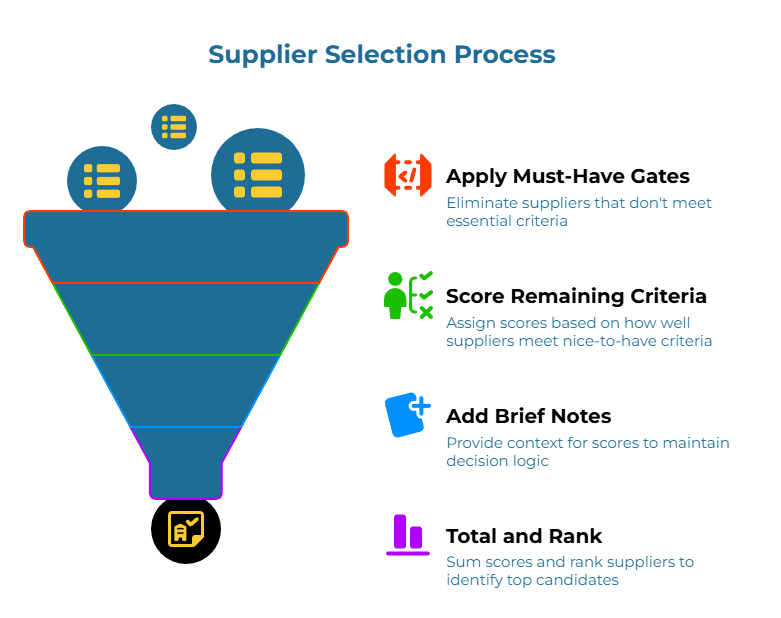
Complex weighted-scoring models require software and time most sourcing teams don’t have. A simpler approach works for shortlisting.
Step 1: Apply must-have gates. Any supplier failing a must-have criterion is eliminated. No exceptions, no scoring.
Step 2: Score remaining criteria 1-5. For each nice-to-have dimension, assign a score based on evidence received:
- 5 = Exceeds requirements with strong evidence
- 4 = Meets requirements with adequate evidence
- 3 = Likely meets requirements, evidence incomplete
- 2 = Partially meets requirements, concerns noted
- 1 = Weak fit or insufficient evidence
Step 3: Add brief notes. Scores without context lose meaning in two weeks. A one-line rationale (“Lead time verified by reference call; 94% on-time reported”) preserves decision logic.
Step 4: Total and rank. Sum scores, rank suppliers, and identify the top two to four for pilot evaluation.
This approach makes supplier differences visible and creates an explainable shortlist for stakeholders who weren’t involved in the evaluation.
Questions to Email Suppliers for Shortlist-Ready Answers
Supplier Inquiry Protocol::
- Confirm MOQ per size/design and whether mixed-SKU orders are possible.
- Provide standard and peak lead times; describe what typically causes delays.
- Describe quality checks used for paper bags (in-process and final); confirm willingness to document the agreed spec.
- Confirm print limitations (coverage, colors, finishing) and provide a comparable sample reference if available.
- Provide certification details and certificate IDs; confirm scope and validity.
- Provide an itemized quote with assumptions held constant across suppliers (dimensions, construction, print, packing, delivery terms).
Paper Bag Supplier Shortlist Scorecard Template
Table 1: Paper Bag Supplier Shortlist Scorecard Framework:
| Supplier | Supplier A | Supplier B | Supplier C |
| Bag Types / Capability Fit | |||
| MOQ (Notes) | |||
| Lead Time (Quoted + Reliability Notes) | |||
| Quality Consistency Signals | |||
| Print/Finishing Fit | |||
| Certifications (Scope Verified Y/N) | |||
| Quote Fields Normalized (Y/N) | |||
| Risk / Backup Notes | |||
| Must-Have Pass/Fail | |||
| Score (1-5) + Rationale |
Where PaperIndex Fits: Discovery Inputs, Not a Substitute for Qualification
Supplier discovery platforms provide starting points. They surface options, filter by product category, and enable initial outreach. PaperIndex, for example, offers access to paper bag suppliers and paper bag product listings across a global network.
But discovery inputs are not the decision itself. A marketplace listing confirms a supplier exists and states their claimed capabilities. It doesn’t verify lead-time reliability, quality consistency, or certification scope. That verification happens through the shortlisting criteria above, followed by samples, reference checks, and pilot orders.
Use discovery platforms to populate the initial long list. For international suppliers, apply systematic verification steps outlined in verifying international paper bag suppliers before moving to structured shortlist criteria. Use pilots to confirm the shortlist before committing volume.
For a broader framework on structuring paper bag sourcing, see from fragmented quotes to a sourcing program and from specs to sourcing.
If You’re a Supplier: How to Make It Onto More Shortlists
Buyers shortlist suppliers who reduce uncertainty. The principles above suggest what suppliers can do to stand out.
Prepare an evidence pack. Have specification sheets, tolerance ranges, certification documents (with scope clearly stated), and sample plans ready before inquiries arrive. Buyers notice when responses are complete versus when they require three follow-up emails.
Respond in comparable fields. If a buyer’s RFQ specifies dimensions, GSM, print coverage, and delivery terms, quote against those exact fields. Responses that require translation or assumption introduce friction.
Clarify limitations upfront. Stating “MOQ 20,000 per design; trial orders of 5,000 available at 15% premium” builds trust. Vague answers create suspicion.
Offer a repeatable spec confirmation process. Show what changes are tracked and how approvals work. Shortlists reward suppliers who make comparisons easy and risk visible.
For additional guidance on supplier verification from the buyer’s perspective, see how to vet wholesale paper bag suppliers and verifying international paper bag suppliers.
Next Steps: Turn Your Shortlist Into a Controlled Pilot
A shortlist is a hypothesis. Pilots test it.
Move from shortlist to samples, then from samples to a controlled pilot order that represents real production conditions—not just capability demonstration. Evaluate pilot performance against the same criteria used for shortlisting: Did lead times hold? Did quality match samples? Were certifications applied correctly?
Build this feedback into a performance review loop before committing to volume. Beyond individual supplier performance, consider supply chain fragility risks that emerge from single-source dependencies, weak lead-time buffers, and MOQ constraints—factors that can create packaging crises even when individual suppliers perform well.
Ready to start building your shortlist? Browse paper bag suppliers on PaperIndex or submit an RFQ to receive quotes from suppliers directly. For more sourcing frameworks and supplier evaluation guidance,explore the PaperIndex Academy.
Disclaimer:
This article is provided for general educational purposes only and does not constitute legal, regulatory, financial, or professional procurement advice.
Our Editorial Process:
Our expert team uses AI tools to help organize and structure our initial drafts. Every piece is then extensively rewritten, fact-checked, and enriched with first-hand insights and experiences by expert humans on our Insights Team to ensure accuracy and clarity.
About the PaperIndex Insights Team:
The PaperIndex Insights Team is our dedicated engine for synthesizing complex topics into clear, helpful guides. While our content is thoroughly reviewed for clarity and accuracy, it is for informational purposes and should not replace professional advice.