

📌 Key Takeaways
Decision fatigue erodes procurement quality through volume and uncertainty, not weak willpower—the fix is designing systems that match decision rigor to actual risk.
- Systems Problem, Not Character Flaw: Decision fatigue stems from high-volume judgment calls under uncertainty, not burnout or lack of motivation.
- The Uncertainty Tax Compounds Fast: Fragmented tools, inconsistent evidence, and unclear thresholds force procurement teams to spend cognitive resources evaluating context instead of making decisions.
- Shortcuts Emerge Predictably Under Load: Late-day approvals skip verification steps, defaults replace analysis, and exception handling replaces standards when decision reserves deplete.
- Decision Hygiene Matches Rigor to Risk: Defaults eliminate low-value choices, standardized evidence packs reduce uncertainty per decision, and clear gates protect high-stakes calls without slowing routine work.
- Self-Diagnosis Drives Targeted Action: Scoring decision volume, uncertainty, and friction reveals whether teams need defaults, evidence standardization, or decision-rights clarification within 30 days.
Better decisions come from better-designed decision environments, not more effort.
Procurement managers in high-compliance categories will gain a diagnostic framework and 30-day action plan, preparing them for the self-check tool and intervention roadmap that follows.
4:47 PM. Fourteen unread supplier messages. Three spec-change requests awaiting sign-off. A compliance document from a new vendor looks incomplete—but there is no time to investigate why.
Click. Approved.
That moment, where careful evaluation collapses into a quick click, is not a weakness. It is not laziness. And despite how it feels, it is not simply burnout.
Decision fatigue is not a motivational problem—it is a systems problem. In modern procurement, the day rarely ends after one “big” decision; it consists of hundreds of micro-judgments: verifying material substitutions, validating incomplete compliance artifacts, or determining the risk profile of a lead-time exception. Over time, that volume quietly changes how decisions get made. Instead of careful evaluation, the default becomes a shortcut: defer, rubber-stamp, or choose the familiar option. It is decision hygiene—defaults, clear thresholds, standardized evidence, and protected time for high-stakes calls—so the team’s best thinking is reserved for the decisions that truly matter.
The Procurement Myth: “It’s Just Burnout”
This is just what the job feels like now.
That thought surfaces most often around mid-afternoon, somewhere between the third spec-change request and the supplier issue that cannot wait until tomorrow. Quality needs a response on a packaging change. Finance flagged an invoice discrepancy. By the time the actual sourcing work arrives—evaluating a new vendor’s qualification documents—mental reserves are already depleted.
Most procurement professionals label this state as burnout. And burnout is real. But treating every form of cognitive exhaustion as burnout obscures a more specific, more fixable problem.
The real enemy is not effort. It is the sheer volume of decisions made under uncertainty, each one drawing from the same cognitive reservoir. In high-sensitivity categories — corrugated boxes and folding cartons that sit inside compliance-heavy operating models with traceable documentation, controlled changes, and internal audits—those small decisions carry disproportionate weight. A rubber-stamped approval at 5 PM can become a compliance scramble three months later.
Burnout is how it feels. Decision fatigue is how it fails—quietly, through shortcuts and inconsistent standards.
What Decision Fatigue Actually Is (And What It Is Not)
Decision fatigue describes the deterioration in decision quality that occurs after making many consecutive choices. It is not about being “bad at decisions.” It is not general tiredness. It is a predictable pattern: as decision load increases, the brain conserves resources by defaulting to simpler, faster responses.
Early research into ‘ego depletion’ suggested that willpower is a finite resource; while the degree of depletion is debated, the operational impact on professional judgment remains a critical bottleneck. More recent organizational studies confirm that decision fatigue affects workplace performance across industries. Psychological research, notably that building on Baumeister’s ego-depletion, suggests that decision fatigue is a phenomenon shaped by cognitive load limits rather than character traits. While the specific biological mechanisms of early ‘ego-depletion’ models are currently a subject of academic debate, recent organizational studies confirm that the operational impact of decision overload on professional judgment is a critical bottleneck. Procurement is uniquely exposed; the role is essentially a continuous sequence of high-variance judgment calls.
Three behaviors typically emerge as decision reserves deplete:
Decision avoidance. Deferring choices, requesting more data that is not really needed, or pushing decisions to someone else. The phrase “let’s table this for next week” becomes a reflex rather than a strategy.
Impulsivity. Saying yes (or no) too quickly without adequate evaluation. This is the late-day approval that skips verification steps—not because standards changed, but because the cognitive cost of digging deeper feels too high.
Over-reliance on defaults. Choosing the familiar supplier, the standard clause, or the “we’ve always done it this way” option regardless of whether it fits the current situation.
Why Modern Procurement Is a Decision Factory
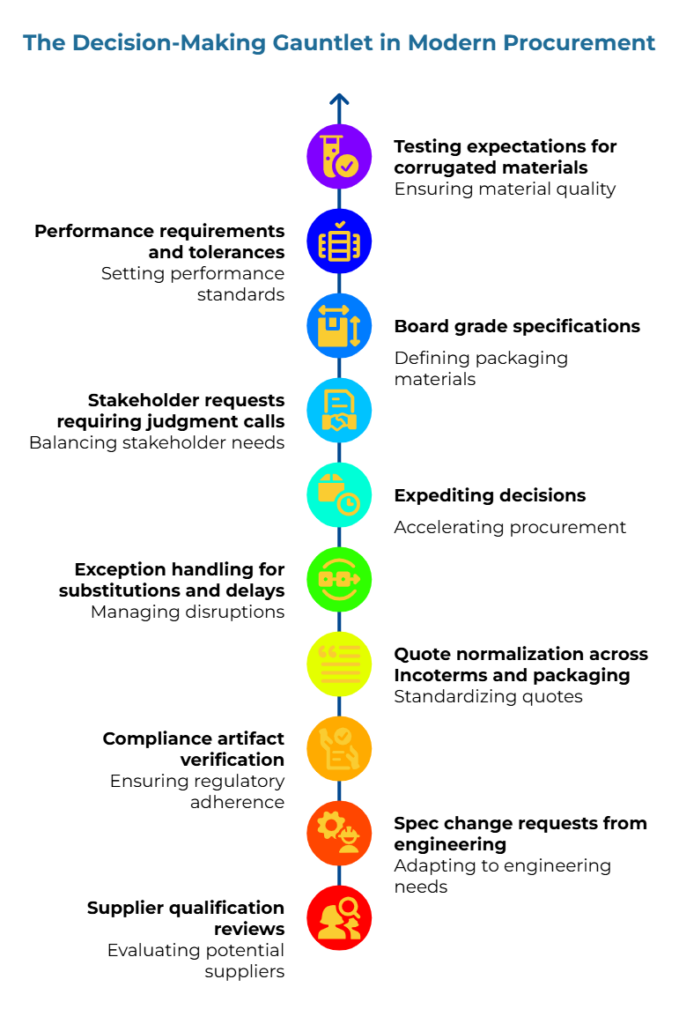
Consider a typical sourcing manager’s decision streams in a single week: supplier qualification reviews, spec change requests from engineering, compliance artifact verification, quote normalization across different Incoterms and packaging configurations, exception handling for substitutions and delays, expediting decisions, and stakeholder requests requiring judgment calls on scope or timing.
In packaging procurement specifically, that decision conveyor belt includes board grade specifications, performance requirements and tolerances, testing expectations for corrugated materials, carton artwork timeline approvals, change control for any shift in material or process, and multi-stakeholder sign-offs across packaging engineering, QA, regulatory, and operations.
Each stream involves context switching—moving between suppliers, data formats, internal stakeholders, and risk profiles. Fragmented tools amplify the load. One system holds supplier data. Another stores documents. A third manages approvals. Email handles everything else.
Then there is the noise. Contradictory information across sources. Unclear ownership of decisions. Fuzzy thresholds for when to escalate. A useful mental model is “uncertainty tax”—inconsistent data sets demand higher cognitive processing power, depleting mental reserves faster than standardized inputs. When RFQ processes lack transparency, quote evaluation becomes cognitively expensive. When there is no documented default for acceptable lead-time variance, every exception requires a fresh judgment.
High decision volume drives shortcuts and inconsistency. Unclear decision rights create stakeholder ping-pong and delays. The result is a high-volume processing environment lacking structural guardrails.
How Decision Fatigue Quietly Degrades Sourcing Outcomes
The damage is rarely dramatic. It is incremental—visible only in patterns that emerge over time.
“Fast yeses” and “slow noes.” Approvals that should require scrutiny get rubber-stamped because the cognitive cost of digging deeper feels prohibitive. Rejections that should be quick get deferred because saying no requires justification, and justification requires energy.
Risk-blind shortcuts. Verification steps get skipped. An evidence pack with a missing certificate gets accepted because the supplier ‘seems reliable’—exactly the scenario that systematic supplier verification protocols are designed to prevent. A critical spec document gets skimmed instead of read. In regulated packaging contexts, ‘we’ll get it later’ can turn into rework, delays, or holds and quarantines triggered by missing or mismatched paperwork—the kind of preventable failures addressed in strategic corrugated box sourcing frameworks. A procurement manager who would never skip supplier verification questions at 9 AM might do exactly that at 4:45 PM.
Relationship friction. When cognitive load is high, communication becomes reactive. Follow-ups slip. QA receives a terse response instead of a thoughtful one. Suppliers receive inconsistent feedback depending on what time of day—or what day of week—they happen to make contact.
These are not character flaws. They are conservation behaviors from depleted decision-makers.
Telltale Signs Inside a Procurement Team
Decision fatigue is not just an individual experience. It shows up in team patterns and operational metrics.
Operational symptoms include increased rework, approvals that need to be revisited, documents requested multiple times, and more exception handling as a percentage of total activity. The phrase “can you re-send that?” becomes a warning sign—documents were not properly reviewed the first time.
Behavioral symptoms manifest as decision avoidance, stakeholder ping-pong where decisions bounce between procurement, QA, and engineering without resolution, and inconsistent standards depending on time of day or who happens to be available.
Governance symptoms appear as unclear decision rights, no documented default rules for common scenarios, and approvals functioning as theater—a checkbox rather than a gate.
When multiple team members exhibit the same patterns, the issue is environmental, not personal.
A Practical Framework: Decision Hygiene for Procurement
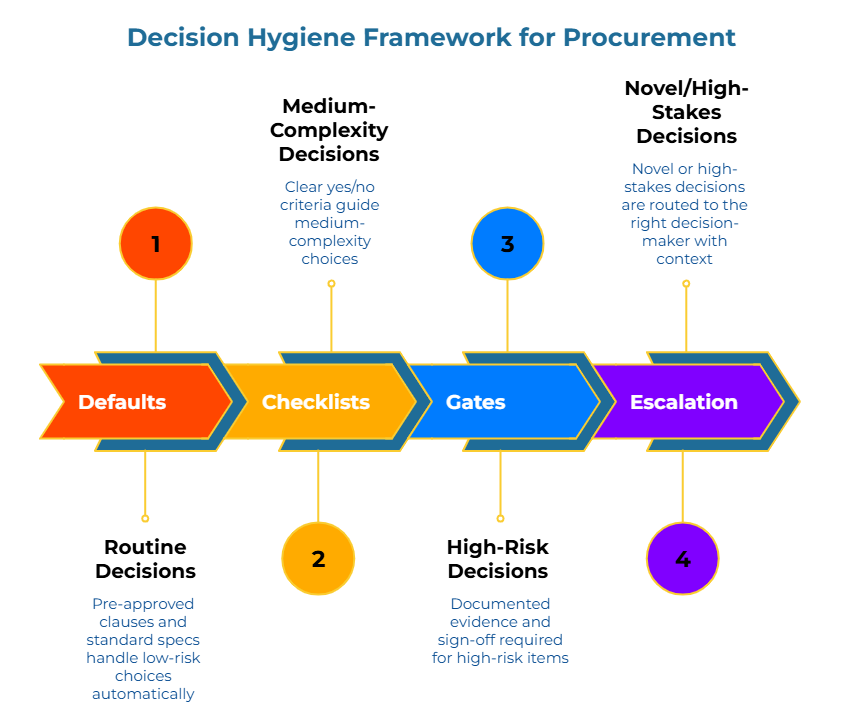
Decision hygiene treats cognitive output as a finite resource to be managed through architectural design rather than individual endurance. The framework operates on three levers.
Reduce the number of decisions. Not every choice needs to be made fresh. Defaults, pre-approvals, and batch processing eliminate low-value decisions entirely. Defaults and checklists cut extraneous cognitive load.
Reduce the uncertainty per decision. Standardized evidence packs reduce uncertainty per decision. Clear criteria for when to audit versus when to trust convert ambiguous judgment calls into verification tasks. Documented thresholds remove the “should I escalate this?” question from the cognitive queue.
Reduce the cost of being wrong. Gates and escalation paths ensure that high-stakes decisions get adequate attention while low-stakes decisions do not consume disproportionate resources.
The core tool is a Decision Ladder that matches rigor to risk:
- Defaults handle routine, low-risk choices automatically—pre-approved clause language, standard spec ranges, Incoterms normalization rules.
- Checklists guide medium-complexity decisions with clear yes/no criteria.
- Gates require documented evidence and sign-off before proceeding on high-risk items.
- Escalation routes genuinely novel or high-stakes decisions to the right decision-maker with adequate context.
Cutting Decision Load Without Cutting Diligence
Reducing decision fatigue does not mean reducing rigor. It means allocating rigor more precisely.
Create defaults. Pre-approved clauses for standard contracts. Acceptable ranges for key specifications. Normalization rules so quotes arrive in comparable formats. Evidence minimums so supplier qualification reviews start from a consistent baseline. These defaults handle routine decisions without consuming cognitive resources.
Standardize evidence packs. A one-page “supplier snapshot” that captures the essentials: capability confirmation, certification status, recent performance data, and renewal cadence. When every supplier folder follows the same structure, evaluation becomes pattern recognition rather than detective work.
Clarify decision rights. Document who owns which decision. A spec deviation under 5% goes to engineering; over 5% requires procurement and QA sign-off. Removing ambiguity removes the cognitive overhead of figuring out “who should handle this?”
Batch decisions and protect focus time. Group similar decisions into dedicated blocks. Protect “high-stakes decision windows” from interruptions. Supplier evaluations happen Tuesday mornings, not scattered across the week in fifteen-minute fragments between meetings.
The Decision Fatigue Self-Check for Procurement
The following diagnostic helps identify where decision fatigue is most acute and which interventions will help fastest.
Scoring: 0 = Rarely | 1 = Sometimes | 2 = Often
Section A: Decision Volume
- More than 20 discrete approval/reject/escalate decisions occur in a typical day.
- Frequent switching between unrelated supplier issues, stakeholder requests, and system tasks within the same hour.
- Low-stakes decisions consume significant time because there is no default or template.
- Most days end with a backlog of decisions that carry over from the morning.
Section B: Decision Uncertainty
- Information needed to make a confident call on supplier qualification or spec changes is often lacking.
- Evidence packs from suppliers arrive in inconsistent formats, requiring extra effort to evaluate.
- Thresholds for escalation are unclear—uncertainty about which exceptions require leadership input.
- Documents or requests sometimes get approved without full review because the stakes “seem” low.
Section C: Decision Friction
- Decision rights are ambiguous—frequent uncertainty about whether a call belongs to procurement, QA, or engineering.
- Three or more separate systems are required to gather the information needed for a single sourcing decision.
- Stakeholders often disagree on criteria, forcing mediation rather than decision-making.
- Decisions frequently get revisited or reversed because initial approvals lacked proper documentation.
Interpreting Your Score
0–8 (Low Risk): The decision environment is relatively well-designed. Focus on maintaining current practices and addressing specific friction points.
9–16 (Moderate Risk): Decision fatigue is likely affecting consistency and quality. Prioritize the highest-scoring section for immediate intervention.
17–24 (High Risk): The decision environment needs structural redesign. Implement defaults, standardize evidence packs, and clarify decision rights within 30 days.
30-Day Action Plan
For Low Risk (0–8): Document current defaults and share them with the team to prevent drift. Identify one recurring decision type that still lacks a template and create one. Schedule a quarterly review to catch emerging friction points early.
For Moderate Risk (9–16): Standardize evidence pack requirements for the top 10 supplier categories. Create a one-page decision-rights map clarifying ownership for common scenarios. Block two hours weekly as protected decision time for high-stakes evaluations.
For High Risk (17–24): Codify automated approval logic for the five highest-frequency, low-variance decision types immediately. Standardize a supplier snapshot template and require it for all new qualifications. Escalate governance gaps to leadership with a concrete proposal for change control and approval thresholds.
What to Do Next
Decision fatigue is real, but it is not inevitable. The teams that avoid its worst effects do not have superhuman willpower—they have better-designed decision environments.
Modern procurement teams make worse choices when decision load outpaces decision structure. Effective intervention shifts the burden from individual grit to architectural design. It is designing systems where defaults handle the routine, checklists guide the moderate, gates protect the critical, and escalation routes the exceptional.
Want more procurement frameworks like this? PaperIndex is a comprehensive B2B marketplace for the paper and packaging industry; explore the PaperIndex Academy for practical checklists and sourcing playbooks designed to reduce cognitive load while maintaining audit readiness. You can also find suppliers or explore additional resources:
- Sourcing Safety Checklist: When to Audit vs. When to Trust
- Seven Questions to Ask a New Supplier (That Scammers Can’t Answer)
Better decisions come from better systems, not more hustle.
Disclaimer:
This article is for informational purposes and reflects general principles in procurement decision-making. It should not replace professional advice tailored to specific regulatory, legal, or operational contexts.
Our Editorial Process:
Our expert team uses AI tools to help organize and structure our initial drafts. Every piece is then extensively rewritten, fact-checked, and enriched with first-hand insights and experiences by expert humans on our Insights Team to ensure accuracy and clarity.
About the PaperIndex Insights Team:
The PaperIndex Insights Team is our dedicated engine for synthesizing complex topics into clear, helpful guides. While our content is thoroughly reviewed for clarity and accuracy, it is for informational purposes and should not replace professional advice.