
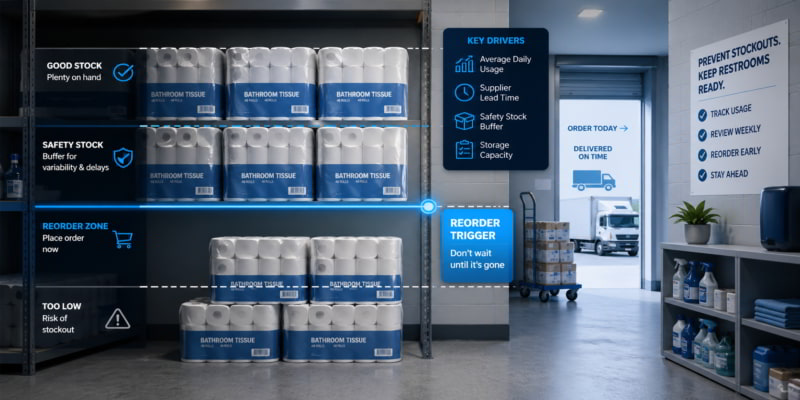
📌 Key Takeaways
A simple reorder point — based on actual usage and supplier delivery time — prevents both empty dispensers and overstuffed closets.
- Track Real Usage, Not Invoices: Invoices show what you bought, not what restrooms actually used, so count rolls by location for two to four weeks instead.
- Set the Reorder Trigger Early: Add your weekly usage during the delivery wait time to a safety buffer — that total is when you order, not when you run out.
- Cap Your Stock With Min/Max Levels: A minimum triggers the next order; a maximum keeps deliveries from overwhelming your storage space.
- Match the Cycle to Your Storage: Weekly ordering suits tight closets and busy buildings, while monthly works only when shelf space and stable demand allow it.
- Plan for Slow Deliveries, Not Fast Ones: Build your reorder math around the longest recent delivery time, not the best-case scenario your distributor quotes.
Clear reorder rules and consistent counting are the only two things standing between reactive scrambling and predictable restroom supply.
AFH procurement buyers and facility managers responsible for restroom supply planning will gain a ready-to-use replenishment framework here, preparing them for the detailed step-by-step workflow that follows.
~ ~ ~ ~ ~ ~ ~ ~ ~ ~ ~ ~ ~ ~ ~ ~ ~ ~
Toilet tissue replenishment may seem like a routine janitorial task.
In the AFH (Away-from-Home) sector, replenishment performance dictates restroom availability and guest satisfaction while directly impacting procurement overhead. The custodian opens the supply closet and finds the last case already opened. Housekeeping sends another rush request to procurement. The distributor cannot deliver until Thursday, and guest check-ins start at three.
For facility managers in high-traffic commercial environments, these supply chain ruptures represent a preventable operational failure. An empty dispenser creates an immediate, visible failure — one that guests, patients, students, and employees notice before anyone on your team does. Yet the opposite problem is just as real: rolls stacked floor-to-ceiling in a closet with no room to move, cash tied up in surplus, crushed stock from improper stacking.
How is this closet empty again? Didn’t the order just arrive last week?
Effective replenishment relies on systemic synchronization rather than custodial effort. Most AFH buyers know when they need to order more. What they lack is a repeatable system — one that connects actual usage data with supplier lead times to answer three questions: when to reorder, how much to keep on hand, and how frequently to replenish. That system also depends on clearly defined commercial toilet tissue rolls specifications and sourcing terms. It requires a usage baseline, a clear reorder trigger, a backup stock buffer, and a replenishment cycle that fits the way your facility operates.
With a defined toilet tissue reorder point and a predictable restocking routine, you stop reacting to shortages and start managing restroom consumables inventory with the same discipline you apply to every other operational process.
Why Toilet Tissue Replenishment Planning Matters in AFH Facilities
Why Stockouts and Overstocking Both Create Problems
AFH toilet tissue demand behaves differently from household demand. It depends on restroom traffic patterns, building occupancy, visitor volume, operating hours, and facility type — variables that shift by season, by day of the week, and sometimes by hour.
When commercial toilet tissue replenishment planning is absent, two problems surface repeatedly.
Stockouts create immediate service failures. An empty dispenser in a hotel lobby or hospital patient floor generates complaints, damages hygiene perception, and pulls custodial staff away from routines to scramble for spare rolls. Emergency replenishment typically costs more than planned orders and disrupts the ordering cadence for every other janitorial supply on the schedule.
Overstocking is the overcorrection. A buyer burned by a shortage orders extra as insurance. Cases pack into a closet with no room for other supplies, rolls get crushed, and capital sits idle. For space-constrained facilities, overstocking creates an ‘inventory trap’ where safety stock exceeds physical shelving limits.
The underlying issue is the same in both cases. Buyers need a system that connects usage patterns with supplier lead times so that orders happen at the right time, in the right quantity. Staff time spent checking shelves without a framework for knowing whether what they see means “order now” or “fine for another week” is time wasted — and it still leads to inconsistent restroom service levels.
Start with Average Toilet Tissue Usage
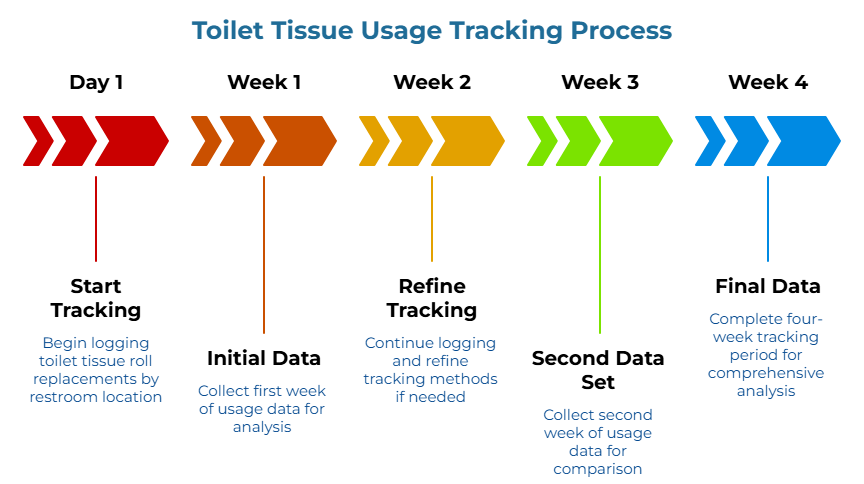
Estimate Weekly Roll Usage Before Setting Stock Levels
Every reorder decision starts with one number: how many toilet tissue rolls your facility actually uses in a given period.
Track how many rolls are used per day or per week. Usage can be measured by facility, restroom, dispenser type, shift, department, or location. A small office with 12 employees can estimate weekly usage with a simple count. A 180-room hotel or a school with 600 students needs to track by restroom bank or floor, because lobby restrooms burn through rolls at rates that have nothing in common with the second-floor staff bathroom.
Start with a two-to-four-week tracking period. Have custodial staff log daily roll replacements by restroom location. For small facilities, simple janitorial logs — a tally sheet on a clipboard — may be enough. Note the roll type and dispenser format. A jumbo roll that lasts 36 hours in a low-traffic restroom may last seven hours in a public-facing lobby. Compact, coreless, and standard rolls all have different replacement rates, and mixing them in a facility-wide average produces a number that helps no one.
A practical usage log can track:
| What to Track | Why It Helps |
| Rolls used per day or week | Establishes the usage baseline |
| Restroom location | Separates high-traffic from low-traffic areas |
| Dispenser type and roll size | Improves refill and case-planning accuracy |
| Shift or operating period | Helps 24-hour or extended-hour sites spot demand patterns |
| Visitor, occupancy, or event notes | Explains unusual spikes |
| Stock remaining after each check | Shows whether the reorder trigger is too late |
Separate high-traffic restrooms from low-traffic restrooms. This is the most important distinction in usage tracking. Public-facing restrooms, guest restrooms, patient areas, and student restrooms consume tissue at rates that diverge sharply from employee-only restrooms in a back office. Averaging them together means your reorder point will be too high for one group and too low for the other.
Use recent data. Last quarter’s invoice total tells you what you ordered, not what you consumed — and if occupancy shifted or you switched dispenser types since then, those numbers no longer reflect this week’s reality. This is a general inventory-planning principle: reorder calculations are only as useful as the usage data behind them. Government inventory-control standards—specifically GAO-02-447G—utilize prior-period usage as the primary baseline for consumption modeling.
How to Calculate a Toilet Tissue Reorder Point
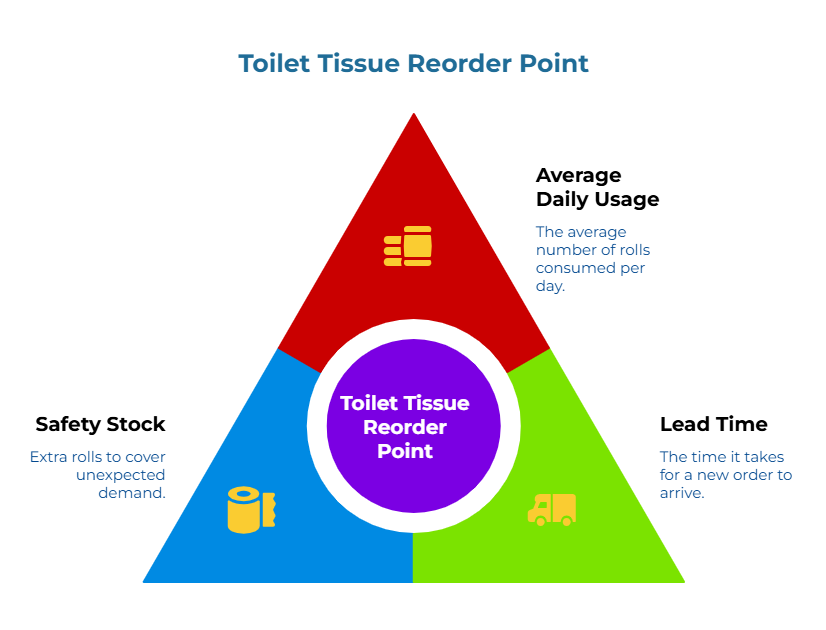
Use Lead Time and Usage Rate to Set the Reorder Trigger
A toilet tissue reorder point is the stock level at which you place your next order. Not the level at which you run out — the level at which you trigger a purchase so new stock arrives before you run out.
The formula is straightforward:
Reorder Point (ROP) = (Average Daily Usage × Lead Time in Days) + Safety Stock
Expected usage during lead time is the number of rolls your facility will consume between placing the order and shelving the delivery. If your facility uses 20 rolls per week and your supplier takes one week to deliver, lead-time usage is 20 rolls. Safety stock covers uncertainty — a conference week that doubles lobby traffic, a delayed shipment, a supplier backorder on your preferred SKU.
This formula reflects a standard order-point logic: an order is triggered when inventory drops to a defined level, and that level must cover expected demand during the replenishment lead time. (ETH Zurich)
To illustrate: if a small facility uses 20 rolls per week, the supplier lead time is one week, and the safety stock buffer is 12 rolls, the reorder point is 32 rolls. Inventory depletion to the reorder point triggers the procurement cycle, ensuring a buffer remains for lead-time variability.
The mistake that creates emergency orders is setting the reorder point too close to zero. The trigger should feel early. That is the purpose — it gives you a margin of time, not just a margin of product.
Longer lead times require higher reorder points. Facilities with variable traffic should build in a larger safety stock buffer. And reorder points should be reviewed periodically — at least quarterly — because usage patterns shift with occupancy, seasonal traffic, staffing changes, and restroom renovations.
Setting Minimum and Maximum Stock Levels
Use Min/Max Levels to Control Inventory Without Guesswork
Min/max inventory planning gives your toilet tissue stock two guardrails. The minimum is the floor — the lowest quantity your storage should reach before a replenishment order is already in transit. The maximum is the ceiling — the highest quantity after a delivery arrives.
The minimum level ties directly to the reorder point. Set the minimum at or slightly above the reorder point so that hitting it automatically triggers the next purchase. When janitorial teams count stock during routine checks and see the quantity has dropped to the minimum, the action is clear: order now.
The maximum protects against overstocking. While formally calculated as the safety stock plus the economic order quantity (EOQ), in practical AFH applications, it is typically constrained by available storage space, order frequency, and procurement budget (Silver, Pyke, & Thomas, Inventory and Production Management in Supply Chains, 4th ed.) For a small facility with a single janitorial closet, the maximum may be constrained by shelving space — which means more frequent replenishment rather than larger bulk orders. Storage capacity is part of the cost.
Min levels should reflect usage, supplier lead time, and safety stock. Max levels should reflect storage capacity, order frequency, and budget. The practical value of this approach is that it turns an inventory decision into a binary check. Is stock at or below the minimum? Order. If the projected delivery volume exceeds the calculated maximum, adjust the order quantity or defer the delivery date. No procurement background or inventory software required.
How Much Safety Stock Should AFH Operators Keep?
Build a Backup Stock Buffer for Demand Spikes and Delays
Safety stock is a buffer, not excess inventory. It exists to cover uncertainty: traffic spikes, delayed deliveries, seasonal demand, emergency usage, or unexpected facility events — a plumbing incident that doubles traffic to one restroom, a school assembly that concentrates hundreds of students in one wing, or a flu season that spikes use across a hospital ward.
The right level depends on operational tolerance for stockouts — how much disruption your facility can absorb before the shortage becomes a visible service failure. A hotel where empty dispensers damage guest satisfaction scores needs a larger buffer than a private office. A healthcare site where supply failures carry hygiene risk needs more than a warehouse with one employee restroom.
Supply-chain practice generally treats safety stock as extra inventory held to protect against demand and lead-time variability, with the ideal level tied to service expectations and stockout tolerance.
Facilities with stable usage and a reliable supplier can keep several days of additional supply. Facilities with variable traffic or inconsistent lead times should ideally calculate this buffer using standard deviation of historical demand, though a practical baseline often starts at covering expected usage during the longest recorded delivery delay (Association for Supply Chain Management, APICS Dictionary, 16th ed.). Seasonal businesses should increase the buffer before peak periods and scale back after.
Safety stock should not become uncontrolled overstock. If the buffer plus a regular order exceeds the maximum stock level, the system is telling you to order more frequently in smaller quantities.
Weekly vs. Monthly Replenishment Cycles
Match the Replenishment Cycle to Usage, Storage, and Supplier Terms
There is no universal best replenishment cycle. The right frequency depends on usage volume, storage capacity, supplier order minimums, delivery schedules, and labor routines.
- Weekly replenishment works well when storage is limited, usage is high or variable, or staff already perform weekly janitorial supply checks. Result: Increased administrative overhead per purchase.
- Monthly replenishment works well when usage is stable, storage is adequate, and supplier pricing favors larger orders. Result: Heightened exposure to stockout risk and increased safety stock carrying costs.
- Biweekly replenishment suits moderate usage, limited but manageable storage, and a desire to balance order efficiency against restroom supply reorder planning.
| Cycle | Best Fit | Main Watchout |
| Weekly | Limited storage, variable usage, tighter inventory control | More frequent purchasing work |
| Biweekly | Moderate usage, partial storage limits, balanced control | Requires reliable midpoint checks |
| Monthly | Stable usage, adequate storage, fewer purchase orders | Higher storage burden if demand shifts |
Match the cycle to existing operations. If custodial staff walk restrooms every Monday, tie the reorder to that routine. If a distributor requires a minimum order that exceeds one week’s consumption, that minimum may push you toward biweekly or monthly cycles.
Storage capacity overrides everything else. A facility that can only hold one week of supply should not be on a monthly cycle, no matter how stable the usage.
How Supplier Lead Times Affect Reorder Planning
Plan Reorders Around Realistic Supplier Delivery Windows
Supplier lead time is the span between placing an order and having usable stock on the shelf — including order processing, warehouse picking, freight transit, facility receiving, and shelving. Lead times can vary due to distributor schedules, order cutoffs, freight delays, backorders, or product availability.
Procurement teams should plan around realistic lead times, not best-case timelines. If a distributor normally delivers within three business days but occasionally takes a full week, build the reorder point around the longer practical window or add enough safety stock to cover the gap.
Know order cutoff times. Submitting at 3:30 PM when the cutoff is 2:00 PM adds a full business day. Know delivery days — some distributors serve your area only on specific days, which means a late-week order may not arrive until mid-next-week.
| Supplier Detail | Why It Belongs in the Plan |
| Normal delivery lead time | Sets the baseline reorder calculation |
| Longest recent lead time | Helps size the safety buffer |
| Order cutoff time | Prevents missed delivery windows |
| Delivery days | Aligns ordering with receiving routines |
| Minimum order quantity | Affects cycle choice and storage needs |
| Approved SKUs | Prevents wrong-product ordering |
| Approved substitutes | Reduces delay during backorders |
Inconsistent lead times signal the need for more safety stock. Supplier reliability should directly influence reorder point settings — not just buffer levels. Where possible, have a substitute product approved in advance. If your primary SKU is backordered and the approved alternative is already documented, the buyer can switch without delay.Specification fit, dispenser compatibility, roll size, case count, ply, and quality expectations should already be defined — not researched under pressure. PaperIndex’s guide on the cost of incomplete bulk toilet tissue specifications illustrates how requirement gaps slow procurement and weaken internal approval. Without pre-approved substitutions from verified suppliers, a backorder becomes a research project — and research projects become stockouts.
For related sourcing discipline, PaperIndex’s guide to AFH toilet tissue specification basics can help buyers define the product requirements that should sit behind any replenishment plan.
Preventing Emergency Toilet Tissue Orders
Create a Reorder Routine Before Stock Runs Low
Emergency orders rarely happen because a facility suddenly started using more toilet tissue. They happen because the system for detecting low stock failed. The pattern is predictable: inconsistent inventory checks, informal reorder points, and high-traffic restrooms checked on the same schedule as low-traffic ones.
Prevention is mechanical. Set a recurring check — weekly for most small facilities, twice weekly for high-traffic locations. Assign a specific person responsibility for monitoring toilet tissue levels. Track stock by case, roll count, or dispenser refill unit, not by visual estimate. Set reorder triggers in your purchasing system or spreadsheet, and document them where the responsible person can access them without thinking.
Review high-traffic restrooms more frequently. The lobby and break room restroom will reach the reorder point days before the private washroom on the fourth floor. Keep approved AFH toilet tissue supplier contacts, product SKUs, and preferred order quantities in one accessible location. Avoid waiting until the final case is opened before reordering — by that point, any delivery delay means empty dispensers.
Building a Simple AFH Toilet Tissue Replenishment System
A Practical Replenishment Workflow for Small Facilities
Everything in the preceding sections feeds into one repeatable workflow. Small facilities can implement this without complex software.
Step 1:
Track average weekly toilet tissue usage. Count rolls consumed over two to four weeks by restroom location. Record the numbers in a janitorial log or spreadsheet.
Step 2:
Identify high-traffic and high-risk restrooms. Flag locations with the highest consumption and where stockouts carry the greatest operational impact.
Step 3:
Confirm supplier lead time and delivery schedule. Ask for the realistic delivery window. Note order cutoff times, delivery days, and minimum order quantities.
Step 4:
Set a reorder point. Multiply weekly usage by lead-time weeks. Add safety stock. That total is the trigger.
Step 5:
Define minimum and maximum stock levels. Set the minimum at or above the reorder point. Set the maximum based on storage capacity.
Step 6:
Select a replenishment cycle. Weekly, biweekly, or monthly — matched to usage, storage, supplier terms, and existing routines.
Step 7:
Assign inventory-check responsibility. Name one person. Provide a schedule, checklist, and supplier contact information.
Step 8:
Conduct quarterly audits. Occupancy shifts, seasonal traffic, restroom renovations, and supplier changes all warrant recalculation.
A clipboard, a spreadsheet, and a laminated card on the supply closet door can run this for a facility with fewer than 20 restrooms. Simple rules beat memory.
Common Mistakes in Toilet Tissue Reorder Planning
Avoid These Replenishment Planning Errors
Even with a system in place, specific mistakes erode its reliability over time. Each one traces back to a principle covered earlier in this guide.
- Ordering based only on last month’s invoice quantity. Invoices show what you ordered, not what you consumed. A double shipment inflates the baseline; a low-occupancy month understates it.
- Ignoring supplier lead times. A reorder point without a delivery-time component is a guess, not a trigger.
- Treating all restrooms as having the same usage rate. Facility-wide averages mask the locations where shortages actually happen.
- Keeping too little backup stock before peak periods. Increase safety stock before the demand spike, not after the first stockout.
- Overstocking beyond storage capacity. Crushed cases, blocked access, and fire-code violations in tight utility spaces all follow.
- Failing to update stock levels after occupancy changes. A reorder point set for 60% occupancy does not protect a facility running at 90%.
- Not documenting approved SKUs and substitutions. When the primary product is backordered, an undocumented substitution process adds days to the cycle. AFH toilet tissue specification normalization keeps substitutes clearly defined.
- Waiting for custodial staff to report shortages instead of using scheduled checks. By the time someone reports it, the dispenser has been empty long enough for a complaint.
From Reactive Orders to a Predictable Restroom Supply Routine
That custodian standing in front of a nearly empty closet — that scenario does not have to repeat.
Track your usage. Set a reorder point around your supplier’s actual delivery window. Define the stock boundaries your storage supports. Build a safety buffer scaled to your facility’s risk. Pick a cycle that matches your team’s rhythm. Assign someone to count, compare, and act — every single week.
The AFH buyers running the tightest janitorial supply replenishment operations are not the ones with the biggest budgets. They are the ones who decided that toilet tissue replenishment deserves the same predictability as every other operational task. Consistent tracking and clear reorder rules are the only two non-negotiables.
Restroom readiness is operational competence made visible — and a predictable purchasing routine supports both custodial teams and procurement goals. When you are ready to evaluate commercial toilet tissue suppliers, a structured supplier verification process helps ensure product fit and delivery reliability across your restroom environments.
Frequently Asked Questions
How do you calculate a reorder point for commercial toilet tissue rolls?
Add expected usage during supplier lead time to your facility’s safety stock. The reorder point should cover lead-time consumption plus a buffer for traffic spikes or delivery delays.
How much backup toilet tissue stock should an AFH facility keep?
It depends on restroom traffic, supplier reliability, storage space, and the consequences of running out. High-traffic, public-facing, and healthcare facilities typically need a larger buffer than small offices with predictable usage.
Is weekly or monthly toilet tissue replenishment better for small facilities?
Weekly works better for limited storage or variable usage. Monthly suits stable demand with adequate storage. Many small facilities use biweekly as a middle ground.
What causes last-minute toilet tissue orders in commercial facilities?
Unclear reorder points, underestimated lead times, inconsistent inventory checks, and high-traffic restrooms that consume stock faster than expected.
What is min/max inventory planning for toilet tissue?
It sets a minimum stock level that triggers replenishment and a maximum that prevents over-ordering, helping buyers maintain supply without crowding storage.
How do supplier lead times affect toilet tissue reorder planning?
Lead time determines how early to reorder. Longer or inconsistent delivery windows require higher reorder points and more safety stock.
How often should AFH buyers review toilet tissue stock levels?
Weekly for most small facilities. Review reorder assumptions after occupancy changes, seasonal shifts, supplier changes, or restroom renovations.
What information should be included in a toilet tissue replenishment plan?
Average usage by location, reorder points, min/max stock levels, safety stock targets, supplier lead times, approved SKUs, order frequency, storage capacity, and the person responsible for checks.
Disclaimer:
The information in this article is educational and intended to support AFH procurement planning.
Our Editorial Process:
Our expert team uses AI tools to help organize and structure our initial drafts. Every piece is then extensively rewritten, fact-checked, and enriched with first-hand insights and experiences by expert humans on our Insights Team to ensure accuracy and clarity.
About the PaperIndex Insights Team:
The PaperIndex Insights Team is our dedicated engine for synthesizing complex topics into clear, helpful guides. While our content is thoroughly reviewed for clarity and accuracy, it is for informational purposes and should not replace professional advice.