
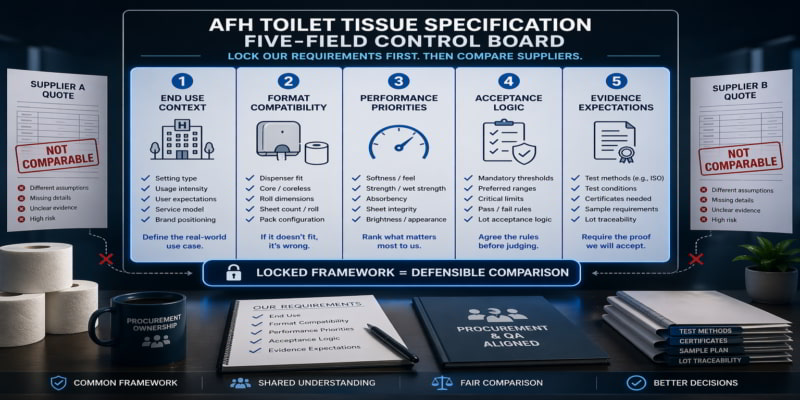
📌 Key Takeaways
Strong supplier comparison starts with a buyer-owned checklist, not supplier labels or early price talks.
- Define Use First: Start with real site needs, because traffic, service levels, and facility type shape the right tissue choice.
- Lock Fit Early: Confirm roll format and dispenser compatibility first, because a product that does not fit is already wrong.
- Rank What Matters: Set performance priorities in order, so teams know when softness matters less than strength or consistency.
- Set Acceptance Rules: Mark what is mandatory, preferred, or irrelevant, and name who decides whether a quote stays alive.
- Keep Teams Aligned: Use one shared checklist so Procurement and QA compare suppliers on the same basis.
Buyer-owned specs beat quote guesswork and turn false comparability into defensible supplier review.
Away-From-Home (AFH) procurement and QA teams will gain a clearer way to screen suppliers, setting up the detailed framework below.
~ ~ ~ ~ ~ ~ ~ ~ ~ ~ ~ ~ ~ ~ ~ ~ ~ ~
Before comparing Away-From-Home (AFH) toilet tissue suppliers, procurement teams should first lock a buyer-owned minimum field set covering end use, format compatibility, performance priorities, and acceptance thresholds. Without that baseline, two quotes can look comparable while hiding different assumptions about dispenser fit, service expectations, performance, and what “acceptable” actually means. The first goal is not to create a perfect technical standard. The goal is to create a clear, usable requirement set that Procurement and QA can both defend before commercial comparison begins.
What Procurement Teams Must Define Before Comparing Suppliers
A useful AFH bath tissue specification framework starts with five field groups: use-case definition, format and compatibility, performance priorities, acceptance logic, and evidence basics. That is the minimum structure that turns a vague product request into a quote-ready specification method. Specifically, the framework defines site-level operational requirements, including placement, dispenser constraints, and usage volume.
This matters because supplier comparison breaks down when teams compare offers before defining the requirement set. A supplier may respond to a broad label such as “premium bathroom tissue” or “2-ply AFH roll,” but those labels do not define the same product in the same way across bathroom tissue suppliers. The framework has to come from the buyer side first. Procurement should define what the product must do, how it must fit, what counts as acceptable, and how those points will be judged. Only then does price comparison become meaningful.
Start With End-Use Context, Not Supplier Brochures
The first definition step is not sheet count or softness language. It is a use case. Labels such as premium, commercial, soft, or standard may help a supplier describe an offer, but they are not a buyer requirement framework.
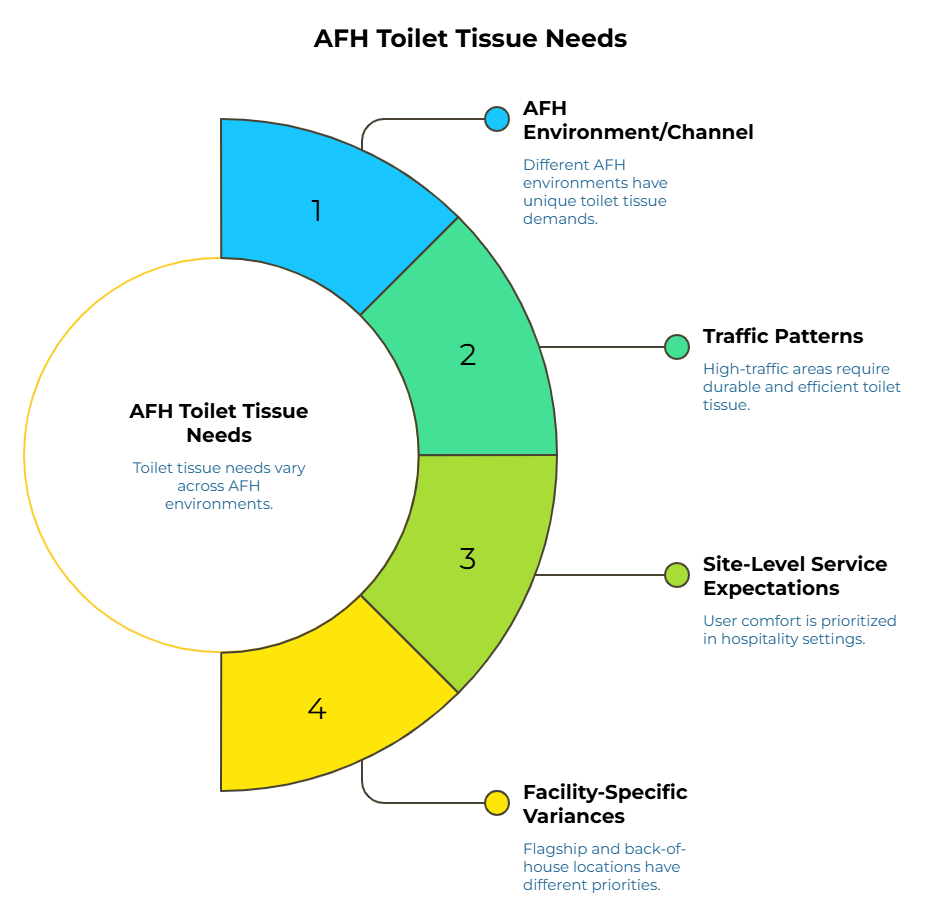
Away-From-Home (AFH) toilet tissue performs differently across hospitality, healthcare, education, public institutions, and jan-san environments because each setting places different demands on refill frequency, user expectations, consumption patterns, and complaint tolerance. A high-traffic public washroom may need a very different balance of durability and replenishment efficiency than a hospitality setting where user comfort carries more weight. Site variation matters too. A flagship facility and a back-of-house location may sit under the same organization while requiring different practical priorities.
Audit the following four variables:
- AFH environment/channel;
- Traffic patterns;
- Site-level service expectations;
- Facility-specific variances.
This step keeps the framework grounded in real operating conditions. It also prevents teams from copying generic supplier descriptions that sound complete but do not reflect the actual duty of the product. A buyer-owned specification framework earns its value here because it forces the team to define the job before it evaluates the offer.
Lock The Format and Compatibility Fields Early
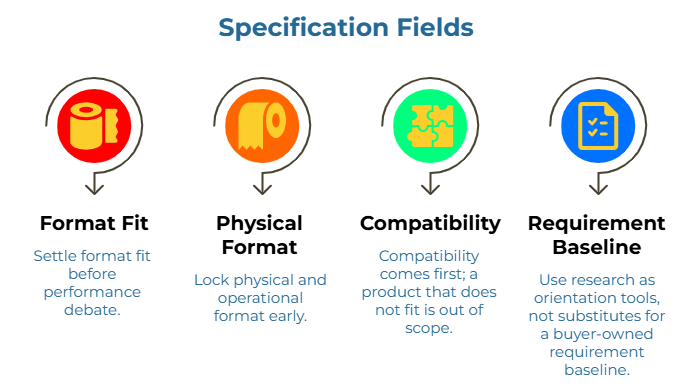
Many specification problems are not performance problems at all. They are fit problems. Format fit should be settled before performance debate begins.
Before debating softness, absorbency, or finish, the team should lock the physical and operational format. That includes the format of the toilet tissue rolls, dispenser fit, core or coreless requirements where relevant, sheet or roll presentation assumptions, and pack configuration where that affects storage, handling, or replenishment. A supplier may quote an acceptable tissue on paper, but if the roll format does not match the installed dispenser base, or if the pack configuration creates replenishment inefficiency, the quote was never truly comparable.
A clean way to handle this is to separate “must fit” fields from “should perform well” fields. Compatibility comes first because a product that does not fit the operating system is already out of scope. Where category research is useful later, teams can consult resources such as bath tissue rolls and toilet tissue raw material suppliers. Those are orientation tools, not substitutes for a buyer-owned requirement baseline.
Define the Core Performance Priorities for the Away-From-Home (AFH) Setting
Once the use case and format are clear, the team can define the core performance stack. This does not need to become a long laboratory specification in the first draft. It needs to identify the few performance priorities that actually matter in the intended AFH setting. In most cases, that means some combination of softness, strength, absorbency, bulk or feel where relevant, and consistency.
The important point is prioritization. Not every field should carry equal weight in the first version. Some environments will value comfort and presentation more highly. Others will prioritize durability, refill efficiency, or performance stability across locations. A high-traffic institutional setting may place strength, consistency, and refill efficiency above feel. A guest-facing hospitality setting may push softness and presentation higher. The exact thresholds can vary by AFH environment, but the principle stays the same: define the priority order before supplier comparison starts.
A practical first pass often sounds like this: softness matters, but only after dispenser fit is confirmed. Strength is mandatory because the product must hold up in use. Absorbency matters if the service expectation includes a stronger user-perceived quality threshold. Consistency matters because one good batch does not solve a recurring site requirement. That kind of language helps internal teams move from abstract preference to operational intent.
Set the First Acceptance Thresholds and Evidence Expectations
A framework is incomplete until the team defines what counts as acceptable. At a starter level, that does not demand an exhaustive technical manual; rather, it requires a binary distinction between what is non-negotiable, what is preferred, what is out of scope, and who signs off on acceptance. If ownership is unclear, disagreement usually appears late, after supplier responses are already in hand.
This is also the point where Procurement and QA often drift apart if the framework is weak. Procurement may see a quote as close enough. QA may see the same quote as undefined. A simple acceptance layer prevents that gap. At minimum, the team should document:
- the fields that must be met before a quote stays under review
- the fields that can be discussed as preferences
- the fields that are not relevant for this buying round
- the internal owner for final acceptability judgment
Where method discipline matters, the team can state that the same named test method, reporting basis, or sampling expectation must apply across suppliers. Teams should define references such as ISO 536 for grammage, ISO 287 for moisture content, and ISO 186 for sampling. The exact testing scope can vary by buying context, but the principle is consistent.
Separate Mandatory Fields from Secondary Preferences
One of the most common early mistakes is trying to define everything at once. A first-pass framework should focus on clarity before exhaustiveness. That means separating mandatory fields from secondary preferences instead of building a bloated list that no one can apply consistently.
Mandatory fields determine operational fit, acceptable use, or internal approval. Secondary preferences may improve the final decision, but they should not block the first round of comparability. This distinction keeps the framework usable in fast-moving sourcing cycles, prevents suppliers from guessing which details matter most, and makes internal review faster because everyone can see which items decide whether a quote is truly comparable. A good starter framework is short enough to use, but specific enough to defend.
A compact starter checklist can help:
- end-use setting
- format and dispenser compatibility
- performance priorities
- minimum acceptance thresholds
- evidence or test-method expectations where needed
- internal owner, reviewer, and sign-off
That is enough to start well. It is not necessary to build a full enterprise specification library before the next quote round.
How Procurement and QA Should Use the Same Starter Checklist
One shared checklist changes the conversation. Instead of asking which supplier looks best, the team starts by asking whether the requirement set is clear enough for any supplier to answer consistently.
The value of a buyer-owned specification framework is not only better supplier input. It is better internal alignment. Procurement should use the checklist to define what goes into the request. QA should use the same checklist to define what has to be credible, acceptable, and reviewable. When both teams work from one baseline, internal conversations become more productive because they are anchored to shared fields instead of personal interpretation.
This is especially helpful in growth-stage environments where sourcing, QA, and category ownership overlap. A common checklist creates a repeatable decision language. It reduces the risk of approving a supplier on incomplete logic, then struggling to explain the rationale after rollout. Supplier verification should sit in the right sequence as well: verification comes later, after the team defines what fit means.
Common Mistakes in The First Specification Framework
Most early frameworks fail for simple reasons. The first is starting with price. Price comparison is downstream work. If the field set is weak, price only creates false confidence. The second is using generic product labels as if they were specifications. They are not. They are broad descriptions. The third is letting suppliers define the comparison logic. That shifts control away from the buyer and invites inconsistent interpretation. The fourth is overloading the framework with optional preferences before locking the mandatory fields. The fifth is skipping internal ownership. If no one is clearly responsible for acceptance, borderline quotes turn into debate instead of decision.
All of these mistakes lead to the same outcome: false comparability. The quotes look orderly. The underlying requirements are not.
Next Step: Normalize Supplier Inputs Into a Comparable Requirement Set
A starter framework is the first control point, not the final one. Once the minimum fields are defined, the next step is normalization: converting supplier responses into the same basis so that differences in wording, reporting style, or assumptions do not distort the comparison. That is where the follow-on piece should take over.
For now, the objective is simpler and more important: create a buyer-owned specification baseline that reflects real AFH use, locks the critical fit and performance fields, and gives Procurement and QA a shared language before commercial comparison starts. Use the Minimum Fields Starter Checklist internally before the next quote round and before you contact suppliers, so the first commercial review starts on firmer ground.
Minimum Fields Starter Checklist
- Define the Away-From-Home (AFH) use case and site conditions
- Lock format and dispenser compatibility
- Rank the core performance priorities
- Mark each field as mandatory, preferred, or out of scope
- State who approves acceptability internally
- Require the same comparison basis across suppliers
Disclaimer:
This article is for educational purposes only.
Our Editorial Process:
Our expert team uses AI tools to help organize and structure our initial drafts. Every piece is then extensively rewritten, fact-checked, and enriched with first-hand insights and experiences by expert humans on our Insights Team to ensure accuracy and clarity.
About the PaperIndex Insights Team:
The PaperIndex Insights Team is our dedicated engine for synthesizing complex topics into clear, helpful guides. While our content is thoroughly reviewed for clarity and accuracy, it is for informational purposes and should not replace professional advice.