

📌 Key Takeaways
A reorder point formula eliminates stockout guesswork by calculating exactly when to place your next bag order based on usage, lead time, and safety buffer.
- Calculate Your Trigger Point: Multiply daily bag usage by supplier lead time, then add safety stock days to set your reorder threshold.
- Boost Buffers for Peak Seasons: Increase safety stock from 3 days to 5-7 days when holidays compress supplier schedules and spike customer demand.
- Track With What You Have: A simple notebook, spreadsheet, or mobile app works equally well if you update it consistently and honor reorder triggers.
- Verify Lead Times Before Rush Periods: Confirm realistic delivery windows and holiday slowdowns with suppliers 4-6 weeks before peak season starts.
- Apply Uplift to Forecast Peak Demand: Multiply normal daily usage by historical peak percentage (typically 25-40%) to size orders for holiday volume.
Formula discipline replaces panic with predictable restocking.
Small retail owners and operations managers responsible for checkout supplies will gain an immediately implementable inventory system here, preparing them for the calculation worksheet and supplier coordination checklist that follows.
A peak-season paper bag stockout rarely starts as a “bag problem.” It starts as a missing system. For a store owner staring at a dwindling pile of paper bags on a Friday afternoon before a festival weekend, that sinking feeling is all too familiar. Customers are lining up, sales are strong, and yet the most basic element of every transaction is about to run out.
This scenario plays out in small retail businesses every peak season. The problem rarely stems from poor planning intentions. It stems from the absence of a system.
Inventory management for paper bags transforms guesswork into a reliable process. Rather than hoping stock will last or scrambling when it doesn’t, a simple formula-based approach tells you exactly when to reorder and how much buffer to keep. Think of your bag inventory as a fuel gauge for your checkout counter. When the needle drops to a certain point, you refuel. No panic, no surprises.
With even a basic inventory system in place, the anxiety of peak seasons gives way to calm control.
Why Bag Inventory Management Matters Most During Peak Season
Inventory management for paper bags means tracking what you have, forecasting what you need, and setting triggers that prompt timely reorders. During peak retail seasons, this discipline becomes critical.
Stockouts carry costs that extend far beyond a single lost sale. When bags run out, a visible chain reaction unfolds:
- Lost sales — Customers abandon baskets or shorten purchases rather than carry loose items
- Brand damage — The store looks unprepared or unprofessional to shoppers
- Operational chaos — Staff scramble for makeshift solutions or slow checkout lines to a crawl
“Inventory isn’t just stuff on a shelf; it’s money waiting to be made.”
Packaging functions as currency in retail. Every transaction requires it. When the supply pipeline feeding your bag inventory runs dry during a holiday rush, commerce itself stutters. The retailers who navigate peak seasons smoothly aren’t necessarily bigger or better funded. They simply treat inventory as a system rather than an afterthought.
This connects to a broader reality: wholesale paper bag sourcing is the process that feeds your bag inventory, while inventory management is how you keep that pipeline flowing during peak season. One without the other leaves gaps.
The Basic Bag Inventory System: Forecast, Safety Stock, and Reorder Points
The foundation of any bag inventory plan rests on three elements: understanding your daily usage, knowing your paper bag supplier‘s lead time, and maintaining a safety buffer.
Daily or weekly usage refers to how many bags move through your checkout under normal conditions. Lead time is the number of days between placing an order and receiving delivery. Safety stock acts as a cushion for delays, demand spikes, or supplier hiccups.
These three inputs combine into a straightforward calculation.
Reorder Point Formula (for Paper Bags)
Reorder Point = (Average Daily Usage × Lead Time in Days) + Safety Stock
Example 1: A small grocery uses 50 bags daily. Supplier lead time is 7 days. Safety stock is set at 100 bags for unexpected delays.
Reorder Point = (50 × 7) + 100 = 450 bags
When inventory drops to 450 bags, it’s time to order.
Example 2: A boutique using kraft paper bags requires 20 bags daily with a 10-day lead time and wants 80 bags as a safety buffer.
Reorder Point = (20 × 10) + 80 = 280 bags
A simple timeline illustrates the logic: picture order date → dispatch → arrival at store, with a shaded “lead time window” spanning that period. Safety stock is the buffer that prevents hitting zero anywhere during that window.
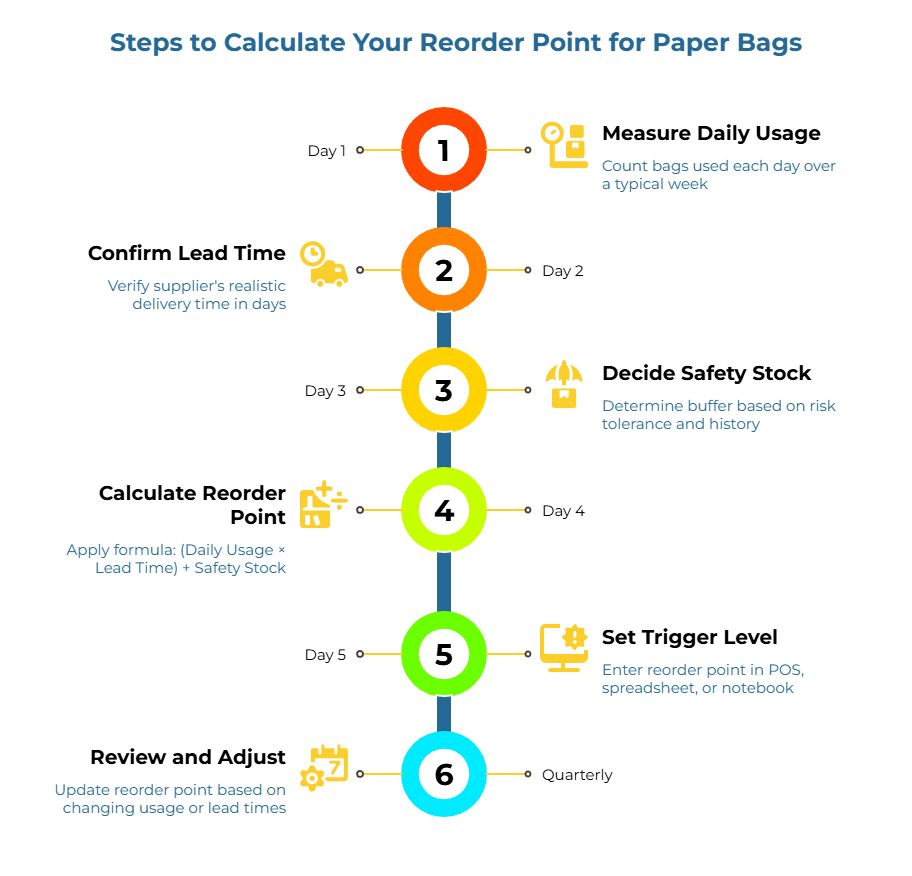
Steps to Calculate Your Reorder Point
- Measure average daily bag usage over a typical week by counting how many bags leave your stock each day.
- Confirm your supplier’s realistic lead time in days, not their best-case promise but what actually happens.
- Decide on safety stock based on your risk tolerance and any history of delivery delays or demand surges.
- Calculate your reorder point by multiplying daily usage by lead time, then adding safety stock.
- Enter this reorder point as a trigger level in your POS system, inventory spreadsheet, or tracking notebook.
- Review and adjust quarterly or before major seasonal shifts.
For readers who want statistical precision in setting safety stock levels, service level factors offer an alternative approach. These Z-values correspond to desired in-stock probabilities: 1.28 for 90% service level, 1.64 for 95%, and 1.96 for 97.5%. Multiplying your chosen Z-value by demand variability during lead time yields a statistically derived safety stock figure. Most small retailers find the simpler “days of coverage” method sufficient, but the statistical approach becomes useful when historical data reveals significant demand swings.
How to Plan Bag Quantities for Peak Seasons Without Overstocking
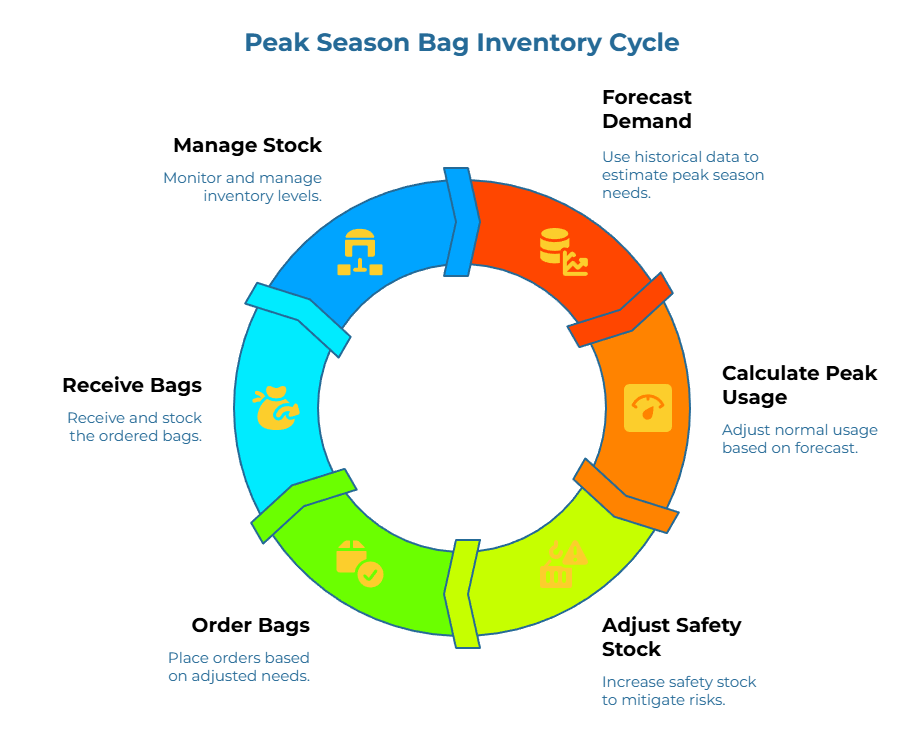
The basic formula works for steady demand. Peak seasons require adjustment.
Forecasting Demand for Holidays and Local Peaks
Historical data offers the most reliable starting point. Pull sales figures from the same period last year. If your festive season or tourist months showed a 40% increase in transactions, apply that uplift percentage to your current daily usage estimate.
Here’s how the calculation works in practice: if normal usage is 800 bags per day and peak season tends to run 25% higher, your peak usage estimate becomes:
800 × 1.25 = 1,000 bags/day
Without historical data, conservative estimates work better than optimism. A 25–30% buffer above normal usage provides reasonable protection for first-time peak season planning. Regional holidays, local festivals, and annual sale events each warrant their own forecast adjustments.
The goal is informed estimation, not perfection. Even rough calculations outperform gut feelings when inventory decisions carry financial consequences.
Adjusting Safety Stock for Higher Risk Periods
Peak seasons compound two risks simultaneously: suppliers face higher demand from all their customers, and your own sales velocity increases. Both factors argue for larger safety buffers.
A practical rule provides clear starting points:
- Normal weeks: safety stock = 3 days of bags
- Peak weeks: safety stock = 5–7 days of bags (when delivery reliability drops)
This modest increase guards against the supplier delays that become more common when everyone orders at once. The tradeoff involves cash tied up in additional stock. For most small retailers, the cost of carrying extra bags for a few weeks pales against the cost of running out during the busiest sales period of the year.
Practical Ways to Implement Your Inventory System (For Very Small Teams)
Sophisticated software isn’t required. The right implementation matches available resources.
Manual tracking works for the smallest operations. A notebook page with columns for date, bags received, bags used, and running total provides visibility. Mark the reorder point clearly so any staff member checking inventory knows when to alert the owner.
Spreadsheet tracking adds automation without complexity. Set up columns for:
- Date
- Opening Stock
- Received
- Used
- Closing Stock
- Lead time (days)
- Average daily usage (rolling 7-day average)
- Safety stock level
- Calculated reorder point
- Reorder Trigger
A simple formula highlights when closing stock drops below the reorder point. This approach suits owners comfortable with basic spreadsheet functions who want automatic alerts. The feeling of checking a spreadsheet on Thursday and knowing with certainty there’s enough stock for the weekend replaces the anxiety of hoping and wondering.
Simple inventory apps offer mobile convenience. Several free or low-cost options allow barcode scanning, automatic calculations, and push notifications when stock hits trigger levels. For retailers already using smartphones for other business tasks, this tier reduces friction further.
The implementation choice matters less than consistency. A notebook checked daily beats sophisticated software ignored for weeks.
Coordinating Inventory Management with Your Suppliers
Good inventory systems require good supplier information and reliability. Before peak season arrives, confirm four details with your primary bag supplier:
- Typical lead time — The number quoted at purchase may differ from actual performance. Ask for realistic estimates based on recent deliveries, not best-case promises.
- Holiday slowdowns or blackout periods — Many suppliers reduce operations or face backlogs during festival periods. Build these delays into your lead time assumptions.
- Minimum order quantities — If MOQs have increased or if larger orders receive priority dispatch, this affects order timing.
- Dispatch schedule — Understanding which days shipments actually leave helps you time orders to avoid weekend delays.
Communication prevents surprises. A brief conversation or email exchange before the season starts costs nothing and can prevent stockout emergencies. For retailers sourcing internationally or looking to expand their supplier network, B2B marketplaces designed for the paper industry can streamline the process of finding and vetting new suppliers. For suppliers you haven’t worked with before, consider using a systematic verification approach to ensure reliability.
Diversifying suppliers adds another layer of protection, though that topic extends beyond inventory basics into broader sourcing strategy. For comprehensive guidance on building supply chain resilience, the related guide on building a reliable paper packaging sourcing strategy addresses supplier diversification in depth. And if despite best efforts something goes wrong, a crisis-response approach to fixing stockouts quickly provides the emergency playbook.
Putting It All Together: A One-Page Peak-Season Bag Inventory Plan
The entire system condenses into a brief action checklist suitable for printing or screenshot:
- Define your peak season period (specific dates or weeks)
- Calculate current average daily bag usage
- Confirm realistic supplier lead time, including any holiday adjustments
- Set safety stock level (higher for peak periods)
- Apply the reorder point formula
- Choose tracking method: notebook, spreadsheet, or app
- Enter reorder point as your trigger level
- Contact suppliers to verify lead times and MOQs before the rush begins
A basic inventory management system is the strongest defense against peak-season stockouts. It transforms reactive scrambling into proactive control.
Instead of praying every delivery will arrive before stock runs out, you have a simple system that tells you exactly when to restock. The fuel gauge approach means no more surprises at the checkout counter. Peak season becomes manageable, even predictable.
The math is simple. The discipline is straightforward. The peace of mind is worth far more than the small effort required to set it up.
For more guidance on paper packaging procurement, supplier verification, and strategic sourcing, explore additional resources in the PaperIndex Academy—a comprehensive knowledge hub for paper industry professionals navigating supply chain challenges.
References
[1] North Carolina State University, Reorder Point Formula (reorder point as lead-time demand plus safety stock): https://scm.ncsu.edu/scm-articles/article/reorder-point-formula-inventory-management-models-a-tutorial
[2] MIT, Understanding Safety Stock and Mastering Its Equations (conceptual basis for safety stock and service level thinking): https://web.mit.edu/2.810/www/files/readings/King_SafetyStock.pdf
[3] ASCM (Association for Supply Chain Management), Planning with the Right Cycle Stock Levels (inventory fundamentals used in planning): https://www.ascm.org/globalassets/ascm_website_assets/docs/better-planning-and-scheduling-with-the-right-cycle-stock-levels.pdf
[4] SCORE (SBA Resource Partner), Inventory Management Basics (small-business inventory basics): https://www.score.org/resource/blog-post/inventory-management-it-time-a-change
Disclaimer: This article is provided for educational purposes only. The formulas and strategies discussed represent general inventory management principles and should be adapted to your specific business circumstances. Actual results will vary based on supplier reliability, market conditions, and individual operations. Readers are encouraged to validate calculations against their own historical data before implementation.
Our Editorial Process:
Our expert team uses AI tools to help organize and structure our initial drafts. Every piece is then extensively rewritten, fact-checked, and enriched with first-hand insights and experiences by expert humans on our Insights Team to ensure accuracy and clarity.
About the PaperIndex Insights Team
The PaperIndex Insights Team is our dedicated engine for synthesizing complex topics into clear, helpful guides. While our content is thoroughly reviewed for clarity and accuracy, it is for informational purposes and should not replace professional advice.