
📌 Key Takeaways
Comparing toilet tissue parent roll quotes fairly requires converting every offer to the same technical and commercial baseline before price ever enters the conversation.
- Same Number, Different Material: Two suppliers can quote identical GSM figures while delivering rolls that behave completely differently on your converting line.
- Samples Prove Possibility, Not Consistency: A soft, clean-winding sample roll doesn’t guarantee production shipments will match—it only shows what’s achievable under ideal conditions.
- Name the Test Method: A specification target without a named testing standard lets suppliers measure the same property in different ways, making quotes impossible to compare fairly.
- Separate Technical Fit from Price: Only quotes meeting your baseline specifications should advance to commercial comparison—attractive pricing means nothing if the material won’t run.
- Document Every Assumption: Recording freight terms, moisture tolerances, and testing methods in writing prevents disputes and makes recalculation easier when conditions change.
Quote gaps usually reflect assumption gaps, not true supplier differences.
Private-label converters and procurement managers sourcing toilet tissue parent rolls globally will find a practical normalisation workflow here, preparing them for the detailed specification checklist that follows.
~ ~ ~ ~ ~ ~ ~ ~ ~ ~ ~ ~ ~ ~ ~ ~ ~ ~
The line stops.
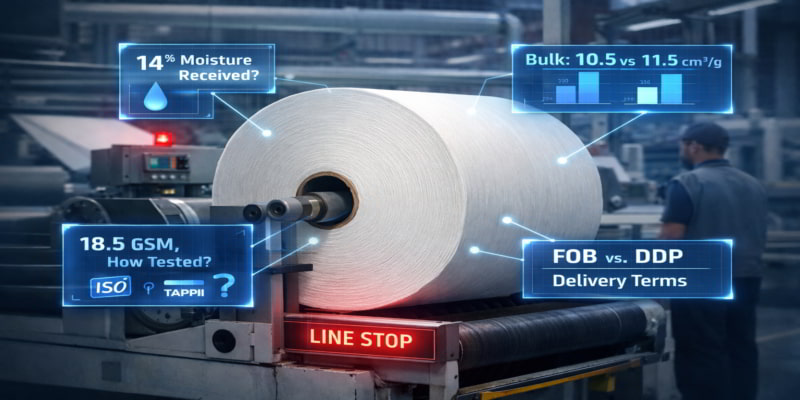
A loud crunch echoes across the converting floor. Three operators converge on the unwinder while a shift supervisor examines the toilet tissue parent roll that arrived last week. The GSM matched the specification sheet. The sample felt right. The quote looked competitive.
None of that mattered when the roll hit production speed.
This scenario unfolds in private-label converting plants worldwide. It rarely traces back to a dishonest supplier. The root cause is subtler: a comparison process that treated incompatible quotes as equivalent. When several toilet tissue parent roll quotes sit in an inbox showing similar GSM figures and comparable pricing, the differences hiding beneath those numbers remain invisible until material reaches the converting line.
Toilet tissue parent roll specification normalization is the methodological process of aligning disparate supplier quotes to a single, standardized set of technical baselines. Think of it like translating five different currencies into a single benchmark so the actual value becomes clear. Without this translation, converters compare numbers that look similar but represent fundamentally different commitments regarding moisture, bulk, test methods, and delivery terms. The buyer owns the baseline. Suppliers respond to it.
With a normalization method in place, private-label converters gain the ability to filter misleading quotes before they reach the shortlist, identify hidden assumption gaps that would otherwise surface as runnability issues, and build a defensible basis for supplier conversations. The outcome extends beyond cleaner procurement. It delivers operational confidence that the toilet tissue parent jumbo rolls approved for production will perform as expected.
Why Toilet Tissue Parent Roll Quote Comparison Breaks Before Price Is Even Discussed
Quote chaos begins earlier than most converters realize. It starts the moment one supplier interprets an RFQ differently from the next.
One mill quotes 18.5 GSM toilet tissue parent rolls tested at ambient conditions in a warm, humid production environment. Another quotes 18.5 GSM tested in standard conditions at 23°C and 50% relative humidity. Both numbers say “18.5 GSM.” Both numbers describe different materials.
Multiply this ambiguity across bulk, moisture content, caliper, and delivery terms. An inbox quickly fills with incompatible documents disguised as comparable offers.
The instinct to rely on visual samples compounds the problem. A sample roll feels soft, winds cleanly, and matches the desired appearance. But that sample may have been conditioned differently, produced on a different machine position, or cut from a run with tighter-than-typical moisture control. The sample proves what is possible. It does not prove what is repeatable. When production shipments arrive with moisture two percentage points higher, softness remains but runnability disappears.
Quote chaos is not caused by bad suppliers. It is caused by assumption gaps that remain invisible until material reaches the private-label converting line.
When basic comparison stops being reliable: Comparing EXW or CIF quotes directly based on stated GSM works reasonably well when sourcing from a single region with consistent testing standards. That approach breaks down when sourcing globally from multiple suppliers across regions with varying recycled-fiber constraints, different conditioning protocols, or divergent test method conventions. The tipping point occurs when the number of global suppliers in an RFQ increases. At that point, quote gaps begin reflecting assumption gaps rather than true supplier efficiency. Rigorous normalization becomes essential.
What Must Be Normalized Before Two Toilet Tissue Parent Roll Quotes Can Be Called Comparable
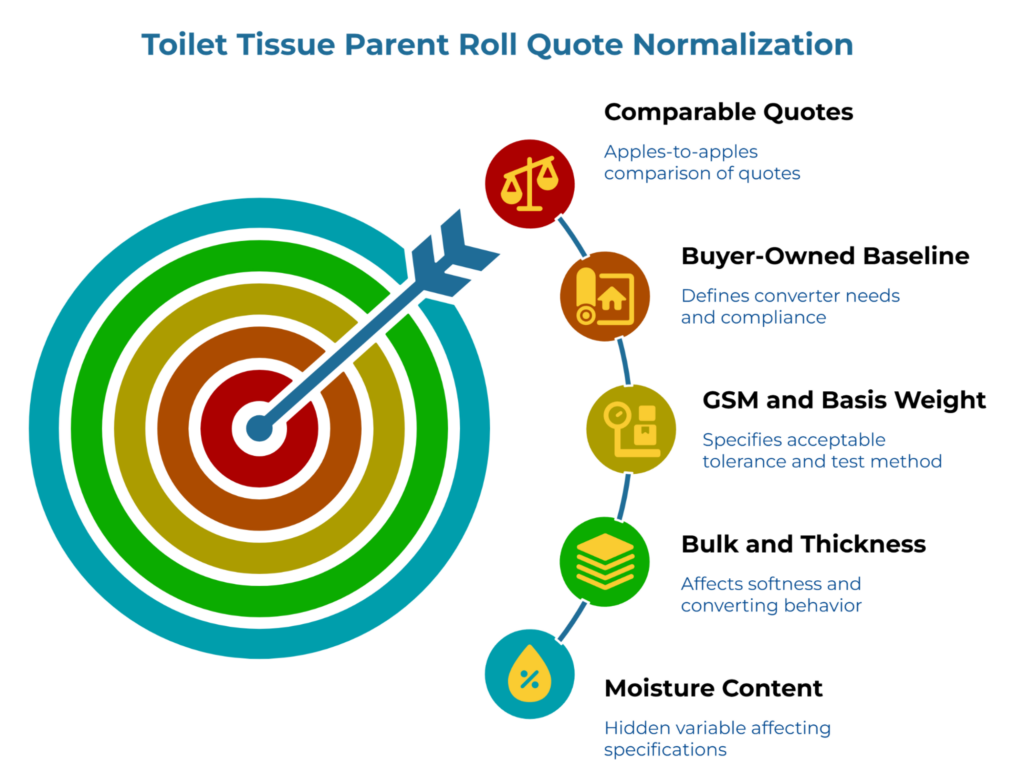
Normalization converts every quote into an apples-to-apples comparison by forcing suppliers to respond to the same technical and commercial framework. A buyer-owned baseline defines exactly what the converter needs, how compliance will be measured, and where responsibility transfers.
Consider the analogy of comparing flight prices. One airline quotes a base fare. Another quotes an all-inclusive price with baggage, seat selection, and meals. The lower number is not necessarily cheaper until both quotes are normalized to the same inclusions. Toilet tissue parent roll quotes work identically. A lower price per ton means nothing if the quote excludes freight to the receiving dock, assumes different moisture tolerances, or references a test method the converter cannot verify at incoming inspection.
A useful anchor concept clarifies this relationship: toilet tissue parent roll specifications define the material baseline, while quote normalization defines the comparison baseline. One is the blueprint. The other is the comparison method built on top of that blueprint. One without the other is incomplete.
The baseline must address six categories. Skipping any one creates a comparison gap that may not become visible until after the award.
GSM and Basis Weight. Targets alone are insufficient. The baseline must specify the acceptable tolerance range and the test method used to verify compliance. Different test methods produce different results on identical material. A supplier testing at ambient plant conditions may report different GSM than one following strict ISO test procedure as per ISO 12625-6.
Bulk and Thickness. Bulk affects softness perception, sheet count per roll, and downstream converting behavior. A parent roll with lower bulk but identical GSM feels different to consumers and may require rewinder adjustments. The challenge is that bulk measurements depend heavily on measurement pressure and conditioning. TAPPI T 580 specifies tissue-specific caliper measurement test methods, but results vary if conditioning differs. Converters should specify the target bulk range and measurement test method so every supplier quotes against the same standard.
Moisture Content. Moisture is the hidden variable affecting nearly every other specification. A parent roll tested at 6% moisture reports different GSM, caliper, and bulk than the same roll tested at 8% moisture. Rolls absorbing moisture during transit or storage may jam, web-break, or produce inconsistent perforation. The baseline should specify acceptable moisture range at time of receipt and reference a named test method.
Test Method Naming. Stating a target value without naming the test method is the single most common normalization failure. A GSM target of 18.5 g/m² means different things depending on whether it references ISO conditioning, TAPPI conditioning, or ambient plant conditions. The baseline should explicitly name the standard for every variable verified at receiving.
Tolerance Language. Tolerances define acceptable range around a target. Without explicit tolerances, suppliers may ship material that technically meets specification while falling outside the converter’s actual operating window. A complete tolerance statement includes the target value, acceptable range, and consequence of non-compliance.
Recycled-Fiber and Climate-Related Variables. Regional differences in recycled-fiber availability, environmental regulations, and climate conditions affect parent roll characteristics. Converters sourcing globally from diverse tissue paper raw material suppliers must explicitly surface these variables. A supplier in a humid tropical climate may struggle to maintain the same moisture specifications as one in a temperate region without additional process controls. Variations in regional recycled-fiber recovery streams further introduce volatility in tensile strength and brightness, necessitating calibrated benchmarking for global sourcing.
Why Toilet Tissue Converters Need Both Specification Discipline and Quote Discipline
A buyer-owned specification tells suppliers what material the converter needs—and once that specification is locked, converters can find suppliers capable of meeting those requirements. A normalization method tells suppliers how that requirement must be quoted so offers can be compared fairly. That sequence is central. It should not be blurred.
When the physical specification is vague, quote comparison becomes vague. When the physical specification is strong but suppliers are still allowed to quote against mixed delivery terms, mixed methods, or mixed tolerance assumptions, comparison still breaks. The specification and the quote-normalization method solve different parts of the same problem.
The practical rule is straightforward: define the baseline first, then compare quotes against that baseline. Never reverse the order.
The Specification-True Workflow for Standardizing Toilet Tissue Parent Roll Quotes
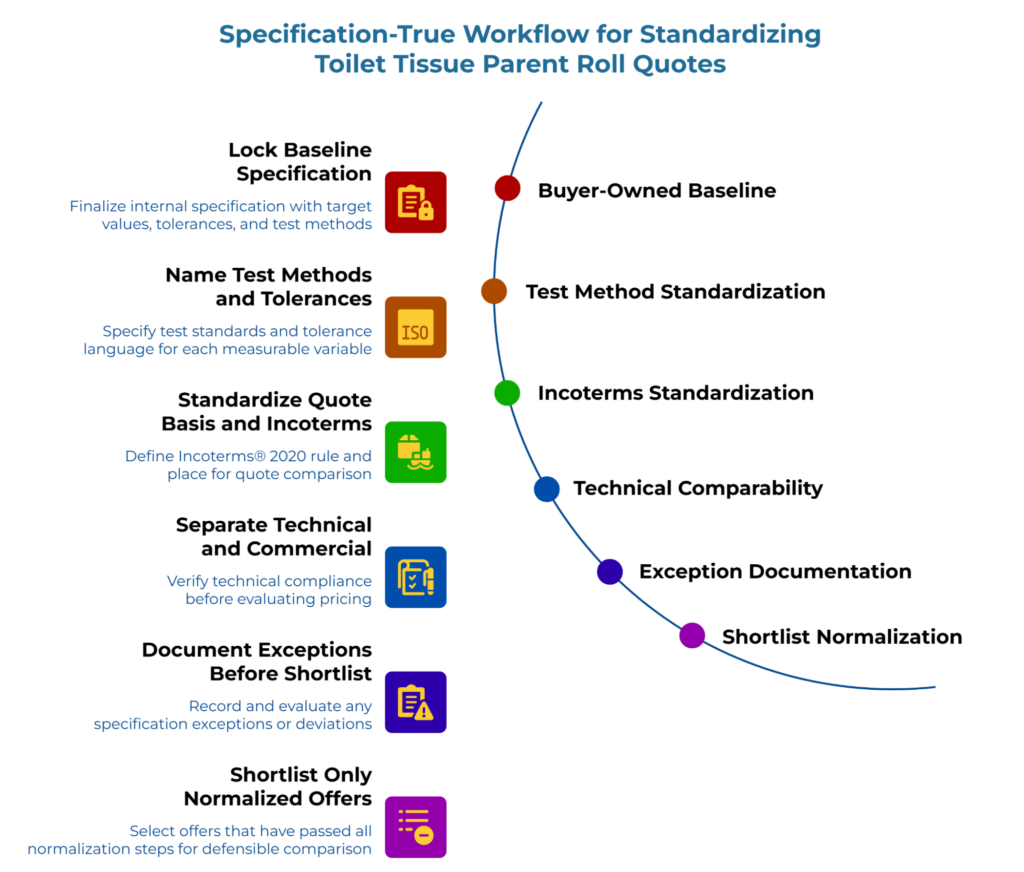
The following workflow converts scattered quotes into a comparable shortlist. Execute each step sequentially.
Lock the Buyer-Owned Baseline. Before requesting quotes—whether through direct outreach or platforms where buyers can submit RFQ and receive quotes free—finalize the internal specification. This specification is buyer-owned, reflecting the converter’s actual operating requirements rather than a supplier’s standard product sheet. Include target values and tolerances for GSM, bulk, moisture, caliper, and any variables affecting runnability or product quality. Each variable should reference a named test method.
Name Test Methods and Tolerance Language. Every measurable specification requires three elements: a target value, an acceptable tolerance, and a named test standard. Instead of “GSM 18.5 ±3%,” specify “GSM 18.5 g/m² ±3% per 12625-6“. Instead of “moisture content within acceptable range,” specify “moisture content 6.5% ±1.0% per ISO 287, tested at receiving.”
Standardize Quote Basis and Incoterms Assumptions. The RFQ should specify a single Incoterms® 2020 rule and named place as the comparison basis. Whether specifying EXW, FCA, CIP, or DAP, every quote should be converted to the comparison basis before evaluation. The International Chamber of Commerce generally recommends FCA or CIP over FOB and CIF for the containerized freight typically used for parent rolls.
Separate Technical Comparability from Commercial Comparison. Only quotes meeting the technical baseline should advance to commercial comparison. A quote offering attractive pricing but unable to demonstrate compliance with the specification baseline is not comparable to quotes that can. Technical compliance verification should happen before price negotiation.
Document Exceptions Before Shortlist Decisions. Some suppliers may request specification exceptions or offer material deviating slightly from the baseline. These deviations are not automatically disqualifying but must be documented and evaluated. An exception log should capture what was requested, whether it was approved, and what impact the deviation may have on runnability or quality.
Shortlist Only Normalized Offers. A shortlist should contain offers that have passed the same comparison test. Offers that remain attractive only because assumptions stayed hidden do not belong on a defensible shortlist. Otherwise, confusion is merely being postponed rather than resolved.
How Moisture, Bulk, GSM, and Test-Method Mismatches Create False Quote Spreads
False quote spreads occur when price differences reflect hidden assumptions rather than genuine value differences.
Same GSM claim, different bulk reality. Two suppliers quote 18.5 GSM toilet tissue parent rolls. Supplier A’s material runs at 8.0 cm³/g bulk. Supplier B’s material runs at 7.2 cm³/g bulk. Both meet the GSM spec. Neither meets the same product profile. This gap emerges when the RFQ specifies GSM without specifying bulk requirements.
Same sample feel, different moisture behavior. A sample roll arrives soft and consistent. The production shipment arrives slightly stiffer, with moisture content two percentage points higher than the sample. The production material meets specification because the specification did not define moisture at time of receipt rather than at time of manufacture.
Same specification headline, different test method or conditioning basis. Two suppliers quote 18.5 GSM per “ISO standards.” One test per ISO 536 after full conditioning per ISO 187. The other tests per ISO 536 at ambient plant conditions. This gap emerges when specifications name a test method without specifying conditioning requirements.
These mismatches create the conditions for unexpected line jams, runnability issues, rejected production batches, misleading shortlist outcomes, and hidden landed-cost assumptions appearing too late to address. Converters should be careful with phrases such as “close enough” or “basically the same.” In toilet tissue parent roll sourcing, close enough is often where downstream problems begin.
How to Document Assumptions Across Incoterms, Freight, and Tolerances
Documentation transforms verbal agreements into enforceable baselines. Without written records, assumptions remain invisible until disputes arise.
Incoterms Documentation. Record the exact Incoterms rule and named place specified in each quote. A quote stating “FCA Shanghai” and another stating “CIP Los Angeles” cannot be compared without adjusting for the remaining freight, insurance, and anticipated import duties required to reach a true landed cost. The documentation should capture what is included, what is excluded, and how the converter calculated landed metric normalization to reach a common comparison point.
Freight Assumptions. Specify whether freight quotes include or exclude port handling, inland drayage, customs clearance, and delivery to the converter’s warehouse. Document the freight rate assumptions used to normalize quotes to a common delivery point. When freight rates fluctuate, this documentation allows recalculation without renegotiating the entire agreement.
Tolerance Acknowledgment. Require suppliers to acknowledge tolerance specifications in writing before awarding. This acknowledgment should confirm the target value, acceptable range, test method, and consequence of non-compliance. Disputes over whether material is “within spec” become easier to resolve when both parties have agreed to specific tolerance definitions in advance.
Exception Documentation. When approving any deviation from the baseline specification, document the specific exception granted, the justification, and any conditions attached. This prevents scope creep and establishes clear expectations for ongoing supply.
Common Failure Patterns That Make the Cheapest Quote the Most Expensive Operationally
Private-label converters often discover that the lowest-priced toilet tissue parent roll quote generates the highest total cost once operational impacts are included.
- Runnability failures. Material meeting GSM specifications but falling outside bulk or moisture windows causes web breaks, tension inconsistencies, and perforation irregularities. Each unplanned line stop carries direct costs in lost production time and indirect costs in schedule disruption.
- Rejected production batches. When incoming material passes receiving inspection but fails during converting, the converter absorbs waste costs, rework time, and potential customer delivery delays. These costs rarely appear in the original quote comparison.
- Misleading shortlist outcomes. Quotes appearing competitive based on headline pricing may exclude critical cost components. A quote based on EXW terms looks attractive until freight, duties, insurance, and handling add what is typically an estimated 15 to 40 percent to the landed cost, depending on shipping lanes and regional tariffs
- Hidden assumption gaps appearing too late. Differences in test method interpretation, conditioning protocols, or tolerance expectations often surface only after production problems occur. At that point, the award decision has been made and switching suppliers carries its own costs and delays.
The pattern is consistent: quote gaps often reflect assumption gaps, not true supplier efficiency. The cheapest quote wins when comparison occurs on normalized terms. It fails when normalization is skipped.
What a Toilet Tissue Converter Should Ask Every Supplier Before Shortlist Decisions
These questions surface assumption gaps before they reach the shortlist.
- On GSM and Bulk: What is the standard GSM range and tolerance for this product? What bulk value should the converter expect, and how is it measured? What conditioning protocol is followed before testing?
- On Moisture: What moisture content does material typically reach at time of shipment? How is material protected against moisture gain during transit? What moisture tolerance is committed at time of arrival?
- On Test Methods: Which ISO or TAPPI standards are referenced for GSM, bulk, and moisture testing? Can test certificates referencing these standards be provided with each shipment?
- On Quote Basis: What charges are included in the quoted price? What charges are excluded? Is the supplier able to quote to the converter’s specified Incoterms and named place?
- On Recycled Content and Regional Variables: What percentage of recycled fiber is used in production? Are there regional or seasonal factors affecting material consistency? What process controls maintain specification compliance across climate variations?
- On Exceptions: Are there any specification requirements that cannot be met? If so, what alternatives are proposed, and what impact might they have on runnability?
- On Comparison Readiness: Can the offer be represented cleanly in a normalized comparison sheet without side notes or exceptions hidden in email text?
A Simple Toilet Tissue Parent Roll Normalization Checklist to Use Before Award
Technical Normalization
- GSM target, tolerance, and test method explicitly stated in RFQ and acknowledged by supplier
- Bulk target, tolerance, and measurement method specified
- Moisture content range and test method defined, with testing at receiving rather than at manufacture
- All critical specifications reference named ISO or TAPPI standards
- Recycled-fiber content and any regional variables documented
- Supplier confirmed ability to provide test certificates with each shipment
Commercial Normalization
- All quotes converted to single Incoterms basis and named place
- Freight, insurance, duties, and handling charges either included or separately itemized
- Payment terms documented and comparable
- Lead time commitments confirmed in writing
Exception Documentation
- Specification deviations requested by suppliers logged
- Impact of deviations on runnability or quality assessed
- Approved exceptions documented in award communication
Comparability Verification
- Technical compliance verified before commercial ranking
- Price comparison reflects normalized landed cost, not raw quoted price
- Visual samples used as supporting evidence, not as the comparison framework
- Shortlist includes only suppliers whose quotes meet normalization baseline
- Procurement, operations, and product teams reading the same comparison sheet
Frequently Asked Questions
What is quote normalization for toilet tissue parent rolls?
Quote normalization is the process of converting disparate supplier offers into a single, comparable framework. It aligns every quote to a buyer-owned baseline covering technical specifications and commercial terms. Without normalization, converters compare numbers that look similar but represent different commitments.
Why are visual samples not enough for toilet tissue sourcing?
Visual samples prove what a supplier can produce under controlled conditions. They do not prove what production shipments will consistently deliver. Samples may be conditioned differently, produced on different machine positions, or cut from runs with tighter-than-typical controls.
Which specifications matter most before comparing toilet tissue parent roll prices?
GSM, bulk, and moisture content have the greatest impact on runnability and product quality. Each variable should include a target value, acceptable tolerance, and named test method. Comparing prices before aligning these variables creates false comparability.
How do Incoterms affect toilet tissue quote comparability?
Incoterms define where responsibility transfers between seller and buyer. A quote stating FOB Shanghai and another stating DAP Chicago cannot be directly compared because they include different cost elements. Converters should normalize all quotes to a single Incoterms basis and named place before price comparison.
Moving from Quotes to Confidence
The converting floor does not care about quote comparisons. It cares whether the material runs.
Everything upstream—specification development, RFQ structure, supplier evaluation, award decisions—exists to ensure that the toilet tissue parent jumbo rolls arriving at the dock perform as expected. Normalization is the discipline connecting these upstream activities to downstream outcomes.
When quotes are normalized to a buyer-owned baseline, comparison becomes factual rather than speculative. Suppliers respond to the same requirements. Prices reflect the same scope. Shortlist decisions rest on documented compliance rather than hope. A clear normalization method does more than tidy a spreadsheet. It gives the converter a safer way to think.
The converter who builds this discipline does not eliminate every risk. But they eliminate the preventable risks: assumption gaps, test method ambiguities, freight surprises, and tolerance disputes that turn attractive quotes into operational problems.
Explore the PaperIndex Academy for additional methodology-first guidance on specification development and supplier verification. Once the internal baseline is defined, browse toilet tissue parent roll suppliers to apply the normalization framework across a global supplier base. For manufacturing-side sourcing options, review toilet tissue mills to understand available production capacity.
Disclaimer:
This content is for informational purposes only and does not constitute procurement, technical, or legal advice. Specification requirements, test methods, and commercial terms vary by application and jurisdiction. Verify all information with qualified professionals before making sourcing decisions. Results depend on individual circumstances, supplier capabilities, and operational conditions.
Our Editorial Process:
Our expert team uses AI tools to help organize and structure our initial drafts. Every piece is then extensively rewritten, fact-checked, and enriched with first-hand insights and experiences by expert humans on our Insights Team to ensure accuracy and clarity.
About the PaperIndex Insights Team:
The PaperIndex Insights Team is our dedicated engine for synthesizing complex topics into clear, helpful guides. While our content is thoroughly reviewed for clarity and accuracy, it is for informational purposes and should not replace professional advice.