
📌 Key Takeaways
FDA and ISEGA are signals pointing to different regulatory systems—neither automatically means your food packaging paper is safe for your specific use.
- Match Paperwork to Your Market: US operations need FDA-referenced documents; EU operations need EU-aligned evidence like ISEGA testing.
- Certificates Have Expiration Dates on Relevance: A test done at room temperature won’t protect you when hot, greasy food sits in that container for 45 minutes.
- Scope Gaps Hide in Plain Sight: Certificates often cover just the base paper—not the coatings, inks, or adhesives that also touch your food.
- “Food Safe” Isn’t Documentation: That phrase is marketing, not proof—ask for the actual Declaration of Compliance naming specific regulations.
- Ask Four Questions Before You Buy: Request the DoC, confirm what layers it covers, verify testing conditions match your use, and get traceability details.
Documentation survives audits; marketing claims do not.
Restaurant owners and food service buyers managing takeout food packaging paper compliance will gain clear verification questions here, preparing them for the detailed supplier-audit guides that follow.
~ ~ ~ ~ ~ ~ ~ ~ ~ ~ ~ ~ ~ ~ ~ ~ ~ ~
FDA 21 CFR and ISEGA are regulatory signals, not guarantees. FDA references the US framework for food-contact materials; ISEGA provides EU-aligned testing evidence. Which one matters depends on where you sell—and whether your supplier’s documentation actually covers your specific paper, coatings, and use conditions.
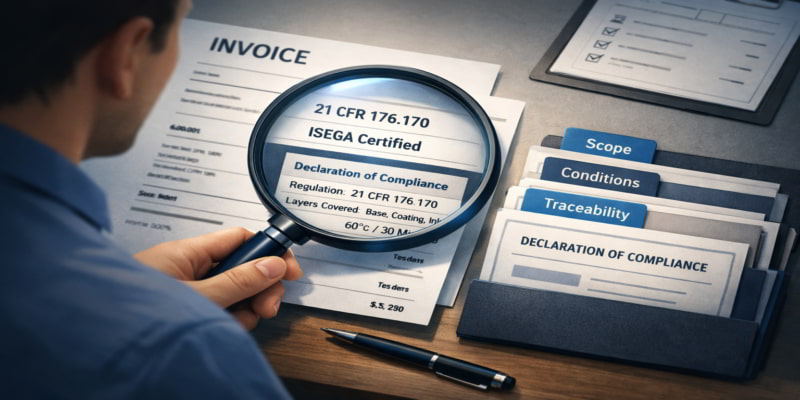
Imagine reviewing an invoice for takeout paper. One line cites “21 CFR 176,” while another mentions “ISEGA certified.” For a restaurant operator, these are more than acronyms—they are the legal baseline for your food packaging paper.
These acronyms indicate which regulatory system the supplier’s documentation aligns with. FDA 21 CFR references US food-contact rules. ISEGA is a German testing institute that evaluates materials against European frameworks. Neither acronym automatically means “safe for your use.”
The practical question is whether documentation covers your specific material—paper, coatings, inks—under actual contact conditions, which is why understanding food packaging paper specifications matters. Think of certifications as a driver’s license: they signal that someone passed a test under specific conditions, but you still need the correct, in-scope proof for where you operate.
A certificate for room-temperature dry goods won’t protect you when hot, greasy food sits in that container for 45 minutes during delivery—a gap the guide Stop Serving Soggy Food: The Operator’s Clear Guide to GSM and Kit Levels in Food Packaging Paper addresses from a performance specification perspective.
FDA (21 CFR): What It Covers for Takeout Food Packaging Paper

The US Food and Drug Administration regulates food-contact materials through Title 21 of the Code of Federal Regulations. For paper and paperboard—including food grade kraft paper—the key sections are 21 CFR 176.170 (for contact with aqueous and fatty foods) and 21 CFR 176.180 (for dry foods). Note that 176.170 is the stricter standard; paper compliant with 176.170 is generally acceptable for 176.180 applications, but the reverse is not true. These regulations list permitted substances and set limits on extractable compounds—what can migrate from paper into food. For a broader overview of how FDA regulates packaging materials, see the FDA Packaging & Food Contact Substances page.
Common indicators on a Declaration of Compliance (DoC) include:
• “Compliant with 21 CFR 176.170”
• “Meets FDA food-contact requirements for paper/paperboard”
• References to food-type categories (aqueous, fatty, dry)
A critical distinction: The phrase “FDA approved” is legally inaccurate for food-contact materials. FDA doesn’t approve specific paper products pre-market the way it approves drugs. Manufacturers must ensure their materials comply with applicable regulations—the responsibility sits with them, not with pre-market FDA approval.
This distinction matters during inspections. An inspector won’t ask for an “FDA approval letter.” They’ll ask whether you can demonstrate that your food packaging paper complies with requirements for the food types and contact conditions in your operation.
ISEGA Explained: What It Signals (and What It Doesn’t)
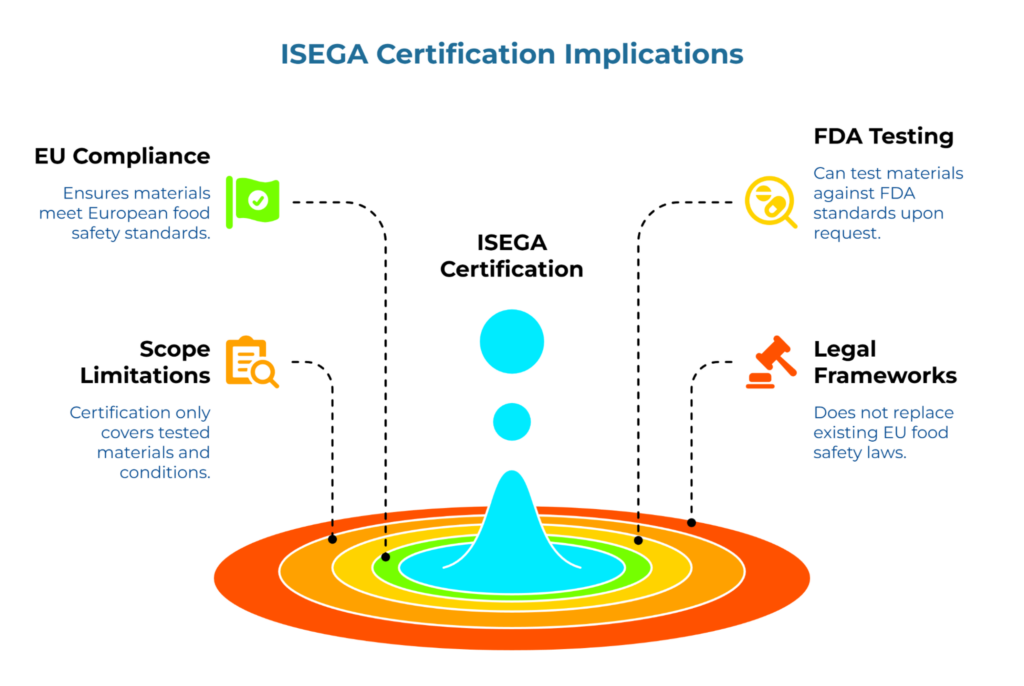
ISEGA is an independent German testing and certification institute specializing in food-contact materials. When a supplier references ISEGA certification, they are typically indicating that a third-party laboratory has tested the material against European frameworks (such as BfR or EU regulations). However, note that ISEGA is a testing institute, not a standard itself; while they primarily certify for the EU market, they can also test against FDA standards. Always verify which specific regulation the certificate references. Importantly, ISEGA is not a law—it does not replace the legal frameworks that apply in the EU market.
ISEGA testing typically evaluates compliance with EU Regulation 1935/2004—the overarching EU framework requiring that food-contact materials not transfer substances in quantities that could endanger health or cause unacceptable changes to composition, taste, or odor. For authoritative guidance on EU food-contact rules, see the European Commission Food Contact Materials page. For paper specifically, testing often references Germany’s BfR Recommendation XXXVI, which provides detailed guidance on permitted substances for paper and paperboard.
The scope problem: An ISEGA certificate covers only what was actually tested. ISEGA’s service descriptions show they work across multiple material categories—paper, plastics/laminates, adhesives, lacquers/colors—which is a clue that coverage depends on what was actually evaluated. If certification applies to the base paper but not the grease-resistant coating, or if testing was conducted at room temperature when you use the food packaging paper for hot food, the certificate may not cover your actual use case—a phenomenon explained in Why Food-Safe Labels Fail: How Compliance Decay Happens in Food-Grade Packaging Paper. This scope limitation applies to any food-contact testing—the certificate answers a specific question under specific conditions.
FDA vs. ISEGA Comparison Table
| What it is | Where it matters most | What you should see on paperwork | Common misconceptions / red flags |
| FDA 21 CFR: US regulatory framework listing permitted substances and extractive limits for food-contact paper | US market operations | DoC citing 21 CFR 176.170 or 176.180; food-type classifications (aqueous, fatty, dry) | Vague “FDA compliant” without specific CFR sections; assuming “FDA approved” means pre-market approval |
| ISEGA Certification: German third-party testing against EU frameworks (EU 1935/2004, BfR XXXVI) | EU market operations; also recognized internationally | Certificate number; test report referencing EU 1935/2004 or BfR XXXVI; testing conditions (temperature, time, simulant) | Certificate scope doesn’t cover coatings, inks, or your actual temperature conditions |
Note: Neither certification guarantees that secondary components—such as inks, adhesives, or specialized coatings—are included in the testing scope, a gap explored further in The Compliance Shield: How to Audit Your Food Packaging Paper Suppliers for FDA & ISEGA Safety.
Which One Do You Need? A 3-Question Decision Checklist
1. Where does your food packaging paper get used?
US operations need FDA-referenced documentation. EU operations need EU-aligned evidence. Many international food packaging paper suppliers offer dual compliance—materials tested against both frameworks. This dual-verification streamlines procurement and mitigates cross-border regulatory risk.
2. What are the specific contact parameters?
Consider: What food types touch the paper? Greasy, aqueous, dry, acidic? For how long? At what temperature? Does food sit at high temperatures for 30 minutes during delivery, or is it room-temperature dry goods?
Your documentation must cover conditions at least as demanding as actual use. Room-temperature certification doesn’t protect you when hot food contacts that food packaging paper during a delivery run—a compliance gap addressed in Navigating Specific Migration Limits (SML): A Global Compliance Workflow for Food-Grade Packaging Paper.
3. Does the paperwork explicitly cover every layer?
Food-contact paper often has multiple components: base paper, grease-resistant coating, inks, adhesives. A DoC may cover only the base paper. Ask your supplier directly whether compliance documentation covers every material layer that contacts food—and get that answer in writing.
Invoice-Decoding: How to Ask Your Supplier the Right Questions
Documentation beats labels. Scope, conditions, and traceability are what survive audits—not marketing claims or logos on food packaging paper.
Request the Declaration of Compliance (DoC) and test scope:
“Can you provide the DoC for this product? I need to verify which regulations it references and what materials are covered.”
A proper DoC should name the specific regulatory framework (21 CFR 176.170 for US; EU 1935/2004 or BfR XXXVI for EU) and clarify whether it covers the complete finished article.
Ask about component coverage:
“Does this compliance documentation cover the grease-resistant coating and any inks or adhesives? Or does it apply only to the base paper?’ For a structured approach to these questions, see Why Food Packaging Paper Suppliers Fail Food Contact Compliance Verification Protocol.”
Confirm testing conditions:
“What were the testing conditions—temperature, contact time, and food simulant? Will these cover hot greasy food for 45 minutes?”
Request traceability:
“Can you provide the test report reference number and the date of the most recent compliance verification?’ The How to Verify Food Contact Compliance Beyond Certificates: A Supplier Shield Modelexplains how to structure this verification systematically.”
Identifying the “Food Safe” Marketing Trap
That phrase alone isn’t documentation. “Food safe” is a marketing claim, not a regulatory reference. Ask for the DoC naming specific regulations (21 CFR section or EU 1935/2004). If suppliers can’t provide documentation beyond “food safe,” treat it as a warning sign.
Critical Compliance Clarifications
Am I breaking the law if I buy European (ISEGA) paper for US use?
It depends on your liability framework. While both seek to prevent migration, a certificate verifying compliance only with European standards (even from a reputable body like ISEGA) does not validate compliance under US law (21 CFR). To be valid in the US, the documentation must explicitly state compliance with FDA regulations (e.g., 21 CFR 176.170), regardless of which institute performed the testing. For US use, buyers typically want documentation that references relevant FDA/21 CFR pathways rather than relying on a non-US certificate alone. Dual-certified materials—tested against both FDA requirements and EU frameworks—avoid this ambiguity.
If my supplier says “food safe,” what exact document should I ask for?
Request the Declaration of Compliance (DoC) that names the specific regulation: 21 CFR 176.170 or 176.180 for US markets, or EU 1935/2004 and BfR XXXVI for EU markets. The DoC should state what materials are covered and under what conditions. Without this, “food safe” remains an unverified claim.
Does a certificate cover inks, coatings, and adhesives automatically?
No. Certificates cover what was specifically tested. If testing was performed on uncoated base paper, adding a grease-resistant coating or printed graphics introduces materials not included in that original certification scope. Ask explicitly whether documentation covers every material layer contacting food.
What happens during an inspection or import check?
Inspectors typically ask whether you can produce documentation demonstrating that your food-contact materials comply with applicable regulations. Having organized, traceable documentation—DoCs, test reports with scope and conditions, certificate numbers—turns an inspection question into a quick file retrieval. The Food Packaging Paper Sourcing Matrix: Balancing Safety Certification with Performance Specs provides a framework for organizing this documentation. Missing or vague documentation turns it into a problem.
The acronyms on your invoices are signals, not substitutes for due diligence. FDA and ISEGA each point toward a regulatory framework—but the documentation behind those references determines whether your food packaging paper actually meets compliance expectations for your specific operation.
This article is the foundation of a documentation-first sourcing approach. You now know what the acronyms mean, where they apply, and which questions surface the details that matter. The next step is building a repeatable process: standardized supplier questions, binder-ready documentation, and verification before you commit.
Further Reading:
See the food-grade certification checklist for delivery packaging bags to verify what documentation should include.
Learn how to verify compliance beyond certificates when a logo isn’t enough.
Understand why migration testing scope changes across markets.
Ready to explore supplier options? Browse food packaging paper suppliers and food packaging paper mills to request the right documentation.
Disclaimer:
This guide is informational and documentation-focused. Requirements can vary by market, product, and conditions of use; when stakes are high, verify documentation and interpretations with qualified compliance support.
Our Editorial Process:
Our expert team uses AI tools to help organize and structure our initial drafts. Every piece is then extensively rewritten, fact-checked, and enriched with first-hand insights and experiences by expert humans on our Insights Team to ensure accuracy and clarity.
About the PaperIndex Insights Team:
The PaperIndex Insights Team is our dedicated engine for synthesizing complex topics into clear, helpful guides. While our content is thoroughly reviewed for clarity and accuracy, it is for informational purposes and should not replace professional advice.