

📌 Key Takeaways
Most suppliers fail food contact compliance verification not because their materials are unsafe, but because they cannot produce audit-grade evidence when it matters.
- Proof Quality Beats Price: Screens for traceable, retrievable documentation—not cost—and most suppliers fail because evidence cannot survive audit scrutiny.
- Three Failure Modes Predict Risk: Certificates without test reports, test conditions that do not match actual use, and weak change control account for nearly all verification failures.
- Stage Your Verification: A ten-minute triage separates governable suppliers from the rest before deeper diligence consumes procurement time on candidates who cannot produce evidence.
- Score Decisions Consistently: A five-pillar CRA Scorecard converts subjective judgment into repeatable pass/fail decisions that hold up under audit pressure.
- Approval Starts Compliance, Not Ends It: Defined re-verification triggers and retrieval drills prevent the compliance decay that accumulates when materials, mills, or processes change undocumented.
Structured evidence packs separate verifiable suppliers from those who merely appear compliant.
Procurement and quality assurance professionals sourcing food-contact packaging will gain a repeatable verification framework here, preparing them for the detailed protocol and questionnaire that follows.
~ ~ ~ ~ ~ ~ ~ ~ ~ ~ ~ ~ ~ ~ ~ ~ ~ ~
A supplier sends over a compliance certificate. The logo looks official. The document references the right regulations. Everything appears in order—until the quality assurance team requests the underlying test reports. Suddenly, silence. Or worse: a generic document that cannot be traced to specific materials, test conditions, or batch numbers.
A supplier may offer competitive pricing and claim full regulatory compliance, yet fail verification because their documentation cannot answer three critical questions: Can the evidence be retrieved quickly and consistently? Can it be tied to specific materials and batches? Does it reflect actual conditions of use?
The verification approach operates on two layers. First, a fast triage screen that takes approximately ten minutes and determines whether a supplier is worth deeper investigation. Second, a structured evidence review that examines documentation quality, traceability, and change control procedures. This staged approach matches verification rigor to risk without consuming disproportionate procurement time on suppliers who cannot pass basic evidence thresholds.
Why Most Suppliers Fail: The Three Recurring Failure Modes
When suppliers fail food contact compliance verification, the reasons cluster into three predictable patterns. Understanding these failure modes allows procurement and quality teams to screen more efficiently and ask the right questions earlier in the sourcing process.
The consequences of inadequate verification extend beyond documentation gaps — the hidden risk of unverified suppliers can compromise entire supply chains.
Failure Mode 1: Certificates Without Supporting Evidence
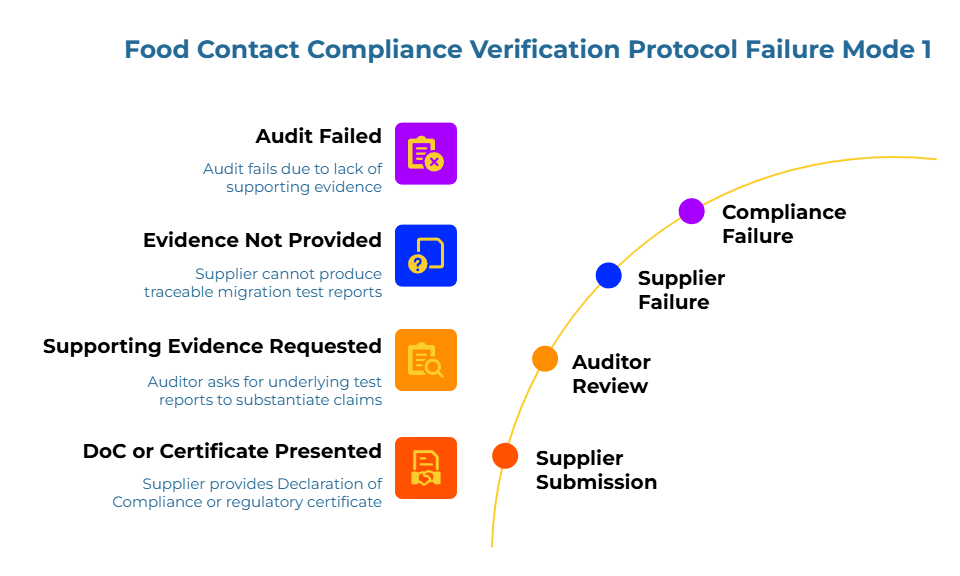
Certificates do not prove ongoing compliance under real conditions of use. The most common failure occurs when a supplier presents a Declaration of Compliance (DoC) or regulatory certificate but cannot provide the underlying test reports that substantiate the claims. A valid DoC should be supported by traceable migration test reports that identify the testing laboratory, the specific test method used, the batch or sample identification, conditioning protocols, and the scope of materials covered.
Auditors and regulatory bodies require the ability to trace compliance claims back to specific, dated test results.
For practical guidance on distinguishing legitimate documentation from questionable submissions, buyers can reference methods for identifying fake FSC, PEFC, ISO certificates versus real ones.
Failure Mode 2: Specification-Verification Mismatch
A supplier may possess legitimate test documentation that nonetheless fails to match actual conditions of use. Migration testing must reflect the real-world application: temperature exposure, contact duration, and food simulant type all affect whether a material performs safely. A test report demonstrating compliance at room temperature provides limited assurance for packaging that will contact hot foods. Similarly, testing with aqueous simulants may not address migration risks for fatty or acidic foods.
This mismatch often goes undetected because procurement teams accept test reports without verifying whether the test conditions align with their specific application requirements. The result is documentation that satisfies a checkbox but does not actually demonstrate fitness for the intended use.
Failure Mode 3: Chain-of-Custody and Change Control Latency
Compliance decay happens when change control is weak and evidence packs are not updated. Initial qualification documents may have been accurate at the time of approval, but materials, processes, and suppliers change. A new coating formulation, a different ink supplier, a relocated production facility, or a substituted raw material can all affect migration properties—yet these changes frequently occur without customer notification or evidence refresh.
Traceability gaps compound this problem. If a supplier cannot demonstrate clear lot-to-lot linkage between delivered goods and the specific materials that were tested, the entire chain of evidence breaks. One-time documents do not prevent drift; ongoing compliance depends on robust change control procedures and the discipline to maintain them.
The Four-Gate Food Contact Compliance Verification Protocol

Verification protocols require traceable test reports, declarations, and change control—not just certificates. The following staged approach allows procurement and quality teams to match verification depth to supplier risk while maintaining consistent standards across the supply base.
Gate 1: Ten-Minute Triage
The triage stage applies six pass/fail questions designed to force evidence production rather than accept claims at face value:
- Can the supplier provide a Declaration of Compliance that names the specific regulation scope, material identifiers, date of issue, and authorized signatory?
- Can the supplier provide at least one traceable migration test report with identified laboratory, test method, date, sample ID, conditioning protocol, and scope?
- Are conditions of use (time, temperature, simulant) stated clearly enough to compare with the intended application?
- Can the supplier describe their change control process and identify what changes trigger customer notification?
- Can the supplier provide batch traceability documentation linking delivered goods to specific production lots and input materials?
- Can the supplier retrieve the requested evidence quickly—within 24 to 48 hours—when asked?
A supplier who cannot answer these questions within 48 to 72 hours is unlikely to pass deeper verification. The triage stage efficiently filters the supplier pool before investing additional procurement time. A supplier who fails Gate 1 is not necessarily unsafe; they are simply not governable in an audit-grade workflow.
Gate 2: Minimum Evidence Pack
Suppliers who pass triage must provide a complete evidence pack. “Traceable” means each document can be linked to specific materials, dates, and responsible parties. The compliance audit checklist for packaging suppliers provides additional guidance on structuring evidence requirements.
Gate 3: Risk-Based Verification
This gate aligns evidence to actual conditions of use. Verification must confirm that test conditions (temperature, contact time, food simulant) match the buyer’s application requirements. For high-criticality applications or elevated volume, verification should include independent review of Specific Migration Limits (SML) and Overall Migration data against regulatory thresholds. Resources such as FDA guidance on food-contact substances and the EU framework regulation for food contact materials provide authoritative reference points.
For suppliers located internationally, these verification gates can be executed remotely using the zero-trust sourcing model for verifying overseas suppliers without travel.
Gate 4: Ongoing Monitoring Triggers
Qualification is not a one-time event. Gate 4 establishes the triggers that force re-verification: material changes, production relocations, process modifications, and annual reviews. Without defined monitoring triggers, compliance status degrades over time as undocumented changes accumulate.
The Minimum Evidence Pack: What to Request and How to Judge It
The following table defines the documentation required for each supplier under consideration. Red flags indicate common deficiencies that should prompt additional scrutiny or disqualification.
| Evidence Item | What It Proves | Non-Negotiable Fields | Common Red Flags | Internal Owner |
| Declaration of Compliance (DoC) | Supplier assertion of regulatory conformity | Regulation scope, material IDs, issue date, authorized signatory | Undated, unsigned, or missing regulation reference | Quality Assurance |
| Migration Test Reports | Material performance under specified conditions | Lab ID, method, simulant, temperature, time, detection limits, sample ID | Generic reports, conditions not matching application, missing lab accreditation | Quality Assurance |
| Material Composition Identifiers | Traceability to specific formulations and inputs | Formulation codes, substrate grades, coating/ink specifications | Vague descriptions, inability to link to test reports | Procurement / QA |
| Change Control Documentation | Supplier process for managing and communicating changes | Change notification policy, approval workflow, evidence refresh triggers | No documented process, no customer notification commitment | Quality Assurance |
| Batch/Lot Traceability Pack | Linkage between delivered goods and production records | Lot codes on delivery documents, production date ranges, input material batch IDs | Missing lot codes, inability to trace back to specific production runs | Procurement / Receiving |
Normalization Table: Making Suppliers Comparable
A standardized evidence pack enables fair comparison across multiple suppliers. The matrix below normalizes supplier performance across five evidence vectors:
| Evidence Pack Component | Supplier A | Supplier B | Supplier C |
| DoC has scope + material IDs + date + signer | ✅ | ⚠️ (missing IDs) | ✅ |
| Test report includes method + lab + sample ID + conditioning + conditions | ✅ | ❌ | ⚠️(conditions unclear) |
| Change control SOP with notification triggers | ⚠️ | ❌ | ✅ |
| Batch/lot traceability example pack provided | ✅ | ❌ | ⚠️ |
| Retrieval drill: can produce docs within 24 hours | ✅ | ❌ | ✅ |
CRA Scorecard: A Governance Tool for Pass/Fail Decisions
A Compliance Readiness Assessment (CRA) Scorecard converts judgment into a consistent decision rule. Five pillars are scored on a 0-2 scale, with an explicit pass threshold that removes ambiguity from supplier approval decisions.
Scoring key: 0 = missing or weak, 1 = partial, 2 = audit-grade
| CRA Pillar | 0 (Fails) | 1 (Partial) | 2 (Audit-Grade) |
| DoC integrity and scope clarity | Generic or undated; scope unclear | Present but missing key fields | Clear scope + IDs + signer + date |
| Test report traceability | No traceable report | Report exists but missing key metadata | Method + lab + sample ID + conditioning + conditions |
| Conditions-of-use match | No mapping to real use | Partial mapping; gaps remain | Evidence matches intended use conditions |
| Change control governance | No defined process | Policy exists but vague | SOP + triggers + notification workflow |
| Batch/lot traceability and retrieval discipline | Traceability unclear; retrieval unreliable | Some traceability; slow retrieval | Example trace pack + reliable retrieval drill |
A score of 8 out of 10 or higher represents a reasonable pass threshold for routine programs. Higher-volume or higher-criticality procurement may warrant stricter thresholds. The scorecard does not guarantee compliance—it provides a governance tool that makes approval decisions repeatable and defensible.
Risk-Based Thresholds: When Verification Must Get Stricter
At scale, risk becomes predictable—so verification must tighten with volume and criticality. Standard practice calls for document review at the start of a supplier relationship. However, when supply chain volume exceeds approximately 50 tons per month, the probability of compliance drift becomes material. Small risks compound across high-volume operations, and the consequences of a compliance failure scale proportionally.
The following matrix provides a structured framework for adjusting verification intensity:
| State | What to Do | Why It Matters |
| Standard | Document review at onboarding | Establish baseline evidence set early |
| Exception trigger | When volume exceeds 100 metric tons per quarter | Drift risk becomes material at scale |
| Mechanism | Compliance drift occurs at scale | More change events, more lots, more opportunities for mismatch |
| Pivot | Apply the same acceptance threshold logic to ongoing audits | Keep the bar consistent over time, not just at onboarding |
For high-volume relationships, apply the same acceptance threshold logic used during initial qualification to ongoing audits. This means periodic evidence refresh requests, random batch verification, and more rigorous change control monitoring. Concentration risk amplifies when high-volume suppliers lack robust, on-demand evidence retrieval protocols
Copy-Paste Supplier Questionnaire: Fast Screen Before RFQs
The following questionnaire can be sent to prospective suppliers before issuing formal requests for quotation. Each question maps to one of the three failure modes and is designed to force evidence production rather than accept general assurances. For a condensed verification approach, the seven questions to ask a new supplier that scammers can’t answer provides a rapid screening framework.
| Question | Failure Mode | Pass Criteria |
| Submit a formal Declaration of Compliance (DoC) including regulatory scope, material IDs, date of issuance, and a verified signatory. | FM1 | All four fields present and verifiable |
| Provide migration test reports identifying laboratory, test method, simulant type, temperature, contact time, and detection limits. | FM1 | Complete report with accredited lab identification |
| In the test report, list the key conditions and state which product variant or material ID the report applies to. | FM1/FM2 | Clear linkage between report and specific material |
| Confirm the test conditions (temperature, time, simulant) match our intended application: [specify your conditions]. | FM2 | Test conditions meet or exceed application requirements |
| Describe the food types and contact conditions for which this material has been tested and approved. | FM2 | Documented scope covers buyer’s application |
| Identify any coatings, inks, or adhesives used with the paper and state whether the compliance scope includes them. | FM2 | All components covered under compliance documentation |
| Provide a material composition identifier list (how the supplier distinguishes grades and variants). | FM1/FM3 | Clear identification system for grades and variants |
| Describe your change control process. What changes trigger customer notification? | FM3 | Documented policy with defined notification triggers |
| Confirm whether subcontractors or alternate mills are used. If yes, describe how evidence remains traceable across sites. | FM3 | Traceability maintained across all production sites |
| List any material, formulation, or process changes made in the past 12 months that affect food-contact properties. | FM3 | Complete disclosure with evidence of retesting where applicable |
| Provide batch traceability documentation linking a recent shipment to production lot and input material batch IDs. | FM3 | Clear linkage from delivery to production records |
| Identify the testing laboratory used and confirm its accreditation status for food-contact material testing. | FM1 | Named laboratory with verifiable accreditation |
| State how long the supplier retains test reports, DoCs, and batch records. | FM3 | Retention period meets or exceeds buyer requirements |
| If a raw material substitution occurs, describe the evidence refresh process and who approves it. | FM3 | Defined process with clear approval authority |
| Provide your company registration certificate and confirm the legal entity that will appear on invoices. | FM3 | Verifiable via public registry |
| How quickly can you retrieve and provide compliance documentation if requested during an audit? (Target: within 24 hours) | FM1/FM3 | Confirmed 24-hour retrieval capability |
This questionnaire complements broader supplier screening methodologies, including how to vet corrugated box suppliers for technical competence before you send an RFQ.
How to Maintain Compliance After Approval
Approval marks the beginning of compliance management, not the end. A robust governance model for pharmaceutical packaging compliance illustrates how organizations maintain compliance between audits through defined accountability, evidence requirements, and change controls.
The following triggers should prompt re-verification of an approved supplier:
- New coating, ink, or adhesive formulations applied to the material
- New manufacturing facility or subcontractor involvement
- Raw material substitution affecting migration barrier properties
- Process parameter changes that could impact migration barrier integrity
- Annual review cycle (minimum) regardless of reported changes
When a change is detected, the decision path is straightforward: if the change affects coating, ink, adhesive, mill, subcontractor, raw material, or process barrier, request refreshed evidence (DoC plus relevant test traceability) and re-score the CRA. If the change does not affect these areas, log the change, confirm no scope impact, and maintain the monitoring cadence.
Governance Practices That Prevent Frantic Audits
Effective evidence management requires three operational commitments. First, define a single evidence storage location with clear access rules and version control that distinguishes current approved documents from superseded versions. Second, establish a retrieval service level agreement—the ability to produce complete documentation within 24 hours. Third, run periodic retrieval drills and treat failures as a governance issue rather than a paperwork inconvenience.
Consider what failure looks like in practice: a food service procurement manager preparing for a routine customer audit on a tight timeline finds that the supplier’s certificate is easy to email, but the underlying test report cannot be retrieved quickly. No one can confirm the sample ID or conditions of use. Under pressure, the team pauses a rollout and scrambles for substitutes. The immediate pain is not regulatory theory—it is operational disruption caused by missing, non-traceable evidence.
Regulatory and Standards References
The following resources provide authoritative guidance on food-contact material requirements:
- FDA guidance on food-contact substances – Overview of U.S. regulatory framework for packaging materials
- 21 CFR 170.39 Threshold of regulation – Establishes the process for determining when a substance used in a food-contact article has such a low level of migration (typically 0.5 ppb or less) that it is exempted from the requirement of a food additive petition (FAP)
- EU framework regulation for food contact materials – European Commission guidance on FCM requirements
- EFSA guidance for food-contact material submissions – Technical dossier requirements for European authorization
- Verify a supplier’s legal entity record – OpenCorporates company search for entity verification
Key Terms Defined
- Food Contact Materials (FCM): Materials intended to contact food; regulated to prevent harmful migration or changes to food.
- Food Contact Substance (FCS): FDA term for substances intended for use as components of food-contact materials.
- Declaration of Compliance (DoC): Supplier statement of compliance supported by test evidence and traceability.
- Specific Migration Limit (SML): Maximum permitted migration of a specific substance into food or simulant under defined conditions.
- Overall Migration: Total migration of non-volatile substances from material to food or simulant.
- Change Control: Controlled process for material or process changes, including notification, approval, and evidence refresh.
- Traceability: Ability to link delivered goods to specific batches or lots, inputs, and process records.
Disclaimer:
This article is provided for informational purposes only and does not constitute legal, regulatory, or professional advice. Requirements for food-contact compliance can vary by jurisdiction and application. Always consult qualified regulatory and quality professionals for decisions affecting compliance.
Our Editorial Process:
Our expert team uses AI tools to help organize and structure our initial drafts. Every piece is then extensively rewritten, fact-checked, and enriched with first-hand insights and experiences by expert humans on our Insights Team to ensure accuracy and clarity.
About the PaperIndex Insights Team:
The PaperIndex Insights Team is our dedicated engine for synthesizing complex topics into clear, helpful guides. While our content is thoroughly reviewed for clarity and accuracy, it is for informational purposes and should not replace professional advice.