

📌 Key Takeaways
Certificates capture a moment in time, not an ongoing state—compliance decay happens silently when documentation lags behind supply chain changes.
- Certificates Are Snapshots, Not Shields: A Declaration of Conformity validates conditions at testing, not current production after mills shift, coatings change, or converters substitute materials.
- Compliance Decays Through Four Steps: Snapshot paperwork, upstream change events, documentation lag, and audit exposure form a predictable pattern that verification habits can interrupt.
- “Food-Safe” Is Marketing, Not Regulation: The term signals intent without identifying governing frameworks, test conditions, material recipes, or validity windows—requiring formal declarations instead.
- Evidence Stacks Answer Four Questions: What exactly is it, what claim under which framework, under what conditions of use, and is it current and traceable to what shipped?
- Quarterly Spot Checks Prevent Audit Panic: Randomly comparing one shipment per month against documentation on file catches drift before inspections reveal gaps.
Verification is a habit, not a filing cabinet—compliance confidence is earned through ongoing attention.
Procurement managers and QA professionals responsible for food-contact packaging will gain a repeatable framework for catching documentation drift, preparing them for the detailed verification checklists that follow.
~ ~ ~ ~ ~ ~ ~ ~ ~ ~ ~ ~ ~ ~ ~ ~ ~ ~
The auditor’s clipboard hits the table.
Fluorescent lights buzz overhead. Someone is already sprinting to the file room, pulling folders that haven’t been opened since the last supplier qualification. The certificates are there—dated, signed, official-looking. But as the auditor cross-references lot codes against the morning’s delivery, a quiet dread settles in. Does this paperwork actually match what arrived on the pallet?
This is the moment when “food-safe” labels reveal their fundamental limitations.
The team sends the supplier certificate marked “Food Safe / FDA / EU Compliant.” The auditor asks: “For which conditions of use? Which components? Which dates? Which sites?” That is where labels stall—and where the distance between a marketing claim and verified compliance becomes painfully visible.
Food packaging paper functions as a barrier system, not a commodity. It represents specialized materials engineered to prevent chemical migration—a surgical barrier for the food supply chain. If that barrier has an untracked seam—an ink change, a coating substitution, an outdated declaration—the system can fail even if the outer label stays the same. The confidence of knowing every wrap is verifiably safe requires more than collecting certificates at the start of a supplier relationship. It requires verification-first sourcing: treating compliance not as a static file, but as a live signal that can degrade without deliberate attention.
Most procurement and QA professionals understand HACCP principles. They know how to qualify suppliers. But a persistent misconception undermines even rigorous programs: the belief that a “food-safe” label or Declaration of Conformity (DoC) provides durable protection.
It doesn’t.
In food-contact packaging, “food-safe” typically signals an intent to be suitable for food contact. It does not, by itself, identify the governing legal framework, the test conditions, the exact material recipe (including inks, adhesives, and coatings), or the validity window of supporting documents. The term varies by jurisdiction and by how each supplier uses it. A certificate is a snapshot—and distinguishing fake FSC, PEFC, ISO certificates from real ones requires more than surface inspection. Compliance is dynamic. And the gap between them creates what experienced food safety professionals recognize as compliance decay.
Critical Limitations of ‘Food-Safe’ Designations
Certificates are point-in-time artifacts. A DoC confirms that a specific material, produced under specific conditions, at a specific facility, met regulatory requirements when tested. The document captures a moment—not an ongoing state.
However, production is fluid. Compliance degrades through operational shifts that rarely trigger automatic documentation updates:
- A supplier shifts production to a different mill or line
- A coating formulation changes to reduce costs or improve performance
- Recycled content ratios vary between batches
- A converter substitutes an ink, adhesive, or barrier treatment
None of these changes necessarily appear on the packaging received at your dock. The certificate in your file may remain technically authentic—referencing real tests, real facilities, real dates—while no longer reflecting what actually arrives.
Your role is not simply to collect documents. It is to align those documents to the specific material, process, and batch reality of each shipment. This distinction separates reactive audit panic from the quiet confidence of verification-first sourcing.
How Compliance Drift Occurs- A Four-Step Pattern
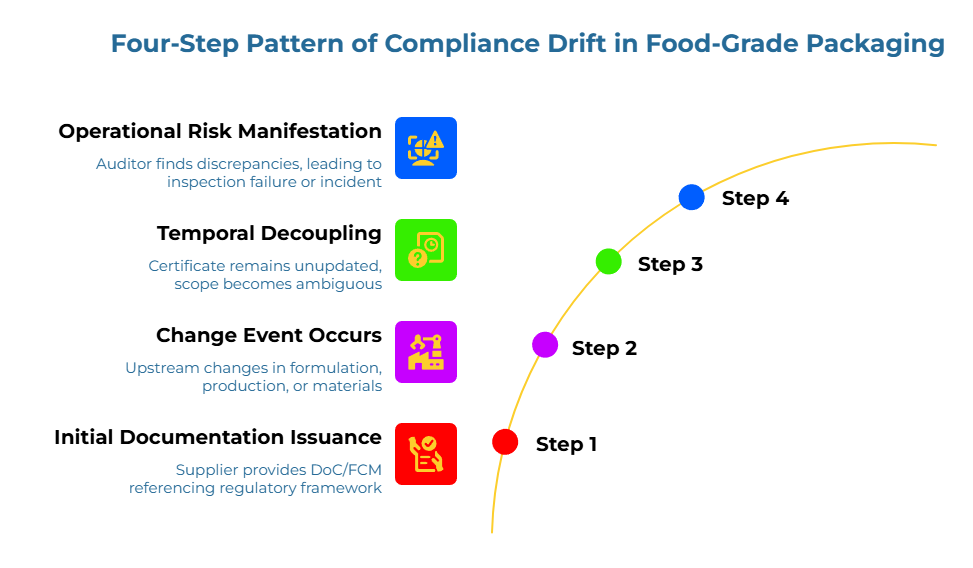
Compliance drift follows a recognizable sequence. Understanding this mechanism transforms abstract risk into something you can detect and interrupt.
Step 1: Initial Documentation Issuance
A supplier provides a DoC or FCM (Food Contact Material) statement.
The document references a regulatory framework — FDA 21 CFR Part 176 Subpart B section 176.170 for US markets, EU Regulation 1935/2004 (the framework regulation) and EU 2023/2006 (GMP) for European applications, or specific national standards like Germany’s BfR Recommendation XXXVI for paper and board. While the EU has harmonized plastic regulations (EU 10/2011), paper and board often rely on these national recommendations to demonstrate compliance with the broader EU safety mandates (European Commission, Food Contact Materials). You file it, satisfy the initial supplier pre-qualification requirement, and move forward.
Step 2: A Change Event Occurs
Upstream, something shifts. The supplier reformulates a barrier coating. Production moves to a facility with different equipment—perhaps a different one among food grade kraft paper mills with varying process controls. A converter in the supply chain switches adhesive vendors to manage costs. The original test basis—the specific combination of materials, processes, and conditions that the certificate validated—no longer describes current output.
Step 3: Temporal Decoupling
The certificate isn’t updated. Its scope becomes ambiguous. The document still exists, still looks official, still references legitimate testing. But it now describes a product configuration that may no longer exist in the form you’re receiving.
Step 4: Operational Risk Manifestation
An auditor requests traceability. Lot codes don’t align. Migration limits validated for the original formulation may not apply to the current material. The gap between documentation and reality becomes visible at the worst possible moment—during an inspection, a customer complaint, or a safety incident.
This four-step pattern explains why standard advice breaks down at scale. The conventional approach—reviewing documents when first qualifying a supplier—works adequately for simple, low-volume relationships. It fails when volumes reach industrial scales where manual batch-tracking becomes decentralized, when supply chains diversify across multiple mills and converters, or when supplier relationships span years without systematic re-verification.
Compliance drift increases as supply chain complexity grows. One-time document checks cannot keep pace with the operational changes that accumulate silently over months and years.
Myth vs. Reality: Certificate Red-Flag Checklist
Most certificate failures are discoverable through a small set of targeted questions. The following checklist identifies five common misconceptions—often functioning as fraud-prone shortcuts—and the verification steps that expose them.
Myth 1: “Scope Misconception: Universal Coverage.”
Reality: Certificates have scope limits. A DoC may apply only to specific product codes, specific grades, or specific intended food types (dry goods versus fatty foods versus aqueous contact). A generic document that doesn’t explicitly reference your SKU, coating variant, or application conditions may provide no actual coverage.
Verification step: Request documentation that names the exact product code, coating system, and intended food contact conditions for your specific orders. If the supplier cannot provide this specificity, the certificate’s relevance to your shipments is questionable.
Myth 2: “The certificate date is recent, so we’re current.”
Reality: A recent date confirms when testing occurred. It does not confirm that current production matches tested conditions. If the supplier changed mills, reformulated coatings, or modified processes after the test date, the certificate may be authentic but no longer applicable.
Verification step: Ask for the supplier’s change control policy. Specifically: what events trigger a document update? If the answer is vague or nonexistent, documentation lag is likely.
Myth 3: “Our supplier is certified, so the material is compliant.”
Reality: Supplier-level certifications—ISO 22000, or the GFSI-recognized FSSC 22000 (which includes ISO 22000 plus industry-specific PRPs like ISO/TS 22002-4 for packaging)—confirm that management systems and hygiene controls are in place. They do not confirm that a specific product meets migration limits or Specific Migration Limits (SML) for your intended use. Facility certification and product compliance are separate questions.
Verification step: Request product-specific migration testing data or a DoC that explicitly references the relevant regulatory standard and SML values for your application. For third-party certifications like FSC or ISO, run a quick registry check to confirm validity.
Myth 4: “The label says ‘food-safe’—that’s sufficient.”
Reality: “Food-safe” is a marketing term without regulatory definition. It communicates nothing about which standards were tested, what food types are covered, what temperature or contact duration conditions apply, or whether the claim extends to the specific batch you received. As the FDA notes in its guidance on “Is It Really ‘FDA Approved’?”, claims like “FDA approved” are often used loosely and can mislead if they imply blanket endorsement.
Verification step: Require a formal DoC naming the regulatory framework (FDA, EU, national standards), test methods, and migration limits. Reject vague assurances that cannot be traced to documented testing.
Myth 5: “We’ve used this supplier for years without problems.”
Reality: History demonstrates past performance, not current compliance. Supply chains evolve continuously. A supplier who was fully compliant three years ago may have made multiple upstream changes—mill consolidations, formulation adjustments, converter substitutions—none of which automatically triggered customer notification.
Verification step: Request annual confirmation that no material changes affecting food contact compliance have occurred. Alternatively, establish batch-level traceability that links each shipment to current documentation.
For deeper guidance on structuring your compliance audit checklist for packaging suppliers, PaperIndex Academy provides frameworks that expand these verification principles into systematic supplier review processes.
High-Level Internal Audit Protocol
Pull three certificates from your active supplier files. For each document, answer three questions:
- Does it name the specific product code you currently receive?
- Does it reference a regulatory standard with specific migration limits—not just “food-safe” or “suitable for food contact”?
- Does it include a change control statement explaining what triggers updates?
Any “no” or “unclear” answer identifies a supplier requiring immediate follow-up. This exercise, repeated quarterly, catches drift before it reaches audit exposure.
What Good Documentation Looks Like
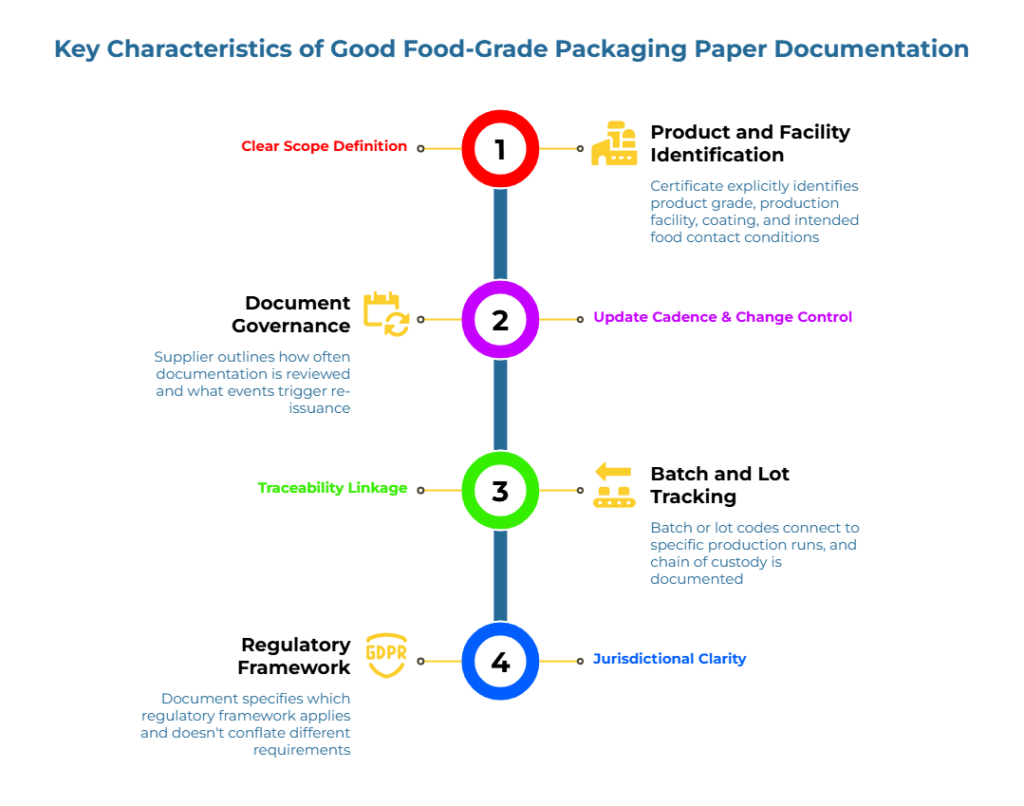
Documents that resist compliance decay share four characteristics. When evaluating suppliers or requesting updated paperwork, use these criteria as a benchmark.
Clear scope definition. The certificate explicitly identifies the product grade, production facility (food packaging paper mills and line where relevant), coating or barrier system, and intended food contact conditions. Ambiguity in any of these elements undermines the document’s value. A DoC covering “paper products” without further specification provides minimal assurance.
Stated update cadence and change control triggers. The supplier articulates how often documentation is reviewed and what events require re-issuance: formulation changes, facility transfers, converter substitutions, regulatory updates. This information transforms a static document into a governed process.
Traceability linkage. Batch or lot codes connect to specific production runs. If converters are involved in the supply chain, the chain of custody—who handled the material at each stage—is documented. Traceability enables you to verify that the certificate actually applies to the shipment in front of you.
Jurisdictional clarity. The document specifies which regulatory framework applies and doesn’t conflate different requirements. EU GMP Regulation 2023/2006 imposes different obligations than FDA expectations. A single generic statement rarely satisfies both, and attempting to treat them as equivalent creates audit risk in both markets.
The Evidence Stack: Four Questions That Prove Compliance
A practical evidence stack for food-grade packaging paper answers four questions—so the claim can survive audits and change events:
What exactly is it? Material identity plus components that matter: coatings, inks, adhesives; product code; manufacturing site.
What claim is being made, under which framework? Jurisdictional basis and recognized guidance, plus what is explicitly not covered.
Under what conditions of use? Food types, temperature, time and contact assumptions that match the real application.
Is it current and traceable to what was shipped? Revision date, lot and PO linkage, document continuity from production to delivery.
The European Commission’s overview of food contact materials and the Council of Europe’s guidance on paper and board provide the regulatory logic for why these four questions matter: materials must be safe in use and manufactured under controlled processes, not merely labeled.
Frequently Unasked Questions
Certain questions rarely appear in standard supplier qualification processes—yet the answers carry significant compliance implications.
Does FSC or PEFC certification indicate food contact compliance?
No. Forest stewardship certifications address sustainable fiber sourcing. They concern chain-of-custody for wood and pulp, not chemical migration, barrier integrity, or regulatory compliance for food contact. For guidance on verifying FSC claims and avoiding greenwashing, separate verification workflows apply. These are entirely separate claim categories with different verification requirements. Accepting sustainability certification as evidence of food safety represents a category error. For guidance on distinguishing certificate scope, see Certificate Scope Explained: How to Spot Out-of-Scope FSC/PEFC Claims.
Does “BPA-free” matter for paper packaging?
Only in specific circumstances. BPA concerns arise primarily with certain coatings, thermal papers, and polymer-based treatments.For uncoated virgin papers, ‘BPA-free’ claims are often technically redundant. However, for papers incorporating recycled content, BPA is a significant non-intentionally added substance (NIAS) originating from thermal paper contamination in the recycling stream (ECHA, 2023). In these cases, ‘BPA-free’ or ‘Low-BPA’ designations reflect critical screening for cross-contamination rather than coating chemistry. The claim should prompt a question—what coating chemistry does this paper use?—rather than serve as blanket reassurance.
If a supplier changes a coating formulation, do they automatically re-issue documentation?
They should. Many do not unless explicitly asked. When evaluating new suppliers or reviewing existing relationships, ask directly: “What triggers a document update to your customers?” The answer reveals whether the supplier treats compliance as an ongoing responsibility or a one-time checkbox completed during initial qualification.
Building a Lightweight Verification Routine
Verification-first sourcing reduces audit panic by aligning documentation to actual shipments before problems emerge. Whether sourcing from food grade kraft paper suppliers or broader food packaging sources, this approach doesn’t require a dedicated compliance team or complex systems—it requires a repeatable habit embedded in existing procurement workflows.
Establish review triggers using a structured supplier onboarding checklist. Schedule verification checks quarterly, or when cumulative order volume exceeds a defined threshold. The specific threshold depends on your risk tolerance and supply chain complexity; 50 tons is a reasonable starting point for many operations.
Conduct shipment-to-document spot checks. Select one shipment per month at random. Compare the lot code, stated mill of origin, and product grade against the documentation on file. Mismatches—even minor ones—warrant investigation. A pattern of mismatches indicates systemic documentation lag.
Define escalation triggers. Flag suppliers for immediate review when you encounter: scope statements that don’t name your specific product; certificate dates older than 18 months with no change control statement; mill or converter information that conflicts with shipping documents; missing regulatory references; or vague “food-safe” claims without supporting test data.
Document your verification activity. Maintain a simple log of what you checked, when, and what you found. This record demonstrates due diligence during audits and creates institutional memory that survives staff turnover.
The 15-Minute Verification Workflow
For teams that want a concrete, repeatable ritual—especially useful at onboarding or after change events like site changes, formulation updates, or new product codes—the following workflow makes drift visible before audits do.
In the first few minutes, match the document’s legal entity and manufacturing site to the supplier and the shipped paperwork (purchase order, invoice, packing list). Then confirm scope: the exact product code and key components if listed, plus which claim is being made and what is excluded. Next, verify conditions of use: time, temperature, and food type assumptions must match the real application. Finally, file the evidence stack in a retrievable location tied to the SKU and supplier, so audit retrieval becomes predictable rather than frantic.
This workflow, run at onboarding and triggered by change events, catches most compliance decay early. For related frameworks on verifying supplier capability and food-grade certification standards for delivery packaging bags, PaperIndex Academy offers complementary guidance.
From Reactive to Proactive: The Shift That Matters
The certificate filed during initial supplier qualification felt reassuring. It represented due diligence, a box checked, a risk addressed. But that confidence, unverified over time, is fragile.
Compliance decay is not a supplier failure or a paperwork problem. It is a structural reality of complex supply chains where change is constant and documentation inevitably lags. Recognizing this mechanism—snapshot, change event, documentation lag, risk exposure—transforms compliance from a static file into something you actively manage.
The shift from reactive document-chasing to proactive verification is neither expensive nor complex. It begins with accepting that certificates are validations of a single point in time, rather than permanent safeguards. It continues with a lightweight routine that aligns documentation to shipment reality. And it matures into a sourcing approach where compliance confidence is earned through ongoing attention rather than assumed from historical paperwork.
When you’re ready to apply verification-first principles to your sourcing, explore food packaging paper suppliers and food-grade kraft paper options on PaperIndex, and use the checklist above to request documentation that stays aligned to what actually arrives.
Disclaimer:
This article provides educational information about food contact material documentation practices. Regulatory requirements vary by jurisdiction, application, and specific material configurations. The information presented here reflects generally accepted principles in the field and should not be construed as legal, regulatory, or compliance advice for specific situations. Consult qualified food safety, legal, or regulatory professionals for guidance tailored to your operations and compliance obligations.
Our Editorial Process:
Our expert team uses AI tools to help organize and structure our initial drafts. Every piece is then extensively rewritten, fact-checked, and enriched with first-hand insights and experiences by expert humans on our Insights Team to ensure accuracy and clarity.
About the PaperIndex Insights Team:
The PaperIndex Insights Team is our dedicated engine for synthesizing complex topics into clear, helpful guides. While our content is thoroughly reviewed for clarity and accuracy, it is for informational purposes and should not replace professional advice.