
📌 Key Takeaways
The label “wax paper” tells you what it’s made of, not how it performs—only a measured grease-resistance rating protects your customer experience.
- Kit Levels Replace Guesswork: A Kit rating (1–12) gives you a testable number for grease resistance instead of vague claims like “food safe.”
- Three Questions Pick Your Specification: Assess heat, grease load, and hold time to find the right Kit range in under 30 seconds.
- Wax Paper Fails Hot Food: Standard wax coatings melt around 50–65°C, so hot burgers or fried items will soak through before customers take a bite.
- Thickness Doesn’t Equal Protection: Heavy paper without the right coating soaks through just as fast as thin paper—barrier treatment matters more than weight.
- Test Before You Scale: A 15-minute kitchen trial with real menu items catches failures before they reach customers.
Specifications protect the customer; labels just describe materials.
Food service operators and QA managers choosing food packaging paper for hot or greasy items will gain a clear selection framework here, preparing them for the detailed application matrix that follows.
~ ~ ~ ~ ~ ~ ~ ~ ~ ~ ~ ~ ~ ~ ~ ~ ~ ~
The wrapper softens. Grease transfers to the customer’s fingers before they take a single bite.
The burger is cooked to temperature; the ingredients are crisp. But the wrapper—labeled “food safe”—failed the moment it met hot, greasy food. That grease stain is not just a paper problem. It is an operational failure that compromises brand perception… empirical performance metrics… safeguard the diner’s interaction.
Operators choose wax paper because it seems reasonable. It worked for cold sandwiches. It carries a food-safe label. But when hot, greasy menu items enter the picture, wax paper often cannot keep up.
The fix is not buying thicker paper. The fix is matching a measurable specification—grease resistance—to actual menu conditions. Kit Level Logic provides that match. By answering three questions about heat, grease load, and hold time, any operator can identify the right specification range. The Three-Question Application Matrix provided below streamlines this selection process to under 30 seconds.
The Wax Paper Trap: When “Food Safe” Still Fails the Customer
Wax paper carries a simple appeal: widely available, often inexpensive, and the “food safe” label suggests it should work for food packaging paper. For cold items and short hold times, it often does. The trap springs when operators extend that assumption to hot, greasy foods.
Wax paper—a type of wrapping paper—is coated with paraffin or food-grade wax. That coating provides moisture resistance at cool temperatures. When temperatures rise—as they do with fresh-off-the-grill burgers or fried chicken—standard paraffin-based wax coatings typically soften. Because traditional paraffin melts between 115°F to 155°F (~45–70°C), the coating that was supposed to protect the food generally transfers onto it unless the paper utilizes specialized, high-temperature wax formulations.
This is not a compliance failure. The paper may meet all applicable food-contact regulations. It is a performance failure: the paper cannot handle the specific conditions it encounters. An inspector checking documentation will find nothing wrong. But the customer picking up a greasy wrapper will notice immediately.
When wax paper fails, it tends to fail in visible ways:
- Grease halos that soak through to hands, bags, or trays
- Wax transfer or sticking that changes the bite and makes food feel “old”
- Double-wrapping as a workaround—extra cost, extra waste, same complaints
The customer experience impact extends beyond the immediate moment. Grease stains signal poor quality control, even when the food itself is excellent. Consistent problems suggest the operation does not pay attention to details.
Myth vs Reality: Why Wax Paper Isn’t a Grease-Resistance Specification
Three common assumptions lead operators into the wax paper trap. Each sounds reasonable until examined closely.
Myth: Wax paper is greaseproof.
Reality: Wax paper provides moisture resistance, not grease resistance under heat. The wax coating has a relatively low melting point—generally in the range of 120-150°F (~50–65°C), depending on the specific wax formulation. Standard food service temperatures for burgers, fried chicken, and similar items exceed this threshold. Once the coating softens, grease penetrates the paper and transfers to hands, trays, and packaging.
Myth: If paper is food-safe, it will perform.
Reality: Food-contact compliance and performance address different questions. Regulations such as those found in 21 CFR Part 176 govern which substances may be safely used in paper and paperboard intended for food contact. These regulations establish safety baselines—whether materials can transfer harmful substances to food. They do not guarantee that the paper will resist grease under specific temperature and contact conditions.
A wrapper can be fully compliant with food-contact regulations and still fail during service. Compliance means the paper passed safety tests under defined conditions. Performance means it actually works for the specific menu items, temperatures, and hold times in a given operation.
Myth: Thicker paper means better grease resistance.
Reality: Paper weight—measured in grams per square meter (GSM)—determines stiffness and structural feel. It does not determine grease resistance. A heavy sheet without appropriate barrier treatment will soak through just as quickly as a lighter one. The barrier comes from how the paper is treated or coated, not from the paper’s weight alone. For more detail on how GSM relates to paper selection, see food packaging paper specifications 101: a beginner’s guide to gsm, coatings, and pulp.
The common thread across these myths: relying on labels or assumptions instead of measurable specifications. Grease resistance can be measured. That measurement is what protects the customer experience.
Kit Levels (1–12) in Plain English
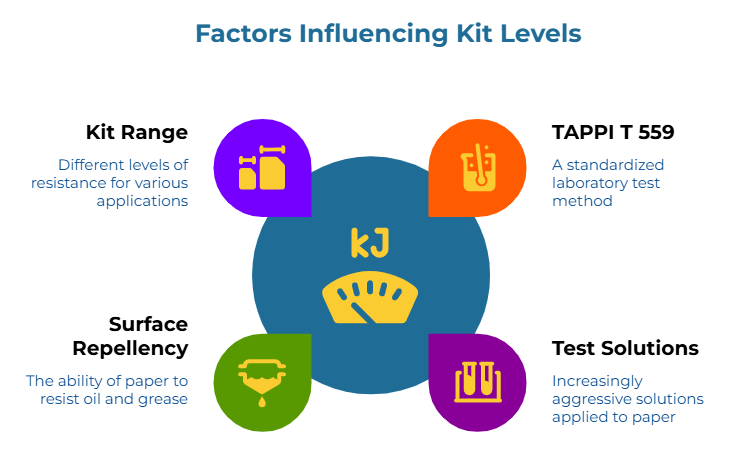
A Kit Level is a standardized measurement that indicates the surface repellency of paper or paperboard to oil and grease solvents. While operators use it as a practical proxy for grease resistance, the measurement comes from a quick laboratory spot-test — TAPPI T 559 — that applies a series of increasingly aggressive test solutions to the paper surface for 15 seconds. The highest-numbered solution that the paper resists without surface darkening or staining becomes its Kit rating.
This standardized approach allows direct comparison between different papers. When a supplier states “Kit 7,” that number has a specific, testable meaning. It is not a marketing claim or a general descriptor—it is a result from a defined test method.
Higher Kit numbers indicate stronger resistance under harsher conditions:
| Kit Range | Resistance Level | Typical Applications |
|---|---|---|
| 1–4 | Light | Dry bakery items, bread, cold sandwiches |
| 5–7 | Moderate | Burgers, deli sandwiches, items with light sauces |
| 7–9 | High | Fried foods, hot dogs, items with moderate fat content |
| 10–12 | Very High | Heavy fried items, extended hold times, delivery scenarios |
These ranges represent general starting points. Actual requirements depend on specific menu conditions and should be confirmed through supplier documentation and operational testing.
What Kit Levels do not replace:
Kit Level measures grease resistance specifically. It does not replace other specifications that matter for food packaging paper. GSM still determines paper weight and stiffness. Coating type affects moisture handling, heat tolerance, and other properties. Food-contact compliance remains a separate regulatory requirement. Fit-for-use testing confirms that laboratory results translate to real-world performance.
Real-world performance depends on more than the flat-sheet test. In operations, wrap, crease, fold, and compress. Some standards, such as ISO 16532, explicitly allow testing on creased or uncreased samples to account for these conditions.
Kit Level is one essential specification among several. For a complete guide to grease resistance measurement, see food packaging paper kit levels 1–12: an easy-to-understand guide to grease resistance.
Kit Level Logic: A 3-Question Method to Match Paper to Your Menu
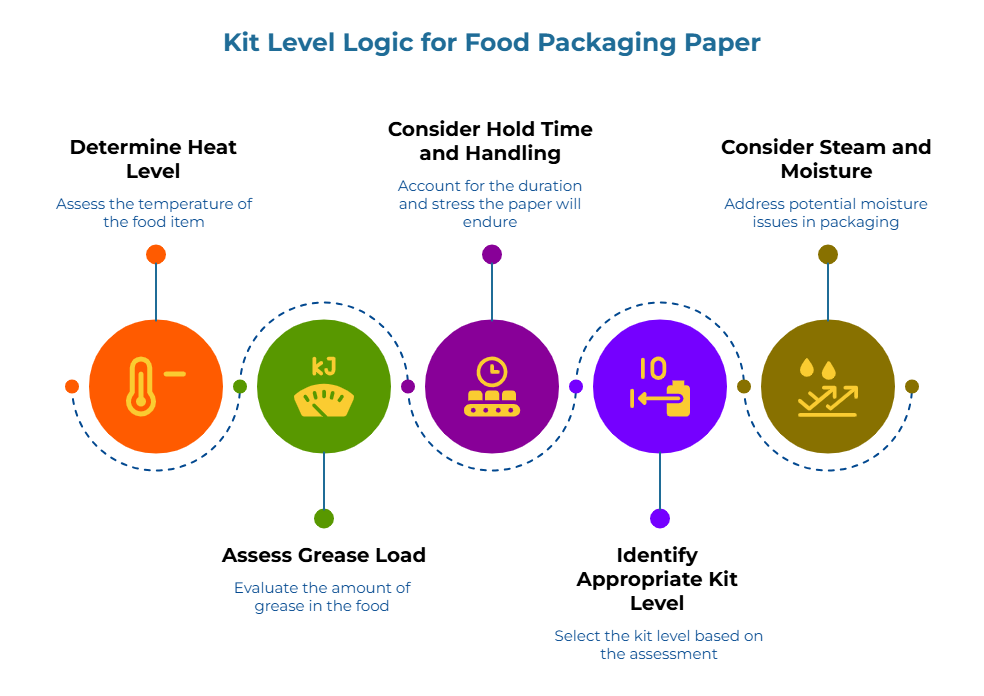
Kit Level Logic translates menu conditions into specification requirements. Instead of guessing or relying on generic labels, answering three questions identifies the stress that food packaging paper must handle.
Question 1: What is the heat level?
Temperature determines whether certain coatings can survive contact. The three practical bands:
Warm (below 50°C / 120°F): Room temperature or just above. Cold sandwiches, pastries, items that have cooled before wrapping. Wax coatings generally remain stable at these temperatures.
Hot (50–80°C / 120–175°F): Typical temperatures for burgers and hot sandwiches. Wax coatings begin to soften in this range. Greaseproof paper or papers with more heat-stable treatments become safer choices.
Very hot (above 80°C / 175°F): Fresh-from-fryer items, foods held in warming drawers, items with significant steam. Wax coatings will likely fail. Papers rated for high-heat applications and documented thermal stability are needed.
If menu items are served hot or very hot, generic wax paper becomes a risky default.
Question 2: What is the grease load?
Grease load determines how aggressive the barrier treatment must be:
Low grease: Dry breads, plain buns, pastries without fillings. Kit 1–4 range generally sufficient.
Medium grease: Standard burgers, deli meats, items with cheese or light sauces. Kit 5–7 range typically appropriate.
High grease: Fried chicken, bacon-heavy items, foods cooked in or dressed with oil. Kit 7–9 range or higher usually required.
The same menu category can have different grease loads depending on preparation. A grilled chicken sandwich has a lower grease load than a fried chicken sandwich. The preparation method affects specification needs.
Question 3: What is the hold time and handling?
Time and physical stress compound heat and grease exposure:
Short hold, minimal handling: Dine-in service where food moves quickly from kitchen to table. Paper faces brief exposure with limited physical stress. The lower end of the appropriate Kit range may suffice.
Extended hold or delivery: Food sits in kraft paper bags for 15–30 minutes or longer. Transit vibration, stacking, and temperature fluctuation add stress. The higher end of the Kit range provides more margin for these conditions.
High-pressure handling: Customers squeezing wraps, delivery bags stacked in backpacks, items jostled during transport. Consider adding 1–2 Kit levels above baseline.
A fried chicken wrap served dine-in might work well at Kit 7. The same wrap packaged for delivery—with extended hold time and handling stress—might need Kit 9 to avoid problems. Delivery operations, in particular, should account for conditions the paper will face after it leaves the kitchen. For a framework covering different menu scenarios, see the Menu-Match Matrix for food packaging paper.
Bonus consideration: Steam and moisture
Some sogginess problems are moisture-driven, not grease-driven. A higher Kit Level will not automatically solve steam condensation inside a closed bag. When steam is dominant, paper structure (GSM, porosity) and packaging design (vents, separation) matter more than grease resistance alone.
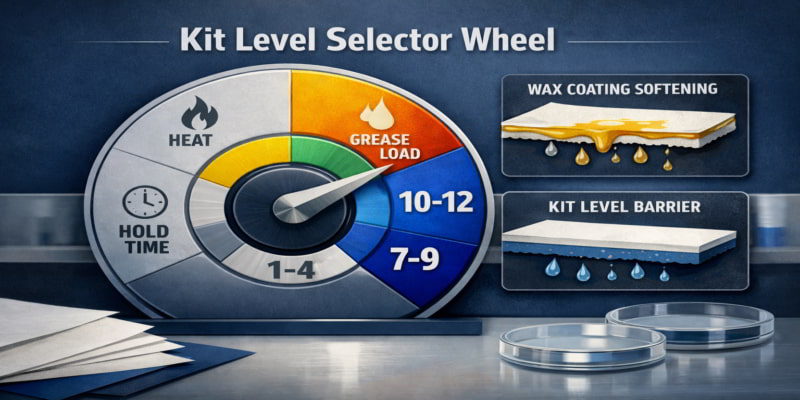
The Kit Level Selector Wheel: Your Menu-to-Specification Shortcut
This decision framework maps any menu item to a starting Kit range. The goal: identify the right specification range in under 30 seconds, then verify with supplier documentation and a simple kitchen trial.
The 3-Question Flow
Step 1 — Assess Heat Level
- Warm → Proceed to Step 2
- Hot or Very Hot → Eliminate generic wax paper from consideration; proceed to Step 2
Step 2 — Assess Grease Load
- Low → Target Kit 1–4 range
- Medium → Target Kit 5–7 range
- High → Target Kit 7–9+ range
Step 3 — Adjust for Hold Time and Handling
- Short hold, minimal handling → Use lower end of target range
- Extended hold or delivery → Use higher end of target range
- High-stress handling → Increase baseline by 2 Kit levels
Application Matrix
| Category | Menu Examples | Conditions | Kit Band | Avoid / Prefer |
|---|---|---|---|---|
| A. Cold + Low Grease | Cold deli sandwiches, pastries, cookies, bread rolls, dry snacks | Low heat / low grease / short–medium hold | Kit 1–4 | Wax paper can be acceptable. Confirm food-contact documentation. |
| B. Warm + Light–Medium Grease | Warm breakfast wraps, grilled vegetables, light paninis, quick-serve wraps | Warm / light–medium grease / short hold | Kit 3–6 | Avoid relying on “wax paper” as proof. Prefer paper with stated Kit level. |
| C. Hot + Medium Grease | Fresh burgers, hot sandwiches, pizza slices, grilled chicken sandwiches, quesadillas | Hot / medium grease / medium hold + pressure | Kit 5–8 | Avoid zone: generic wax paper on hot handheld items.Prefer food packaging paper with a documented Kit. |
| D. Hot + High Grease or Long Hold | Fried chicken, wings, fries in bags, bacon-heavy items, long-hold delivery combos | Hot / high grease / medium–long hold + compression | Kit 7–10+ | Avoid zone: wax paper under heat lamps or delivery compression. Prefer higher-kit greaseproof. |
These ranges are starting points for specification discussions. Confirm requirements with supplier Technical Data Sheets and operational testing before committing to volume orders.
Critical Constraint: Direct contact between wax paper and high-temperature, high-lipid foods during extended hold times poses a significant failure risk. Switch the conversation to Kit Level + proof.
Supplier Proof Checklist
Before committing to volume orders, request:
- Technical Data Sheet (TDS) showing stated Kit Level with named test method (TAPPI T 559), GSM range, coating type, and food-contact compliance references
- Lot consistency information documenting variation ranges and quality control frequency
- Scope confirmation verifying the TDS covers the exact grade being ordered and that test conditions align with intended use
For EU-aligned testing and food-contact assessments, independent institutes such as ISEGA provide relevant services. In the United States, FDA regulations including requirements found in 21 CFR 176.170 govern paper and paperboard components used with aqueous and fatty foods.
Ready to source paper with documented specifications? Browse verified listings and request quotes from food packaging paper suppliers..
Proof, Not Promises: How to Verify Grease Resistance Before You Scale
Supplier claims require verification. A simple kitchen trial confirms whether laboratory specifications translate to real-world performance.
Step 1: Run a Short, Realistic Kitchen Trial
This is not a lab test. It is a “will this fail in front of a customer?” screen.
- Select 3 representative menu items spanning different stress levels—perhaps a cold item, a hot item, and a fried item
- Wrap each item immediately after cooking using normal service procedures (same fold pattern used in service)
- Hold for the typical service window—5 minutes for dine-in, 15–20 minutes for delivery scenarios; include worst case: heat lamp, warmer, delivery bag
- Unwrap and inspect for visible grease transfer to outer surface, coating sticking to food, paper softening or losing structure, and discoloration indicating heat stress
- Document results with photos and notes on time, temperature, and observed issues
If problems appear during testing, address them before committing to larger orders. Testing three items takes roughly 15 minutes and prevents surprises at scale.
Step 2: Add a Receiving Check Mindset
Even a correct specification can fail if lots vary. Sampling a few sheets from different parts of the roll or stack can catch issues early. A lightweight screening option is a fast grease spot check on incoming lots—use it as a red-flag tool, not a certification test.
For a hands-on testing method, see a simple 5-minute grease spot test to check your food packaging paper supply.
Step 3: Separate Structure from Barrier in Your Internal Specification
Many teams over-index on thickness because it is easy to feel. Treat the specification as two lanes:
- GSM (structure and stiffness): how the wrap holds shape and feels
- Kit Level (grease barrier): how it resists oil migration
A practical GSM explainer for food wraps: food packaging paper gsm explained: how to match paper weight to your menu items.
What to Ask Suppliers
When requesting quotes or evaluating options, these questions distinguish suppliers who understand their products from those who do not:
“What is the Kit Level for this grade, and which test method was used?”
An acceptable answer names a specific number and method: “Kit 7 per TAPPI T 559.” A vague response—“It’s greaseproof”—without measurable data signals incomplete product knowledge.
“What temperature range was the food-contact testing conducted at?”
Specific temperatures matter: “Tested for contact at 70°C for 2 hours” provides useful information. “It’s food-safe” without temperature-specific data does not address performance under actual use conditions.
“Can you provide a Technical Data Sheet with lot-specific test results?”
A dated TDS with test results and lot references supports verification. A generic product brochure without test data does not. More detail on evaluating supplier documentation is available in the wax paper trap: why generic wraps fail high-heat tests.
Catching Drift Early
Verification is not a one-time activity. Menu changes, supplier changes, and production variation can introduce problems over time. Build a habit of periodic checks:
- When adding new menu items, confirm current paper specifications cover new conditions
- When switching suppliers, verify the new grade performs equivalently
- When customer complaints emerge, investigate whether specifications still match menu demands
Frequently Asked Questions
Is wax paper greaseproof?
Wax paper provides moisture resistance at cool temperatures but not grease resistance under heat. The wax coating softens when temperatures exceed approximately 50–65°C (120–150°F), depending on the formulation, allowing grease to penetrate and transfer. For hot, greasy foods, greaseproof paper with a documented Kit Level provides more reliable performance.
What is a Kit Level?
A Kit Level is a standardized measurement of grease resistance for paper and paperboard, rated on a scale from 1 (lowest resistance) to 12 (highest resistance). The test method (TAPPI T 559) applies increasingly aggressive solutions to the paper surface; the highest solution the paper resists without failure determines its Kit rating.
What Kit Level do I need for fried chicken or fries?
Fried foods typically require Kit 7–9 as a starting range for dine-in service and Kit 9–11 for delivery or extended hold times. When sourcing bags for delivery operations, work with verified paper bag suppliers who can provide documented specifications. The specific requirement depends on fat content, serving temperature, and hold duration. Confirm with a kitchen trial using samples from the intended supplier.
Can a higher Kit Level fix sogginess?
Not always. Sogginess is often driven by steam and condensation, not grease. Kit Level addresses grease resistance, not necessarily moisture management. When steam is the main problem, focus on packaging design (venting, separation) and paper structure as well as barrier properties.
How can I test grease resistance quickly in my kitchen?
Wrap a representative menu item at peak service temperature, hold for the typical service window, then unwrap and inspect for grease transfer, coating stickiness, or paper softening. Repeat across multiple menu items. Document results before committing to volume orders.
What proof should I ask my supplier for?
Request a Technical Data Sheet showing stated Kit Level with named test method (TAPPI T 559), GSM range, coating type, thermal limits, and food-contact compliance references. Ask for lot-specific test results and confirm the TDS covers the exact grade being ordered under conditions matching intended use.
From Guesswork to Specifications: Protect the Customer Experience
The wax paper trap catches operators who rely on material labels instead of measurable specifications. “Wax paper” describes a material type, not a performance guarantee.
Implementing this protocol shifts the burden from subjective estimation to a repeatable verification cycle: quantifying thermal and lipid loads to calibrate specific Kit requirements against empirical trial results. When specifications match conditions, grease stays on the food—not on the customer’s hands.
As menus evolve—adding greasier items, extending hold times for delivery—specifications need periodic review. The next step: consolidate menu items into 2–4 standardized specification families. For a framework on building house specifications, see the Menu-Match Matrix for food packaging paper.
Labels describe materials. Specifications protect the customer experience.
For comprehensive guidance on food packaging paper selection, visit the PaperIndex Academy.
Resources
- Food Packaging Paper Kit Levels 1–12: An Easy-to-Understand Guide to Grease Resistance
- The Wax Paper Trap: Why Generic Wraps Fail High-Heat Tests
- The Menu-Match Matrix for Food Packaging Paper: How to Match Your Menu with the Right Kit Level and Specifications
- Food Packaging Paper Specifications 101: A Beginner’s Guide to GSM, Coatings, and Pulp
- A Simple 5-Minute Grease Spot Test to Check Your Food Packaging Paper Supply
- Food Packaging Paper GSM Explained: How to Match Paper Weight to Your Menu Items
References
[1] Transport Information Service (TIS-GDV), “Waxed Paper.” The melting point of paraffin is between 50°C and 60°C; microcrystalline waxes melt between 60°C and 80°C. Waxed paper – Transport Informations Service
[2] U.S. Food and Drug Administration, 21 CFR § 176.170, “Components of paper and paperboard in contact with aqueous and fatty foods.” eCFR :: 21 CFR 176.170 — Components of paper and paperboard in contact with aqueous and fatty foods.
[3] TAPPI, “T 559 – Grease Resistance Test for Paper and Paperboard.” The test applies numbered reagent solutions varying in surface tension and viscosity; the highest solution remaining on the surface without causing failure is reported as the Kit rating. Grease resistance test for paper and paperboard, Test Method T 559 cm-22
Disclaimer
This article is for educational purposes and does not constitute legal, regulatory, or food-safety compliance advice. Always confirm food-contact compliance and performance requirements with your supplier documentation and applicable regulations.
Our Editorial Process:
Our expert team uses AI tools to help organize and structure our initial drafts. Every piece is then extensively rewritten, fact-checked, and enriched with first-hand insights and experiences by expert humans on our Insights Team to ensure accuracy and clarity.
About the PaperIndex Insights Team:
The PaperIndex Insights Team is our dedicated engine for synthesizing complex topics into clear, helpful guides. While our content is thoroughly reviewed for clarity and accuracy, it is for informational purposes and should not replace professional advice.