

📌 Key Takeaways
GSM tells you how heavy paper feels, not whether it blocks grease—those are two separate specs you need to set independently.
- Weight Isn’t Grease Protection: A thick paper without barrier treatment soaks through just as fast as thin paper when wrapping oily foods.
- Match Format Before Numbers: Choose GSM based on whether you need a wrap, liner, or bag—each format has different stiffness needs.
- Specify Two Lanes Separately: Set GSM for structure and feel, then add grease resistance as its own requirement when oily menu items are involved.
- Same GSM Can Feel Different: Two papers at identical GSM can vary in stiffness because fiber type, coatings, and density all affect hand-feel.
- Test With Real Food: A 15-minute trial with your actual menu items reveals more than any spec sheet about how paper performs in service.
Heavy paper that lets grease through is just expensive failure—spec both weight and barrier.
Food service operators and procurement managers choosing packaging paper will gain clarity on specification basics here, preparing them for the detailed GSM reference chart and supplier evaluation guidance that follows.
~ ~ ~ ~ ~ ~ ~ ~ ~ ~ ~ ~ ~ ~ ~ ~ ~ ~
Two paper samples on the counter.
Choosing the right paper weight is a balance of tactile rigidity and cost efficiency. For sandwich wraps and basket liners, the decision starts with understanding GSM.
That uncertainty is familiar. You’re holding samples, staring at numbers, and wondering whether “heavier” means “better”—or just “more expensive.” The truth is simpler than most suppliers make it sound: GSM tells you about weight and rigidity, not grease resistance. Once you separate those two decisions, choosing paper becomes straightforward.
GSM in Plain English: What That Number Actually Means
GSM stands for grams per square meter. Imagine cutting a perfect one-meter-by-one-meter square from a roll of paper and placing it on a scale. The weight in grams is the GSM. A 40gsm sheet weighs 40 grams per square meter; a 60gsm sheet weighs 60 grams.
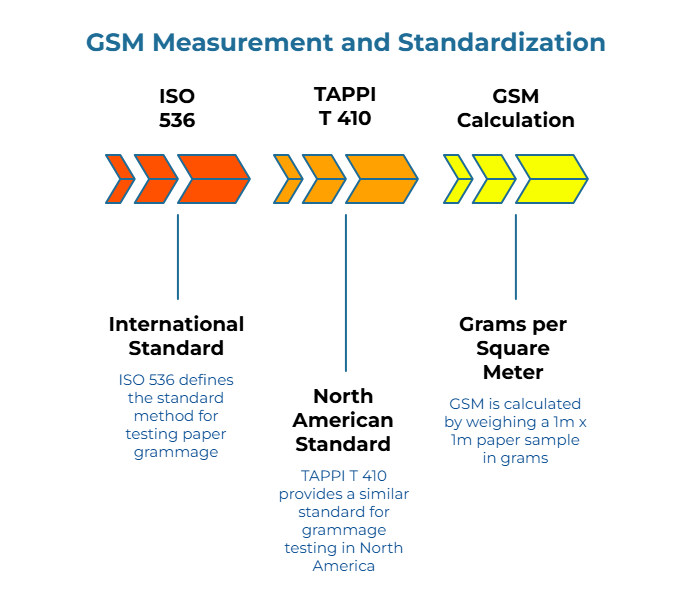
The measurement is standardized internationally. ISO 536 and TAPPI T 410 define exactly how to test grammage, which means suppliers worldwide use the same methodology. When a spec sheet says “60gsm tested per ISO 536,” you can compare it directly to another supplier’s 60gsm rating.
Think of it like comparing two blankets of identical size. The heavier blanket has more material packed into the same area—it feels denser, more substantial. GSM works the same way for paper.
One clarification matters here: GSM is not thickness. Two papers with identical GSM can feel noticeably different in your hand. Fiber type, density, calendering, and coatings all affect how thick or stiff a sheet actually feels. GSM tells you the mass per area. It is a primary indicator of mass, though physical properties like tensile strength and stiffness are influenced by fiber orientation and bulk.
GSM vs. Basis Weight: Why Quotes Can Get Confusing
Some suppliers—particularly in North America—quote “basis weight” in pounds instead of GSM. Basis weight is calculated using ‘basis reams’ (typically 500 sheets) of a specific ‘trade size.’ Because trade sizes differ between paper grades (e.g., Bond vs. Text), a 50 lb Bond sheet is significantly heavier than a 50 lb Text sheet if they’re using different basis sizes.
Asking for the GSM equivalent is the clean way to compare paper weight across suppliers. Request both the GSM value and confirmation of the basis sheet size they’re using if they quote in pounds.
What GSM Changes—and What It Doesn’t
Higher GSM generally delivers more rigidity and perceived sturdiness. A 70gsm wrap holds a tight fold better than a 40gsm sheet. It feels more substantial when a customer picks up their sandwich. It resists tearing during aggressive wrapping.
Lower GSM provides flexibility and drapes. A 28gsm tissue conforms around a croissant without adding bulk or fighting the shape. Lighter sheets work well for applications where stiffness would be a problem—interleaving pastries, for example, or lining a basket where the paper should settle into corners.
A heavy 85gsm sheet can turn translucent and oily within minutes if it lacks barrier treatment. Meanwhile, a lighter 45gsm sheet with proper greaseproof coating will block oil from a basket of fries for the entire meal. Grease resistance depends on barrier chemistry—specific treatments, coatings, and resistance ratings—not on how much the paper weighs.
When a wrapper fails and grease soaks through, the instinct is to order heavier paper. Instead, you must specify a Kit Level (TAPPI T 559), which measures the paper’s resistance to oil and grease penetration.
Food-contact compliance works the same way. Paper weight doesn’t prove regulatory compliance—that requires separate documentation tied to applicable standards.. When compliance matters for your application, it’s typically demonstrated through declarations referencing regulations like 21 CFR 176.170 for food-contact materials, not through GSM values.
A Simple Menu-to-GSM Matching Framework
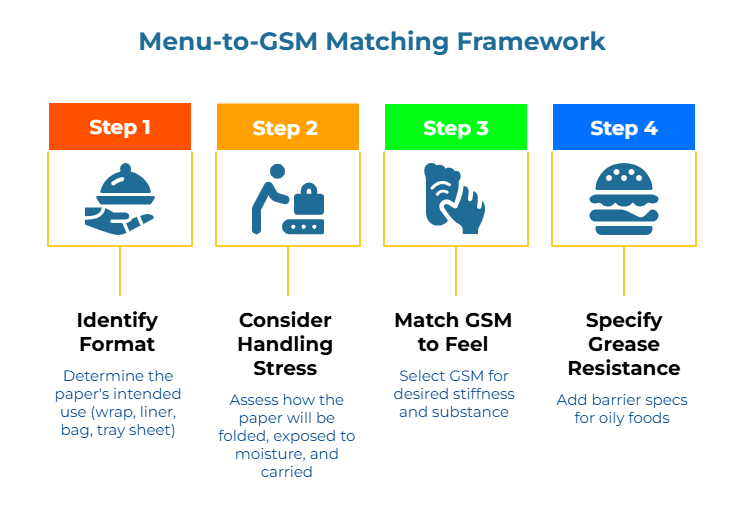
Start with how the paper will be used—not with the GSM number itself.
Identify the format first. Is it a wrap that folds tightly around food? A liner sitting flat in a basket or tray? A bag that carries weight and handles stress? A tray sheet with minimal handling? Each format has different rigidity requirements.
Consider handling stress. Will the paper be folded multiple times? Will it face steam or moisture from hot food? Will customers carry it for several minutes before eating? Higher handling stress generally calls for higher GSM to maintain wrapper integrity and tear strength.
Match GSM to the feel you need. A flimsy liner that slides around in a basket frustrates kitchen staff. An overly stiff wrap that cracks when folded wastes money and looks unprofessional. Use GSM to dial in the right “substance” for your application.
Specify grease resistance separately. If the menu item is oily—burgers, fries, fried chicken, anything with visible grease—add a barrier spec to your requirements. Don’t assume that higher GSM handles this. It won’t.
Think of this as a two-lane approach. Lane A covers GSM: you’re setting stiffness, feel, and structural integrity. Lane B covers grease resistance: you’re specifying barrier performance when oily foods are involved. Keeping these lanes separate is how you escape the compliance-cost trap—paying for unnecessary weight when the real issue is a missing greaseproof requirement, or choosing “cheap” paper that fails mid-service because barrier specs were never addressed.
Common GSM Ranges by Application
Paper grades form a natural progression from light and flexible to heavy and structured. Understanding this spectrum helps you place your application in the right zone before narrowing to specific numbers.
The following ranges represent industry-standard benchmarks for food-service conversion in food packaging paper. Actual performance varies with fiber type, coatings, and your specific menu items. Always test samples with your actual food before committing to volume orders.
| Application | Menu Examples | Typical GSM Range | Additional Specs to Consider |
| Tissue / interleave | Pastry separators, deli tissue | 25–38 gsm | Food-contact compliance |
| Basket liners | Fries, onion rings, bread service | 35–50 gsm | Grease resistance rating if oily items |
| Pastry wrap / sheets | Croissants, cookies, muffins | 40–55 gsm | Wet strength if moist fillings |
| Sandwich wraps | Deli sandwiches, burritos, gyros | 50–70 gsm | Greaseproof barrier for oily fillings |
| Butcher / kraft wrap | Burgers, hot dogs, shawarma | 60–90 gsm | Grease resistance + wet strength |
| Takeout bags | Delivery, carryout | 80–120+ gsm | Tear strength; handle attachment if needed |
These ranges are illustrative. A 52gsm sheet from one mill may feel stiffer than a 58gsm sheet from another due to differences in fiber blend and density. Use this chart to narrow your sampling—not to finalize specs without testing.
For deeper context on how GSM tolerances affect consistency across deliveries, see Paper Bag Raw Material Grades: GSM and Burst Factor Explained.
How to Read a Spec Sheet (and What to Ask When You Only Have Samples)
A complete supplier spec sheet should include several elements beyond the GSM number alone.
GSM with tolerance. Look for something like “60gsm ±5%” rather than just “60gsm.” The tolerance tells you the acceptable batch-to-batch variation. Tighter tolerance generally means more consistent performance but may affect unit cost and supplier reliability.
Test method named. Reputable suppliers reference ISO 536 or TAPPI T 410. If no method is listed, ask which standard they follow. Without a named method, you can’t verify that two suppliers measured grammage the same way.
Basis weight clarification. If a supplier quotes basis weight in pounds, request the GSM equivalent and confirm the basis sheet size they’re using. Without both pieces of information, you can’t make accurate comparisons.
Grease resistance as a separate line. If oil blocking matters, the spec sheet should include a Kit Rating (typically 1-12). If it’s missing, ask for the specific barrier chemistry used (e.g., fluorochemical-free coatings).
Frequently Unasked Questions That Prevent Expensive Mistakes
Is thicker always better?
No. Heavier paper costs more per unit and may not improve performance for your application. A 90gsm wrap around a light pastry is wasteful—you’re paying for rigidity you don’t need. A 40gsm wrap around a loaded burrito will likely tear and frustrate your kitchen staff. Match the weight to the job, not to a general assumption that heavier equals better.
Why does my heavy paper still feel greasy after wrapping a burger?
Because grease resistance and paper weight are separate properties. A thick sheet without barrier treatment absorbs oil just as readily as a thinner one. If grease soak-through is the complaint, the fix is specifying barrier performance—not ordering higher GSM. This is the single most common specification mistake in food service packaging.
Can two papers with the same GSM feel different?
Absolutely. Bulk, density, fiber blend, calendering, and surface coatings all influence how a sheet feels. Two 60gsm papers from different mills can have noticeably different stiffness, texture, and drape. GSM tells you mass per area; it doesn’t capture everything about hand-feel or performance.
Quick Reference FAQ
What does 40gsm mean on a food wrap?
One square meter of that paper weighs 40 grams. GSM measures grammage (weight per area), which primarily affects how sturdy the sheet feels and how well it holds its shape.
Is higher GSM always better for greasy foods?
Higher GSM can feel sturdier, but grease resistance depends on barrier specifications—the right greaseproof grade or resistance rating. A heavy paper without barrier treatment will still let oil through.
What should I look for on a supplier spec sheet?
Request GSM with tolerance (e.g., “60gsm ±5%”), the test method used (ISO 536 or TAPPI T 410), and any relevant performance specs like grease resistance listed separately.
If a supplier quotes “basis weight” in pounds, how do I compare?
Ask for the GSM equivalent and the basis sheet size they’re using. Basis weight depends on sheet size conventions, while GSM does not—making GSM the cleaner comparison standard.
Turn Your Menu into a Simple Paper Spec
The framework is now clear: GSM controls feel and rigidity; barrier specs control grease performance. Both matter, and they’re specified separately.
Your practical next step is straightforward. List your top menu items that use paper packaging. For each one, note the format (wrap, liner, bag), the handling stress (folding, carry time, steam exposure), and whether grease resistance matters. Use the reference chart to identify a starting GSM range, then request samples from suppliers to test with your actual food under real service conditions.
When you can write a spec that reads “55gsm ±5% greaseproof wrap, tested per ISO 536, with medium grease resistance for oily fillings”—you stop guessing and start ordering with confidence. Used consistently, that approach becomes a practical Food Grade Packaging Paper Selection Criteria sheet: clear enough for repeat orders and defensible in any compliance conversation.
When you’re ready to explore sourcing options, browse food packaging paper listings or food grade kraft paper options.
For more educational resources on food packaging specifications and sourcing, visit PaperIndex Academy.
Disclaimer:
This article provides educational information about paper specifications for food service applications. All specifications should be verified with suppliers and tested for your specific applications.
Our Editorial Process:
Our expert team uses AI tools to help organize and structure our initial drafts. Every piece is then extensively rewritten, fact-checked, and enriched with first-hand insights and experiences by expert humans on our Insights Team to ensure accuracy and clarity.
About the PaperIndex Insights Team:
The PaperIndex Insights Team is our dedicated engine for synthesizing complex topics into clear, helpful guides. While our content is thoroughly reviewed for clarity and accuracy, it is for informational purposes and should not replace professional advice.