

📌 Key Takeaways
Sustainable packaging sourcing stalls when Sustainability and Procurement use separate rulebooks—one shared method fixes the bottleneck.
- Same Goal, Different Words: Both teams want fewer bad supplier decisions; aligning their criteria ends the conflicting recommendations.
- Compliance Gates Come First: No supplier should move to pricing talks until they pass regulatory fit checks with documented proof.
- Certificates Prove Capability, Not Delivery: A valid certification doesn’t mean the specific shipment you ordered carries a valid claim—check the scope.
- Lock Decisions in 45 Minutes: A short alignment session produces one RFQ template, one scorecard, and one change-control rule for all future sourcing.
- Changes Trigger Reviews: New coatings, different factories, or switched materials should automatically restart the approval process.
One checklist, two departments, shared proof—compliance becomes a shield when both teams hold it together.
Sustainability Directors and Procurement Managers navigating EPR requirements will gain a ready-to-use alignment framework here, preparing them for the detailed checklist and matrix that follow.
~ ~ ~ ~ ~ ~ ~ ~ ~ ~ ~ ~ ~ ~ ~ ~ ~ ~
Packaging sourcing breaks down when sustainability requirements and procurement workflows operate as separate systems. The solution is a dual-mandate framework that translates Extended Producer Responsibility requirements into shared supplier-evaluation criteria. When Sustainability and Procurement align around one neutral methodology, organizations achieve faster internal sign-off, safer supplier evaluation, and stronger compliance discipline. This article provides the alignment tools, checklist structure, and implementation sequence to operationalize that shift.
Why Sustainable Packaging Decisions Stall Inside the Business
The compliance deadline is three months away. The Sustainability Director has flagged two suppliers whose recyclability documentation appears incomplete. The Procurement Manager has shortlisted those same suppliers because their lead times and pricing fit the operational window.
This operational stalemate stems from asymmetric information—each department optimizes for its own siloed metrics without a shared data layer, a challenge that requires both teams to find suppliers through a unified evaluation process.
Two weak habits make the problem worse. The first is treating EPR compliance as a Sustainability-only concern. The second is treating generic eco-friendly claims as close enough to real verification. Both fail for the same reason: they separate legal intent from day-to-day buying behavior.
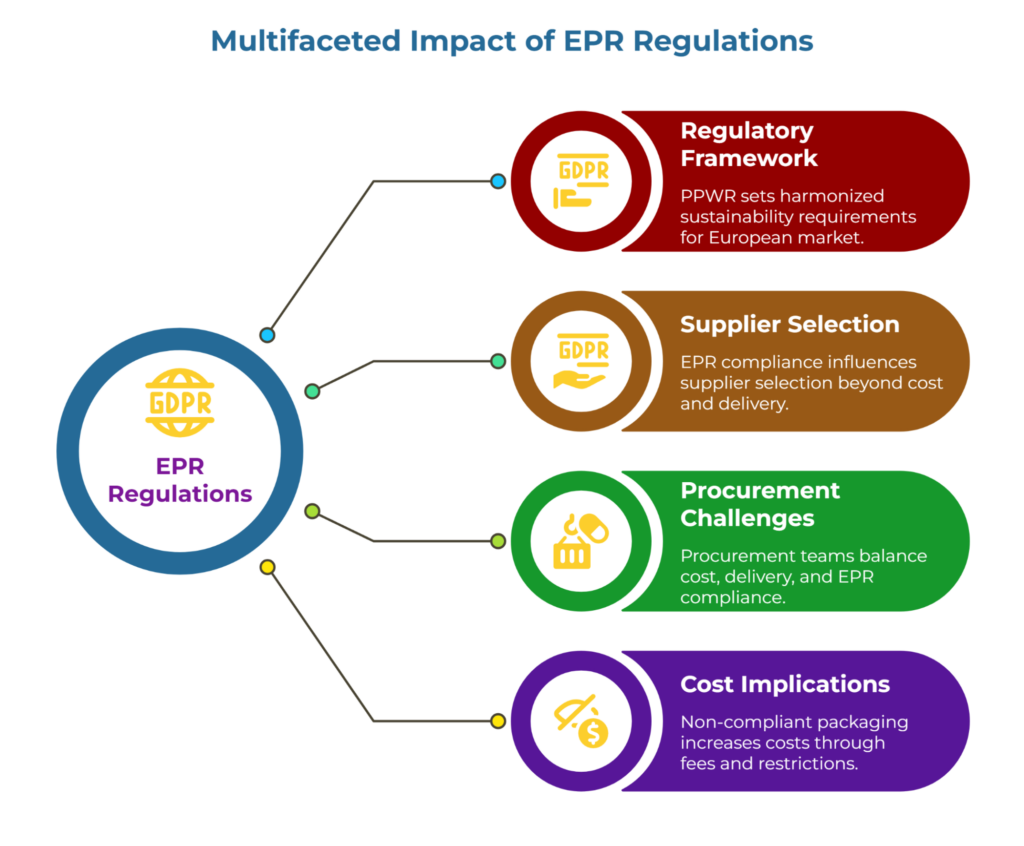
Extended Producer Responsibility regulations are expanding globally.The Packaging and Packaging Waste Regulation (PPWR), which updates the previous Directive 94/62/EC, is the defining framework for the European market. As of March 2026, the PPWR is in the final stages of its transition period, with the first major wave of harmonized sustainability requirements scheduled for mandatory application in late 2026. Similar frameworks are expanding across North America and Asia-Pacific markets. These requirements carry regulatory weight that affects supplier selection—whether evaluating paper manufacturers or packaging converters—not just sustainability reporting.
When EPR compliance remains siloed within sustainability teams, procurement continues evaluating suppliers without visibility into which packaging formats will meet upcoming recyclability thresholds. OECD’s guidance on Extended Producer Responsibility describes EPR as a policy approach designed to shift responsibility for products from municipalities and consumers to producers. For packaging buyers, this means the sourcing decision is no longer purely operational.
Procurement teams face pressure to maintain cost targets and delivery windows. These are legitimate operational priorities. A supplier whose folding cartons cannot demonstrate recyclability under applicable Design for Recyclability criteria becomes a compliance liability regardless of pricing or delivery performance. The cheapest supplier may become the most expensive if their packaging triggers EPR fee escalations or market access restrictions.
Time pressure pushes teams back to legacy suppliers. The false fix of assuming a generic eco-friendly badge is enough creates exposure that surfaces only when regulatory enforcement begins or when a customer audit requests traceable evidence.
Sustainability reviews certifications, lifecycle assessments, and chain-of-custody documentation. Procurement reviews pricing, capacity, quality consistency, and delivery reliability. Each department submits recommendations to leadership. The recommendations conflict. Leadership either delays the decision or overrides one department’s concerns to meet a deadline.
The underlying problem is structural. Two departments operating from separate rulebooks will keep colliding until they share one.
Institutional Alignment: Converging Sourcing Mandates
Both teams want fewer bad supplier decisions. Both need defensible criteria that hold up under scrutiny. Both are trying to protect continuity and brand trust.
The Sustainability Director protecting the organization from compliance penalties is serving the same enterprise interest as the Procurement Manager protecting the organization from supply chain disruption. EPR readiness represents brand protection. Supplier reliability represents operational security. These are not competing goals.
The framework question both departments are actually asking is identical: Is this supplier safe to work with? Sustainability frames safety as compliance integrity. Procurement frames safety as execution reliability. A shared framework makes both dimensions visible in every supplier evaluation, removing the need for sequential reviews that contradict each other.
Once producer responsibility moves upstream, supplier evaluation cannot remain a narrow price-and-lead-time exercise. Policy sets the destination, but sourcing decides whether the business actually gets there.
Decision fatigue compounds the problem when departments review suppliers separately. As explored in beyond burnout: why decision fatigue is the real enemy of modern procurement, the volume of supplier decisions erodes quality when evaluation criteria are fragmented rather than unified.
From EPR Rulebook to Daily Buying Decisions
EPR legislation speaks in regulatory language: recyclability targets, recycled content thresholds, labelling harmonization, producer registration. Procurement speaks in operational language: unit cost, lead time, minimum order quantity, quality consistency. The bridge between these vocabularies is where sustainable packaging sourcing either works or fails.
A supplier may describe their packaging as “recyclable” or “sustainable” without traceable evidence that the packaging meets applicable regulatory criteria. Certifications like FSC or PEFC prove participation in a chain-of-custody system. They do not prove that a specific invoice or shipment carries a valid claim. Understanding this distinction is essential when evaluating folding carton suppliers for sustainable packaging programs. Verification requires checking certificate scope against the specific product grades being sourced. The methodology for structuring this verification is detailed in structuring your compliance audit checklist for packaging suppliers.
A usable sustainable packaging sourcing framework asks a tighter set of questions:
- What obligations apply in the target market?
- What material and structural requirements are non-negotiable?
- What evidence proves the claim for this product, site, and process?
- What operational conditions must be true before approval?
- What changes trigger revalidation?
This methodology mirrors the UN Environment Programme’s (UNEP) strategic framework, which positions procurement as a primary market-shaping lever. UNEP’s sustainable public procurement guidance treats procurement as a strategic tool that shapes markets. The US EPA’s guidance on Sustainable Materials Management (SMM) frames packaging decisions as a critical lever for reducing life-cycle environmental impacts. This approach emphasizes that ‘sustainable packaging’ is not a static attribute but a result of systemic waste reduction and material productivity.
As a general sourcing principle, policy language should be converted into buying behavior before suppliers are compared. The exact documents, test methods, and thresholds will vary by product, geography, and risk profile. The method should not.
A similar translation discipline appears in sustainable sourcing of bag paper: aligning packaging with brand values, where abstract commitments are turned into measurable supplier requirements.
The Dual-Mandate Sourcing Checklist
Each lane below defines what Sustainability needs to see, what Procurement needs to see, and what counts as acceptable shared evidence.
Regulatory Fit — Sustainability needs confirmation that packaging formats meet applicable EPR requirements in target markets, including recyclability grade classification. Procurement needs clarity on which markets the supplier can serve without triggering compliance gaps. Shared standard: No supplier advances to commercial evaluation until regulatory fit is confirmed with documentation naming specific regulations.
Material and Specification Fit — Sustainability needs material composition transparency, including coatings, adhesives, and inks that may affect recyclability classification. Procurement needs technical specifications matching production requirements, a principle that applies equally when sourcing folding cartons or any sustainable packaging format. Shared standard: Specifications documented in comparable units with named test methods before RFQ distribution.
Supplier Evidence and Verification Fit — Sustainability needs proof of compliance and certificate scope verification confirming certifications cover the specific grades and facilities relevant to the order. Procurement needs repeatable, comparable submissions that allow fair evaluation. Shared standard: Evidence must be standardized before evaluation begins.
Operational Fit — Sustainability needs assurance that operational pressures will not override compliance requirements. Procurement needs capacity confirmation, lead time reliability, and pricing within budget parameters. Shared standard: Operational evaluation proceeds only after compliance gates pass. Both gates must be cleared before onboarding.
Governance and Change-Control Fit — Sustainability needs regulatory drift prevention and assurance that material or process changes trigger disclosure. Procurement needs supply continuity protection. Shared standard: Material composition changes, coating chemistry changes, or manufacturing process changes trigger revalidation, written into supplier agreements—a governance principle equally applicable to corrugated box suppliers and other secondary packaging categories.
Stakeholder Alignment Matrix
The matrix below makes explicit what each function owns at each decision point and what shared rule governs the handoff.
| Decision Area | Sustainability Priority | Procurement Priority | Shared Neutral Rule |
| Packaging requirement definition | EPR compliance, lifecycle ecosystem | Clarity, comparability, supplier response quality | No supplier compared until requirements are measurable sourcing criteria |
| Supplier evidence | Proof of compliance and claim integrity | Repeatable, comparable submissions | Evidence must be standardized before evaluation |
| Supplier onboarding | Risk containment | Speed and execution reliability | Onboarding only after both gates passed |
| Change control | Regulatory drift prevention | Supply continuity | Material/process changes trigger revalidation |
| Supplier shortlist | Verifiable fit | Efficient comparison | Only suppliers meeting both evidence and execution thresholds move forward |
| Final approval | Brand protection | Commercial discipline | Joint sign-off required against the same rule set |
Financial Rationale: Mitigating the ‘Fragmented Review’ Tax
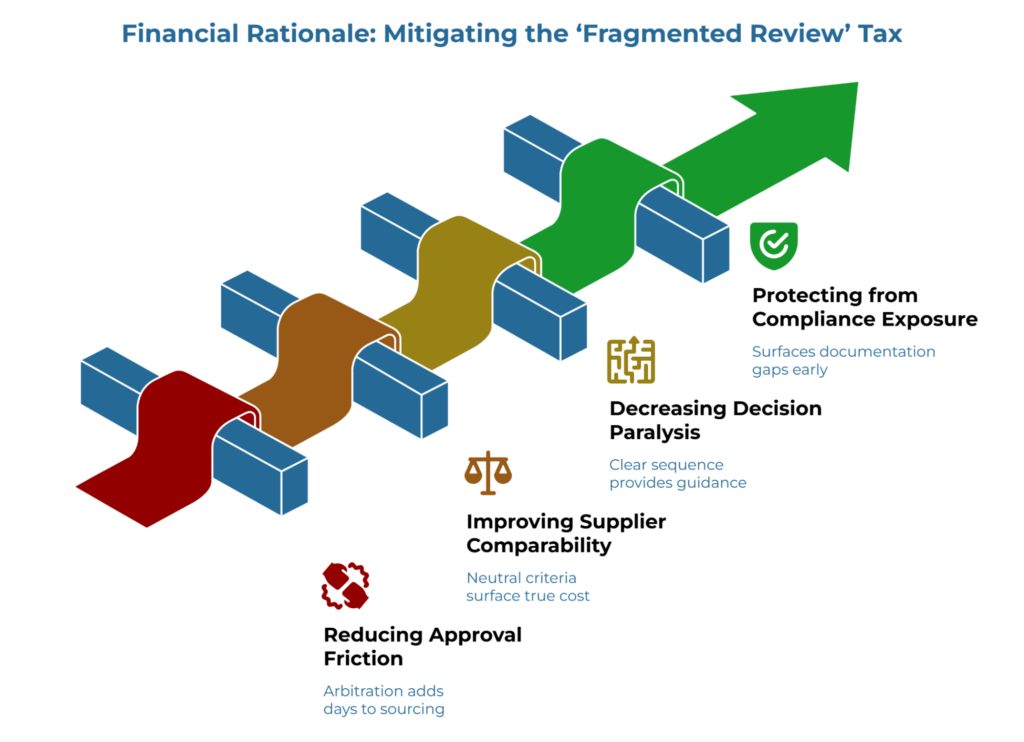
The dual-mandate framework is not an additional layer of bureaucracy. It removes hidden costs that organizations have learned to tolerate.
Reducing approval friction: When Sustainability and Procurement submit conflicting recommendations, leadership must arbitrate. Each arbitration cycle adds days or weeks to the sourcing timeline. The framework standardizes the arbitration process by requiring alignment before recommendations reach leadership.
Improving supplier comparability: Neutral criteria applied consistently across all candidates surface the true cost-risk profile of each option.
Decreasing decision paralysis: The framework provides a clear sequence: compliance first, operations second, approval only when both gates pass.
Protecting from compliance exposure: The framework surfaces documentation gaps during evaluation rather than after volume is committed.
The methodology in sustainable sourcing of bag paper: aligning packaging with brand values applies the same principle to a different product category, demonstrating that alignment logic transfers across packaging formats.
A 45-Minute Alignment Session to Operationalize the Framework
The framework becomes operational through a structured alignment session between Sustainability and Procurement, producing three outputs that become the new sourcing standard.
Pre-Session Audit Requisites: Current RFQ template (Procurement), current supplier compliance checklist (Sustainability), list of active sourcing decisions, summary of applicable EPR requirements by target market, current evidence examples already being accepted, and known operational constraints including lead times, service levels, and commercial terms.
Decision Parameters: Which compliance fields join the RFQ template, what evidence constitutes a compliance pass, who owns final sign-off at each decision point, what triggers revalidation under change control, and who approves, who escalates, and who records the decision.
Finalized Standardization Assets: A unified RFQ template with compliance and operational fields, a supplier evaluation scorecard with weighted criteria from both functions, and a change control protocol specifying revalidation triggers. Once documented, these apply to all future evaluations.
For a closely related operational model, aligning procurement and operations priorities: a checklist for a shared wholesale paper bag sourcing plan shows how fast alignment improves once teams agree on shared decision rules before quotes go out.
Frequently Asked Questions
Can Sustainability set the rules and let Procurement execute?
Not safely. Sustainability can define the intent, but Procurement has to help define the operating logic. A framework that Sustainability defines unilaterally will lack operational buy-in. Procurement will route around it, creating parallel processes. The framework’s value comes from shared ownership, not imposed compliance.
What happens when a supplier has certifications but weak evidence?
Certifications prove capability. Evidence proves execution. A supplier with FSC certification but incomplete chain-of-custody documentation on invoices has not demonstrated that specific shipments carry valid claims. Buyers seeking folding carton manufacturers should apply this evidence-based verification standard consistently. The framework treats certifications as necessary but not sufficient.
How often should the framework be reviewed?
Review it when regulations change, when the packaging design changes, when new claims are introduced, or when suppliers change site, process, or material inputs. Annually at minimum, or whenever material regulatory changes occur. As a general governance rule, change is the trigger.
What changes require revalidation?
Any change that could affect compliance, claim integrity, structural performance, or traceability. Material substitutions. Process changes. Site changes. New coatings. New product-contact conditions. Anything that changes what was originally approved.
Under this dual-mandate architecture, the evaluation stage acts as a binary filter: suppliers must clear both gates to proceed. This synchronizes formerly divergent criteria into a singular, sequential workflow where conflicting recommendations are resolved through standardized data before reaching leadership.
Sustainable packaging sourcing becomes more reliable when policy, specification, evidence, and execution are allowed to work together. Not separately. Working well together.
Compliance is a shield. Make sure both departments are holding it together.
Explore PaperIndex Academy for methodology-first sourcing and compliance guidance.
Disclaimer: This article is for educational purposes only and does not constitute legal advice. PaperIndex is a neutral, non-transactional platform. PaperIndex does not sell market intelligence or publish pricing indices.
Our Editorial Process:
Our expert team uses AI tools to help organize and structure our initial drafts. Every piece is then extensively rewritten, fact-checked, and enriched with first-hand insights and experiences by expert humans on our Insights Team to ensure accuracy and clarity.
About the PaperIndex Insights Team:
The PaperIndex Insights Team is our dedicated engine for synthesizing complex topics into clear, helpful guides. While our content is thoroughly reviewed for clarity and accuracy, it is for informational purposes and should not replace professional advice.