

📌 Key Takeaways
Sustainable packaging sourcing succeeds when brand values translate into measurable specifications, suppliers provide verifiable evidence, and internal teams align on a shared approval framework.
- Values Need Measurable Translation: Abstract commitments like “circular” or “ethical” must become specific requirements suppliers can quote against—recycled content percentages, certification scope, test methods.
- Certificates Require Scope Verification: An FSC or PEFC certificate proves nothing unless its scope explicitly covers the mill, product grade, and claim type you’re actually purchasing.
- Evidence Ladders Prevent Greenwashing: Sequencing checks from claim to certificate to registry validation to chain-of-custody logic filters weak assertions before they become compliance risks.
- Governance Stops Silent Drift: Assigning procurement, operations, and brand clear ownership over requirements, performance criteria, and claim language—plus change-control triggers—prevents certification lapses from going unnoticed.
- Suppliers Win With Proactive Documentation: Assembling evidence packs before inquiries arrive, stating limitations honestly, and avoiding vague claims like “eco-friendly” accelerates qualification and builds buyer trust.
Verifiable sourcing protects brands while honoring operational realities.
Procurement managers, operations leaders, and brand stakeholders implementing sustainable packaging programs will gain a structured methodology here, preparing them for the detailed five-step framework that follows.
Sustainable packaging is often treated as a design choice or a marketing claim. In practice, it is a sourcing system: values must translate into measurable requirements, paper bag suppliers must quote against them, and claims must be verified with evidence that stands up to scrutiny.
This gap between brand intent and verifiable sourcing is where most sustainable packaging programs fail. Marketing wants bold claims. Procurement needs quotable specs. Operations require materials that run on existing lines. Without a shared framework, these priorities collide rather than align.
Sustainable packaging sourcing works when brand values translate into measurable requirements that suppliers can quote against and buyers can verify. The methodology below provides that translation layer—a practical operating model that serves both sides of the transaction while protecting against greenwashing risk and operational disruption.
A simple operating model keeps teams aligned and reduces greenwashing risk:
Brand values → Packaging principles → Sourcing requirements → Evidence pack → Governance
This guide is deliberately methodology-first. It aims to help procurement, operations, and brand stakeholders implement sustainable packaging sourcing that is verifiable and operationally realistic—while also giving suppliers a practical playbook for presenting evidence without slowing qualification.
Why “Brand-Aligned” Packaging Sourcing Fails in Practice
Three failure patterns account for most breakdowns between sustainability intent and procurement reality.
Values remain abstract. A commitment to “environmental responsibility” or “circular economy principles” gives procurement nothing to specify. Suppliers receive vague RFQs, respond with generic assurances, and buyers have no basis for evaluation or verification. The brand value exists in strategy decks but never reaches purchase orders.
Supplier claims go unverified. A certificate logo on a website is not evidence. Certification scope varies—a supplier may hold FSC certification for one product line while the specific grade being quoted falls outside that scope. Without systematic verification, buyers inherit compliance risk they cannot see until an external audit or media inquiry surfaces it. Our guide on avoiding greenwashing provides a practical framework for this verification process. Chain-of-custody frameworks like FSC are designed to support traceability through the supply chain—but only if certificate scope and product coverage are validated.
Cross-functional teams disagree on what matters. Brand teams optimize for messaging flexibility. Procurement optimizes for cost and supplier reliability. Operations optimizes for line performance and delivery consistency. When these functions define “sustainable packaging” differently, execution fragments. Suppliers receive conflicting signals, and internal approvals stall.
These failures share a common root: no shared language connects brand values to procurement specifications to supplier evidence. The five-step methodology below builds that connective tissue.
Step 1 — Translate Brand Values into Measurable Packaging Principles
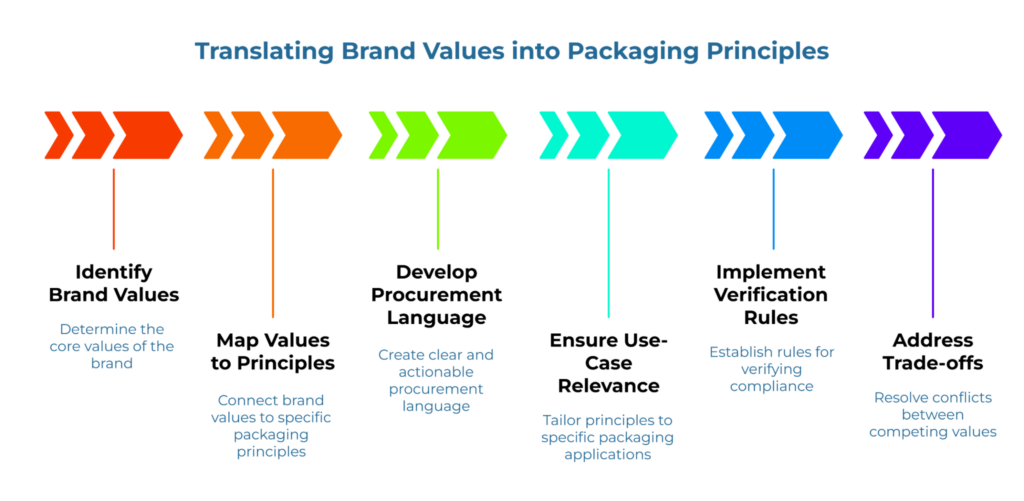
Brand values require translation before they become actionable. The table below maps common sustainability values to packaging principles and procurement-ready language:
| Brand Value | Packaging Principle | Procurement Language |
| Transparency | Traceability and documented chain-of-custody | “Supplier must provide chain-of-custody documentation from fiber source to finished product” |
| Circularity | Defined recycled content and end-of-life pathway | “Minimum 30% post-consumer recycled content; material must be recyclable in standard paper streams” |
| Ethical Sourcing | Verified responsible forestry practices | “FSC or PEFC certification required; certificate scope must cover quoted product” |
| Safety | Compliance with food-contact or chemical regulations | “Must meet applicable food safety standards, such as FDA 21 CFR, EU Regulation 1935/2004, or relevant local jurisdiction requirements for direct food contact” (where applicable) |
| Carbon Reduction | Lower-impact material choices and supply chain | “Supplier to provide carbon footprint data per tonne; preference for regional sourcing where quality permits” |
This translation step forces specificity. “We value sustainability” becomes “we require documented chain-of-custody, minimum recycled content thresholds, and active certification covering the specific products we purchase.”
Not every value applies to every packaging application. Food-contact compliance matters for primary packaging but may be irrelevant for shipping boxes. The mapping exercise should reflect actual use cases, not aspirational coverage.
Two implementation rules prevent overreach:
Only require what will be verified. If a requirement will not be checked, it will become a “paper policy.”
Make trade-offs explicit. Some values compete—recycled content versus strength or print fidelity, for example. Resolving trade-offs upfront avoids downstream exceptions.
Step 2 — Turn Principles into Sourcing Requirements Suppliers Can Quote Against
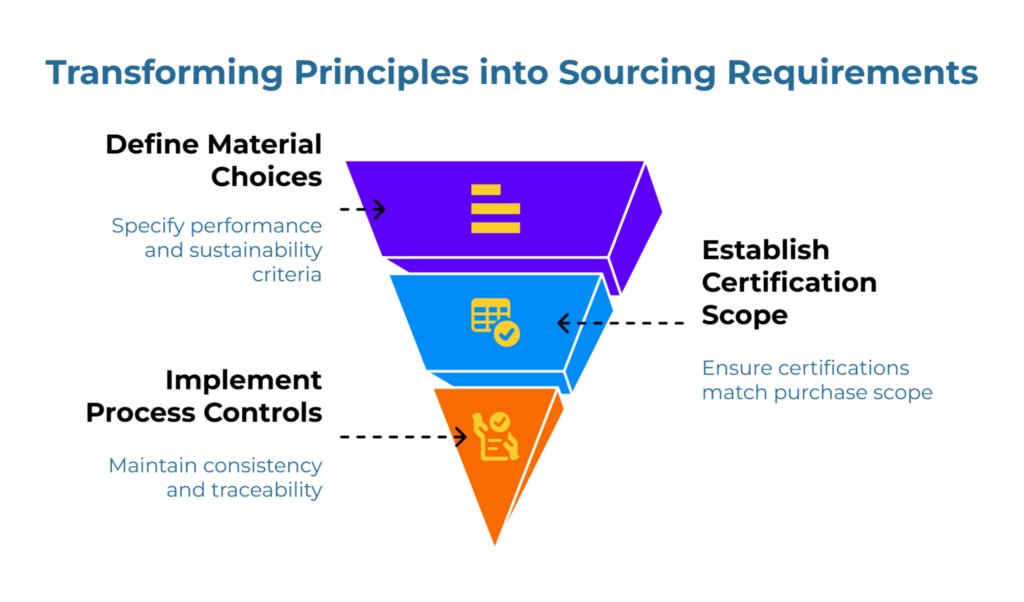
Principles become operational when structured into three requirement categories that suppliers can respond to directly.
A) Material Choices and Constraints
Specify what matters for performance and sustainability claims. Define substrate and basis weight ranges with acceptable alternates, fiber position such as recycled-content targets or virgin-allowed conditions, additives or coatings or barriers with clear restrictions tied to performance or recyclability or compliance needs, and converting details that affect integrity like glues, inks, handles, seams, and laminations.
As a general principle, higher recycled content can introduce variability in strength, appearance, and runnability depending on furnish and process controls. Virgin kraft can offer more consistent tensile and tear performance. The operationally safe approach is not ideology—it is specification. Define the minimum performance properties required for the use case, then qualify whichever fiber mix meets both performance and evidence requirements.
Copy-ready procurement clause (example):
“Supplier to declare substrate composition per SKU: basis weight in gsm, fiber type, recycled content percentage by weight, coating or barrier type. Any change to substrate, coating, ink system, or adhesive requires written notification and buyer approval prior to shipment.”
B) Certification Scope Requirements
Certification matters only when scope matches the purchase. An FSC certificate covering containerboard does not automatically extend to specialty papers from the same mill. Chain-of-custody certifications verify traceability and origin, but they do not replace lifecycle assessments or carbon footprint data increasingly required by corporate ESG reporting standards and emerging climate disclosure laws to substantiate low-impact claims.
Define which certification schemes are acceptable, which sites must be covered—mill versus converter versus trader—which products or SKUs must fall under scope, and which claim type is acceptable with documentation of how it will appear on invoices and delivery documents.
Copy-ready procurement clause (example):
“Chain-of-custody certification must cover the manufacturing or converting site supplying the goods. Supplier must provide certificate code, scope statement, and evidence the supplied product group is included in scope.”
Additional sourcing guidance and specification frameworks are available through the PaperIndex Academy, which offers educational resources for both buyers developing requirements and suppliers preparing qualification documentation.
C) Process Controls and Documentation Cadence
Lot-to-lot consistency affects both sustainability claims and operational performance. Sustainable sourcing fails when documentation is ad hoc. Set a cadence that is realistic for small and medium enterprises.
Specify lot identification and traceability using batch or lot codes and invoice references, documentation frequency per shipment or quarterly or annually based on risk, retention period for how long records must be kept, and quality consistency controls including certificate of analysis availability and key properties tracked.
Copy-ready procurement clause (example):
“Supplier must provide per-shipment documentation: invoice with claim statement if applicable, lot or batch identification, and a basic certificate of analysis or equivalent quality record for agreed properties. Supplier must retain records for [defined period] and provide within [request window].”
Step 3 — Verify Sustainability Claims Using an Evidence Ladder
Verification protects against greenwashing risk while respecting resource constraints. The evidence ladder below sequences checks from fastest to most thorough, allowing verification depth to match risk level.
Claim. Start with what the supplier states—website language, sales materials, RFQ responses. Note specific assertions: “100% recycled,” “FSC certified,” “carbon neutral.” Vague language like “eco-friendly,” “green,” or “planet-safe” is a red flag because it is hard to verify.
Certificate. Request the actual certificate document, not a logo or badge. Certificates specify the holder entity, scope of certification, issuing body, and validity period.
Scope check. Compare the certificate scope against what you are actually purchasing. Does the certificate cover the specific mill producing your order? Does it include the product grades you require? Scope mismatches are common and often unintentional.
Registry validation. Verify certificate authenticity through the issuing body’s public registry. FSC certificates can be validated through the FSC Certificate Database. PEFC certificates are searchable via the PEFC Find Certified portal. This step confirms the certificate is current and has not been suspended or withdrawn.
Chain-of-custody logic. For claims like “100% recycled” or “certified sustainable fiber,” trace the logic from raw material to finished product. Does the supplier’s chain-of-custody certification allow the claim being made? Some certifications permit percentage-based claims; others require physical segregation. If a product is sold with a certified claim, supporting sales documents typically need to carry claim information in the way the scheme requires. A certificate alone is not proof that a specific shipment is eligible.
Recent supporting documents. Request documentation dated within the past 12 months: test reports, audit summaries, internal compliance records. Current documentation demonstrates active management rather than legacy certification.
This sequence distinguishes marketing claims from procurement-verifiable claims. A supplier stating “committed to sustainability” offers a marketing claim. A supplier providing a current FSC chain-of-custody certificate with scope covering the quoted product, validated through the FSC database, offers procurement-verifiable evidence.
Separate Marketing Claims from Procurement-Verifiable Claims
Use two buckets:
Procurement-verifiable (stronger):
- “Chain-of-custody certified under FSC or PEFC for this converting site and product group”
- “Recycled content percentage by weight, defined and measured under ISO 14021 or equivalent recognized approach for self-declared claims”
Marketing-forward (higher risk unless substantiated):
- “Sustainable,” “environmentally friendly,” “better for the planet,” “carbon neutral”—these often require deeper substantiation and boundary definitions
For detailed verification procedures across FSC, ISO, and food-contact certifications, see kraft paper manufacturer certifications: FSC, ISO & food-contact – a verification guide.
Step 4 — Build an Internal Approval Path That Prevents Future Drift
Sustainable sourcing requires governance that survives personnel changes and supplier transitions. A lightweight model assigns clear ownership across three functions.
Procurement owns requirements and evidence intake. Sourcing teams define specifications, collect supplier documentation, and maintain the evidence archive. They verify certificates at onboarding and confirm ongoing validity at defined intervals.
Operations owns performance acceptance criteria. Materials must run on existing equipment within acceptable quality parameters. Sustainability gains mean nothing if the packaging fails during pack-out. Operations validates that specified materials meet functional requirements before procurement commits to sustainability-driven changes. To support this validation process, procurement teams can use systematic supplier verification checklists that align quality requirements with sustainability claims
Brand owns claim language and public-facing statements. Marketing determines what can be said externally based on the evidence procurement has collected. Claims should not exceed what documentation supports. “Made with recycled content” requires evidence of recycled content. “100% recycled” requires evidence that no virgin fiber is present.
Change-control triggers prevent silent drift. Define what supplier changes require re-verification: new mill sources, certificate scope changes, material reformulations, certification lapses. Without explicit triggers, a supplier’s certificate expiration or scope reduction may go unnoticed until an external inquiry surfaces the gap. This is not bureaucracy; it is version control for packaging.
Quarterly cross-functional reviews—even brief ones—maintain alignment and surface emerging issues before they become compliance failures.
Step 5 — Supplier-Side Playbook: How to Prove Sustainability Without Slowing the Deal
Suppliers benefit when buyers can verify claims quickly. The following practices reduce qualification friction and build repeat trust.
Assemble an evidence pack before inquiries arrive. Prepare a standard documentation package including current certificates with scope clearly marked, chain-of-custody explanations showing how certified or recycled material flows through production, recent test reports or audit summaries, and clear statements of what the certification does and does not cover. Proactive documentation signals professionalism and reduces back-and-forth during qualification.
Present scope and limitations honestly. If certification covers some product lines but not others, say so clearly. If recycled content varies by grade, provide the ranges. Trust accelerates when constraints are stated upfront. Buyers appreciate specificity over vague assurances—it builds credibility and prevents post-award disputes when documentation does not match expectations.
Avoid vague claims that trigger deeper audits. Broad statements like “environmentally friendly” or “green packaging” invite scrutiny because they lack verifiable meaning and increasingly face regulatory challenges. Specific, bounded claims like “FSC Mix Credit certified” or “minimum 30% post-consumer recycled content per lot” give buyers something they can check and accept.
Suppliers seeking systematic approaches to remote buyer qualification can review how to verify international suppliers without travel, which addresses documentation practices from the verification perspective.
Putting It into Action: A Brand-to-Packaging Alignment Checklist
The following checklist consolidates the methodology into questions that can be addressed in 30–60 minutes of focused work.
Values Translation (10 minutes)
- Which 2–3 sustainability values are non-negotiable for this packaging application?
- What does each value mean in measurable packaging terms?
- Are there values that apply to some products but not others?
Requirements Definition (15 minutes)
- What material specifications will we include in RFQs?
- Which certifications are required versus preferred?
- What documentation cadence will we require from suppliers?
Verification Protocol (10 minutes)
- Who will validate certificates against issuing-body registries?
- What scope checks will we perform before awarding business?
- How will we handle suppliers whose claims cannot be verified?
Governance Assignment (10 minutes)
- Who owns requirements, evidence collection, and supplier qualification?
- Who approves public-facing sustainability claims?
- What supplier changes trigger re-verification?
Supplier Communication (5 minutes)
- Have we shared our requirements clearly enough for suppliers to quote accurately?
- Are we asking for documentation that suppliers can reasonably provide?
For buyers ready to apply these requirements, PaperIndex offers a global supplier directory where you can find suppliers across paper and packaging categories, including specialized directories such as paper bag suppliers. When requirements are defined, you can submit an RFQ to receive quotes directly from qualified suppliers.
Frequently Asked Questions
What does FSC or PEFC certification actually guarantee—and what doesn’t it guarantee?
FSC (Forest Stewardship Council) and PEFC (Programme for the Endorsement of Forest Certification) certify that fiber originates from responsibly managed forests or acceptable controlled sources. Chain-of-custody certification tracks that fiber through the supply chain to the final product. However, certification does not guarantee specific recycled content percentages, carbon footprint levels, or compliance with food-contact regulations. Those attributes require separate verification. Certification scope also varies—a supplier’s certificate may cover some products and not others, so scope verification against the specific purchase is essential.
How can certificate scope be validated quickly?
Both FSC and PEFC maintain public certificate databases. For a comprehensive guide on verifying these certifications when sourcing kraft paper, see our article on kraft paper manufacturer certifications. The FSC database at info.fsc.org allows searching by certificate code, company name, or product category. PEFC’s portal at pefc.org/find-certified offers similar functionality. A five-minute check confirms certificate validity, identifies the certified entity, and shows exactly which product categories fall within scope. This step catches expired certificates and scope mismatches before they become procurement problems.
How should packaging claims be worded to avoid greenwashing risk?
Claims should be specific, bounded, and supportable. “Made with FSC-certified material” is defensible if chain-of-custody documentation supports it. “Eco-friendly packaging” is vague and invites a challenge. The general principle: claim only what documentation proves, and phrase claims to match the evidence precisely. When in doubt, regulatory guidance from bodies such as the U.S. Federal Trade Commission Green Guides or the EU’s framework on Unfair Commercial Practices and Green Claims provides direction on substantiation requirements. Enforcement bodies using these frameworks increasingly penalize generic terms that lack specific, verifiable evidence.
What should buyers request from suppliers when internal compliance resources are limited?
Focus on the evidence ladder’s middle steps: certificate copies with scope clearly visible, registry validation confirmation—suppliers can provide screenshots—and a clear statement of what the certificate covers and excludes. For ongoing relationships, request automatic notification when certificates are renewed or when scope changes. This approach provides reasonable verification without requiring deep audit capability. Many suppliers serving international markets are accustomed to providing such documentation as part of standard qualification processes.
How should recycled content be defined in requests?
Ask suppliers to state recycled content percentage by weight, specify whether it is pre-consumer or post-consumer, and describe the basis used for the claim. ISO 14021 is a widely recognized reference for self-declared environmental claims and related evaluation concepts, though jurisdictional requirements may still apply.
For a comprehensive approach to packaging compliance across multiple jurisdictions, see our retailer’s guide to sustainable packaging compliance.
Disclaimer:
This content is for educational purposes only.
Our Editorial Process:
Our expert team uses AI tools to help organize and structure our initial drafts. Every piece is then extensively rewritten, fact-checked, and enriched with first-hand insights and experiences by expert humans on our Insights Team to ensure accuracy and clarity.
About the PaperIndex Insights Team:
The PaperIndex Insights Team is our dedicated engine for synthesizing complex topics into clear, helpful guides. While our content is thoroughly reviewed for clarity and accuracy, it is for informational purposes and should not replace professional advice.