

📌 Key Takeaways
A supplier certificate proves they have quality systems—it does not prove the folding cartons on your dock meet your exact specifications.
- Certificates Are Starting Points: Management system certificates confirm a supplier has processes, but they say nothing about the board grade, barrier coating, or tolerances on your specific order.
- Hidden Risk Starts Before Shipping: Most imported folding carton failures trace back to vague specifications and missing test requirements—not damaged containers or humid ports.
- Same Name, Different Product: Two suppliers quoting “300 GSM food-grade folding carton” may apply different tolerances, coatings, and test methods, making quotes non-comparable.
- Match Proof to the Shipment: Run-specific evidence—exact board specifications, named test methods, batch-linked documents—closes the gap that certificates leave open.
- Audit One Order This Week: Pull your most recent import file and check if documents tie to this specific run, not just general supplier capability.
Specifications-first validation prevents dock failures that certificates alone cannot catch.
Procurement managers, QA teams, and packaging engineers sourcing imported folding cartons will gain a practical framework for spotting hidden specification gaps, preparing them for the detailed verification methods that follow.
~ ~ ~ ~ ~ ~ ~ ~ ~ ~ ~ ~ ~ ~ ~ ~ ~ ~
It satisfies no one.
The shipment arrives at 8:00 AM. The bill of lading matches. The pallet count is correct. The supplier’s ISO certificate sits in your compliance folder, dated and stamped. Then someone from QA pulls a folding carton from the middle of the stack, runs a thumb along the interior surface, and pauses. The barrier coating feels different. Thinner. The product is frozen cream. The folding carton was supposed to handle moisture migration at sub-zero temperatures. Now the team is standing on a loading dock, staring at a container full of packaging that looks compliant on paper but fails the actual use case.
This is the moment when “certified supplier” stops meaning what you thought it meant.
The assumption that led here is common: if a supplier holds a recognized certificate, the folding cartons they ship must be safe for your product. This logic is incomplete. A certificate describes a supplier’s management system or facility capabilities. It does not automatically validate the specific folding carton run sitting on your dock—its board grade, its barrier performance, its tolerances, or its suitability for your exact food-contact conditions.
Myth 1: “If the Supplier Is Certified, the Folding Carton Run Is Compliant”
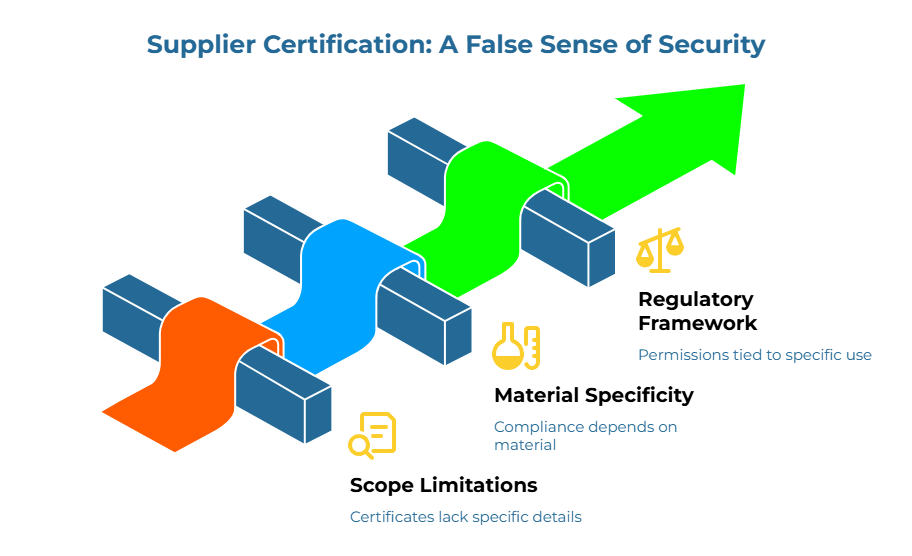
Reliance on certifications persists because it streamlines procurement. A thick folder of supplier certificates—ISO 9001, FSSC 22000, BRC Packaging—signals that someone, somewhere, has verified that the company operates responsibly. And that is true, as far as it goes. Management-system certifications confirm that a supplier has documented processes, quality controls, and audit trails.
But here is the gap: why certificates alone do not qualify a folding carton supplier comes down to scope. A company-level certificate does not specify which board grade was used for your order. It does not confirm whether the moisture barrier meets your frozen-food application. It does not state the caliper tolerance applied to this production run. The certificate proves the supplier has a system. It does not prove the folding carton matches your specification.
Food-contact compliance depends on the material, the intended use, and the applicable regulatory framework—not a vague “food-safe” label. Under 21 CFR part 170-190, permissions are tied to specific material compositions and use conditions. A supplier’s general certification does not transfer that specificity to your folding carton.
Reality: Certificates Are Starting Points, Not Proof Packs
Certificates establish baseline credibility. They confirm a supplier participates in a recognized quality or food-safety management system. That participation matters—but it answers a different question than the one QA needs answered at the dock.
The question a certificate answers: Does this supplier maintain a management system compliant with [ISO 9001/FSSC 22000] standards?
The operational question: Does this specific folding carton configuration, produced for this specific order, meet my documented requirements for board grade, barrier performance, tolerances, and food-contact conditions?
No certificate bridges that gap automatically. The buyer needs evidence tied to the exact folding carton configuration, intended food-contact conditions, and named performance fields. Even recognized packaging food-safety certifications are designed to strengthen governance rather than replace product-specific validation—a distinction FSSC’s packaging-manufacturing overview makes clear. Without run-specific proof, the certificate is a starting point—not a finish line.
Myth 2: “Imported Folding Carton Problems Usually Start in Transit”
When a folding carton fails in production—barrier breakdown, structural collapse, print defects—teams often look at logistics first. Was the container too humid? Did the shipment sit too long at a hot port? Transit damage is visible and easy to blame.
But many failures begin much earlier. The real breakdown often traces back to vague specifications, incomplete proof requirements, or missing test-method alignment before the folding carton ever left the supplier’s facility. The problem is not what happened during shipping. The problem is what was never defined before shipping.
A situation that recurs across sourcing teams: a buyer requests “food-grade folding cartons” without specifying barrier performance, moisture tolerance, or acceptable caliper range. The supplier interprets the request based on their standard production parameters. The folding carton arrives, technically matching the order description, but failing the buyer’s actual use case. No one lied. The specification was simply too loose to catch the mismatch.
This is why folding carton clarity matters before supplier review starts. The risk originates in the technical specification gap—the delta between assumed performance and defined parameters—long before the vessel leaves the quay.
Reality: Hidden Folding Carton Risk Begins with Undefined Specifications
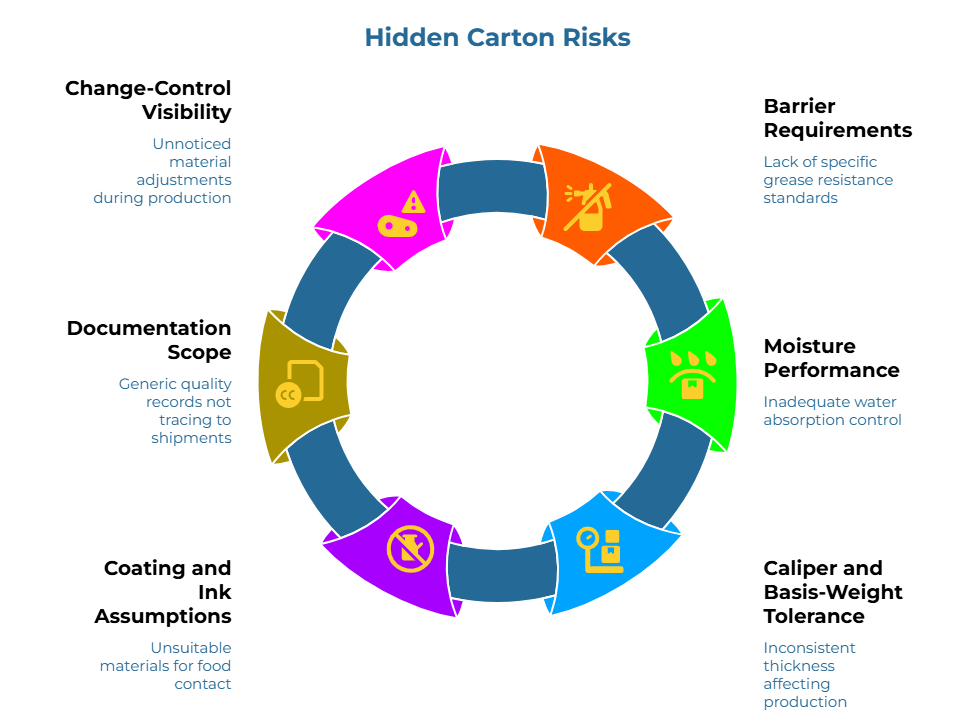
When buyers skip explicit specification fields, several categories of performance can drift without anyone noticing until production:
Barrier requirements. A folding carton labeled ‘grease-resistant’ may perform differently than one tested to a specific Kit level under TAPPI T 559. Without a named standard, “grease-resistant” means whatever the supplier decides it means.
Moisture performance. Cobb values measure water absorptiveness. A folding carton intended for frozen products needs tighter moisture control than one used for dry goods. If the buyer does not specify a Cobb target and test method, the supplier’s default may not match the application.
Caliper and basis-weight tolerance. Two folding cartons can share the same nominal basis weight but differ meaningfully in thickness consistency. That variation affects die-cutting, folding, and filling-line performance. Without stated tolerances, suppliers interpret “acceptable” differently.
Coating and ink assumptions. Food-contact coatings and inks carry migration risks. If the buyer does not specify low-migration requirements or reference applicable regulations, the supplier may use standard formulations that are unsuitable for direct food contact.
Documentation scope. A Certificate of Analysis from one production run does not cover the next. If the buyer does not require batch-specific or lot-specific documentation, the supplier may provide generic quality records that do not trace to the actual shipment.
Change-control visibility. Approved samples can differ from production runs when suppliers adjust materials or coatings without notification. If the buyer does not establish change-control requirements, formulation drift becomes invisible until it causes a failure.
When relying on supplier data sheets instead of buyer-controlled specifications, buyers inherit whatever assumptions the supplier made. Those assumptions may not match the buyer’s actual requirements.
Myth 3: “If Multiple Suppliers Quote the Same Folding Carton, They Are Quoting the Same Thing”
Two suppliers quote “300 GSM SBS folding carton with moisture barrier, food-grade.” While the line items appear identical, the underlying technical tolerances suggest otherwise.
One might accept ±5% variation; another might hold ±3%. The moisture barrier could be achieved through different coating chemistries, each with different performance thresholds under different temperature and humidity conditions. The test method used to verify barrier performance might differ—or might not be specified at all. Even the definition of “food-grade” can vary based on which regulatory framework the supplier references.
This hidden variation explains why board grade tolerances create specification gaps across suppliers. Product names describe categories. They do not guarantee alignment on the technical details that determine whether a folding carton actually works for your application.
Technical Requirements for Imported Folding Cartons
Generic certificates describe supplier capability. The proof that matters describes folding carton capability—tied to the exact product, the exact run, and the exact use case.
What You Think a Certificate Covers vs. What Actually Matters for Food-Grade Barriers
| Certificate-Based Assumptions | What Actually Matters Before You Trust the Folding Carton |
| Supplier is certified | Supplier can produce evidence for this specific order |
| General quality system | Exact folding carton grade and board specification for this run |
| “Food-safe” facility | Food-contact applicability verified for your product type and conditions |
| Standard production capability | Barrier or moisture performance tested for your use case |
| Quality controls exist | Named test method (e.g., TAPPI T 441 for Cobb values) documented |
| Acceptable quality | Tolerance band stated and agreed before production |
| Ongoing compliance | Run or batch specificity linking documentation to your shipment |
| System audits | Change-control visibility—notification if materials or coatings changed |
| Documentation available | Document traceability to this actual shipment, not generic records |
This comparison captures the core shift: from trusting a supplier’s general status to verifying proof tied to the specific folding carton being shipped. The certificate opens the conversation. Run-specific evidence closes the loop.
The First Move to Make This Week
Overhauling an entire supplier qualification process takes time. But one step can start immediately: pull the most recent imported-folding carton order file and audit it against the proof categories in the table above.
Ask these questions:
Does the documentation reference the exact board grade and specification for this order? Understanding what proof to request at RFQ stage helps structure these requirements before quotes arrive. Is the food-contact claim tied to a named regulatory provision (such as FDA 21 CFR 176.170 or EC No. 1935/2004), or is it a vague ‘food-safe’ statement? Is there a test report confirming barrier or moisture performance—using a named test method—for this production run? Are tolerances stated explicitly, or are they assumed? Can the documents be traced to this specific shipment, or do they describe the supplier’s general capability? Does the evidence pack show change-control visibility from approved sample to production run?
If gaps appear, you have found the hidden risk. The goal is not to reject suppliers. The goal is to replace assumption with specification—before the next shipment arrives.
Stop Collecting Reassurance, Start Collecting Spec-True Proof
The sinking feeling on the loading dock is preventable. It starts not with finding different suppliers, but with asking better questions earlier in the process.
Certificates are not the problem. The problem is treating them as proof of folding carton compliance when they were only ever proof of supplier capability. The shift is simple in concept: stop asking “Are you certified?” and start asking “Can you show me evidence that this exact folding carton, for this exact use case, meets these exact specifications?”
That shift—from certificate collection to specification-first validation—is what separates teams who catch problems at the dock from teams who prevent them before production ever starts.
For more practical frameworks on packaging compliance and supplier verification, explore the PaperIndex Academy. If supplier research is next, browse folding carton suppliers with the same spec-first mindset.
Disclaimer
This article is for educational purposes only.
Our Editorial Process:
Our expert team uses AI tools to help organize and structure our initial drafts. Every piece is then extensively rewritten, fact-checked, and enriched with first-hand insights and experiences by expert humans on our Insights Team to ensure accuracy and clarity.
About the PaperIndex Insights Team:
The PaperIndex Insights Team is our dedicated engine for synthesizing complex topics into clear, helpful guides. While our content is thoroughly reviewed for clarity and accuracy, it is for informational purposes and should not replace professional advice.