

📌 Key Takeaways
Supplier data sheets describe what a supplier makes—they don’t define what you should accept, and that gap causes folding carton failures.
- Own the Specification, Own the Outcome: When buyers write the specification instead of copying supplier sheets, they control quality, comparability, and consistency across every SKU.
- Numbers Without Ranges Mean Nothing: A basis weight of 295 g/m² is useless if no one states whether ±3% or ±5% is acceptable—suppliers fill that silence with their own interpretations.
- Name the Test Method Every Time: Two suppliers reporting “caliper” under different testing standards produce numbers that look equal but behave differently on your converting line.
- Lab Conditions Aren’t Your Conditions: Moisture values measured at 23°C and 50% humidity may cause cracking or warping in your actual warehouse or production environment.
- Lowest Price Often Means Lowest Specification: Without a standardised baseline, the cheapest quote might simply be the quote with the loosest interpretation of your needs.
Supplier sheets collect data; buyer-owned specifications create control.
Packaging engineers, procurement managers, and converting operations teams managing multi-SKU portfolios will find a practical framework for building enforceable house specifications, preparing them for the detailed implementation guidance that follows.
~ ~ ~ ~ ~ ~ ~ ~ ~ ~ ~ ~ ~ ~ ~ ~ ~ ~
The spreadsheet says the basis weights match. The supplier’s data sheet says “suitable for folding cartons.” Your converting floor says the board won’t fold without cracking at the score line.
This gap between supplier documentation and production reality is known as ‘Specification Drift’. It’s the slow erosion of specification accuracy that happens when buyers rely on supplier-provided data sheets as if they were engineering blueprints. They aren’t. And until your team recognizes that distinction, every multi-SKU RFQ cycle will carry hidden risk.
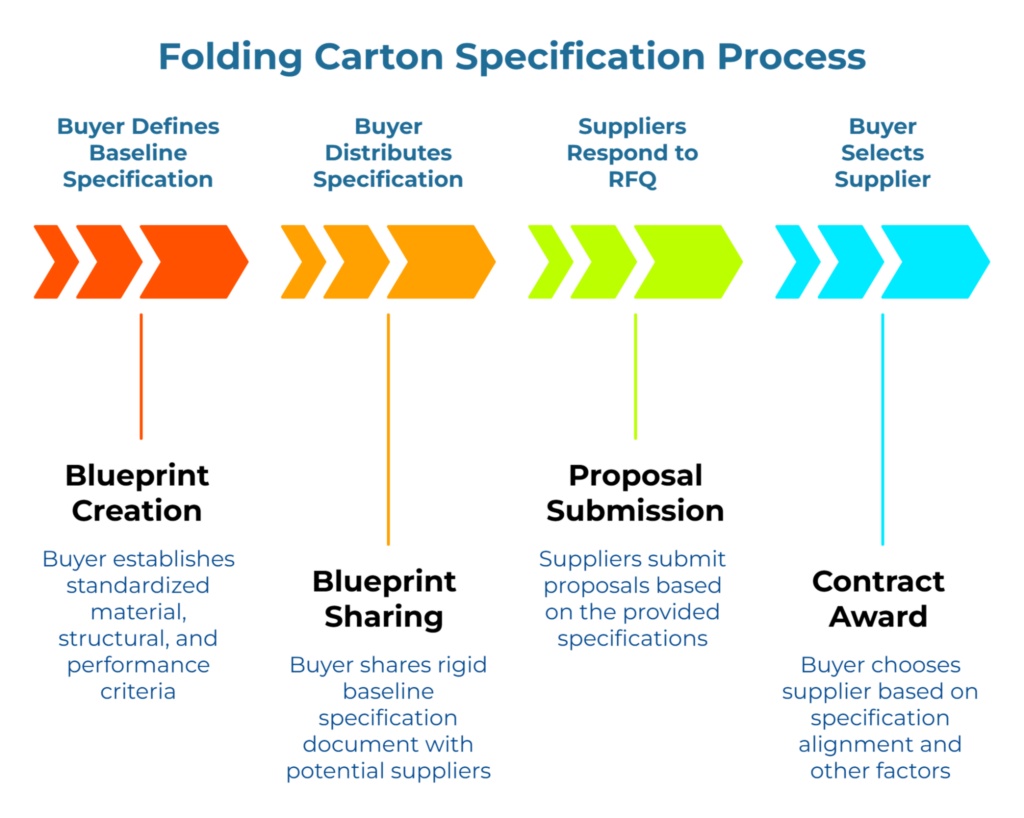
Folding carton specification requirements are the standardized set of material, structural, and performance criteria required to manufacture paperboard packaging consistently across diverse product lines. Think of them as the master architectural blueprint for a neighborhood: every house may be built by a different contractor, but the blueprint ensures safety, comparability, and repeatability. The buyer must define and distribute a rigid baseline specification document before issuing any new multi-SKU RFQs.
Prioritizing specification alignment over price comparability prevents the incremental erosion of portfolio integrity.
The real issue is not whether suppliers provide data. They do. The issue is governance.
The Myth: Supplier Data Sheets Give You a Dependable Specification Baseline
Teams trust supplier data sheets for understandable reasons. These documents look technical. They include numbers, test results, and certifications. They arrive in professional PDF formats with company logos and quality stamps. For a procurement manager juggling dozens of SKUs and compressed timelines, accepting these documents at face value feels efficient. It seems faster than building an internal standard from scratch.
The trouble starts when your portfolio expands. When you’re sourcing folding cartons from three folding carton suppliers across two continents for a product line spanning fifteen SKUs—whether cosmetics packaging, beverage multipacks, or wellness supplement boxes—those individual data sheets stop functioning as a unified specification system. Each supplier has formatted their information differently. Each has chosen which properties to highlight and which to omit. Each has been tested under conditions that may or may not match your converting environment.
You’re no longer comparing apples to apples. You’re comparing a supplier’s marketing summary to another supplier’s technical excerpt to a third supplier’s quality certificate—and hoping the numbers mean the same thing. This isn’t a failure of supplier integrity. It’s a structural problem with how the documentation was designed to function.
The Reality: A Supplier Data Sheet Is Not Your House Specification
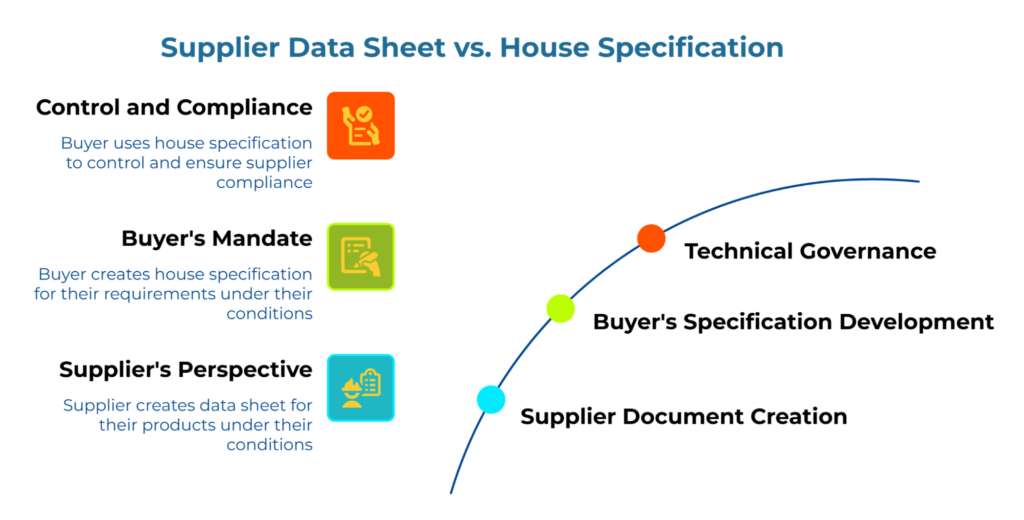
A supplier document acts as a reference; a house specification acts as a mandate.
This distinction is the core of technical governance. A supplier data sheet is a document created by the supplier, for the supplier’s purposes. It describes what they produce under their conditions, using their preferred test methods, formatted to their template. It’s useful reference material—but it is not a control document.
A house specification is a document created by the buyer, for the buyer’s purposes. It defines what you require under your conditions, using named test methods you’ve selected, formatted to a template you control. It tells every supplier exactly what to measure, how to measure it, and what tolerances you’ll accept.
The difference is ownership. And ownership determines control.
Supplier Data Sheet characteristics:
- Supplier’s format and structure
- Declared values without acceptance bands
- Isolated grade data for a single product
- Paper facts disconnected from converting-use relevance
- Marketing-adjacent presentation
Buyer-Owned House Specification characteristics:
- Your standardized format across all suppliers
- Target values plus explicit tolerance bands
- Portfolio-wide comparability across SKUs
- Converting-context requirements built in
- Engineering-first documentation
A practical rule helps here: collect supplier data, but never let supplier formatting become the governing logic of the bid. That logic has to remain buyer-owned.
When you rely on supplier sheets alone, you’ve delegated your specification governance to your vendors. That delegation comes with consequences that compound across every SKU in your portfolio.
Where Truth Decay Actually Starts
Specification Drift is not a product of supplier malfeasance; it is an inherent limitation of documentation optimized for manufacturing output rather than cross-vendor procurement comparability. The gaps are structural, not malicious. Understanding where these gaps occur is the first step toward closing them.
Different Test Methods Create False Equivalence
Two suppliers can both report “basis weight” and give you numbers that look identical. But one measured per ISO 536 (grammage in g/m²) while the other used a regional test method with different conditioning protocols. For guidance on specifying named test methods, see TAPPI/ISO in plain english: which test methods to require in your kraft paper RFQ (and why). The numbers match on paper. The board behaves differently on your converting line.
The same problem appears with caliper measurements, moisture content, and stiffness values. Discrepancies in basis weight, moisture, or COBB values distort RFQ results in ways that aren’t visible until production. Without a named test method attached to every property, you’re trusting that two suppliers made identical methodological choices. They rarely do.
Missing Tolerances Let Suppliers Define the Acceptable Range
A supplier sheet might tell you the board has a basis weight of 295 g/m². What it rarely tells you is the acceptable variation band. Is ±3% within spec? Is ±5%? The supplier knows their internal tolerances, but they haven’t shared them—and more importantly, they haven’t asked what your converting process can handle.
A number without an acceptance band is not a control system. It’s a snapshot. Snapshots don’t give you the control you need when a delivery arrives at the edge of an undisclosed range and your production team has to decide whether to run it or reject it.
Context-Free Values Ignore Your Converting Reality
Supplier data sheets report properties measured under standard laboratory conditions. Your converting floor operates under different humidity, different temperatures, and different machine speeds. Values detached from your runnability, printing, filling, humidity exposure, storage, or handling conditions create false confidence.
A moisture value that looks perfect at 23°C and 50% relative humidity may cause warping or cracking in your actual production environment. A stiffness measurement taken under controlled conditions says nothing about how the board will behave after three weeks in a humid warehouse waiting for your filling line to catch up.
Why Data-Sheet Dependence Ruins Multi-SKU Folding Carton Consistency
The consequences of truth decay compound as your SKU portfolio grows. What starts as minor variation across two suppliers becomes systemic unpredictability across an entire product line. For SMB consumer-goods operations with expanding portfolios, these consequences hit harder because there’s less organizational capacity to absorb surprises.
Portfolio Drift Across Suppliers
When each supplier defines their own acceptable ranges, your portfolio slowly drifts apart. Folding cartons for your skincare line perform differently than folding cartons for your beverage multipacks—not because you specified different requirements, but because you never specified unified requirements in the first place.
Over time, this drift erodes brand consistency. The tactile experience of your packaging varies by production batch. Your quality team spends more time investigating complaints than preventing them. And because nobody documented what “acceptable” actually means, every conversation becomes a negotiation rather than a verification.
Machine Runnability Risk
Converting equipment operates within specific tolerances for caliper, moisture, and stiffness. When the incoming board varies unpredictably—because no one defines the acceptable variation band—your line experiences jams, misprints, and cracking at score lines. For guidance on setting these tolerance windows, see runnability and moisture: how small spec shifts drive big downtime.
These aren’t supplier quality failures in the traditional sense. The supplier delivered what they always deliver. The problem is that “what they always deliver” doesn’t match what your machines expect, and no specification document ever closed that gap. The result is line-side surprises when a “matching” supplier material doesn’t behave the same way in production.
Quote Comparability Failure
Rapid SKU expansion fragments vendor data. Time pressure pushes teams to compare spreadsheets by bottom-line numbers. And people often switch vendors when the real problem is an undefined baseline specification—a challenge explored further in comparability before price: the spec-true mindset that reduces kraft paper RFQ chaos.
Without a standardized specification baseline, your RFQ responses aren’t comparable. Supplier A quotes against their interpretation of your needs. Supplier B quotes against a different interpretation. You’re comparing prices for subtly different products—and the procurement team may not have the technical visibility to recognize it. Consequently, the ostensibly ‘competitive’ bid often reflects a lower performance threshold rather than operational efficiency.
What Your Internal Folding-Carton Specification Requirement Must Control
A buyer-owned house specification replaces supplier interpretation with buyer definition. The goal is to turn a vendor document into a buyer-controlled standard. This means controlling every variable that affects folding carton performance, quote comparability, and production consistency.
Material Properties
Define the paperboard characteristics that matter for your application. For folding cartons, this typically includes grammage (basis weight per ISO 536), caliper (thickness per ISO 534), moisture content, and surface properties like Cobb water absorptiveness per ISO 535.
Each property needs a target value and an explicit tolerance band. “Approximately 300 g/m²” is not a specification. “295–305 g/m² per ISO 536, conditioned per ISO 187” is a specification.
Dimensional and Structural Parameters
Specify the mechanical properties that determine how the board behaves during converting and end-use. Bending resistance (typically measured per ISO 2493 or TAPPI T489), score line performance, and fold endurance directly affect whether your folding cartons run cleanly on your equipment and hold up in your supply chain.
These parameters should reflect your actual converting conditions, not generic industry ranges. If your equipment has specific nip gap requirements or your die-cutting stations demand particular caliper consistency, those constraints belong in your specification.
Performance Criteria and Tolerances
Define the functional requirements for the finished folding carton. What structural integrity does your distribution channel demand? What print surface quality does your brand require? What moisture resistance must the folding carton maintain through your logistics environment?
Performance criteria translate your end-use requirements into measurable standards. Tolerances and variation bands define the acceptable range for each criterion. Together, they create an acceptance and rejection framework that removes ambiguity from incoming inspection.
Named Test Methods and Evidence Requirements
Every property in your specification needs an attached test method. “Basis weight” means nothing without “per ISO 536.” “Caliper” means nothing without “per ISO 534.” For a comprehensive framework on defining and enforcing these standards, explore the quality blueprint: how to define & enforce kraft paper technical specs. Named test methods eliminate ambiguity and enable true quote comparability.
Beyond test method names, specify what evidence you require. Do you need a Certificate of Analysis with every shipment? Do you require third-party lab verification? Do you need the supplier’s internal quality records? A detailed evidence framework is available in build a ‘passport’ for your material: what to include in a kraft paper RFQ evidence pack. Define your evidence expectations upfront so suppliers know what documentation to provide.
The Buyer-Owned Fix: Move from Vendor Sheets to a Rigid House-Specification System
Transitioning from supplier-led documentation to a buyer-owned specification system requires deliberate effort. But the payoff is control—over quality, over comparability, over your portfolio’s consistency. This is the first operational shift a packaging team can begin immediately.
Decide the Non-Negotiable Fields
Start by listing every property that affects your carton’s performance. Work backward from production failures, quality complaints, and RFQ comparison frustrations. If a property has ever caused a problem or created confusion, it belongs in your baseline specification.
For most folding carton applications, the baseline includes grammage, caliper, moisture, bending stiffness, surface smoothness, and COBB values. Your specific application may require additional parameters based on your converting equipment and end-use requirements.
Define the Accepted Test Method Names and Units
Standardize on specific test methods for each property. Choose between ISO and TAPPI standards based on your supplier base and regional norms, but choose one and stick with it. Mixed methods reintroduce the comparability problem you’re trying to solve.
Document the conditioning protocols required before testing. Specify units of measurement. Create clarity that leaves no room for interpretation.
Set Tolerances and Acceptable Variation Bands
For each property, define not just the target value but the acceptable range. These tolerances should reflect what your converting process can actually handle, not what sounds reasonable in a meeting room.
Tight tolerances cost more. Loose tolerances create risk. The goal is finding the band that balances cost efficiency with production reliability for your specific operation.
A useful general principle applies here: if a requirement is important enough to reject a shipment or restart a vendor conversation, it belongs in the house specification—not in someone’s memory, not in a side email, and not buried in a supplier brochure.
Mandatory Response Standardization
Create a standardized supplier response template. Every supplier must complete the same fields, in the same units, referencing the same test methods. No exceptions. For a ready-to-use framework, see the spec-driven kraft paper RFQ template: combine technical specs and commercial terms for comparable quotes.
This single change eliminates most quote comparability problems. When every response follows your format, comparing suppliers becomes straightforward. Separate data collection from supplier interpretation—your specification asks for data; suppliers provide data; you interpret what the data means for your application.
Review Every Bid Against the Same Baseline Before Commercial Comparison
Before any RFQ leaves your organization, run it through a specification review gate. Does every material property have a target and tolerance? Does every property name a test method? Does every requirement reflect your actual production conditions? A detailed RFQ construction methodology is available in anatomy of a perfect kraft paper RFQ: a step-by-step guide for converters.
Only after confirming specification compliance should the procurement team move to commercial comparison. This gate prevents the common error of awarding business based on price when the specifications aren’t actually equivalent.
Use the “Data Sheet vs. Blueprint” Visual to Retrain Internal Teams
The shift from supplier-led to buyer-owned specification requires organizational change. Procurement, engineering, and quality teams need a shared understanding of why the change matters and what it requires from each role. A visual comparison makes the difference concrete—something your team can screenshot or reuse internally.
| Supplier Data Sheet Usually Contains | Supplier Data Sheet Usually Omits | Buyer-Owned Blueprint Must Add |
| Product name and grade designation | Explicit tolerance bands for each property | Your target values with ±tolerance bands |
| Selected material properties (often without named test methods) | Named test methods for every measurement | Your required test methods (ISO 536 for grammage, ISO 534 for caliper, ISO 535 for COBB, ISO 2493 or TAPPI T489 for bending resistance) |
| Marketing language about suitability and applications | Conditioning protocols used during testing | Your conditioning requirements matching your production environment |
| Certifications and compliance statements | Context about which converting conditions the data reflects | Your evidence and documentation expectations |
| Contact information for sales inquiries | Evidence requirements for ongoing quality verification | Your acceptance criteria and rejection protocols |
| Generic test references, sometimes incomplete | Acceptance and rejection criteria | Your supplier response format requirements |
| Material facts in supplier context | Converting, printing, filling, storage, and handling context | Use-case relevance for your operation |
This visual works as a training tool for internal alignment. When packaging engineers, procurement managers, and brand operations teams see the gaps side by side, the need for buyer-owned specifications becomes self-evident.
Control Returns When the Buyer Defines the Specification
The problem is not that suppliers provide data. Data sheets serve their purpose—they describe what a supplier produces under their conditions.
The problem is that buyers mistake supplier data for specification governance. They treat reference material as control documentation. And when that reference material varies across suppliers, the buyer loses comparability, consistency, and ultimately control. Every supplier effectively sets its own rules, and the buyer absorbs the consequences.
The real failure may not be the vendor. It may be the absence of a rigid internal blueprint.
The fix is ownership. Specification Normalization is the prerequisite methodology that enables enforceable Folding Carton Specification Requirements across global vendors. For a detailed normalization workflow, see specification alignment first: how to normalize vendor data across global food packaging paper suppliers. Define your requirements before you request quotes. Distribute that specification to every potential supplier. Require responses in your format, against your test methods, within your tolerances.
Suppliers will comply. They want your business, and a clear specification makes their quoting process easier, not harder. What feels like added work upfront eliminates the confusion, rework, and disputes that plague undefined procurement relationships.
Your next step: before your next multi-SKU RFQ cycle, create or tighten your mandatory internal house specification. Decide the non-negotiable fields. Name the test methods. Set the tolerances. Then watch your quote comparisons become meaningful and your production consistency improve.
Continue Building Your Specification Discipline
The PaperIndex Academy offers additional resources on supplier qualification, RFQ structure, and specification enforcement. For guidance on building specification documents, explore creating your mill spec sheet: a guide for converting operations managers and the quality blueprint: how to define & enforce kraft paper technical specs.
For additional frameworks on RFQ construction, see anatomy of a perfect kraft paper RFQ: a step-by-step guide for converters and how to create your mill spec sheet: a step-by-step guide.
When you’re ready to connect with verified folding carton suppliers or explore folding cartons product listings, your house specification will ensure every conversation starts from a position of clarity and control.
Disclaimer:
This article provides general guidance on packaging specification practices and is not a substitute for professional engineering, procurement, or quality management advice. Specific material properties, tolerances, and test methods should be determined by qualified professionals based on your products, equipment, and operating requirements. Referenced standards may be revised; verify current versions before incorporating into specifications.
Our Editorial Process:
Our expert team uses AI tools to help organize and structure our initial drafts. Every piece is then extensively rewritten, fact-checked, and enriched with first-hand insights and experiences by expert humans on our Insights Team to ensure accuracy and clarity.
About the PaperIndex Insights Team:
The PaperIndex Insights Team is our dedicated engine for synthesizing complex topics into clear, helpful guides. While our content is thoroughly reviewed for clarity and accuracy, it is for informational purposes and should not replace professional advice.