

📌 Key Takeaways
Supplier quotes that look comparable often rest on different assumptions because the carton requirements weren’t clear before review started.
- False Comparability Hides Risk: When specifications are vague, suppliers fill gaps with their own guesses—so quotes describe different packages, not different prices.
- Clarity Means Shared Logic: A carton blueprint defines what must match before suppliers respond, turning vague requests into measurable requirements.
- Late Surprises Start Early: Teams discover specification gaps during pilots or launches because concerns stayed invisible until after quotes arrived.
- Alignment Beats Documentation: A single cross-functional session to surface key assumptions prevents weeks of rework and finger-pointing later.
- Sequence Matters: Clarify requirements first, then compare suppliers, then design proof—this order makes good work hold.
Define the blueprint before you compare the bids.
Procurement managers, packaging engineers, and brand operations leads coordinating folding carton sourcing will find a practical alignment framework here, preparing them for the specification-building guides that follow.
~ ~ ~ ~ ~ ~ ~ ~ ~ ~ ~ ~ ~ ~ ~ ~ ~ ~
In a typical procurement cycle, three supplier quotes are evaluated against a standard folding carton request. While pricing and board weights may appear within acceptable ranges, the lack of a stabilized specification creates a latent risk during production. Procurement sees pricing within range. Engineering notes that board weights look acceptable — but without a validated folding carton specification, the comparison remains superficial. Brand operations confirms the print finishes sound right. Everyone agrees the team can move forward with shortlisting.
Two months later, the first production samples arrived. One supplier interpreted “standard folding carton” as a tuck-end style. Another assumed a different caliper tolerance. The third quoted a board grade that runs differently on the filling line.
The quotes were never truly comparable. They only looked that way because the requirement logic underneath was never stabilized. This is the hidden risk in supplier review: the process can feel rigorous while still resting on unstable assumptions.
Why Supplier Review Becomes Misleading When Folding Carton Requirements Are Still Broad
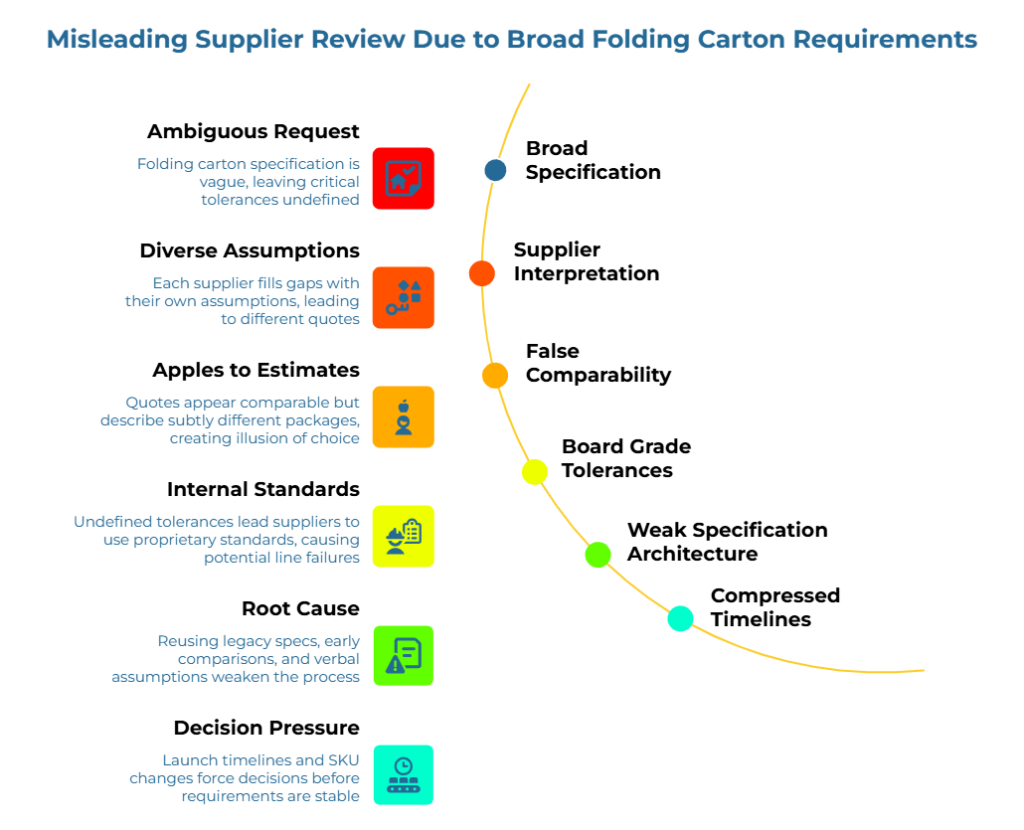
Supplier review is meant to reveal differences in capability, pricing, and fit. But when the underlying folding carton specification is broad or ambiguous, the review reveals something else entirely: how each supplier chose to interpret a loosely defined request.
A description like “folding carton for 250g retail product, SBS board, offset print” sounds specific — yet experienced folding carton buyers know it leaves critical tolerances undefined. It leaves open questions about caliper tolerances, coating weights, crease depth, and acceptable variation bands. Each supplier fills those gaps with their own assumptions. The result is a set of quotes that appear side-by-side but describe subtly different packages.
This creates false comparability. The team believes it is choosing between suppliers. In reality, it is comparing apples to estimates of apples. The decision feels controlled, but the control is an illusion.
When board grade tolerances remain undefined, suppliers revert to proprietary internal standards. A variance of ±3–5% in caliper or grammage—while negligible for some SKUs—can trigger high-speed filling line failures during the validation phase.
Teams may blame supplier behaviour when the deeper failure is a weak specification architecture. Under pressure, teams reuse legacy specifications, compare supplier responses too early, or treat verbal assumptions as documented tolerances. Compressed launch timelines, frequent SKU changes, and distribution realities force decisions before the requirement logic is stable.
What Folding Carton Clarity Really Means in a Cross-Functional Packaging Team
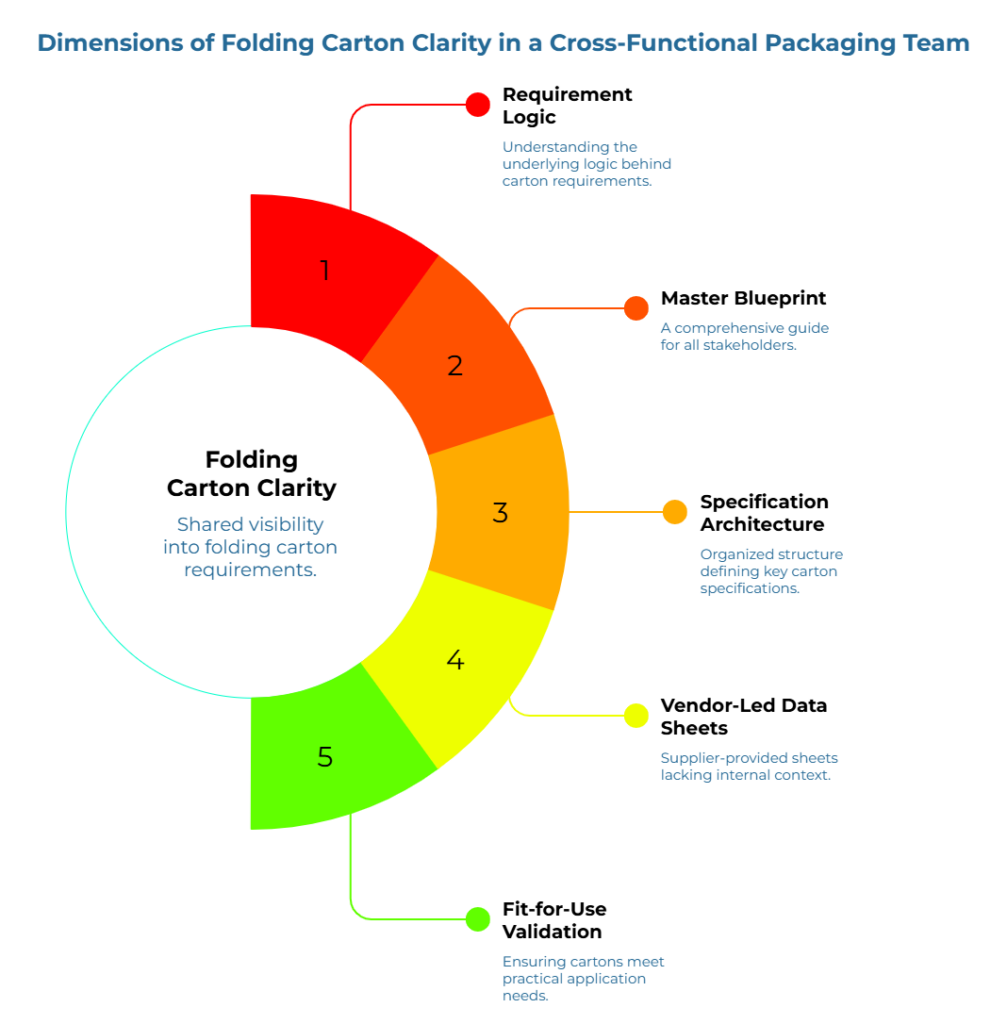
Folding carton clarity is not a documentation exercise. It is shared visibility into the requirement logic before supplier evaluation begins.
Think of it as a master blueprint. When every supplier and every internal team works from the same drawing, comparison becomes meaningful. When they do not, each party is building toward a slightly different outcome. The simplest way to frame the distinction: a shopping list tells suppliers roughly what is needed; a blueprint tells everyone what must match.
A clear folding carton specification architecture defines the fields that matter for quoting, the tolerances that matter for production, and the exceptions that matter for specific SKUs. It answers questions before suppliers have to guess.
This is different from handing suppliers a legacy specification sheet and hoping for the best. Legacy specifications often carry forward assumptions that no longer apply. They may reference materials or constructions that have drifted out of alignment with current SKU realities.
When teams rely on vendor-led data sheets instead of building their own requirement structure, they hand interpretation authority to the supplier — a risk that grows significantly when sourcing from a broad pool of folding carton manufacturers operating under different internal standards. That works when requirements are simple. It creates risk when requirements span multiple SKUs, filling lines, or distribution conditions.
The specification architecture organizes quote-critical fields, defines exceptions, and sets the basis for fit-for-use validation before supplier selection. It transforms a vague request into a shared reference point that procurement, engineering, and brand operations can all see and verify.
Review Without Clarity vs. Review With a Shared Folding Carton Blueprint
The difference between these two states is not always visible at the quoting stage. It becomes visible later, when the team tries to act on the comparison.
| Dimension | Review Without Clarity | Review With a Shared Folding Carton Blueprint |
| What suppliers are really responding to | Each supplier interprets the request differently based on their own assumptions | All suppliers respond to the same defined fields, tolerances, and exceptions |
| How easy it is to compare responses | Surface-level comparison only; pricing looks comparable but scope varies | True like-for-like comparison; differences reflect real capability gaps |
| How internal disagreements surface | Late in the process, often during pilot or validation | Early, during the alignment discussion before RFQs go out |
| Where late surprises show up | At sample review, line trials, or post-launch complaints | Surprises are rare because requirements were explicit upfront |
| What confidence looks like before approval | False confidence based on apparent agreement | Real confidence grounded in shared, documented logic |
| Quality of follow-up conversations | Reactive troubleshooting and finger-pointing | Focused refinement based on clear performance gaps |
That shift changes the quality of the conversation. It replaces assumption-driven review with governed review. This shift grounds the review in verifiable technical data rather than subjective vendor claims.
Why Cross-Functional Visibility Matters Before Comparison Begins
Each function is protecting something real.
Engineering is protecting technical soundness across product, line, and distribution realities. Procurement is protecting governance and clean comparison. Brand operations are protecting rollout consistency and the avoidance of unnecessary complexity.
These concerns are not naturally aligned. Procurement may push for consolidation across SKUs to simplify sourcing. Engineering may resist if that consolidation ignores real differences in product weight or filling-line constraints. Brand operations may flag that a material change affects shelf appearance in ways the specification sheet does not capture.
This tension is normal. The main friction is between simplification for sourcing efficiency and technical precision for real-world fit-for-use. Neither side is wrong. The problem arises when these concerns remain invisible until supplier quotes arrive.
When concerns stay hidden, the review process becomes a negotiation instead of an evaluation. Each function pushes for its own priorities. The discussion drifts from “which supplier fits best” to “what are we even asking for.”
Folding carton clarity changes this dynamic. When folding carton specification requirements are visible in one shared structure, each function sees how its concerns fit into the whole. Trade-offs become explicit. Exceptions become documented. The specification becomes a coordination tool, not a point of friction.
A short internal line can help reset the discussion when alignment stalls. Before comparing suppliers, the team needs to confirm that everyone is pricing against the same folding carton specification architecture. Integrating this alignment phase ensures the review remains technically defensible, prioritizing data-driven metrics over mere administrative throughput.
This also matters for cross-SKU material standardization. Growth-stage companies often expand their SKU count faster than their specification logic. A folding carton structure that worked for three products may not work for twelve. Without a visible framework, teams stretch legacy specifications until something breaks.
How to Slow the Team Down Just Enough Without Stalling the Packaging Program
The concern is understandable. If clarification work delays supplier outreach, it delays the program. Teams under timeline pressure resist anything that feels like bureaucratic slowdown.
But clarification work does not need to be a redesign project. It can be a lightweight alignment step. The goal is not to create a perfect specification. The goal is to surface the assumptions that matter most before suppliers start responding to them differently.
This can happen in a single cross-functional session. Procurement shares what fields drive quote comparability. Engineering shares what tolerances affect fit-for-use. Brand operations share what consistency requirements affect SKU rollout.
The output is not a finished house specification. It is a shared understanding of what the RFQ must define clearly, and what can remain flexible. When teams treat clarification as shared alignment rather than documentation overhead, it becomes faster and less contentious. The time invested upfront is recovered later, when supplier responses actually compare.
What Should Happen Next After the Clarification Step
Once the requirement logic is stable, the next step is proof design. This means defining what evidence suppliers must provide to demonstrate that their offering meets the shared specification. It also means defining how the team will validate fit-for-use before scaling.
This leads naturally into qualification structure: the gates and checkpoints that separate a promising quote from a confirmed supplier relationship. What must a supplier prove? Which test language needs to be anchored in the requirement set? Which distribution or handling realities need validation before approval?
Published resources from TAPPI, ISO packaging standards, and ISTA test procedures can help teams frame those questions more consistently, even though the exact proof mix will vary by application.
Early specification clarity reduces false agreement during supplier review. Cross-functional teams benefit when technical, procurement, and brand requirements are visible before comparison begins. A stronger comparison process starts with a stronger requirement structure, not a faster commercial discussion.
Clarity. Comparison. Proof. This sequence transforms the procurement cycle from a race toward assumptions into a disciplined path toward production-ready results.
For teams ready to build out their folding carton specification requirements in more detail, starting with a structured review of available folding carton suppliers can help procurement teams benchmark real-world capability ranges before finalizing tolerances. Industry standards organizations such as TAPPI and ECMA also offer technical guidelines on tolerance control, evidence packs, and structured qualification logic. Alternatively, teams can consult established guidelines from packaging institutes to structure these requirements.
Disclaimer:
This article is for educational purposes only.
Our Editorial Process:
Our expert team uses AI tools to help organize and structure our initial drafts. Every piece is then extensively rewritten, fact-checked, and enriched with first-hand insights and experiences by expert humans on our Insights Team to ensure accuracy and clarity.
About the PaperIndex Insights Team:
The PaperIndex Insights Team is our dedicated engine for synthesizing complex topics into clear, helpful guides. While our content is thoroughly reviewed for clarity and accuracy, it is for informational purposes and should not replace professional advice.