
📌 Key Takeaways
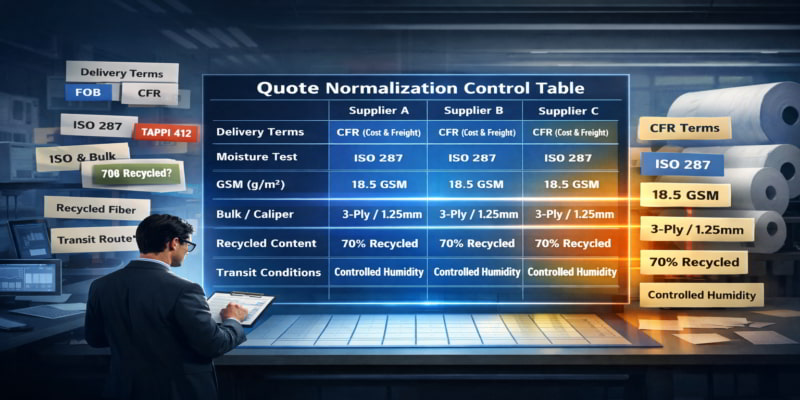
Supplier quotes only become comparable after you strip out the hidden assumptions each one carries about delivery, testing, and materials.
- Lock Delivery Terms First: A quote marked EXW and one marked CIF cannot sit side by side until freight and duties are normalized to the same basis.
- Name the Moisture Method: Suppliers who state a moisture target without naming the test standard are leaving room for interpretation that causes line problems later.
- GSM Alone Is Not a Specification: Two rolls with identical weight can behave differently if bulk and caliper vary, so record all three with tolerance bands.
- Capture Fiber and Transit Notes: Recycled content and shipping routes affect how rolls arrive, and those assumptions belong on the comparison sheet.
- Flag Incomplete Quotes: Any supplier who leaves a variable blank gets held for follow-up, not scored against quotes that answered fully.
The cheapest quote is often the one with the most assumptions left out.
Procurement managers and tissue converters comparing international parent roll quotes will find a ready-to-use normalization checklist here, preparing them for the specification-first workflow that follows.
~ ~ ~ ~ ~ ~ ~ ~ ~ ~ ~ ~ ~ ~ ~ ~ ~ ~
The quote looked solid. The price fits the budget. Then the toilet tissue parent rolls arrived, and the converting line started jamming within the first hour.
This scenario plays out when procurement teams find suppliers and compare quotes without first stripping out hidden variables—the unstated assumptions buried in each RFQ response that make one quote mean something different from another. A stated GSM, a competitive price, and a delivery date tell only part of the story. Discrepancies originate from unstated supplier assumptions rather than explicit specifications.
Until those assumptions surface, quote comparison is guesswork. The goal here is a single, repeatable baseline that forces every toilet tissue parent roll quote onto the same comparison sheet before any award decision. This five-step protocol identifies and isolates these variables, establishing a technical baseline to prevent operational disruptions.
Why Toilet Tissue RFQ Responses Stop Being Comparable
A toilet tissue parent roll quote is never just a price. It carries implicit assumptions about how the roll will be delivered, how moisture was measured, what “within spec” actually means, and whether the supplier factored in your transit corridor’s humidity profile.
When three suppliers—whether tissue paper mills or exporters—quote the same grammage but interpret delivery terms, testing conditions, and recycled-fiber content differently, their quotes cannot sit in the same spreadsheet column. The quotes look comparable on the surface. They are not. This apples-to-oranges problem that leads to line jams, rejected shipments, and finger-pointing after the fact.
Discrepancies in quotes typically stem from unaligned logistics, moisture tolerances, or fiber composition rather than inherent supplier efficiency. The common misstep of comparing EXW and CIF unit prices without cost-normalization renders GSM-based value analysis invalid when sourcing globally across different recycled-fiber constraints and testing standards. Normalization must happen before selection, not after problems appear.
Step 1: Lock the Delivery Basis Before Looking at Numbers
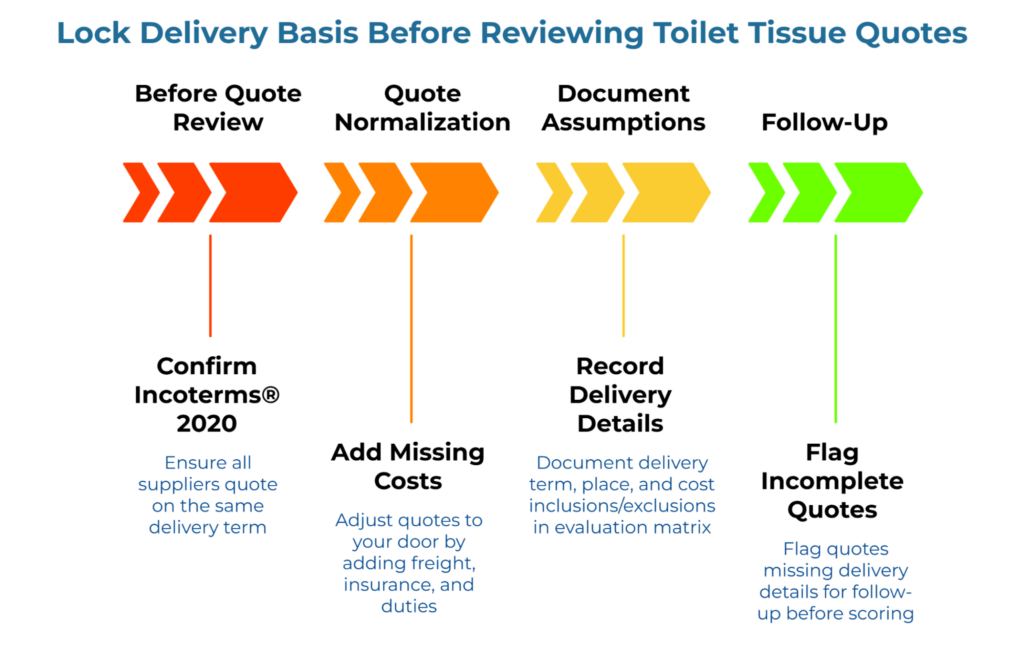
The first hidden variable is logistics responsibility. A quote marked EXW (Ex Works) shifts freight, insurance, duties, and destination handling entirely to the buyer. A quote marked CIF (Cost, Insurance, Freight) bundles some of those costs into the supplier’s number. Comparing them directly is like comparing a wholesale price to a landed price—the gap between quotes may reflect cost allocation, not actual supplier advantage.
Before reviewing any toilet tissue parent roll quote, confirm that every supplier has quoted on the same Incoterms® 2020 basis. If they have not, normalize each quote to your door by adding the missing cost elements to the leaner quotes. Document the delivery term and freight assumption within the primary evaluation matrix. A quote that omits this detail is incomplete—flag it for follow-up before scoring.
What to record: delivery term (EXW, FOB, CIF, etc.), named place, and whether freight, insurance, and duties are included or excluded.
Step 2: Lock Moisture-Control Assumptions for Toilet Tissue Parent Rolls
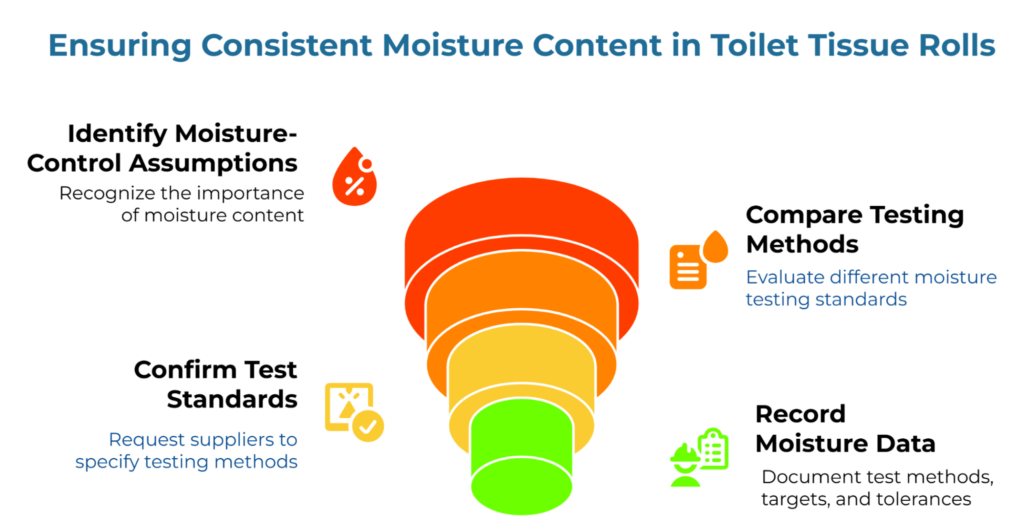
Moisture content is not a side detail for toilet tissue parent rolls. It affects shipment stability and runnability.
A roll that leaves the mill at one moisture level and arrives at your plant at another will behave differently on the converting line. Rolls that absorb moisture in humid transit corridors can swell, telescope, or cause sheet breaks. Rolls that dry out in arid conditions can become brittle and generate dust. Either outcome leads to runnability problems and, in private-label programs, potential retailer rejection.
The hidden variable here is the testing method and tolerance window. One supplier might quote a moisture target tested per ISO 287, the international standard for determining moisture content of paper and board using the oven-drying method. Another might state a number without naming the test method. A third might test under different conditioning atmospheres, as described in TAPPI T 402, which governs standard conditioning and testing atmospheres for paper products. For determining moisture content specifically, TAPPI T 412 provides another widely referenced test method.
If one quote names a moisture method and tolerance window while another does not, those quotes are not yet comparable. Ask each supplier to confirm the test standard, the target value, and the acceptable tolerance band. Record all three on your comparison sheet.
What to record: named moisture test method, target moisture value or acceptable window, and whether conditioning assumptions were stated.
Step 3: Standardize GSM, Bulk, and Caliper Tolerances
Grammage (GSM) tells you how much fiber is in the toilet tissue sheet per square meter. It does not tell you how that fiber is structured. Two parent rolls with identical GSM can have different bulk and caliper—meaning one feels thicker, softer, or more absorbent than the other even though the weight matches. On a converting line, this difference can change tension settings, perforation behavior, and finished-roll diameter. For bath tissue programs targeting specific retail specifications, even small deviations can trigger quality rejections.
When a supplier quotes a GSM, confirm whether the value was determined per ISO 536, the international standard for grammage determination in paper and board. Then ask for bulk and caliper expectations tied to your runnability requirements. A quote that states ‘17 GSM’ without tolerances or bulk context is not a locked specification—it is a loose descriptor that leaves room for interpretation.
Log GSM tolerances, bulk targets, and caliper ranges for each candidate. If any field is missing, the quote is incomplete.
Step 4: Lock Recycled-Fiber and Transit Assumptions
This is where false equivalence gets expensive.
Recycled-fiber content affects toilet tissue strength, softness, and how the sheet responds to humidity changes. A parent roll with a higher recycled-fiber percentage may perform differently under the same converting conditions as a virgin-fiber roll—neither is inherently better or worse for every application, but they are not interchangeable without adjustment. This makes understanding the capabilities of your tissue paper raw material suppliers essential before finalizing specifications. Regional bath tissue brands and contract tissue converting operations often have specific recycled-content requirements driven by sustainability commitments or cost targets.
Transit conditions add another layer of variability. A shipment crossing humid corridors or sitting in uncontrolled storage can absorb moisture regardless of what the mill certificate says. If one supplier ships from a temperate climate zone and another routes through tropical ports with extended dwell times, the parent rolls may arrive in different states even if they left their respective mills identically.
Ask each supplier to confirm the recycled-fiber content percentage and expected transit routing. Capture these assumptions without overcomplicating the RFQ—a simple note field is enough. The point is to know whether two suppliers are quoting the same material arriving in the same condition.
Step 5: Build a One-Baseline Comparison Sheet for Every Toilet Tissue Raw Material Quote
The previous four steps lead to one practical destination: a single-page baseline sheet where every toilet tissue parent roll quote sits in the same format. Each row represents one supplier. Each column represents one locked variable.
Suggested columns for the comparison sheet:
- Delivery term and freight assumption
- Moisture test method and target window
- GSM with tolerance band
- Bulk and caliper expectation
- Recycled-fiber content note
- Transit routing note
- Quote incomplete flag
That last field matters. If a supplier leaves a variable implicit, the quote should be marked incomplete and held for follow-up. That protects the process from false confidence.
The quote that deserves a second look is not the cheapest one on first pass. It is the one that can be understood on the same baseline as the others. The baseline serves as a technical audit rather than a price-leverage tool, ensuring technical comparability before commercial evaluation.
Only after the baseline is locked should evaluation move to price, lead time, or supplier reliability—at which point procurement teams can confidently submit an RFQ knowing all quotes will be comparable. Comparing quotes before this step is comparing assumptions, not offers.
The 5-Point Hidden Variable Identification Checklist
Use this checklist during first-pass quote review for any toilet tissue parent roll RFQ:
- Have all suppliers quoted on the same delivery basis? Lock the Incoterms and freight assumption before comparing prices.
- Is the moisture method and window named, not implied? Require ISO 287 or equivalent, plus a tolerance band.
- Are GSM and basis-weight tolerances stated the same way across all quotes? Confirm ISO 536 alignment and the acceptable ± range.
- Are bulk and caliper expectations tied to converting runnability? A GSM without bulk context is incomplete.
- Have recycled-fiber and transit-condition assumptions been captured? Know what is arriving at your plant, not just what left the mill.
If any answer is “no,” the quote is not yet ready for comparison.
What Not to Do on Your Next Toilet Tissue RFQ Round
Three habits undermine even well-structured RFQs.
Trusting visual samples as a substitute for locked specifications. A sample roll can look and feel acceptable while hiding moisture drift, bulk variance, or recycled-fiber differences that only surface at production scale. Samples are useful for orientation. They are not a replacement for written specifications with named test methods and tolerance bands.
Blaming machinery before checking specification drift. When line jams or quality issues appear after a supplier switch, the first question should be whether the new parent roll matches the locked baseline—not whether the converting equipment needs recalibration. Specification drift is a sourcing problem, not an equipment problem.
Awarding on first-pass cheapest-quote logic. The lowest quote is often the quote with the most hidden variables. A supplier who leaves freight, moisture method, and recycled-fiber content unstated can appear cheaper simply because the comparison is incomplete. Until every supplier is judged against the same baseline, price comparisons are unreliable.
Strip the hidden variables first. Then compare.
For more methodology-first sourcing guidance, explore the PaperIndex Academy. Once your specification baseline is locked, browse verified toilet tissue raw material suppliers, explore toilet tissue mills, or view toilet tissue rolls for sourcing orientation.
Disclaimer:
This article provides general educational guidance on toilet tissue parent roll procurement methodology. It does not constitute professional procurement, legal, or technical advice. Readers should consult qualified procurement specialists, quality assurance professionals, legal advisors, or technical experts before making decisions.
Our Editorial Process:
Our expert team uses AI tools to help organize and structure our initial drafts. Every piece is then extensively rewritten, fact-checked, and enriched with first-hand insights and experiences by expert humans on our Insights Team to ensure accuracy and clarity.
About the PaperIndex Insights Team:
The PaperIndex Insights Team is our dedicated engine for synthesizing complex topics into clear, helpful guides. While our content is thoroughly reviewed for clarity and accuracy, it is for informational purposes and should not replace professional advice.