

📌 Key Takeaways
Comparing paper supplier quotes starts with asking every supplier the same structured questions — not with better tools.
- Structure Your Request First: A detailed RFQ that requires answers on specs, freight, payment, and validity makes supplier responses comparable from the start.
- Normalize Before You Compare: Map every quote into the same fields so missing info and substitutions show up clearly instead of hiding in emails and attachments.
- Unit Price Can Mislead: The cheapest price per ton may cost more once you add freight, payment terms, and delivery gaps that weren’t included in the quote.
- Flag Exceptions Early: Suppliers who offer “similar grades” or short validity windows create hidden risks that should be visible before any ranking begins.
- AI Helps After Cleanup, Not Before: Feeding messy, inconsistent quotes into AI tools produces confident-looking results that quietly carry forward the original gaps.
Comparable data — not faster software — is what makes quote decisions reliable.
Procurement teams, sourcing coordinators, and operations managers comparing multi-supplier paper quotes will gain a repeatable normalization method here, preparing them for the detailed overview that follows.
~ ~ ~ ~ ~ ~ ~ ~ ~ ~ ~ ~ ~ ~ ~ ~ ~ ~
Three paper suppliers responded to the same request for quotation (RFQ) for 80 GSM uncoated woodfree paper. The first includes freight to the buyer’s warehouse. The second offers a lower unit price — but quotes a slightly different grammage tolerance and leaves freight responsibility unstated. The third matches the spec closely, yet buries a 7-day validity window in an email attachment while the other two hold prices for 30 days.
The differences hiding inside specifications, freight assumptions, validity periods, and payment terms can shift landed cost, delay fulfillment, or lock a team into a commitment that does not match the original requirement.
Faster quote comparison begins not with AI or a better spreadsheet, but with structured inputs: a standardized RFQ that forces comparable supplier responses, a normalization step that maps every quote into the same fields, and a disciplined review of hidden differences before any ranking takes place.
Start With the Real Problem: Supplier Quotes Are Rarely Directly Comparable
When the same RFQ — a request for quotation asking suppliers to quote against a defined requirement — goes out to multiple paper suppliers, responses come back in different formats. One arrives as a detailed PDF. Another is an email with partial information and an attached price list. A third uses a spreadsheet with different column headers and blank freight fields.
These inconsistencies hide the gaps that matter most: whether the quoted paper matches the requested spec, who bears transport costs, how long the price holds, and whether a different grade has been substituted without clear disclosure.
A sourcing coordinator may catch a specification gap. A procurement manager may spot the commercial risk in mismatched payment terms. An operations team may be the first to feel the problem when the chosen quote cannot support the required fulfillment window. Inconsistent quotes create specific friction points: procurement loses price leverage, while operations face unpredictable lead times.
Until every response sits in the same structure, any comparison method — manual, spreadsheet-based, or AI-assisted — risks overlooking the differences that change commercial outcomes.
Standardize the RFQ Before Suppliers Respond
Quote comparison quality is determined before quotes arrive. A vague RFQ produces vague responses. A structured one — as outlined in the anatomy of a perfect kraft paper RFQ — requires every supplier to address the same fields, which makes their answers comparable from the start.
A common pitfall is specifying paper grade and quantity while leaving everything else open to supplier interpretation. Without explicit fields for freight terms, price validity, MOQ, stock availability, and delivery timeline, suppliers may omit these details or bury them in separate correspondence.
The RFQ should require each supplier to state:
- Exact paper specification — grade, GSM, brightness, size, reel or sheet format
- Quantity and MOQ
- Unit price and currency
- Price validity period
- Stock availability and estimated lead time
- Freight or delivery terms, including who bears transport responsibility
- Payment terms
- Any exceptions or substitutions being offered instead of the requested spec
A supplier quoting a “similar grade available” without identifying the exact difference is not providing a comparable response. The exception field matters: suppliers should state what changed — GSM, grade, reel width, packing, stock position, delivery basis, or any other field that affects comparison. The RFQ should require suppliers to separate fully matching quotes from substitutions.
Not every supplier will comply perfectly — some will still return partial responses. The goal is not rigid enforcement but reducing the number of gaps that need to be chased after quotes arrive. A spec-first approach to RFQ design makes this achievable without adding significant time to the process. For a related example, standardizing global toilet tissue jumbo roll quotes illustrates this principle applied to a different grade.
Normalize Every Quote Into the Same Comparison Fields
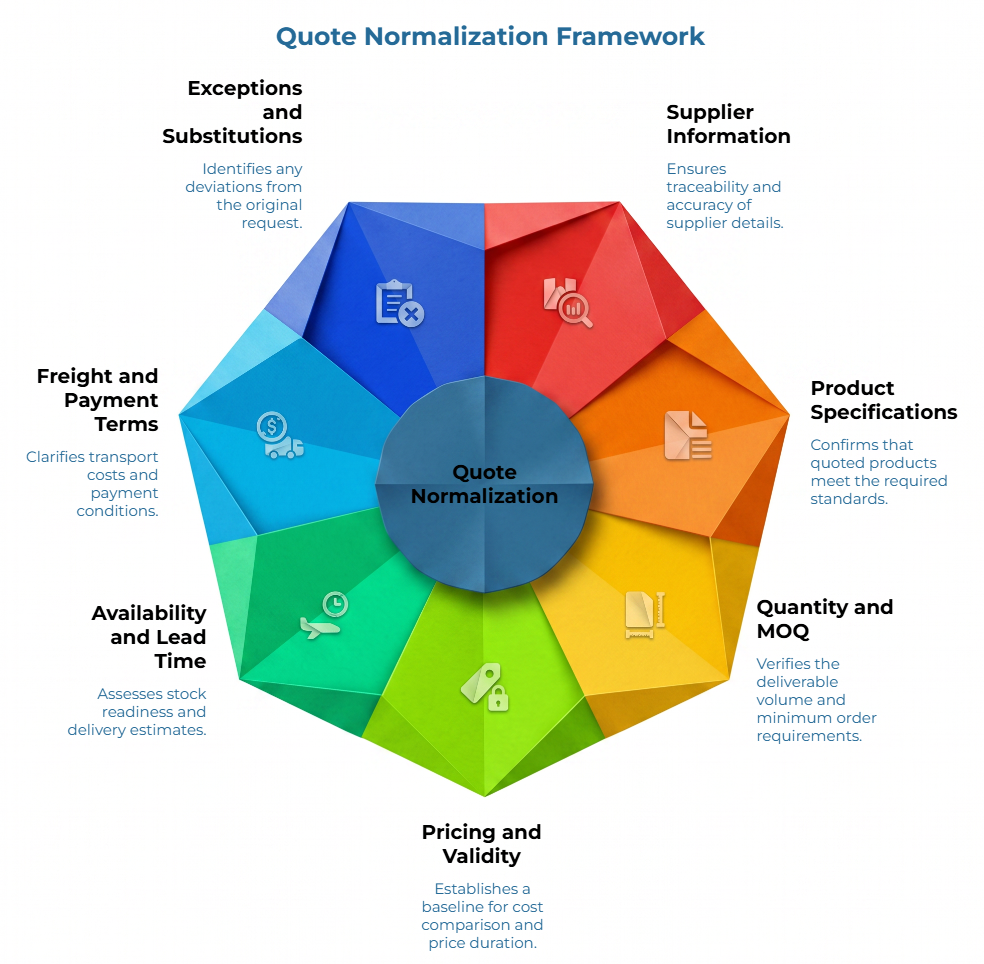
Quote normalization means mapping each supplier’s response into a single, consistent comparison structure. It does not alter what the supplier quoted. It makes every offer visible in the same format so differences become clear before comparison begins.
That distinction is important. The supplier’s original PDF, email, or spreadsheet remains the source. Your quote comparison template becomes the working view. When a field is missing, mark it as missing. When a supplier offers a substitute, mark it as a substitute. When freight is excluded, do not let the blank cell behave like a zero-cost assumption.
The following table provides a structural framework for quote normalization, adaptable to specific trade lanes or end-use requirements.
| Field | Why It Matters | What to Check | Example Issue to Flag |
| Supplier name and quote reference | Keeps the comparison traceable | Legal entity, quote date, quote version | Quote from agent, not the producing mill; updated quote replaces an older email |
| Paper grade / spec | Confirms the quoted product matches the request | GSM, brightness, finish, fiber content | “Similar grade” without stating the difference |
| Size / format | Reel width or sheet dimensions | Exact match to the requested format | Different reel width that may affect converting |
| Quantity and MOQ | Confirms deliverable volume | Minimum order vs. requested quantity | MOQ exceeds the required volume |
| Unit price and currency | Baseline for cost comparison | Price basis (per ton, per ream), currency | Different currencies with no conversion date |
| Price validity | Duration the quoted price holds | Number of days from quote date | 7-day validity vs. 30-day on another quote |
| Stock availability | Whether material is ready or requires production | Ex-stock vs. production lead time | “Available” but needs a 6-week production run |
| Lead time | Delivery estimate from order confirmation | Calendar days to destination | Excludes customs clearance or inland transport |
| Freight / delivery terms | Transport cost responsibility | Named delivery basis | One quote to port, another to door |
| Payment terms | Credit period or advance requirements | Advance %, credit days, or LC requirement | 100% advance vs. 60-day credit |
| Exceptions or substitutions | Any supplier deviations from the original request | Separate from fully matching quotes | Recycled grade offered instead of virgin |
GSM is a common paper buying reference, but teams that need to verify grammage against a testing standard can refer to the ISO method for determining paper and board grammage. For moisture-sensitive specifications, ISO also publishes a method for determining moisture content in paper and board.
This checklist is a practical starting point — not a universal or final template. Refine it based on the paper grades being sourced and the level of specification detail the end use demands. Do not turn it into an oversized spreadsheet. If the template becomes too detailed, teams stop using it. The practical goal is a clear comparison view that exposes missing fields, substitutions, and commercial differences before price ranking begins.
Once every quote sits in the same structure, comparison becomes a matter of reading across consistent rows rather than hunting through emails and attachments for missing details.
Look for Hidden Differences That Affect Landed Cost and Fulfillment
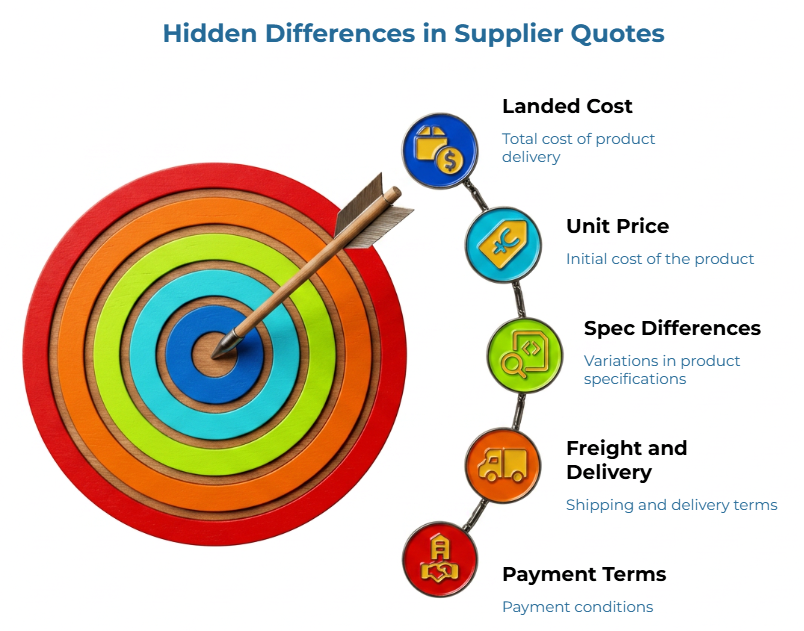
Unit price attracts the most attention during comparison. It is also the most likely field to mislead when other terms differ between suppliers. Before ranking anyone on price, flag these categories of hidden differences.
Landed cost — the broader cost of getting the product to the point where the buyer can use or receive it — is what actually determines the commercial outcome. The exact calculation varies by shipment, region, trade terms, tax treatment, and internal costing method, so avoid treating a simple formula as universal. The principle, however, is stable: a quote that excludes freight, uses different delivery assumptions, or depends on unclear charges should not be compared directly with a delivered or fully specified offer.
Spec differences. Two suppliers may both quote “80 GSM uncoated woodfree” yet differ on brightness, moisture content, or reel width tolerance. A specification mismatch can affect production outcomes and end-product quality. Any substitution should be visibly separated from fully compliant quotes before price enters the discussion.
Freight and delivery assumptions. One supplier may quote delivered to the warehouse while another quotes ex-works, shifting all transport costs to the buyer. Without comparing quotes across the same delivery basis, the lower headline price may not translate into a lower total delivered cost. Consider the scenario where a supplier offers the lowest unit price, but the quote excludes delivery and leaves freight “to be confirmed.” Another supplier quotes a higher unit price but includes clearer delivery assumptions and a workable validity period. The first quote may still win — but it should not win before the freight gap is visible. If freight terms are unclear, flag them for clarification before including that quote. For guidance on how trade terms allocate responsibility, the ICC Incoterms® 2020 rules provide the internationally recognized framework. For a practical method to normalize quotes across different delivery terms, see comparing quotes using Incoterms as a practical normalization method.
Payment terms. A quote requiring full advance payment ties up working capital differently than one offering 30 or 60 days of credit. Even when unit prices look similar, payment structure can materially affect commercial attractiveness.
Price validity. A 7-day validity window creates execution risk. If quote evaluation takes two weeks, a short-validity offer may expire before a decision is made.
Availability and lead time. Ex-stock material versus a 6-week production cycle fundamentally changes the inventory carrying cost and risk profile. Where delivery timing affects customer commitments, availability becomes a core comparison criterion.
Supplier exceptions. Any deviation from the requested specification, delivery terms, or quantity should appear in the comparison table — not buried in an email thread discovered after the order is placed.
Before ranking quotes by price, flag each supplier’s response for: specification differences, commercial term differences (freight, payment), timing differences (validity, lead time), cost assumption gaps, and any stated exceptions or substitutions.
Use AI After the Quote Data Is Structured, Not Before
AI tools can assist with quote extraction, comparison summaries, and exception spotting — but only when the underlying data is already structured. Feeding a stack of inconsistent PDFs and email attachments directly into an AI tool carries a specific risk: the output may look clean and organized while quietly carrying forward the inconsistencies in the source data. Missing freight terms do not become reliable because an AI summary sounds confident. A vague substitute grade does not become equivalent because it appears in a neat table.
Standardizing the RFQ, normalizing responses, flagging hidden differences — ensures that AI-assisted tools are processing high-integrity data.
Post-normalization, AI utility shifts to high-speed delta analysis: isolating missing variables, clustering exceptions, and performing cross-column parity checks. These are support tasks. They do not replace commercial judgment.
Even with clean data, certain comparison steps require human judgment. Specification trade-offs, supplier relationship history, and commercial risk appetite are areas where procurement experience matters more than pattern recognition. AI can surface gaps and summarize structured data, but its output should be reviewed against original supplier quotes before acting on any recommendation. A useful rule: use AI to speed up review, not to skip validation.
For teams still building confidence in their supplier evaluation process, verifying supplier capability beyond the price list remains an essential complementary step. For teams exploring AI-assisted sourcing more broadly, specification alignment across global food packaging paper suppliers shows how normalizing supplier data can make comparisons clearer before decisions are made.
A Simple Quote Comparison Workflow for Paper RFQs
The following steps consolidate this article’s guidance into a repeatable process:
- Send a standardized RFQ that requires responses across specs, pricing, validity, availability, freight terms, payment terms, and exceptions.
- Collect all supplier responses into one comparison template instead of reviewing each quote in isolation.
- Normalize every quote into the same fields using the checklist structure above.
- Flag exceptions and substitutions before any price-based ranking.
- Review hidden differences across specs, freight, payment terms, validity, and availability.
- Apply AI or spreadsheet tools to summarize, compare, or highlight gaps — only after normalization is complete.
- Conduct a cross-functional review of flagged variances to align commercial risk with operational requirements.
This process does not require specialized software. A well-structured spreadsheet with consistent columns can handle it effectively. The value comes from the structure, not the tool.
The objection is predictable: “We already use spreadsheets.” That may be true. But a spreadsheet helps only when the fields are consistent and exceptions are captured the same way every time. Otherwise, it becomes a tidy place to store inconsistent information. The other common pushback — “AI should handle messy formats” — is partly right. AI may help extract information from messy files, but procurement teams still need a normalized structure and human review. The structure is what makes the output usable.
FAQs
What is quote normalization in paper procurement?
Quote normalization means converting each supplier’s response into the same set of comparison fields — covering specifications, pricing, delivery terms, availability, and commercial conditions — so that offers can be reviewed side by side. The goal is to make differences visible before comparison, not after.
Why should RFQs be standardized before using AI to compare quotes?
AI-assisted comparison tools work more effectively when supplier responses follow a consistent structure and exceptions are clearly identified. When quotes arrive in different formats with different fields omitted, AI may carry those inconsistencies into the comparison output. Standardizing the RFQ creates cleaner inputs for any comparison method.
What fields should a paper supplier quote comparison include?
At minimum: paper specification (grade, GSM, size), quantity and MOQ, unit price and currency, price validity, stock availability, lead time, freight or delivery terms, payment terms, and any exceptions or substitutions. For a ready-to-use template that applies these fields to a specific grade, see the spec-driven kraft paper RFQ template. Additional fields such as certification status or packaging requirements may be needed depending on end-use demands.
Is the lowest paper supplier quote always the best option?
Not necessarily. The lowest unit price may not account for differences in freight responsibility, payment terms, price validity, specification compliance, or delivery risk. A quote that appears cheapest per ton can carry a higher total delivered cost once all terms are considered. Normalizing quotes across comparable fields before ranking on price helps surface these differences.
What should remain subject to human review?
Human review is still needed for paper specifications, supplier exceptions, freight assumptions, delivery feasibility, payment terms, supplier reliability, and final commercial judgment. AI can support the process by summarizing structured data and highlighting gaps, but it should not approve the decision on its own.
Faster Quote Comparison Starts With Comparable Data
Faster RFQ workflows are not only about speed. They are about visibility — ensuring that every supplier’s offer is clear, complete, and comparable before a sourcing decision is made.
When supplier quotes are normalized, the spreadsheet becomes more than a price list. It becomes a decision tool. The sourcing coordinator can see missing fields. The procurement manager can see commercial tradeoffs. Operations can see fulfillment risk before the supplier is chosen.
The process is practical: standardize what you ask for, normalize what you receive, flag what differs, and compare on an equal basis. AI can accelerate parts of this workflow, but the foundation is structured, comparable procurement data.
Use a quote comparison checklist to standardize supplier responses before comparing price, availability, and delivery terms. Start with the fields that matter most to your sourcing decisions and build a template your team can reuse across RFQ cycles.
Ready to source? Submit your RFQ and receive quotes free from verified suppliers.
Disclaimer:
This content is for informational purposes only and does not constitute professional procurement, legal, or financial advice. Specific cost calculations, trade terms, and supplier evaluation criteria should be verified independently based on your organization’s requirements. Referenced standards (e.g., ICC Incoterms® 2020, ISO methods) are subject to their respective governing bodies. Always consult qualified procurement or legal professionals before making sourcing decisions.
Our Editorial Process:
Our expert team uses AI tools to help organize and structure our initial drafts. Every piece is then extensively rewritten, fact-checked, and enriched with first-hand insights and experiences by expert humans on our Insights Team to ensure accuracy and clarity.
About the PaperIndex Insights Team:
The PaperIndex Insights Team is our dedicated engine for synthesizing complex topics into clear, helpful guides. While our content is thoroughly reviewed for clarity and accuracy, it is for informational purposes and should not replace professional advice.