
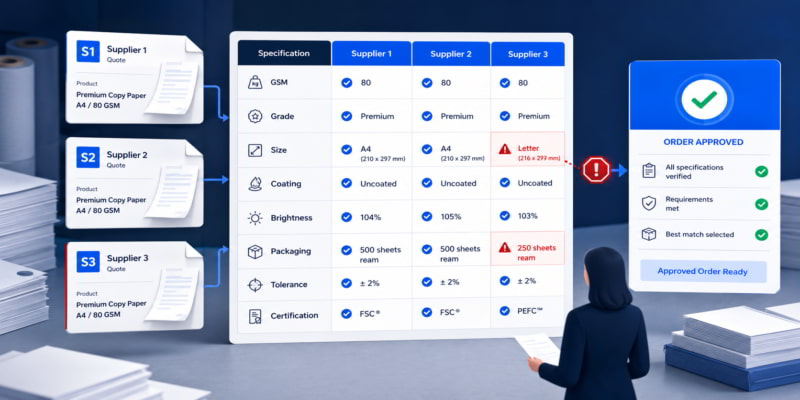
📌 Key Takeaways
Comparing paper suppliers by product name and price alone hides specification mismatches that cause rejected shipments.
- Match Specifications Field by Field: Check GSM, grade, size, coating, brightness, packaging, tolerances, and certifications against customer needs before comparing prices.
- Capture Requirements Up Front: Turn vague requests like “white paper, 80 GSM” into structured fields that sort each detail as must-have, preferred, or not specified.
- “Close Enough” Needs Proof: A near-match on weight or finish isn’t approved until the customer confirms it falls within their acceptable range — and that approval is recorded.
- Verify Certificates, Don’t Assume Them: A supplier’s general certification may not cover the specific product or shipment, so ask for the actual certificate and check its scope.
- Document Every Exception: If a deviation gets approved, record who approved it, when, and on what terms — verbal confirmations offer no protection in disputes.
One structured checklist before each order catches mismatches that scattered emails and spreadsheets hide.
Paper procurement teams and trading businesses managing sourcing through email and spreadsheets will gain a repeatable pre-order process here, preparing them for the detailed overview that follows.
~ ~ ~ ~ ~ ~ ~ ~ ~ ~ ~ ~ ~ ~ ~ ~ ~ ~
Three supplier quotes. Same product name. The price on each one looks reasonable, so the order goes out.
Then the shipment arrives. The sheet size doesn’t fit the customer’s press. The coating finish is matte, not gloss. The packaging won’t clear receiving. The product name matched — but the specification didn’t. The supplier said it matched, but now the customer says it doesn’t.
Paper specifications are easy to mismatch when data is scattered across emails, informal notes, and spreadsheets. That’s not carelessness — it’s a process gap. Requirements get captured loosely, offers get compared on price and product name alone, and the details that determine equivalence slip through.
Procurement teams that compare customer requirements against supplier documentation field by field — checking technical specifications—from mass per unit area to environmental compliance—before confirming an order, can catch the mismatches that lead to rejected shipments and strained customer relationships. The process doesn’t require specialized software. It requires a structured check before every order confirmation.
Why Product Names and Prices Aren’t Enough in Paper Procurement
A product name is a commercial label, not a technical specification. Two suppliers can both quote “80 GSM coated paper” and deliver products that differ in sheet size, coating finish, brightness, packaging, and certification documentation. If the buyer compares only names and prices, those differences stay invisible until someone downstream discovers the mismatch.
Here’s a hypothetical: Supplier A quotes 80 GSM gloss-coated paper in 700 × 1000 mm sheets, ream-wrapped. Supplier B quotes 80 GSM coated paper in 640 × 900 mm sheets, matte finish, shrink-wrapped. Both say “80 GSM coated paper.” Yet these are different products — and the customer’s application may accommodate one but not the other.
Price comparison only makes sense after confirming the offers are equivalent. When teams work from emails, PDFs, and spreadsheets — as many paper suppliers and trading businesses do — ambiguity compounds quickly. Fields get missed, assumptions go undocumented, and by the time anyone notices, the order may already be confirmed. For broader guidance on quote structure beyond specifications, teams can learn how to standardize paper supplier quotes to align supplier responses prior to evaluation.
Start with a Complete Customer Requirement Capture
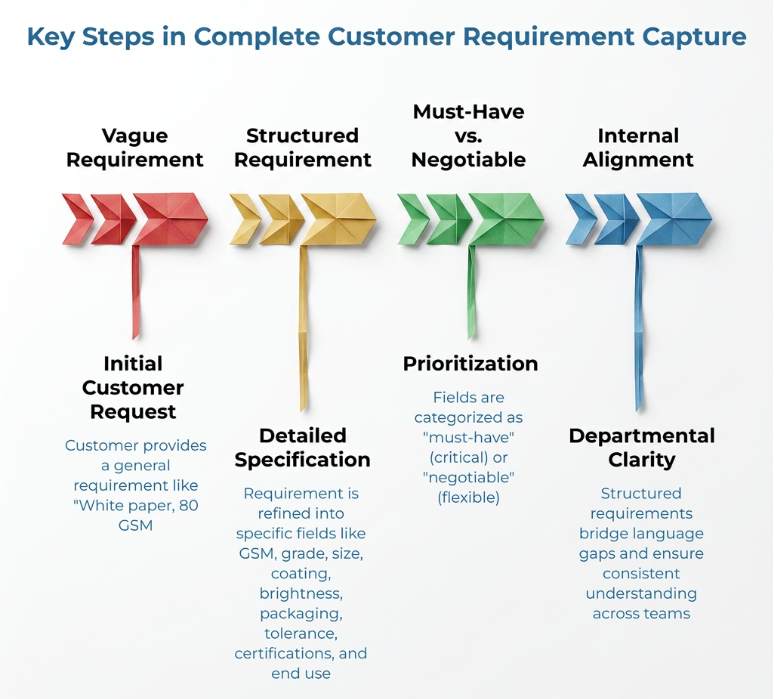
Specification accuracy begins upstream — with how the customer’s requirement is captured, not with how the supplier’s quote is read. A vague requirement makes every downstream comparison unreliable.
Before (vague): “White paper, 80 GSM.”
After (structured): “80 GSM white uncoated woodfree paper, 700 × 1000 mm sheets, ream-wrapped, no brightness requirement specified, no certification required, tolerance per supplier standard.”
When capturing a requirement, aim to record the following fields where the customer provides them:
- GSM or grammage — the paper’s mass per unit area, measured according to standards such as ISO 536.
- Grade — the paper category and intended application (e.g., woodfree offset, kraft liner, coated art paper). GSM and grade are related but distinct: GSM tells you how heavy the paper is, while grade tells you what it’s designed to do. Two papers at 80 GSM can belong to entirely different grades — a distinction explored in depth in understanding kraft paper grades for paper bags.
- Size — exact sheet or reel dimensions.
- Coating — coated or uncoated, and if coated, the finish type (gloss, matte, silk).
- Brightness — the measured brightness level if specified. It is critical to note the exact standard used, as ISO 2470-1 measures diffuse brightness, whereas TAPPI T 452 measures directional (often called GE) brightness — a variation in test methodology that also applies when specifying measurable parameters in kraft paper RFQs. A numerical comparison is only valid if both suppliers use the same testing methodology.
- Packaging — ream wrapping, pallet configuration, labeling, or roll wrapping.
- Tolerance expectations — the acceptable deviation range; for example, a customer may accept ±3% on GSM.
- Certifications — such as FSC or PEFC chain-of-custody, when required.
- End use or application — when it helps clarify which differences are commercially important.
Not every customer will provide every field. The discipline is in sorting what’s been provided into two categories:
Must-have specifications: Fields where deviation would likely cause rejection — a required sheet size, a specific coating finish, or a mandatory certification.
Negotiable preferences: Fields where the customer has flexibility — a packaging format preference or a brightness level mentioned informally but not specified precisely.
Marking each field as “must-have,” “preferred,” or “not specified” prevents the team from treating silence as confirmation. The customer’s use case determines which fields matter most.
This distinction also helps bridge internal language gaps. A sales note may describe “printing paper,” while the customer’s actual need depends on sheet size, coating, brightness, or press compatibility. Structuring requirements into named fields forces those details into the open — regardless of which department captured them.
Match Supplier Offers Field by Field, Not Line by Line
Once the customer’s requirement is structured, compare each supplier offer against the same fields. A line-by-line comparison checks whether the quote looks similar. A field-by-field comparison checks whether the offer actually matches the requirement. The following table serves as an operational starting point — fill in the columns for each supplier offer:
| Specification Field | Customer Requirement | Supplier Offer Value | Match / Mismatch / Unclear | Evidence Source | Action Required |
| GSM / Grammage | (e.g., 80 GSM) | ||||
| Grade | (e.g., woodfree offset) | ||||
| Size | (e.g., 700 × 1000 mm) | ||||
| Coating | (e.g., gloss coated) | ||||
| Brightness | (e.g., ISO brightness 92, if required) | ||||
| Packaging | (e.g., ream-wrapped pallets) | ||||
| Tolerances | (e.g., ±3% on GSM) | ||||
| Certifications | (e.g., FSC CoC required) |
Each field carries a different risk if missed. A GSM mismatch may affect how the paper performs in the customer’s application. A grade mismatch means the paper is entirely unsuited for the intended application. A size discrepancy can cause printing, converting, or handling issues. A coating or brightness difference creates surface or visual mismatches. Packaging errors lead to receiving or handling problems. Undocumented tolerances allow borderline mismatches to pass as approvals. And missing certification documentation leaves chain-of-custody or sustainability claims unsupported.
Resist the impulse to treat a ‘close enough’ answer as a match — a mindset explored further in comparability before price: the spec-true mindset that reduces kraft paper RFQ chaos. A supplier offering 78 GSM against a requirement of 80 GSM may or may not be acceptable — that depends on the customer’s tolerance, not on assumption. Flag differences, document them, and resolve them before comparing prices.
Review Supplier Documentation Before Treating an Offer as a Match
A verbal confirmation or a one-line email reply isn’t documentation. Before treating any offer as a match, review the supplier’s formal quotation, technical datasheet, packaging and delivery details, tolerance notes, substitution language, and any required certification paperwork. Supplier documentation means these formal records — not informal confirmations.
Pay attention to language describing the offered product as “equivalent” or “similar.” These words signal a substitute, not an exact match. Substitutes may be acceptable, but they require explicit customer approval. “Just ask the supplier to confirm” isn’t enough; confirmation without supporting documents leaves the buyer exposed if a dispute arises later. Watch also for softer phrasing like “standard” or “available” — these need follow-up. Equivalent in which fields? Similar to which specification? Available with which documentation?
Certification verification note: If the customer requires FSC chain-of-custody certification or PEFC chain-of-custody certification, don’t assume a general supplier certification covers the specific product and order. Both FSC and PEFC Chain-of-Custody certifications are tied to traceability through the supply chain, applying equally to companies that process, trade, or sell forest-based products. A supplier may hold a valid certificate without it covering every product or shipment. Ask for the certificate, check the scope and confirm it’s current, and verify the certificate covers the specific product and order. Certification claims aren’t simple yes-or-no checks. For a plain-English breakdown of what these labels do and don’t prove, consult FSC vs PEFC claims in plain English: what the labels do (and don’t) prove.
Here’s a hypothetical: a supplier says ‘FSC certification is available.’ That doesn’t confirm whether the specific product is covered, whether the certificate is current, or whether chain-of-custody documentation would travel with the order. Teams can learn how to run a quick registry check for FSC/PEFC certificates to resolve these ambiguities in minutes.
This is general procurement discipline, not formal quality testing — reviewing commercial documentation before committing, not laboratory procedures.
Use Tolerance Checks to Avoid “Close Enough” Mistakes
Not every specification difference is a dealbreaker. Some variation is normal in paper manufacturing, and buyers and suppliers routinely work within agreed tolerances. The problem arises when tolerances are assumed rather than documented.
If a customer specifies 80 GSM and a supplier offers 78.5 GSM, that difference may fall within an acceptable range — or it may not. Tolerances should be confirmed with supplier documentation, customer requirements, or agreed contract terms. When the customer hasn’t provided a tolerance, ask before approving a near-match. If no tolerance is on record, mark the field as unclear rather than treating a near-match as an approval.
If a supplier proposes a substitution — a different mill, grade name, or slightly different specification — treat it as an exception. Document the deviation, get approval, then proceed. The useful question to ask every time is simple: who approved the difference, and where is that approval recorded?
Build a Simple Pre-Order Specification Check
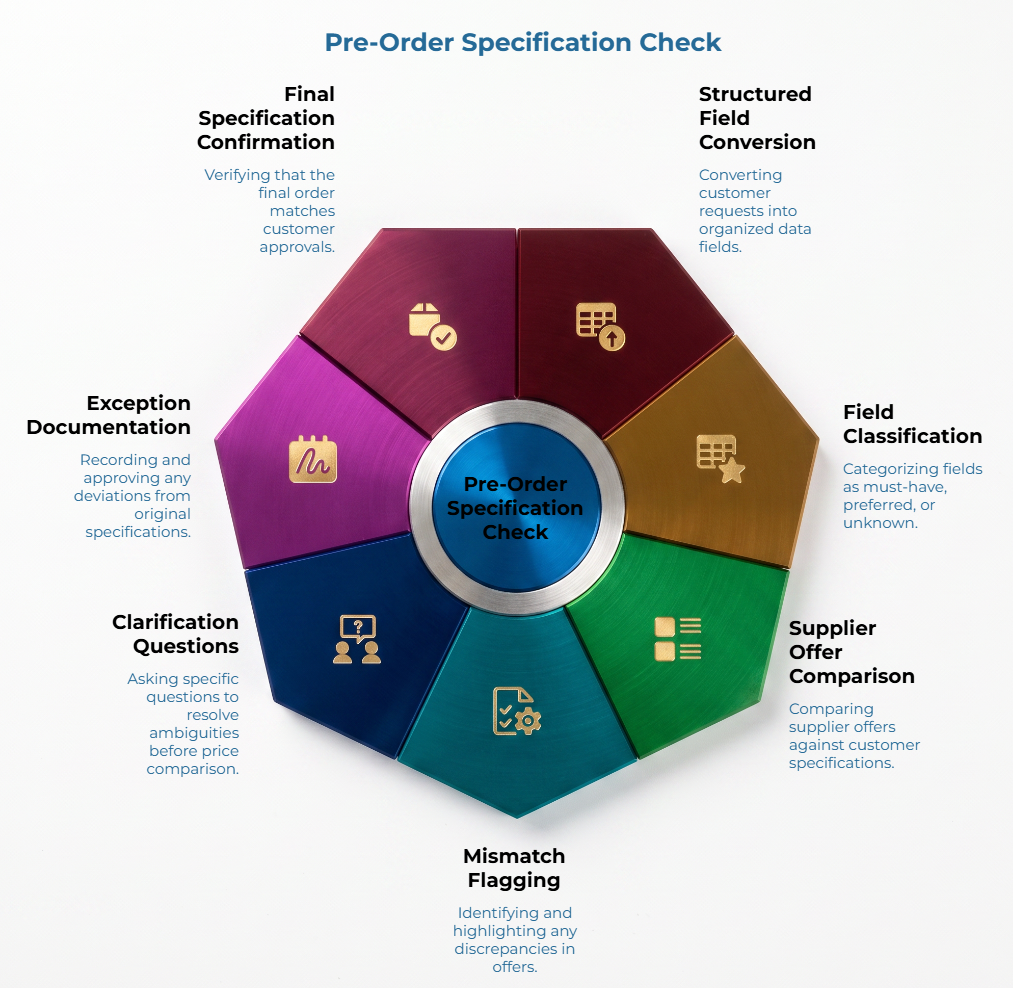
A consistent, lightweight process is enough to catch mismatches — especially for teams that manage sourcing through email and spreadsheets. Seven steps, repeated before every order:
1. Convert the customer request into structured fields. Use a spreadsheet or template. Record every specification provided and mark blank fields as “not specified.”
2. Classify each field as must-have, preferred, or unknown. A must-have requires an exact match or approved tolerance. A preferred field allows flexibility. An unknown field needs clarification — ask the customer before proceeding.
3. Compare each supplier offer against the same fields. Note whether each field is a match, a mismatch, or unclear.
4. Flag mismatches and missing data. Any field where the supplier’s offer doesn’t match — or where data is missing — gets flagged.
5. Ask suppliers for clarification before comparing prices. A lower price on a non-equivalent product isn’t a saving. Good clarification questions are specific: “Can you confirm the coating finish is glossy, not matte?” or “Does your certificate cover this product line?”
6. Document approved exceptions. If the customer accepts a deviation, record the approval, the specific terms, and who approved it.
7. Confirm the final matched specification before placing the order. Verify that what’s being ordered matches what the customer approved.
The “evidence source” column in any comparison spreadsheet matters more than it might seem. It prevents the next person from guessing whether a field came from a formal datasheet, a supplier message, a phone call, or a customer-approved exception. Make “unclear” an acceptable status — a blank cell should mean “not ready for approval,” not “not important.” This is how teams avoid spreadsheet drift, where undocumented assumptions gradually replace verified data.
This process reduces clarification loops, rework, and post-shipment disputes. “Checking every field takes too long” is understandable — but a lightweight checklist that prevents even one rejected shipment per quarter saves more time than it costs. For teams building more structured supplier verification and sourcing processes, this pre-order check is a practical starting point.
Procurement Blind Spots in Specification Logic
Even experienced procurement teams fall into patterns that increase mismatch risk:
- Comparing offers by price before confirming specification equivalence. A cheaper quote that describes a different product is misleading.
- Treating product names as exact specifications. “We already know the product by name” doesn’t account for differences in size, finish, packaging, or certification between suppliers.
- Assuming GSM equals quality. Grammage identifies the paper’s weight. It does not define grade, surface behavior, strength, brightness, or end-use fit.
- Accepting verbal confirmations without documentation. “The supplier confirmed it verbally” provides no protection if a dispute arises — a risk that can be mitigated by requiring verifiable evidence in place of supplier promises.
- Ignoring packaging details. A product that meets every other specification but arrives in the wrong pallet configuration can still be rejected.
- Treating missing fields as “not important.” “The customer only gave a basic description” is a reason to ask for clarification, not to skip the check.
- Failing to document customer-approved exceptions. If the approval isn’t on record, there’s no protection when a dispute surfaces.
From Scattered Data to Structured Confidence
That shipment rejection at the top of this article didn’t happen because someone was careless. It happened because scattered data, vague requirements, and surface-level comparisons made the mismatch invisible until it was too late.
With a structured requirement capture, a field-by-field comparison, and a simple pre-order check, the same team spots those differences before the order goes out. The shift isn’t from slow to fast; it’s from a reactive stance to a prepared one — enhancing the ability to ask the right questions, more confident that what gets ordered is what the customer actually needs.
Before confirming the next supplier offer, compare it against a field-by-field specification checklist rather than relying only on product name and price. To find suppliers who provide the documentation needed for this comparison, start with verified listings.
Frequently Asked Questions
What paper specifications should be checked before confirming a supplier offer?
At a minimum, compare GSM, grade, sheet or reel size, coating type, brightness (if specified), packaging, tolerances, and certifications (if required). The fields that matter most depend on the customer’s end use.
Is matching GSM enough when buying paper?
No. While grammage is a primary metric, it does not account for surface topography, tensile strength, or optical properties like ISO brightness. Two papers at the same GSM can belong to different grades and perform very differently.
What should be done if a supplier offer is close but not an exact match?
Treat it as an exception. Confirm with the customer whether the difference falls within their acceptable tolerance before approving. Document the deviation and the response.
How should certification claims be verified in paper procurement?
Ask the supplier for the specific certificate and confirm it covers the product and order in question. Check against official registries such as FSC’s certificate database or PEFC’s certified entity search — a step-by-step process covered in Fake FSC, PEFC, ISO Certificates vs. Real Ones: a visual spotter’s guide. Don’t assume a general claim applies to every shipment.
Disclaimer:
The information provided here is for general educational purposes and does not constitute professional procurement, legal, or technical advice. Specification requirements, tolerances, and certification standards vary by product, supplier, contract, and application. Readers should verify technical details against their own supplier documentation, customer requirements, and applicable standards. A review by a paper procurement or quality specialist can further improve accuracy.
Our Editorial Process:
Our expert team uses AI tools to help organize and structure our initial drafts. Every piece is then extensively rewritten, fact-checked, and enriched with first-hand insights and experiences by expert humans on our Insights Team to ensure accuracy and clarity.
About the PaperIndex Insights Team:
The PaperIndex Insights Team is our dedicated engine for synthesizing complex topics into clear, helpful guides. While our content is thoroughly reviewed for clarity and accuracy, it is for informational purposes and should not replace professional advice.