
📌 Key Takeaways
The same warehouse can have safe zones and risky zones — and where boxes sit matters more than how dry the building feels overall.
- Location Shapes Box Quality: Boxes near dock doors, exterior walls, or low-airflow corners face more moisture risk than stock in central, well-ventilated aisles.
- Temporary Storage Quietly Becomes Permanent: A pallet staged “just for today” near a loading bay can sit there for weeks if no one tracks it, turning a safe spot into a problem zone.
- Slow-Moving Stock Absorbs More Risk: Boxes that sit longer have more time to soak up moisture — so slow-turn pallets need better placement, not leftover corners.
- Document Before You Blame the Supplier: Photos, dates, pallet condition, and storage location give quality teams real evidence instead of guesswork when boxes show damage.
- A Simple Walkthrough Beats Expensive Fixes: Classifying zones as lower-risk, watch-list, or limit-use takes one walk-through and costs nothing — but catches problems early.
Where the box sits changes the outcome more than what the box is made of.
Warehouse supervisors and quality teams managing corrugated stock will gain a practical zone-classification method here, preparing them for the detailed walkthrough guide that follows.
~ ~ ~ ~ ~ ~ ~ ~ ~ ~ ~ ~ ~ ~ ~ ~ ~ ~
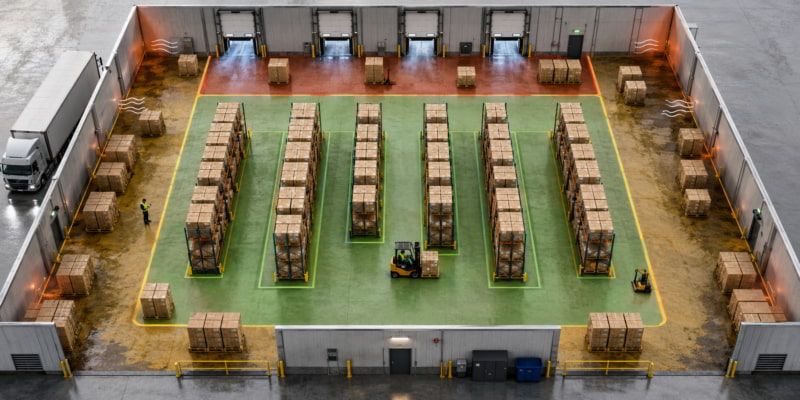
Corrugated boxes can sit inside the same warehouse and still face very different storage conditions. A pallet near a dock door, a stack beside an exterior wall, and cartons left in a low-airflow corner may not share the same exposure history — even when the building is generally described as dry.
For many warehouse teams, the issue is not a lack of effort. It is a practical pressure. Space is limited. Dock areas become overflow storage. Fast-moving and slow-moving pallets share the same aisles. Corrugated stock is sometimes placed where forklifts can reach it easily, not where exposure risk is lowest.
Corrugated boards are sensitive to moisture. When boxes absorb humidity over time, they soften, warp, or lose rigidity — causing problems during packing, stacking, or shipping. For a deeper look at how moisture and compression interact to cause structural failure, see our guide: ‘why standard corrugated boxes fail: the physics of heavy-duty shipping.’ Teams often blame the supplier before asking a more useful first question: where was this stock actually sitting?
A storage zone is any area where corrugated stock is held before use. A watch-list zone is an area that may still be usable but deserves closer inspection. Exposure risk means the possibility that moisture, condensation, airflow gaps, floor contact, damaged wrap, or repeated handling may affect packaging usability over time.
This guide explains how warehouse teams can classify corrugated box storage areas as lower-risk, watch-list, or limit-use zones — before blaming suppliers, changing specifications, or releasing questionable stock into production.
Why Corrugated Box Storage Zones Matter
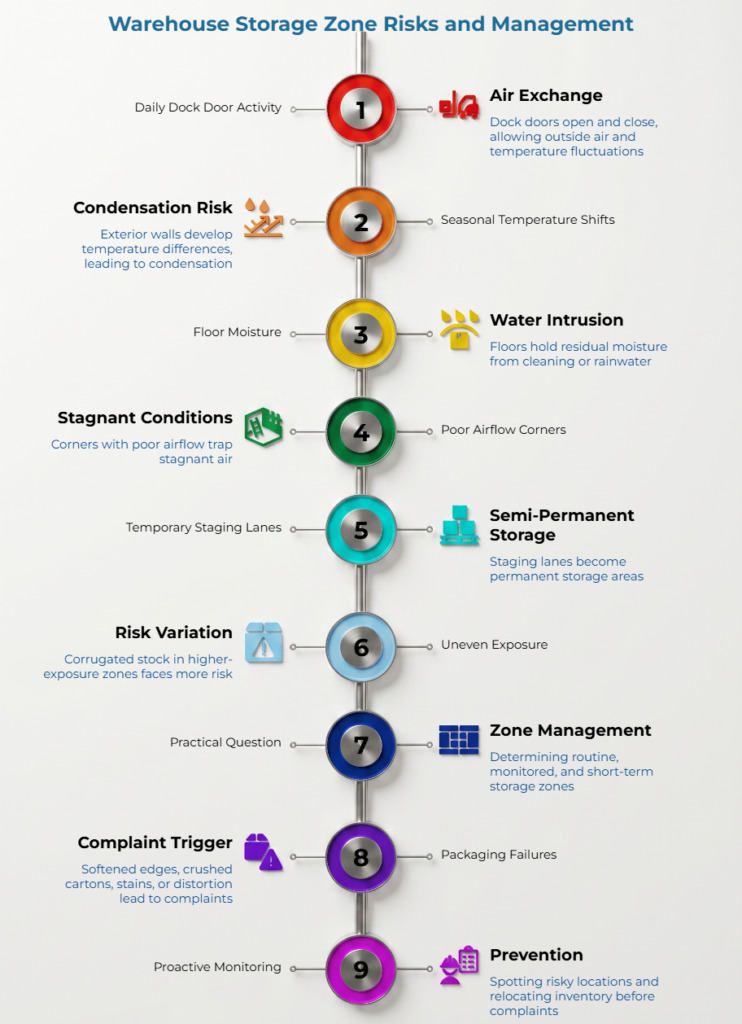
A warehouse is not one uniform environment. Dock doors open and close throughout the day, letting in outside air. Exterior walls can develop temperature differences that lead to condensation, especially during seasonal transitions. Floors may hold residual moisture from cleaning or rainwater tracked in by forklifts. Corners with poor airflow trap stagnant conditions. Temporary staging lanes can quietly become semi-permanent storage.
None of these zones is automatically unsafe. Exposure is uneven, and corrugated stock in a higher-exposure zone for an extended period faces more risk than stock in a well-ventilated, central location. For teams working with limited space — where pallets go wherever forklift access is easiest — recognising this unevenness is the practical starting point.
The practical question is not only “Is the warehouse dry?” A better question is: which areas should hold corrugated stock for routine storage, which areas need monitoring, and which areas should be used only for short staging or exception handling?
That question is especially important for corrugated boxes that may look acceptable in storage but later show softened edges, crushed lower cartons, stains, distortion, or inconsistent performance during packing. The goal is not to diagnose every failure from the warehouse floor. It is to spot locations that deserve closer monitoring or relocation of long-hold inventory before a packaging complaint forces the conversation.
Corrugated Box Storage Zone Risk Review Table
Use this table as a practical warehouse walkthrough tool, not as a compliance standard. Exact humidity limits, temperature limits, wall clearances, or storage durations should come from supplier guidance, internal quality requirements, or verified technical standards.
| Zone / Location | Suggested Classification | Why It May Create Exposure Risk | What to Look For | Suggested Action | Evidence or Verification Needed |
| Dock-door and loading-bay staging | Watch-list / limit-use | Exposure may vary with open doors, outside air, vehicle traffic, wet pallets, and repeated movement | Torn wrap, damp pallet boards, crushed lower cartons, time spent in staging | Use mainly for short staging; move long-hold stock to a more stable area | Receiving photos, staging time, pallet condition, internal dock checks |
| Temporary staging zones | Watch-list / limit-use | Short-term holding zones can become semi-permanent when space is tight | Pallets without date labels, stock waiting “just for now,” repeated exceptions | Label staging clearly; set a review trigger for stock that remains there | Date labels, shift handover notes, supervisor review |
| Exterior-wall rows | Watch-list | Wall-adjacent conditions may differ from central aisles, especially where airflow is limited | Wall contact, condensation signs, odour, carton softness, slow-moving stock | Create clearance between pallets and walls where practical; inspect stock stored there longer | Supplier guidance, facility observations, quality inspection notes |
| Floor-contact or low-clearance pallets | Watch-list / limit-use | Spills, cleaning water, damp floors, damaged pallets, and forklift contact may affect lower cartons | Stains, soft bottom cartons, broken pallet boards, leaning stacks | Keep pallets intact and elevated where practical; isolate suspect stock | Pallet inspection records, photos, housekeeping or QA checks |
| Low-airflow corners or blocked rows | Watch-list | Reduced visibility and airflow may make exposure harder to spot | Dust buildup, odour, blocked vents or aisles, soft cartons, hidden damage | Add to routine review; avoid using these areas for forgotten or slow-turn stock | Warehouse walkthrough notes, airflow observations, inspection frequency |
| Exposed or partially opened pallets | Watch-list | Torn wrap, partial picking, and missing covers leave cartons more exposed | Open tops, loose cartons, crushed edges, re-handled stacks | Rewrap, cover, or inspect before returning to storage or releasing to packing | Wrap condition photos, pick records, QA release notes |
| Long-hold / low-turn stock areas | Watch-list | Longer storage increases uncertainty about exposure history | Old date labels, weak FIFO discipline, distortion, wall or corner placement | Prioritise inspection before use; review weekly or monthly based on internal practice | Date labels, FIFO records, supplier instructions, QA release criteria |
The purpose of the table is classification, not alarm. A zone may be acceptable for one facility and unsuitable for another depending on layout, traffic, stock rotation, climate-control capability, and internal quality rules.
The Warehouse Zones That Deserve a Closer Look
Not every area carries the same level of exposure. Here are the zones worth reviewing during a walkthrough.
Dock-door and loading-bay areas. These zones see the most variability and deserve attention because they often combine convenience with changing conditions. Every time a dock door opens, conditions shift. Pallets near an active dock may be exposed to outside air, rain splash, temperature swings, or traffic that damages wrap. Short staging is acceptable when pallets are wrapped and move promptly.
The risk increases when a pallet meant for same-day staging does not move. A receiving delay or a lack of rack space can turn a few hours into a week. For instance, a corrugated pallet staged near a dock for a morning shipment may remain there through several shift changes if the order is delayed. By the time the stock is used, the warehouse team may not remember whether it was short-stage stock or overflow storage. That quiet drift from temporary to semi-permanent storage is one of the most common ways corrugated stock ends up in a marginal zone.
Exterior-wall rows. Walls facing the outside can develop temperature differences between the surface and interior air. This may create condensation that corrugated board absorbs if pallets sit in direct contact or close proximity. These areas are often used for slower-moving inventory because they are out of the main traffic path. That can be practical, but low-turn corrugated stock left against walls should be checked for airflow, wall contact, visible distortion, odour, and carton condition before use.
Floor-contact or low-clearance pallets. Corrugated stock does not need visible standing water to become questionable. Boxes on damaged pallets or pallets resting on a damp floor face exposure from below. Cleaning water, spills, forklift impacts, condensation on concrete, and stained bottom layers can all wick into lower cartons and create reasons for inspection.
Low-airflow corners and dead zones. Areas behind racks or where air circulation does not reach can develop stagnant conditions. Stock there may not dry out after a humidity spike, and softening may go unnoticed due to less foot traffic.
Exposed or partially opened pallets. When stretch wrap tears during handling or covers are removed for picking, corrugated board loses its primary barrier against ambient moisture. Corrugated stock is more vulnerable once that barrier is compromised.
Slow-moving inventory zones. Stock that moves quickly spends less time exposed. Slow-moving pallets in less-visited sections may sit for weeks, giving moisture more opportunity to affect usability.
Seasonal operating changes may also alter exposure patterns. Door-opening frequency, ventilation routines, cleaning schedules, and warehouse traffic may change during different operating periods. Seasonal shifts — transitional weeks when outside and inside temperatures diverge — can change which zones carry more risk without the building looking any different. This should be treated as a reason to review zones periodically, not as an assumption about specific local climate conditions.
Differentiating High-Turn and Low-Turn Stock Management
Stock turnover directly affects how much exposure risk matters. High-turn stock — boxes that move to the packing line within days — spends less time in any single zone. Basic protection still matters, but the window for moisture absorption is shorter. The main concern for high-turn stock is often handling condition; check whether pallets remain wrapped, stable, and protected after partial picking. A fast-moving pallet can still become a problem if it is repeatedly opened, shifted, crushed, or returned to a poor storage location.
Low-turn stock is where the risk accumulates. Consider a pallet pushed against an exterior wall in a back corner because the fast-moving SKUs filled the central racks. It was placed there because space was available, not because the zone was evaluated. Three weeks of wall proximity, limited airflow, and seasonal temperature shifts create meaningful exposure. Low-turn stock should not automatically be pushed into leftover corners, exterior-wall rows, blocked aisles, or dock overflow areas simply because those spaces are available.
FIFO helps with rotation but does not solve exposure on its own. If the oldest stock has been sitting in a poor zone, rotating it first may just move the problem downstream. Teams managing both corrugated boxes and kraft paper inventory face similar FIFO limitations — a challenge explored in ‘Kraft Paper Bulk Buying: shelf-life trade-offs procurement managers should consider.’
Practical steps for managing low-turn corrugated inventory: label pallets with a received date so long-hold stock is visible at a glance, avoid placing slow-moving inventory in watch-list zones when alternatives exist, and schedule a periodic check — weekly or monthly — for pallets that have not moved. Where monitoring equipment is not available, teams can still use practical evidence: visible carton condition, pallet history, wrap condition, location notes, comparison with stock from lower-risk areas, and supplier storage guidance.
What to Document Before Blaming the Box or the Supplier
When corrugated boxes look soft, stained, distorted, or crushed, supplier quality may be one possible cause. It should not be the first conclusion without storage and handling evidence. Documenting what happened on the warehouse side strengthens the conversation — and often identifies the real cause.
For suspect stock, document the storage zone and date received, pallet condition on arrival, wrap, cover, or strapping condition, whether bottom cartons show stains or softening, and any visible damage. A structured receiving checklist ensures these details are captured consistently — for guidance on building one, see How to verify corrugated box quality at the dock. Note whether the pallet was stored near dock doors, walls, floors, staging lanes, or low-airflow areas. Photos of the pallet top, sides, labels, and lower cartons create a timestamp and visual reference that words cannot replace.
In practice, a warehouse team may find that cartons from a dock overflow pallet show crushed lower edges, while cartons from the same delivery stored in a central aisle appear sound. That comparison does not prove the supplier was or was not responsible. It gives quality and procurement a better starting point than a general complaint.
Involve quality or QA before rejecting stock or escalating. A quality review confirms whether the issue is cosmetic, structural, or specification-related — and whether the root cause is storage, transit, handling, or manufacturing. When escalation is necessary, structuring the dispute around specification tolerances and test evidence produces better outcomes than general complaints — a process covered in handling corrugated box vendor non-compliance disputes: how to use data to enforce specs.
For teams improving receiving-stage checks, the article ‘how to verify corrugated box quality at the dock’ may be useful. For broader damage-pattern thinking before supplier escalation, why corrugated box damage on arrival is a sourcing failure, not a logistics issue can support related internal discussions.
When External Standards or Supplier Guidance Matter
A basic warehouse zone review can remain qualitative. It does not need universal humidity numbers. Technical teams may need formal references, though, when writing supplier specifications, validating package performance, or setting internal QA requirements.
For formal conditioning and testing context, sources such as TAPPI/ANSI T 402 for paper and paperboard conditioning, ASTM D4332 for conditioning containers or packaging components, ISO 2233 for conditioning complete filled transport packages and unit loads, and ISTA resources for package performance testing may be relevant. These references should be used as technical context, not converted into universal warehouse storage rules without proper review.
Recognised industry standards published by TAPPI and ASTM International exist for technical contexts, but converting them into warehouse rules requires professional interpretation specific to your operation. In day-to-day warehouse practice, supplier documentation and internal QA requirements are often the most practical sources for exact storage limits, release checks, and rejection criteria.
Simple Next Steps for Warehouse Teams
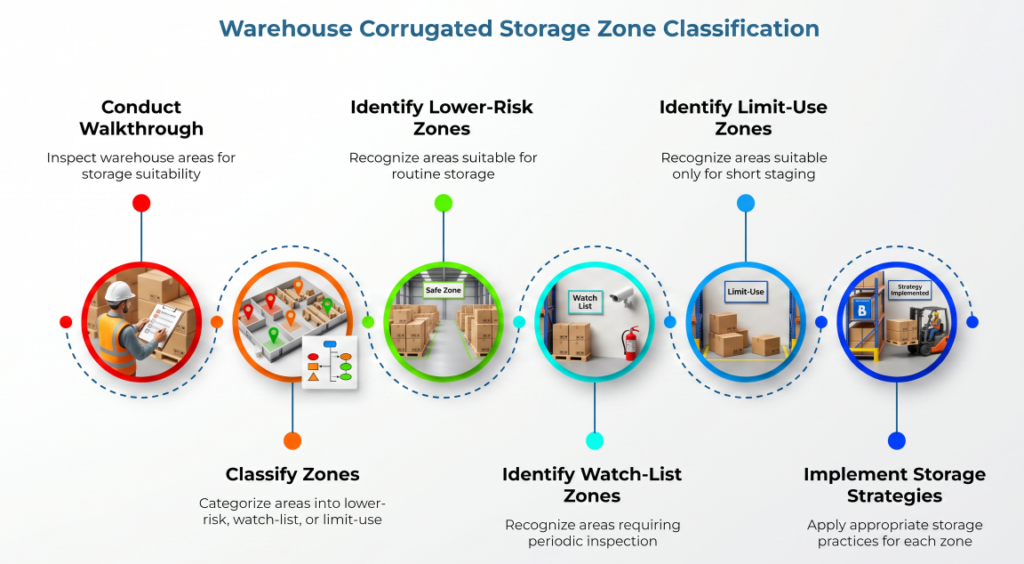
Start with a walkthrough rather than a redesign. You do not need environmental sensors or a facility overhaul. Walk your warehouse this week and classify corrugated storage areas into three categories:
Lower-risk zones: Suitable for routine storage because the area is well-ventilated, central, elevated, with intact pallet wrap, away from obvious exposure points, and with reasonable turnover.
Watch-list zones: Usable with checks because the area has dock proximity, wall adjacency, limited airflow, floor contact, staging drift, damaged wrap, longer hold time, or limited visibility that deserve periodic inspection.
Limit-use zones: Suitable only for short staging, exception storage, or stock awaiting inspection because the exposure or handling risk is higher. Corrugated stock should not sit in these areas for extended periods without protection or relocation.
Once zones are classified, move long-hold corrugated inventory out of watch-list and limit-use areas where space permits. Create a simple weekly or monthly review for slow-moving pallets based on internal warehouse routines. Ask quality to define when stock should be isolated before use. Use procurement escalation only after storage evidence has been gathered, not as the first response to every issue.
For exact humidity thresholds or specification-level guidance, consult your box supplier’s storage recommendations or work with a packaging professional. When reviewing supplier specifications, understanding the interplay between corrugated box ECT and flute profiles can help teams evaluate whether storage-related softening has affected structural performance.
For more practical packaging and sourcing education, explore the PaperIndex Academy. When storage review is complete and the team later needs to compare sourcing options, corrugated box suppliers can be reviewed as a secondary next step — not as a substitute for warehouse inspection.
Frequently Asked Questions
Is it always wrong to store corrugated boxes near dock doors?
No. Dock-door areas may be acceptable for short-term staging when pallets are properly wrapped and move to a more stable zone promptly. They become watch-list or limit-use areas when corrugated stock stays there longer than intended, sits near variable exposure, or shows wrap, pallet, or carton damage.
Should corrugated boxes be rejected if they were stored in a higher-risk zone?
Not automatically. A box stored in a watch-list zone may still be usable. Inspect the cartons visually and by touch, compare them with unaffected stock from the same shipment, check against internal QA requirements, and document findings before rejecting or escalating. A higher-risk storage history should trigger review, not automatic blame.
What humidity level is safe for corrugated box storage?
There is no single universal number. The safe range depends on box specification, intended use, storage duration, supplier guidance, and internal quality requirements. If exact humidity or temperature limits are needed, confirm them through supplier documentation, internal QA procedures, or appropriate technical standards such as those published by TAPPI or ASTM. A packaging professional can help establish values specific to your operation.
Corrugated box storage risk is often a zone problem before it is a supplier problem. The same warehouse can contain stable storage areas, watch-list areas, and limit-use areas — because dock access, wall placement, floor exposure, airflow, pallet protection, handling, and stock turnover vary across the building.
A practical zone review gives warehouse teams a way to protect usable stock, identify questionable pallets earlier, and give quality and procurement better evidence before making supplier or specification decisions. The boxes may be the same. Where they sit changes the outcome.
Disclaimer:
This article is for general informational purposes only and does not constitute compliance, safety, technical, or professional advice. Requirements, risks, and best practices may vary by warehouse layout, packaging specification, supplier guidance, product use, climate, and operating conditions. Confirm important decisions with the appropriate packaging, quality, safety, or technical professional.
Our Editorial Process:
Our expert team uses AI tools to help organize and structure our initial drafts. Every piece is then extensively rewritten, fact-checked, and enriched with first-hand insights and experiences by expert humans on our Insights Team to ensure accuracy and clarity.
About the PaperIndex Insights Team:
The PaperIndex Insights Team is our dedicated engine for synthesizing complex topics into clear, helpful guides. While our content is thoroughly reviewed for clarity and accuracy, it is for informational purposes and should not replace professional advice.