

📌 Key Takeaways
Vendor disputes are resolved by structured evidence—spec references, named test methods, and traceable documentation—not by persuasion or negotiation.
- Evidence Wins Before Emails: Most disputes are decided by what was captured while the shipment was fresh, labels were intact, and chain of custody was clean.
- Spec Clarity Blocks Deflection: Quoting the exact tolerance and test method from the purchase order closes “normal variation” and “your test is wrong” escape routes before they open.
- Consistent Sampling Survives Scrutiny: A repeatable sampling plan with documented sample counts and selection methods defeats the “you only checked one box” objection.
- Facts Over Interpretations: Stating what was measured without speculating about vendor intent keeps disputes professional and preserves the relationship for future work.
- Close the Loop with CAPA: A credit note solves this shipment, but a root-cause review and corrective action plan prevents the next one.
Disputes are process, not persuasion—structure your evidence and the conversation resolves itself.
Procurement managers and QA leads handling off-spec corrugated box shipments will gain a ready-to-use workflow here, preparing them for the detailed evidence pack and email template that follows.
The caliper readings are 0.3 mm below the lower tolerance limit. The moisture is drifting high. And now the vendor’s email arrives: “We believe this falls within normal production variation.”
You know the batch is off. But without structured proof, the conversation becomes opinion versus opinion—and production delays stack up while the argument drags on. Vendor non-compliance disputes are easiest to resolve when the discussion is anchored to objective proof: the agreed specification, a named test method, a repeatable sampling plan, and traceable records (PO, lot, date). When those elements are missing, the dispute becomes an argument about narratives—handling, transit, “normal variation”—instead of a clear nonconformance that can be corrected.
This workflow is location-neutral. Whether receiving happens in the United States, Germany, the UAE, or India, the mechanics remain the same; only contract terms and practical constraints may differ.
Most disputes are won before the first email is sent—by how evidence is collected and structured at receiving.
Why Corrugated Box Disputes Drag On (and Why “More Photos” Isn’t Enough)
Common vendor deflections exploit gaps in documentation:
- “This looks like handling damage at your facility.”
- “Our QC passed this lot—your test method may differ.”
- “You only checked one pallet; that’s not representative.”
Each response targets a weakness: missing traceability, undefined test methods, inconsistent sampling, or vague specifications. The misconception that photos alone win disputes persists—but images without context, scale references, or connection to spec tolerances leave room for interpretation.
The fix is treating disputes as nonconformance conversations, not negotiations. Quality management systems treat nonconforming outputs as something that must be identified and controlled to prevent unintended use—a core principle reflected in ISO 9001:2015. That means tying every claim to a specific spec line item, a named measurement method, and enough samples to survive the “cherry-picking” objection. Disputes are process, not persuasion.
Before Raising the Issue: Confirm the Spec and Test Method
Before sending any communication, verify two elements.
The exact specification and tolerance. Pull the purchase order or supply agreement. Quote the specific line item: “Per PO-2024-0892, Section 4.2: ECT minimum 7.0 kN/m ± 5%.(Range: 6.65 – 7.35 kN/m)”. When working with corrugated box suppliers, ensuring ECT requirements are specified at the RFQ stage—with named test methods—prevents the ambiguity that fuels disputes. If the vendor supplied a pre-production sample that was never formalized into a tolerance, that’s the root cause of the leverage problem. A sample approval doesn’t guarantee production consistency—tolerance-based specs do. For converters working with kraft paper, building enforceable specifications with named test methods prevents these disputes from arising.
The test method and conditioning assumptions. If the spec references ISO 3037 for edge crush testing (ECT), state it explicitly. Ensure the testing lab confirms the failure mode corresponds to a valid crush test rather than a leaning or bending failure. If conditioning (temperature, humidity, acclimatization time) matters, confirm the incoming inspection followed the same protocol. This closes the “your test isn’t valid” escape route before it opens. For a deeper look at how board strength metrics translate to real-world performance, see how containerboard ECT/RCT/SCT translate to real-world box strength.
Build the Evidence Pack in Five Parts
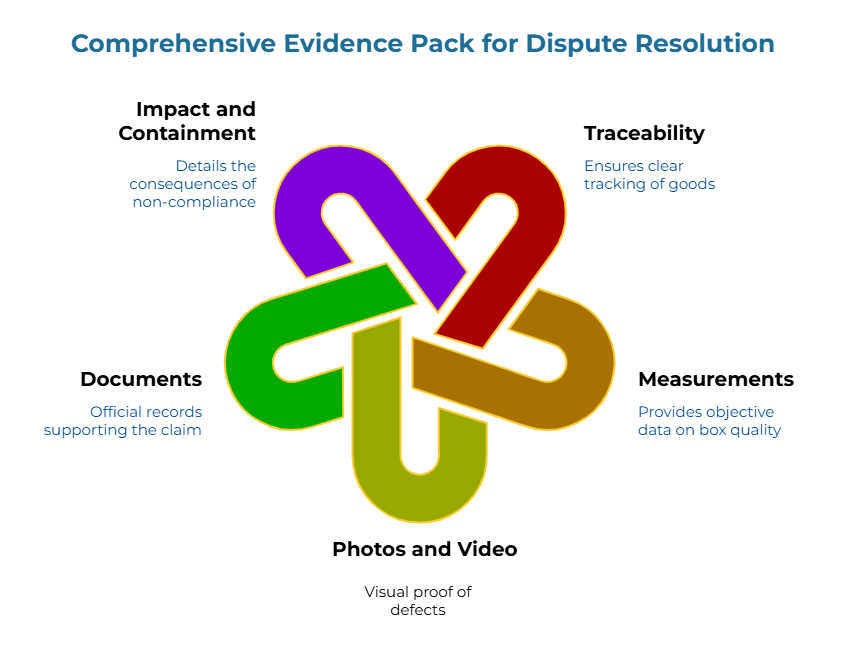
A dispute email with attached photos isn’t a documentation dossier. A structured bundle that ties measurements to documents and documents to the agreed spec—that’s defensible.
Traceability. Purchase order number, lot/batch identifier from carton labels or bill of lading, production date if available, receiving date, and warehouse location. Without traceability, vendors can claim the issue arose post-delivery.
Measurements. What was measured (caliper, moisture, ECT, dimensions), the instrument used and its calibration status, number of samples, selection method, and pass/fail results against spec tolerance. Measurements not standardized or recorded consistently become easy targets for dismissal.
Photos and video. Include a scale reference—ruler or caliper in frame. Capture lot/label information visibly. Show the defect in context rather than isolated close-ups that lack traceability.
Documents. Bill of lading, Certificate of Analysis or Certificate of Conformance if provided, pallet labels, carton markings, and shipping tags. When sourcing directly from paper manufacturers, requesting standardized documentation formats at the RFQ stage reduces evidence gaps during dispute resolution. These establish a chain of custody.
Impact and containment. What was isolated or quarantined, what operational risk was created (line stoppage, delayed shipment, rework). Keep this factual—document actions taken, not speculation about vendor intent.
For a detailed receiving protocol that feeds this evidence pack, see how to verify corrugated box quality at the dock. For guidance on interpreting the test reports suppliers provide, see how to read corrugated box drop test reports.
Sampling and Thresholds: Avoiding “You Only Checked One Box”
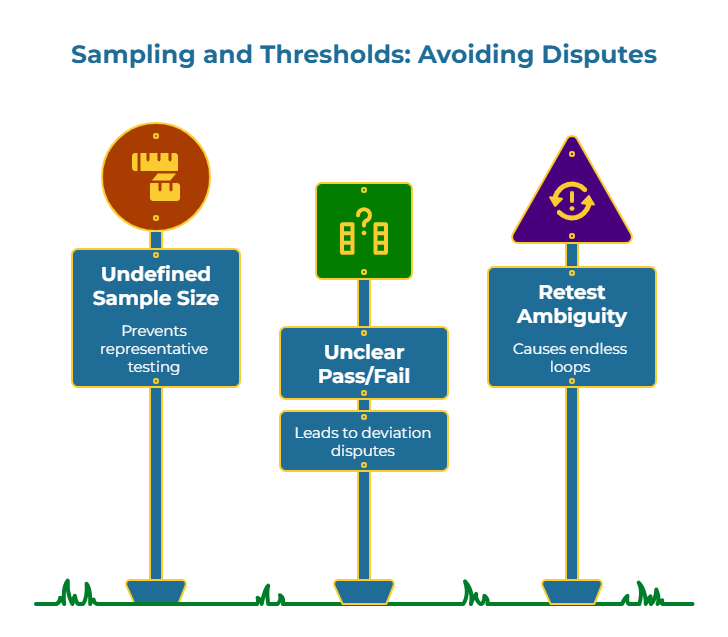
Consistent sampling removes the argument that findings are statistically meaningless.
Define a per-lot or per-pallet sample size in advance—for example, 5 cartons per pallet, 3 measurements per carton. When qualifying corrugated box suppliers, documenting these sampling expectations in the initial agreement prevents disputes over what constitutes representative testing. Use the same method every time and document the selection approach. Set pass/fail thresholds before disputes arise: if 2 of 15 samples fail, is the lot rejected or accepted with deviation?
For formal frameworks, ISO 2859-1 provides attribute-based acceptance sampling plans. Even without full implementation, borrowing the logic—sample size tied to lot size, clear accept/reject criteria—strengthens the position.
Retest logic matters. If the vendor requests a retest, define who conducts it, with what method, and how results are reconciled. This prevents endless loops of competing test results.
Dispute Resolution Email Template
The template below is designed to be firm, professional, and anchored to evidence.
Subject: Non-conformance Notice – PO [Insert PO Number], Lot [Insert Lot Number] – Specification Deviation Detected
Hello [Name/Team],
At receiving on [Date], a non-conformance was identified on shipment for PO [PO Number]. The issue is documented below with measurements and photos tied to the agreed specification.
1. Shipment Identification
- PO: [PO Number]
- Shipment/BOL: [BOL Number]
- Lot/Label: [Lot/Label info]
- Receiving location: [Site]
- Receiving date: [Date]
2. Specification Reference
- Spec section: [Spec name / line item]
- Requirement: [e.g., moisture range, caliper specs, ECT minimum]
- Test method: [e.g., ISO 3037 for ECT]
- Sampling method: [e.g., 5 cartons per pallet, 3 measurements per carton]
3. Findings
| Attribute | Spec Requirement | Measured Result | Sample Count | Pass/Fail |
| [Attribute 1] | [Requirement] | [Result] | [n] | [Pass/Fail] |
| [Attribute 2] | [Requirement] | [Result] | [n] | [Pass/Fail] |
Supporting evidence attached: photos with scale, measurement log, shipment labels.
4. Containment Action Taken [Held pallets X–Y] / [Quarantined quantity] / [Stopped line use]
5. Requested Remedy and Timing Please confirm by [Date/Time] one of the following:
- Credit for non-conforming quantity
- Replacement shipment meeting spec
- Joint root-cause review and corrective action plan with timeline
A brief review call can be scheduled to align on the evidence pack and next steps if helpful.
Regards,
[Name], [Title], [Company]
Keeping Leverage Without Burning Bridges
The most productive approach to non-compliance is firm on facts, flexible on solutions.
Separate facts from interpretations. State what was measured without speculating about why the vendor shipped off-spec product. Ask for corrective action, not just a concession—a credit note solves this shipment, but a root-cause review and remediation strategy prevents the next one. Frame the task around prevention.
Offer a joint investigation track when appropriate. Request the supplier’s internal test records for the same lot, with method IDs and dates. If the supplier rejects evidence, escalate cleanly to their QA lead with the same pack, unchanged.
Document outcomes for supplier scoring. If a supplier scorecard or performance review exists, update it with the resolution. This creates a factual record for future supplier compliance audit decisions without turning the current conversation into a threat.
Closing the Loop: Corrective Actions and Prevention
A resolved dispute isn’t finished until the loop is closed.
If the vendor agrees to a corrective action plan (CAPA), define what that includes: root-cause analysis, process change, verification of effectiveness, and a timeline. ISO 9001:2015 Clause 8.7 provides a framework for handling nonconforming outputs that many suppliers already follow. CAPA expectations vary by supplier maturity and industry—a smaller converter may need more guidance on root-cause methodology than an established mill with a mature quality system.
Update specs and receiving checks. If this dispute revealed ambiguity in the spec, fix it. If the failure mode wasn’t part of the standard dock check, add it. Repeated failures, failure to respond, or refusal to implement corrective actions may warrant re-qualification or pausing orders until confidence is restored. When supplier performance necessitates sourcing alternatives, platforms that enable direct connection with verified vendors can accelerate the qualification of backup sources—buyers can find suppliers without intermediary delay.
For broader frameworks that reduce these disputes upstream through staged verification, see building a strategic framework for corrugated box sourcing and a 4-step system for strategic corrugated box sourcing.
Make Receiving Dispute-Ready
A dispute-ready receiving process standardizes five elements before problems arise:
- A single evidence folder structure per PO/lot (photos, measurement logs, shipping documents in one place)
- A measurement log template with sample IDs and selection locations
- A rule that photos must include scale reference and label visibility
- A defined hold/quarantine trigger and clear responsibility assignment
- A short escalation ladder (receiving → QA → procurement → supplier QA)
Building these habits when things are running smoothly means the evidence is already structured when a dispute surfaces.
Frequently Asked Questions
How much data is enough to prove non-compliance?
Enough to survive the “you only checked one” objection. A consistent sampling plan tied to spec tolerance—documented sample count, selection method, and results—is more defensible than extensive ad hoc testing.
What if the vendor blames transit or handling?
This is where traceability and pattern analysis matter. Documentation of condition at receiving—photos of packaging integrity, seal status, pallet condition—shows whether damage is consistent with transit stress or arrived that way. If defect patterns appear uniformly across multiple pallets (rather than concentrated on exposed edges or bottom layers), the evidence points toward production drift rather than handling damage. If risk transferred at origin under terms like FCA [Named Place], FOB [Named Port of Shipment], or CIF [Named Port of Destination] (Incoterms® 2020), the vendor’s liability for transit damage typically ends once the goods are delivered to the carrier or placed on board. However, manufacturing non-conformance remains the vendor’s responsibility regardless of shipping terms..
When should orders be paused versus accepted with a remedy?
Consider pausing when the same failure repeats, the vendor refuses corrective action, or the nonconformance poses safety or compliance risk. Accept the remedy when the issue is contained, the vendor responds professionally, and a credible CAPA is in progress.
Explore practical procurement guides in PaperIndex Academy for building spec-driven sourcing and QA workflows.
Disclaimer:
This guide is for informational purposes and does not constitute legal advice. Contract terms and remedies vary by agreement and jurisdiction; consider consulting qualified counsel for legal interpretation.
Our Editorial Process:
Our expert team uses AI tools to help organize and structure our initial drafts. Every piece is then extensively rewritten, fact-checked, and enriched with first-hand insights and experiences by expert humans on our Insights Team to ensure accuracy and clarity.
About the PaperIndex Insights Team:
The PaperIndex Insights Team is our dedicated engine for synthesizing complex topics into clear, helpful guides. While our content is thoroughly reviewed for clarity and accuracy, it is for informational purposes and should not replace professional advice.