
📌 Key Takeaways
Certified paper claims fail when documentation loses continuity between quote and invoice, not because suppliers lack valid certificates.
- Lock Claim Wording at Quote Stage: Request exact scheme-approved claim language and certificate codes before placing orders to prevent invoice mismatches that collapse proof requests.
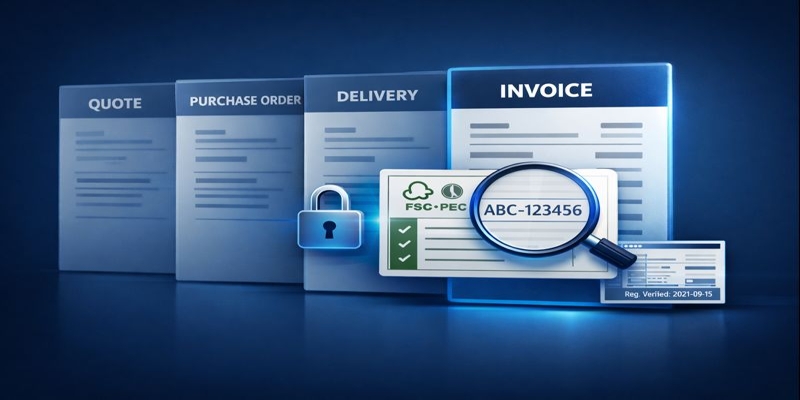
- Mirror Claims Across All Transaction Documents: Copy-paste identical claim wording from quote to purchase order to delivery documents to invoice, treating certification like a controlled technical specification.
- Verify Certificate Status Using Public Registries: Check FSC and PEFC databases at quote and purchase order stages to confirm active status, entity match, and scope coverage before commitment.
- Treat Receiving as a Verification Gate: Flag missing or inconsistent claims on delivery documents before acceptance, since post-acceptance corrections become slower and politically complex.
- Store Transaction Evidence in Consistent Folders: Maintain supplier certificate, quote, purchase order, delivery documents, and invoice together with date-stamped registry screenshots to answer proof requests in minutes.
Four document handoffs, four opportunities to catch problems before they become proof failures.
Procurement managers and quality teams verifying certified paper suppliers will gain practical controls here, preparing them for the stage-by-stage workflow tables and verification checklists that follow.
A “certified” claim usually doesn’t fail because a supplier lacks a certificate. It fails because the claim gets dropped, altered, or disconnected from proof as paperwork moves from quote to purchase order to delivery to invoice. That’s when teams discover the operational gap: the claim that mattered most didn’t make it to the only document many auditors, customers, and internal stakeholders actually check.
Chain-of-custody controls are the operational fix for that failure. Certification functions through a sequence of verified transfers; the claim remains valid only if the documentation remains unbroken at every point of exchange. If the baton drops at any stage—point—including missing claims, altered phrasing, or entity discrepancies—the final claim doesn’t count in practice.
Chain-of-custody is the evidence trail that connects a certified claim to a specific delivery, using consistent claim wording on the documents that govern the transaction. It is not a generic statement that a company “cares about forests,” and it is not guaranteed by a logo or a certificate PDF attached to an email.
What Chain-of-Custody Means for Certified Paper Claims
Chain-of-custody (CoC) certification for paper is the system that allows a certified claim to transfer from one business to another through transaction documents. A CoC certificate confirms that an organization has systems to track certified material and make valid claims on sales documents. The certificate proves capability, not delivery. To ensure audit-proof traceability, the actual claim on a specific transaction should ideally appear correctly on the invoice, reference the right certificate code, and match what was agreed at the quote and purchase order stages. While some schemes allow claims to appear on transport documents (delivery notes) if strictly linked, the invoice remains the gold standard for commercial verification.
A CoC certificate confirms that an organization’s management systems comply with FSC-STD-40-004 or PEFC ST 2002 — FSC vs PEFC claims function differently in proof requirements. This verifies the capacity to process certified material but does not substitute for transaction-specific evidence. That certification shows capability. It means the organization may be able to sell products with specific certified claims when the transaction and product scope meet the scheme rules.
Without document-level continuity, the claim collapses under proof requests. This happens even when the supplier genuinely holds a valid certificate.
For buyers, understanding CoC means knowing what documentation to require at each stage. For suppliers, it means knowing what evidence to prepare proactively so deals close faster and documentation disputes disappear. For more on verification approaches, see stop treating FSC/PEFC as a badge: a buyer workflow to verify paper claims.
Why Certified Claims Fail in Practice

A supplier showing a certificate PDF does not guarantee that an invoice will carry a defensible claim. Claims fail for operational reasons, not because anyone intended fraud.
Entity mismatch occurs when the certificate belongs to one legal entity but the invoice comes from another. The certificate might belong to “XYZ Paper Mills Ltd.” while invoices come from “XYZ Trading Co.” Unless the trading entity also holds chain-of-custody certification or operates under the same certificate scope, the claim cannot legally transfer.
Scope mismatch happens when a certificate covers certain products but not others. A mill’s certificate may cover kraft linerboard production but not tissue paper. Certificates specify which products and activities are covered. If an ordered product falls outside that scope, no valid claim can be made regardless of sales team promises.
The trader gap creates interruptions in the claim lineage. A trader without CoC certification cannot pass through a claim from a certified mill, even when sourcing from a legitimate certified supplier. The chain breaks at the uncertified link.
Wording drift introduces inconsistencies across documents. The quote says “FSC 100%.” The purchase order says “FSC Certified.” The invoice says nothing. These variations create audit failures. Certified claim wording follows strict scheme rules, and marketing language does not satisfy proof requirements.
Expired or suspended certificates result in temporal invalidity. Since certification status can change between order placement and invoicing, real-time verification is mandatory. A certificate valid when an order was placed may not be valid when the invoice arrives.
Site and shipping route breaks occur when goods ship from a location not covered by the certificate. A supplier may be certified, but if the dispatch site falls outside the certificate scope, the claim cannot transfer with that shipment.
“Logo thinking” happens when packaging or product labeling implies certification but commercial documents do not support it. In a B2B sourcing context, labels serve as supporting signals, not primary proof. Unlike retail consumers who rely on on-product labels, business buyers must treat invoice claim continuity as the core control.
Each failure happens after the supplier truthfully said “we’re certified.” The certificate was real. The claim did not survive the document chain.
The Claim Survival Workflow: Quote → PO → Delivery → Invoice

Preventing proof breakage requires controls at every document stage. Both buyers and suppliers benefit from understanding what each party needs to do at each point of transfer. The following table maps requirements, deliverables, and quick verification protocols across the transaction lifecycle.
| Transaction Phase | Buyer Requirement | Supplier Deliverable | Quick VerificationProcess |
| Quote | Quote must state the exact certified claim wording requested (not vague “certified paper”) | Quote shows claim wording + certificate ID + legal entity name that will invoice | Confirm certificate exists and is active in FSC certificate search or PEFC Find Certified; confirm invoicing entity matches certificate holder |
| Purchase Order | PO repeats the same claim wording and makes it a document requirement for invoice | PO acknowledgment confirms the claim wording will appear on invoice and relevant paperwork | Check wording is identical (copy/paste) and certificate reference is consistent |
| Delivery | Delivery note/packing list includes the claim wording (where applicable) and identifies shipping site/entity | Delivery paperwork includes claim wording and traceable references (order number, product code) | Match delivery docs to PO line items; flag missing claim before acceptance |
| Invoice | Invoice contains the approved claim wording, certificate code, and line-item linkage | Invoice is “claim-complete” and consistent with PO + delivery docs | Confirm entity match, claim wording match, and that invoice references the PO/order |
Quote Stage: Lock the Claim Wording Before It Leaves the Sales Email
If the wording is vague at quote stage, it will almost certainly be vague on the invoice. The quote is the cleanest place to show competence and avoid rework later.
What to Require on the Quote
Request specific claim wording that can be mirrored across documents. Avoid leaving the requirement as “FSC paper” or “PEFC certified paper,” because those phrases are easy to interpret differently.
A practical quote requirement should include:
- Claim wording (exact): Use the scheme’s approved claim format for the product sold
- Certificate reference: The FSC or PEFC certificate code
- Entity clarity: The legal name of the company that will issue the invoice
- Line-item mapping: Product code or grade that will appear on the invoice
The “certified” label that survives is the one that is copy/pasted, not retyped.
Quick Verification Process at Quote Stage
Use public registries to check status early—before a PO is placed. Verify FSC certificate status via FSC certificate search. Verify PEFC certification via PEFC Find Certified.
For a step-by-step approach including what to match and what to screenshot for your evidence file, see how to run a quick registry check for FSC/PEFC certificates.
Purchase Order Stage: Mirror the Claim and Make It Invoice-Required
The PO is where “preference” becomes a deliverable. Treat the certified claim like a technical spec field.
What to Put on the PO
The PO line should include:
- The exact claim wording agreed at quote stage (copy/paste)
- A requirement that the same claim wording appears on the invoice
- A requirement that the invoice entity matches the certified entity
An illustrative PO clause (general template, not legal advice):
“Supplier must state the certified claim on the invoice using the same wording as this PO line item. Invoice must include the applicable certificate reference and must be issued by the entity authorized to make the claim under the relevant chain-of-custody certificate — similar to how kraft paper RFQs specify test methods and tolerances.”
What to Confirm
A strong PO acknowledgment confirms the claim wording will appear on the invoice and flags any constraints before shipping—for example, site coverage limitations or a trading entity that invoices on behalf of a certified operation. These arrangements can be workable in some contexts, but they must be documented and aligned with scheme requirements.
Before releasing the purchase order, re-check certificate status. Certificates can be suspended between quote and order.
Delivery Stage: Treat Receiving as a Verification Gate
CoC is not only a procurement function. It becomes real on the loading dock. If receiving closes out delivery without checking claim continuity, the team loses its best leverage point to fix documentation issues quickly.
What to Look for on Delivery Documents
Depending on the supply setup and document set, request that the dispatch paperwork (delivery note, packing list, dispatch note) includes:
- PO number or order reference
- Line items that match the PO
- Claim wording where applicable
- Shipping location or site identifiers
Quick Verification Process at Receiving
Before final acceptance:
- Confirm the delivery paperwork matches the PO line items
- If the certified claim is missing from delivery paperwork, flag it immediately and request a corrected document set or written confirmation that the invoice will carry the agreed claim wording
For broader verification workflows beyond CoC wording, see the buyer’s guide to paper certifications: FSC, PEFC, and beyond.
Invoice Stage: The Finish Line Is the Invoice
Most organizations end up proving certified claims using invoices, not email threads — the same documentation rigor that prevents disputes in kraft paper deliveries. The invoice is the formal commercial record of sale and the document most frequently requested as proof.
What an “Invoice-Ready” Claim Usually Includes
For paper transactions using FSC or PEFC claims, invoices commonly include:
- Claim wording (exact) at the line-item level or clearly associated with the products sold
- Certificate reference using the supplier’s valid certificate code
- Entity match between invoice issuer and certificate holder or authorized entity
- Traceability references such as PO number, order number, or product code
Buyers should verify that claim wording matches the purchase order, the certificate code is present and correct, and the invoicing entity matches the certificate holder or has documented authorization.
Suppliers should verify before sending that all claim elements are present, no marketing language has replaced scheme-compliant wording — the same evidence-first approach that replaces promises in kraft paper procurement, and the invoice could withstand an auditor asking for proof.
If the invoice fails these checks, request a corrected invoice before payment. Accepting a non-compliant invoice means accepting the proof gap.
Document Controls: Buyer and Supplier Checklists
Buyer Checklist (Quote → PO → Delivery → Invoice)
At Quote/RFQ:
- [ ] Request supplier’s certificate or license code
- [ ] Confirm certificate is valid using public database
- [ ] Confirm scope covers the specific product
- [ ] Receive exact claim wording for invoice
- [ ] Confirm invoicing entity matches or is authorized under certificate
At Purchase Order:
- [ ] Include exact claim wording
- [ ] Include certificate or license code
- [ ] Add no-substitution clause requiring written approval for changes
- [ ] Require invoice to carry identical claim wording
- [ ] Re-verify certificate status before releasing order
At Delivery:
- [ ] Confirm documentation received with claim references
- [ ] Verify documentation matches purchase order specifications
- [ ] Flag missing or inconsistent documentation before acceptance
At Invoice:
- [ ] Verify claim wording matches purchase order
- [ ] Confirm certificate code is present and correct
- [ ] Verify invoicing entity matches certificate holder
- [ ] Store invoice with supporting documentation for future proof requests
Supplier Evidence Pack
Suppliers who prepare evidence proactively close deals faster and face fewer documentation disputes.
Materials to maintain ready-to-share:
- Current certificate or license document
- Certificate scope document showing covered products and activities
- Standard claim wording for each product category following scheme requirements
- Clear documentation of which legal entity holds the certificate and which entities invoice
At quote stage, provide:
- Certificate code and current validity dates
- Confirmation that scope covers the buyer’s requested product
- Exact claim wording for the invoice
- Identification of the invoicing entity and its relationship to the certificate
At invoice stage, verify:
- Claim wording matches what was agreed in the purchase order
- Certificate code is included
- Invoicing entity is correct
- No marketing language has replaced scheme-compliant wording
A Simple Filing System That Makes Proof Requests Take Minutes
This is where CoC becomes operationally cheap. Store one evidence pack per supplier and one subfolder per transaction — the same systematic approach used in kraft paper supplier pre-qualification.
Evidence Folder Structure
A workable approach for small procurement and QA teams:
Supplier Name
- Certificate (PDF + registry screenshot)
- Transaction YYYY-MM
- Quote
- PO + acknowledgment
- Delivery docs
- Invoice
- Exception notes (if any)
This structure supports defensibility without turning CoC into an administrative burden. Save one registry screenshot per transaction (date-stamped). Save the exact quote, PO, and invoice documents—not rewritten summaries.
For suppliers, routinely sending an evidence pack at quote stage reduces friction:
- Certificate PDF + registry link
- Confirmation of invoicing entity name
- Confirmation that the quoted products are within scope
- Commitment that claim wording will appear on invoice and match the PO
While buyers value speed, they often value defensibility even more when a customer or regulator asks, “Prove it.” For related guidance on FSC claim verification specifically, see greenwashing alert: how to verify FSC claims on paper bag orders.
Common Myths About Chain-of-Custody (and the Facts)
Myth: “If a supplier is certified, every shipment is certified.”
Fact: A certificate shows capability under a scheme. The transaction still needs consistent claim wording and a valid proof trail for the specific delivery.
Myth: “A certificate PDF is proof.”
Fact: A certificate PDF is a starting point. Status, entity, and scope are verified via public registries such as FSC certificate search and PEFC Find Certified.
Myth: “Receiving doesn’t matter—it’s paperwork.”
Fact: Receiving is where mismatches are easiest to catch and correct. Once internal acceptance is complete, exceptions often become slower and more political.
Myth: “The logo on packaging proves the claim.”
Fact: Labels are supporting signals, not primary proof — the same logo-thinking that creates greenwashing risk in paper bag orders. Invoice claim continuity is the core control. Verify through official registries, not graphics.
For a wider verification lens that includes sustainability-claim risk, see avoiding greenwashing: how to verify supplier sustainability claims.
Frequently Asked Questions
What is the difference between forest management certification and chain-of-custody?
Forest management certification applies to forests and sustainable management practices. Chain-of-custody certification applies to businesses that buy, process, or sell certified material. Forest management ensures the source meets sustainability standards. Chain-of-custody ensures claims can be tracked and transferred through the supply chain. Paper buyers interact with chain-of-custody certification because it allows suppliers to make claims on invoices.
Can a trader pass an FSC or PEFC claim to a buyer?
Only if that trader holds chain-of-custody certification—the same principle applies when evaluating kraft paper exporters versus direct mill sources. A trader without CoC certification cannot legally transfer a certified claim, even when sourcing from a certified mill. Each entity in the chain must either hold certification or operate under the scope of a certificate covering their activities.
Where should the claim appear?
Ideally on the purchase order, packing list, and invoice. The purchase order establishes the contractual requirement. The packing list confirms what shipped. The invoice provides the proof document most commonly requested. Consistency across documents prevents disputes.
What should be stored for future proof requests?
At minimum: the supplier’s certificate, the purchase order specifying the claim requirement, the invoice carrying the claim wording and certificate code, and delivery documentation. Store these together to respond to proof requests by pulling one folder rather than chasing emails across months of correspondence.
How often should certificate status be re-verified?
At minimum: at quote stage before committing to an order and at purchase order stage before releasing the order. For ongoing supplier relationships, quarterly verification of active certificate status is good practice. Certificates can be suspended at any time, and annual renewals may lapse.
Making Certified Claims Defensible
A certified paper claim that fails under proof requests damages more than one transaction. It creates rework, delays customer relationships, and raises questions about verification processes.
If any handoff lacks documentation, the finish-line claim does not count. By building document controls into each stage and ensuring both buyers and suppliers know what evidence to provide and require, certified claims become defensible rather than hopeful.
Systematic verification at each stage—quote, purchase order, delivery, and invoice—converts certification from a hopeful assumption into a defensible commercial fact.
Explore more verification workflows and sourcing guides in PaperIndex Academy, or connect with verified paper suppliers through PaperIndex‘s neutral marketplace.
Disclaimer:
This article provides educational guidance on chain-of-custody documentation practices. Specific requirements vary by certification scheme, contract terms, and jurisdiction. For compliance decisions, consult relevant certification body standards and qualified advisors.
Our Editorial Process:
Our expert team uses AI tools to help organize and structure our initial drafts. Every piece is then extensively rewritten, fact-checked, and enriched with first-hand insights and experiences by expert humans on our Insights Team to ensure accuracy and clarity.
About the PaperIndex Insights Team:
The PaperIndex Insights Team is our dedicated engine for synthesizing complex topics into clear, helpful guides. While our content is thoroughly reviewed for clarity and accuracy, it is for informational purposes and should not replace professional advice.