

📌 Key Takeaways
Sustainability claims on packaging create legal liability for retailers unless verified through documentation before artwork approval.
- Evidence Chain Protects Brands: Run every claim through five verification steps—translate to testable statements, request documentation during quoting, confirm authenticity in public registries, verify applicability to your specific SKU, and lock approved language into purchase orders.
- MVE Pack Speeds Decisions: Request a Minimum Viable Evidence Pack upfront containing product specs, current certificates with scope documents, legal entity details, traceability signals, and compliance contacts to decide approve/qualify/reject.
- Claim Types Require Different Proof: FSC/PEFC needs active registry status and scope matching; recycled content demands percentage breakdowns and test methods; compostable requires standard certification (EN 13432/ASTM D6400) plus infrastructure verification.
- Red Flags Signal Verify Harder: Expired certificates, entity name mismatches, scope gaps, overly broad phrasing without qualifiers, and claims that shift definitions mid-conversation all indicate deeper investigation needed before approval.
- Governance Prevents Marketing Drift: Maintain approved and banned phrase lists, document claim decisions in one-page records, and establish 6–12 month re-verification intervals with clear procurement-QA-marketing approval authority.
Unverified claims = inherited risk; verified claims = defensible positioning.
SMB retail packaging buyers managing supplier relationships will gain practical verification workflows here, preparing them for the detailed evidence-chain framework that follows.
“Sustainable.” “Eco-friendly.” “Biodegradable.”
These words appear on supplier brochures, product specs, and sales emails with increasing frequency. The problem? Marketing language travels faster than evidence. When you repeat a supplier’s sustainability claim on your packaging, shelf talkers, or website, you inherit the risk attached to that claim. If the evidence behind it crumbles, your brand takes the hit.
Regulators in major markets are tightening scrutiny on environmental claims. The US Federal Trade Commission’s Green Guides, the UK Competition and Markets Authority’s Green Claims Code, and evolving EU legislation on substantiating sustainability claims all point in the same direction: vague virtue signaling is becoming a compliance liability.[1][2][3] Recent regulatory developments, including discussions around proposed directives, signal that enforcement frameworks continue to evolve and may face implementation delays or revisions, making ongoing verification even more critical.
The solution isn’t to avoid sustainability claims altogether. It’s to verify before you buy and before you print. This article provides a practical workflow for SMB retail packaging buyers to validate supplier sustainability claims, spot red flags early, and document decisions so your marketing team doesn’t outrun your procurement controls.
Executive Summary

If a supplier’s sustainability claim gets repeated on packaging artwork, shelf talkers, e-commerce pages, or in-store signage, you effectively inherit the legal liability for verifying that claim against current local regulations. A practical way to reduce that risk is to run every sustainability claim through an evidence-chain verification workflow before you connect with suppliers:
Claim → Evidence → Authenticity → Applicability → Documentation → Governance
The goal is not to “catch suppliers out.” The goal is to create a repeatable, auditable process that separates verifiable claims from marketing phrasing, then locks approved language into purchasing and artwork controls. This workflow helps you distinguish between vague virtue claims (high-risk) and verifiable claims backed by documentation (lower-risk when substantiated), while building internal governance that prevents marketing from outrunning procurement.
What Greenwashing Looks Like in Paper Bags
Vague Virtue Claims vs. Verifiable Claims
Greenwashing rarely announces itself. It typically appears as language that sounds meaningful but lacks specificity. Consider the difference between these two statements:
Vague (high risk): “Our bags are environmentally friendly and made with sustainable practices.”
Verifiable (lower risk when substantiated): “These bags contain 80% post-consumer recycled content, verified by [specific test method], with FSC Chain of Custody certification (license code: FSC-C123456).”
The first statement offers no testable criteria. The second provides specific claims you can verify against documentation and public registries.
The Five Most Common Claim Types Buyers Repeat
Before you put any sustainability language on your packaging or marketing materials, understand what evidence each claim type requires:
Recycled content claims require documentation of the percentage (post-consumer vs. pre-consumer), the test method used, and ideally third-party verification or supplier declarations with traceable data.
Certified sourcing claims (FSC/PEFC) require a valid certificate with active status, correct scope covering your product category, and chain-of-custody relevance to your specific order.
Compostable or biodegradable claims require certification to specific standards (such as EN 13432 for industrial composability in Europe or ASTM D6400 in the US), and you must verify whether local waste infrastructure actually accepts the material. A bag certified “compostable” means nothing if your customers’ municipal facilities reject it.
“Plastic-free” or “eco-friendly” general claims are high-risk because they’re often subjective. These require you to define what “plastic-free” means precisely (coatings, linings, handles, inks?) and to have documentation supporting each element. Regulatory definitions vary—for example, under the EU Single-Use Plastics Directive (SUPD), modified natural polymers and coatings are often legally classified as plastics if they function as a main structural component, even when marketed as ‘plastic-free’ or ‘aqueous’.
Carbon and climate claims (carbon neutral, net zero, climate positive) typically require specialist validation and third-party verification. These represent the highest-risk category for SMB buyers because the substantiation requirements are complex and evolving rapidly.
The Evidence Chain Workflow
Think of supplier sustainability verification as building an evidence chain. Each link must hold for the claim to be defensible. Here’s a five-step workflow you can apply before approving any supplier or greenlighting marketing language.
Step 1: Translate the Marketing Claim into a Testable Statement
Supplier marketing often bundles multiple claims into appealing but imprecise language. Your first task is to break this down into discrete, testable statements.
For example, when a supplier says “FSC-certified,” you need to determine: Does the supplier hold an FSC Chain of Custody certificate? Is that certificate currently active? Does the certificate scope cover the specific product you’re ordering? Will the invoice and delivery documentation reference the FSC claim correctly?
Each of these becomes a verification checkpoint. A useful rule: if a claim cannot be expressed as a statement that could be confirmed by documentation, registry checks, testing, or audit, it is not ready for packaging.
Step 2: Request the Minimum Viable Evidence Pack (MVE Pack)
Don’t wait until after you’ve placed an order to request documentation. When you find suppliers, ask for evidence during the quoting stage. Request this evidence before sample approval or artwork sign-off. A credible supplier should be able to provide a Minimum Viable Evidence Pack that includes, at minimum:
- Product specification sheet (paper grade, basis weight, coatings/additives, inks, adhesives)
- Claim-specific evidence (current certificates, declarations, test reports—not expired, not “pending renewal”)
- Supplier identification details (legal entity name, address, production site(s))
- Certificate scope documents showing which products and sites are covered
- Traceability signals (batch/lot references, invoice claim statements where relevant)
- Chain of custody documentation process (for certified sourcing claims)
- Contact person responsible for compliance/quality (not only sales)
This MVE Pack doesn’t need to be “perfect evidence.” It needs to be enough to decide whether the claim is approved, approved with qualifiers, or rejected. If a supplier responds with “certificate available on request” but delays providing it, treat this as a yellow flag.
Step 3: Verify Authenticity
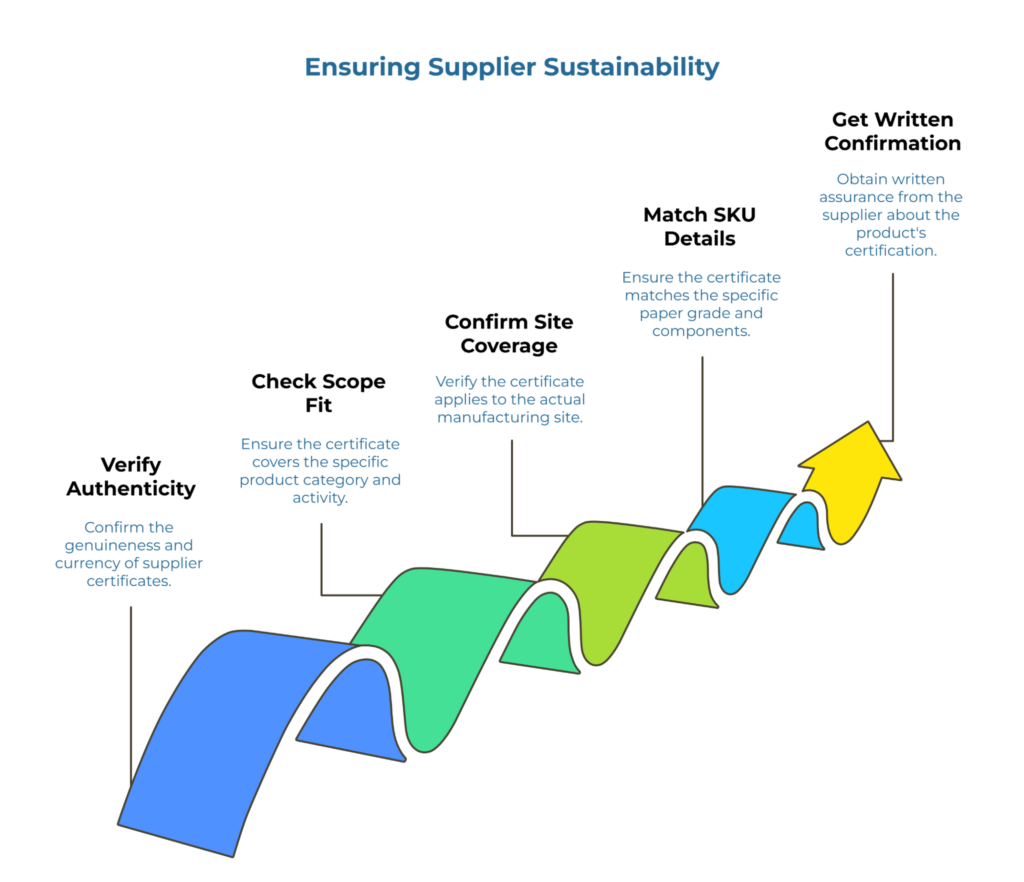
Having documents in hand is not enough. You need to verify they’re genuine and current. Authenticity checks focus on registries and cross-matching:
For FSC certificates, check the FSC Certificate Database. For PEFC, use the PEFC Certificate Search. Confirm that the certificate number matches, the status shows “valid” or “active,” the legal entity name matches your supplier exactly, and the scope covers your product type.
Validate certificate IDs in official certification databases—not screenshots. Confirm validity dates and status (active, suspended, expired). Match the legal entity name and address on documents to the supplier actually being contracted. Check whether logos and labels are permitted for the claimed certification type and claim context.
Entity matching matters more than you might expect when evaluating paper suppliers. If your supplier is “ABC Paper Trading Co. Ltd.” but the certificate belongs to “ABC Paper Manufacturing Ltd.,” you have a scope gap that could invalidate the claim for your purchase. Environmental claim guidance consistently emphasizes substantiation and avoiding misleading presentation.[1]
Step 4: Verify Applicability
A valid certificate doesn’t automatically cover your specific order. You must confirm that your particular SKU, paper grade, and manufacturing site fall within the certificate scope. This is where many “technically true” claims become misleading in practice.
Applicability checks include:
Scope fit: Does the certificate scope cover the right product category and activity (e.g., converting vs. trading vs. manufacturing)?
Site fit: Does the certificate cover the actual manufacturing site for the SKU (not just a headquarters or sales office)?
SKU fit: Does the evidence relate to the same paper grade, coatings, inks, or additives used in the bag?
Component fit: Does “compostable” apply to the full bag, including handles, inks, adhesives, and coatings?
Ask your supplier directly: “Is this specific product, produced at this specific facility, covered under your certification?” Get the answer in writing. If they’re sourcing from multiple mills, confirm which mill will fulfill your order and whether that mill is within scope.
Step 5: Lock Claims into Purchasing and Artwork Controls
Once you’ve verified a claim, build it into your procurement controls so it doesn’t drift over time. Verification has limited value if approved claim language is not controlled.
Include specific claim wording in your purchase order terms and require that it becomes part of the specification. Reference the certificate number and require that invoices carry the relevant certification marks. Define what happens if the supplier’s certification lapses mid-contract.
For artwork and marketing, establish a clear approval process. The exact phrasing that goes on your packaging should trace back to verified documentation, not to a supplier’s sales brochure. Only approved phrases can appear on print files.
Set a re-verification cadence. Claims get re-checked on a schedule or when material/site changes occur. UK CMA guidance frames expectations around claims being truthful, clear, and properly evidenced.[2]
Fast Red Flags
When evaluating supplier documentation, use this as a stoplight check before spending time on deep due diligence. Certain patterns should trigger deeper investigation:
“Certificate on request” or only a blurry certificate image with no ID to validate indicates the supplier may not have documentation readily available.
Expired or “inactive” certificates indicate either administrative neglect or a more serious compliance issue. Always check the valid-to date.
Mismatched legal entity names between the certificate and the company you’re dealing with may indicate the certificate belongs to a parent company, a different subsidiary, or an unrelated entity entirely.
Scope gaps occur when the certificate covers “kraft paper” but you’re ordering “coated kraft paper bags,” or when certification covers one manufacturing site but your order ships from another. The certificate exists but does not cover the relevant site, product type, or activity.
Overly broad phrasing such as “100% eco-friendly” or “fully biodegradable everywhere” without qualifiers suggests marketing enthusiasm has outpaced documentation.
“We are FSC” phrasing without chain-of-custody context is imprecise. A company might hold FSC certification for some products but not others, or might be FSC-certified as a manufacturer but unable to pass that claim through for trading activities. The question is always whether the specific product you’re buying, on the specific order you’re placing, carries the claim.
Claims that shift definitions mid-conversation such as “recycled” becoming “recyclable” or “compostable” becoming “biodegradable” signal confusion or intentional obfuscation.
No component clarity with handles/inks/adhesives/coatings not addressed leaves room for misleading claims.
Pressure tactics such as “everyone uses this wording” or “no one asks for that” instead of evidence should raise immediate concerns.
None of these red flags necessarily indicate fraud. They indicate you need to verify harder before proceeding.
How to Verify the Big Three Claim Categories
FSC/PEFC and Responsible Sourcing Claims
Forest certification claims are among the most common and the most verifiable. The FSC and PEFC systems both maintain public databases where you can confirm certificate validity in minutes.
When verifying, confirm the certificate is active (not suspended, terminated, or expired), the product scope matches what you’re ordering, and the supplier can demonstrate chain-of-custody controls for your order. Additionally, assess manufacturing reliability by requesting Process Performance (Ppk) data; a Ppk of ≥1.33 confirms the process is stable and consistent, which directly supports sustainability by minimizing scrap rates, energy waste, and material loss during production.
For deeper guidance on verifying these certifications, including the evidence playbook for buyers, see the kraft paper manufacturer certifications verification guide.
Recycled Content Claims
Recycled content verification is less standardized than forest certification. Evidence typically comes in the form of supplier declarations, sometimes supported by third-party testing or audit reports.
Key questions to ask: What percentage is post-consumer recycled versus pre-consumer (post-industrial) recycled? What test method or standard does the supplier reference? Can they provide batch-specific or production-run-specific data, or only general mill averages?
Ensure evidence is SKU-specific, not a generic company statement. If mass-balance or mixed sourcing is used, require clarity on how the percentage is calculated and how it ties to procurement records. For terminology discipline on self-declared claims, ISO 14021 is widely referenced as a framework for environmental claim terms and definitions.[4]
Jurisdiction matters here. What qualifies as acceptable recycled content documentation varies by market and by the specific claims you intend to make.
Compostable and Biodegradable Claims
This category generates the most confusion and carries significant risk. “Biodegradable” and “compostable” are not interchangeable terms, and neither guarantees environmental benefit unless the material actually enters an appropriate waste stream.
Treat “compostable” as incomplete unless paired with the relevant standard and conditions. Compostability certifications such as EN 13432 in Europe or ASTM D6400 in the US specify conditions: typically industrial composting facilities operating at specific temperatures for specific durations.[5] A bag certified compostable under industrial conditions will not break down in a home compost bin or a landfill within any practical timeframe. When sourcing packaging paper, verify certifications match your customers’ actual disposal infrastructure.
Confirm the claim covers the full bag system including paper, coatings, inks, adhesives, and handles. Add context qualifiers where appropriate, as disposal infrastructure and acceptance vary by jurisdiction and facility.
Before making compostable claims, verify what certification standard applies, confirm whether the infrastructure exists in your customers’ locations to actually process the material, and ensure your claim language accurately reflects these limitations.
How to Document Decisions So Marketing Doesn’t Outrun Procurement
A One-Page Claim Approval Record
Create a simple internal document that records, for each sustainability claim you use:
- Claim requested: exact wording
- Intended usage: on-pack, web PDP, shelf signage
- SKU(s) and site(s) covered
- Evidence received: document list with dates
- Verification steps performed: registry checks, scope checks, tests reviewed
- Decision: approve / approve with qualifiers / reject
- Approved phrasing: exact text, copy-paste ready
- Owner and approver(s): Procurement + QA/Compliance + Brand (as applicable)
- Re-verification interval and triggers: site/material change, annual review
This record creates accountability and prevents situations where marketing launches a campaign based on a supplier conversation while procurement is still verifying documentation.
Governance That Works in Small Teams
Maintaining governance doesn’t require complex systems. Even small procurement and brand teams can implement effective controls:
Maintain an Approved Phrases List with copy-paste ready language that has been verified and documented.
Maintain a Banned or High-Risk Phrases List including terms like “eco-friendly,” “100% sustainable,” and “biodegradable anywhere” that either cannot be verified or carry unacceptable risk.
Set a review cadence with quarterly or semi-annual reviews plus immediate review on supplier or material changes. This aligns with a Plan-Do-Check-Act cycle for ongoing quality management.
Establish clear approval authority. Define who must sign off before sustainability language appears in marketing materials—typically involving procurement (who verifies supplier documentation), quality assurance (who confirms technical accuracy), and marketing (who ensures claim language is accurate).
Set annual re-verification as a reasonable baseline for most SMB operations. Additionally, re-verify whenever certificates approach expiration, when you change products or suppliers, or when you plan to make new marketing claims. UK CMA guidance is explicit that how a claim is presented can be misleading even when a narrow interpretation is technically true.[2]
Supplier Sustainability Claim Verification Scorecard
Use this framework when evaluating any sustainability claim from a paper bag supplier:
| Claim Type | Required Evidence | Verification Method | Pass Criteria | Red Flags | Decision Options | Next Step | Re-verify Interval |
| FSC/PEFC Certified | Chain-of-Custody certificate; scope statement; transaction/invoice claim statements (where relevant) | Public registry check; entity matching; scope/site/SKU mapping | Active status; correct holder; scope covers site + product; claim rules align to usage | Expired/suspended; entity mismatch; scope excludes activity/site | Approve / Approve with qualifier / Reject | Approved wording added to spec + PO; restrict logo use to compliant context | 6–12 months; sooner if site/material changes |
| Recycled Content | Supplier declaration; spec showing %; test report or credible mass-balance method (as applicable) | Evidence review; batch/SKU traceability check | % defined; pre vs post-consumer stated; applies to SKU; supporting method credible | “Recycled” with no %; no definition; evidence not SKU-specific | Approve / Approve with qualifier / Reject | Approved wording + qualifiers (“contains X% recycled fiber”); require change notification | 6–12 months; on material change |
| Compostable | Test report to a recognized standard relevant to target market; component breakdown | Report review; component applicability check | Standard is relevant; covers full bag/components; conditions specified | “Compostable” with no standard; only partial components covered | Approve / Approve with qualifier / Reject | Limit claim to approved context (“industrial composting where facilities exist”) | 12 months; on component change |
| Biodegradable | Standard/test method; conditions and timeframe; component scope | Evidence review; claim wording risk review | Conditions/timeframe explicit; not misleading for typical disposal routes | “Biodegradable” used as blanket claim; no conditions/timeframe | Approve with qualifier / Reject (often) | Prefer removing or heavily qualifying; align to local guidance | 12 months |
| “Eco-friendly” / “Sustainable” | Claim rationale plus specific substantiation (tie to measurable attribute) | Claim translation + evidence mapping | Converted into specific claim with evidence | Pure virtue claim; no measurable attribute | Approve with qualifier / Reject | Replace with specific, evidenced statements | 6–12 months |
| Carbon / Climate Claims | Boundary definition; methodology; credible third-party validation (often needed) | Specialist review; governance sign-off | Scope/boundary clear; substantiation appropriate | “Carbon neutral” with no boundary/method; vague offsets narrative | Requires specialist validation | Treat as high-risk; require governance approval | 6–12 months |
Five-Minute Greenwashing Triage
When you receive a sustainability claim from a supplier, run through this quick assessment:
- Can you state the claim in testable terms? If you can’t translate “eco-friendly” into a specific, measurable statement, it’s not verifiable.
- Has the supplier provided documentation without you asking? Credible suppliers anticipate verification requests.
- Can you confirm the certificate or claim in a public registry? If yes, do it now. If no registry exists, what alternative verification is available?
- Does the documentation match your specific order? Check entity names, product scope, and manufacturing sites.
- Would you be comfortable explaining this claim to a regulator? If the evidence trail feels thin, it probably is.
If any answer raises concern, move to full verification before approving the supplier or using the claim.
Frequently Asked Questions
What counts as greenwashing in packaging claims?
Greenwashing includes making environmental claims that are vague, unsubstantiated, misleading, or irrelevant. Claiming a paper bag is “eco-friendly” without specifying what makes it so, or stating a product is “biodegradable” without noting the specific conditions required, both represent greenwashing risks.
How do I verify an FSC or PEFC certificate is real and applicable?
Use the official FSC or PEFC certificate databases to confirm the certificate number, check that the status is active, verify the legal entity matches your supplier, and confirm the product scope covers what you’re ordering.
What proof should I request for recycled content claims?
Request a declaration stating the percentage of recycled content (distinguishing post-consumer from pre-consumer), the test method or standard used, and ideally batch-specific or production-run data rather than general mill averages.
What’s the difference between biodegradable and compostable claims?
Compostable claims are tied to specific certification standards (EN 13432, ASTM D6400) that define conditions and timeframes. Biodegradable is a broader term with less standardization. A product can be technically biodegradable (capable of decomposing eventually) but may lack the specific timeframe and condition requirements of compostability standards, meaning it could persist in the environment for years without breaking down.
How often should we re-verify supplier claims?
Annual re-verification is a reasonable baseline. Additionally, re-verify whenever certificates approach expiration, when you change products or suppliers, or when you plan to make new marketing claims.
Who should approve sustainability claims internally?
Establish a clear approval process involving procurement (who verifies supplier documentation), quality assurance (who confirms technical accuracy), and marketing (who ensures claim language is accurate). Document who approved what, based on which evidence.
What to Do Next
Building a verification workflow takes initial effort, but it protects your brand from compliance risk and ensures your sustainability messaging rests on solid ground.
If you’re currently shortlisting suppliers for paper bags, start by requesting documentation upfront during the quoting process. Use the scorecard framework above to evaluate claims systematically. Compare paper bag suppliers or browse kraft paper bag suppliers to begin your search.
For deeper guidance on supplier verification, the factory audit checklist for certification integrity provides additional due diligence frameworks. When you’re ready to request quotes from verified suppliers, you can submit an RFQ to connect directly with suppliers who can provide the documentation you need.
The goal isn’t to become a certification expert. It’s to ask the right questions, request the right evidence, and document your decisions so that when someone asks “how do you know these bags are sustainable?” you have an answer that holds up.
References:
[1]: US Federal Trade Commission, “Green Guides,” provides guidance on environmental marketing claims to help marketers avoid making misleading claims.
[2]: UK Competition and Markets Authority, “Green Claims Code,” outlines principles for businesses making environmental claims to consumers.
[3]: European Commission developments on substantiating green claims continue to evolve, with proposed directives aimed at requiring companies to substantiate environmental claims using recognized scientific evidence. Implementation timelines and scope remain subject to ongoing regulatory discussions.
[4]: ISO 14021 provides standards for self-declared environmental claims, including definitions and requirements for terms like “recyclable” and “compostable.”
[5]: EN 13432 and ASTM D6400 specify requirements and test methods for packaging recoverable through composting and biodegradation under industrial composting conditions.
Disclaimer:
This article provides general information about verifying supplier sustainability claims for educational purposes. For personalized guidance tailored to your packaging sourcing risk controls, it is recommended to consult with a qualified professional.
Our Editorial Process:
Our expert team uses AI tools to help organize and structure our initial drafts. Every piece is then extensively rewritten, fact-checked, and enriched with first-hand insights and experiences by expert humans on our Insights Team to ensure accuracy and clarity.
About the PaperIndex Insights Team
The PaperIndex Insights Team is our dedicated engine for synthesizing complex topics into clear, helpful guides. While our content is thoroughly reviewed for clarity and accuracy, it is for informational purposes and should not replace professional advice.