

📌 Key Takeaways
FSC verification takes ten minutes and prevents brand exposure when suppliers make unsubstantiated sustainability claims on paper bag orders.
- Certificate Codes Enable Verification: Collect the supplier’s FSC licence code and confirm it in the public FSC database before approving artwork or shipment.
- Scope Determines Validity: A valid certificate must explicitly cover finished paper bags and the supplier’s specific activity—manufacturing or trading—not just raw materials.
- Contract Language Prevents Disputes: RFQ and PO clauses requiring verifiable FSC documentation before artwork approval shift risk from reactive damage control to preventive gates.
- Document Consistency Signals Quality: Claims matching exactly across quotes, purchase orders, artwork proofs, and invoices indicate proper chain-of-custody controls; mismatches warrant investigation.
- Expired Certificates Fail Audits: Annual audits maintain FSC validity; expired, suspended, or mismatched certificates mean chain-of-custody hasn’t been recently verified.
Verification before commitment protects procurement decisions during audits and customer inquiries.
Procurement managers sourcing paper bags for retail, food delivery, or e-commerce operations will gain a repeatable verification workflow here, preparing them for the detailed implementation steps that follow.
“FSC-certified.” Two words that appear on supplier quotes, product catalogs, and invoices with reassuring frequency. Most procurement teams accept them at face value.
That trust is often misplaced.
The quote arrives with all the right language. This looks legitimate. The sustainability team will be pleased. Artwork gets approved. The purchase order goes out. Bags ship. Then a customer, a journalist, or an internal auditor asks a simple question: ‘Can you prove this certification is real?’ This is why verifying paper bag suppliers through documented gates is essential before any bulk order
The documentation trail goes cold. The certificate code doesn’t match. Or worse—it never existed.
This isn’t always supplier fraud. Certificates expire. Scope changes. Trading companies make claims their actual manufacturers can’t substantiate. Understanding how to verify supplier capability beyond price lists reveals why documentation matters more than quoted costs. The result is the same: your brand name attached to an unverified sustainability claim, with all the reputational exposure that entails.
To verify an FSC claim on a paper bag order, collect the supplier’s FSC licence or certificate code, confirm it in the FSC public search tool, check that the certificate status is valid and covers the correct activity (manufacturing or trading finished goods), and ensure the ‘FSC Claim’ (e.g., FSC Mix, FSC Recycled) on the supplier’s invoice matches their scope in the FSC database. Document every verification in your RFQ and PO so checks happen before artwork approval and shipment—not after.
The process takes roughly ten minutes. It eliminates most greenwashing exposure before money changes hands.
Common Myths That Create Risk
Several assumptions routinely lead procurement teams astray.
Myth: “If the supplier says ‘FSC certified,’ the bags are certified.”
Reality: A supplier’s facility may hold a certificate, but that doesn’t automatically qualify every product they sell. Certificate scope specifies which product categories and activities are covered. A certificate for corrugated boxes doesn’t extend to paper bags.
Myth: “A logo on the bag proves the claim.”
Reality: Printing an FSC logo without proper authorization violates trademark rules and certification requirements. The logo itself proves nothing without underlying chain-of-custody documentation.
Myth: “Any FSC certificate covers any product.”
Reality: Certificates are specific. They define product categories, activities (manufacturing versus trading), and material types. Assumptions about what “should” be covered don’t survive audit scrutiny.
Myth: “Distributors don’t need their own certification.”
Reality: Every entity making FSC claims on sales documents requires valid chain-of-custody certification. Your immediate supplier needs verification regardless of where they sit in the supply chain.
Myth: “A PDF certificate is enough.”
Reality: PDFs are static snapshots. Only the FSC Public Dashboard provides real-time validity, suspension status, or scope terminations.
What FSC Claims Look Like in Procurement Documents
When reviewing paperwork, FSC claims appear in several places:
- Supplier quotations
- Purchase order line items
- Commercial invoices and packing lists
- Artwork proofs
A substantiated claim includes three elements:
- A valid code—either a License Code (formatted as FSC-C######, typically found on marketing materials and products) or a Certificate Code (formatted as XXX-COC-######, found on official invoices and proofs). Note that while quotes may list a License Code, the final invoice must list the supplier’s Chain of Custody (CoC) Certificate Code to be valid.[1][3]
- Precise claim language such as “FSC Mix” or “FSC 100%” rather than vague terms like “eco-friendly” or “sustainable”
- Consistency across all documents
The kraft paper grade selection directly impacts both sustainability claims and structural performance—FSC certification must cover the specific grade family you’re sourcing.
If the quote references “FSC Mix” but the invoice says “environmentally responsible paper,” that gap warrants investigation.. The certificate code is the verification key. Without it, you’re working with marketing language rather than a substantiated claim.
The 10-Minute FSC Verification Workflow

Any procurement team member with internet access can complete this process. No specialized training required.
Step 1: Collect claim details.
From the quote or purchase order, record the exact claim text, any certificate code mentioned, and the supplier’s legal entity name exactly as it appears on official documents.
Step 2: Access the FSC public search.
Navigate to search.fsc.org. This database is the sole ‘Single Source of Truth’ for Certificate validity.
Step 3: Search for the supplier.
- Open the FSC Public Certificate Search
- Search the supplier’s legal name (use the name shown on the quote)
- Open the result and confirm the certificate is current/active
- Review the certificate scope and confirm it is appropriate for making a claim on finished paper bags
- Save a screenshot or PDF of the result page and file it with the PO and approved proof
Enter the certificate code if available. Otherwise, search by company name. Look for an exact match on the legal entity name—trading names or parent company names may not appear in search results.
Step 4: Confirm status and scope.
Verify three things: Is the certificate status “Valid” (not expired, suspended, or terminated)? Does the certificate type cover trading or manufacturing of finished paper products? Does the certificate cover the specific FSC Product Class (e.g., P5.1 Cardboard packaging, P5.2 Corrugated paper packaging, or P5.3 Sacks and bags of paper)? Ensure the category specifically matches the goods ordered.[1]
Step 5: Validate the claim type.
FSC uses three main claim categories: FSC 100% (containing exclusively material from FSC-certified forests), FSC Mix (a mixture of verified inputs, which may include certified wood, recycled materials, and/or FSC Controlled Wood), and FSC Recycled (containing exclusively pre-consumer or post-consumer reclaimed material).[2][3]. The claim on your documents should align with what the certificate permits.
Step 6: Record the verification.
Log the date, a link to the search result, certificate status, scope notes, and who completed the check. This documentation protects procurement decisions during audits and customer inquiries.
The Final Link: Transactional Validation
A valid database entry only confirms the supplier’s eligibility to sell certified goods. For your specific order to be officially recognized, you must perform a “Transactional Audit” upon receipt of the invoice. Ensure that the supplier’s unique FSC Certificate Code and the specific FSC Claim (e.g., FSC Mix) are clearly printed as a line-item description. If the claim is missing from the invoice or packing list, the Chain of Custody (CoC) is legally broken, regardless of what the database says.
If the search returns no results or the certificate details don’t match, pause the approval process. A missing match isn’t necessarily fraud—it might be a data entry error or outdated supplier information—but it requires resolution before proceeding.
Red Flags Signaling Likely Greenwashing
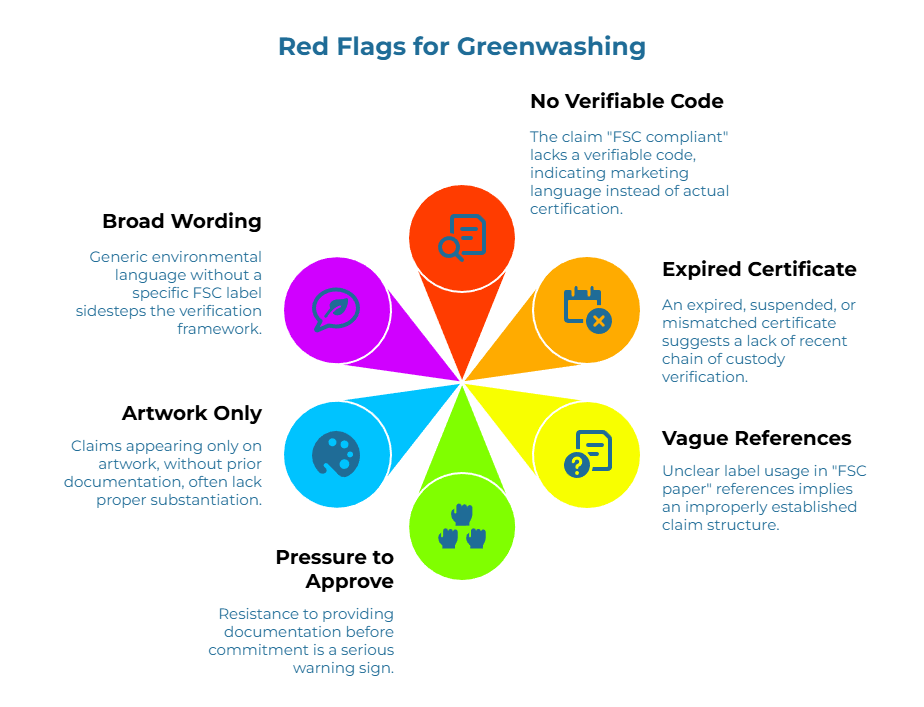
Certain patterns consistently indicate claims that won’t survive scrutiny. Treat these as stop-and-check triggers:
“FSC compliant” without a verifiable code. “Compliant” is not a recognized FSC claim category. It’s marketing language that sidesteps actual certification requirements.
Certificate is expired, suspended, or shows a different company name. Certificates require annual audits to maintain validity. An expired certificate means the chain of custody hasn’t been recently verified.
Vague “FSC paper” references without label usage clarity. If the supplier cannot explain whether and how FSC marks will appear on finished products, the claim structure hasn’t been properly established.
Pressure to approve artwork or PO before documentation arrives. Legitimate suppliers expect verification requests. Resistance to providing documentation before commitment is a serious warning sign.
The claim appears only on artwork, not on the quote or PO. Claims that materialize late in the process, without prior documentation, often lack proper substantiation.
The claim wording is broad without a specific FSC claim to substantiate it. Generic environmental language like “eco-friendly” or “green” without a specific FSC label designation sidesteps the verification framework that makes claims meaningful. Refer to the FTC Green Guides (16 CFR Part 260) regarding ‘General Environmental Benefit’ claims to understand the litigation risk of unbacked ‘eco-friendly’ labels.
Writing FSC Requirements into RFQ and PO Language
Clear contract language shifts verification from reactive checking to contractual requirement. When you submit your buying requirements, including FSC verification clauses ensures compliance before production begins. Consider adapting these clauses:
For RFQs:
Supplier must provide verifiable FSC certificate/licence information and supporting documentation with the quotation. Quotes submitted without verification documentation will not be evaluated for FSC-related requirements.
For Purchase Orders:
Any FSC claim on invoices, packing lists, or product labeling must match verified certificate scope and status at shipment. Supplier agrees to notify buyer immediately if certificate status changes during the order period.
For Artwork Approval:
FSC logo or claim usage on packaging requires documented verification of certificate scope and status prior to print production. Artwork approval is conditional on successful verification.
Nonconformance clause:
If verification fails, buyers may require corrected artwork/documentation, removal of FSC claims, or cancellation for nonconforming sustainability claims, without penalty.
These clauses establish expectations upfront. They benefit both parties by eliminating ambiguity before production begins.
The Supplier Evidence Pack: What Good Documentation Looks Like
Professional suppliers anticipate verification requests. When sourcing wholesale paper bags, evidence-based verification reduces supplier lists by 60-80% through systematic qualification. For those on the supplier side reading this, here’s what builds buyer confidence efficiently:
- Legal entity name and address matching all official documentation
- FSC certificate or licence code with a direct link to the public search result
- Written confirmation that the certificate covers the specific finished paper bags being supplied (not only raw material inputs)
- Claim wording intended for sales documents (quotation, invoice, packing list)
- Artwork proof showing any FSC marks—provided only after buyer verification is complete
Providing this package proactively demonstrates professionalism and reduces quoting cycle time. Resources like PaperIndex Academy and guides on verifying supplier sustainability claims offer additional frameworks for structuring verification documentation.
When Verification Fails: Practical Off-Ramps
Verification failures don’t always end supplier relationships, but they require clear next steps.
Request clarification. The supplier may have provided an outdated code or incorrect legal entity name. Allow opportunity for correction before escalating.
Remove the FSC claim. If business requirements permit, proceed with the order but strip all FSC references from documents and artwork. The bags may still meet functional requirements—they simply cannot carry the sustainability claim.
Source from a verified supplier. If FSC certification is non-negotiable for brand positioning or customer commitments, document the verification failure and begin sourcing from suppliers whose credentials check out. The paper bag suppliers directory provides a starting point for expanding your verified supplier base.
Document what happened and why in all cases. This record protects procurement decisions during later audits.
Building Verification into Ongoing Operations
One-time verification isn’t sufficient. Certificates expire. Suppliers change ownership. Scope gets updated.
Build verification checkpoints into two moments: supplier onboarding (before any FSC-claimed order is placed) and repeat orders (before artwork approval and before prepayment on orders carrying FSC claims). FSC verification integrates into broader compliance systems for packaging procurement. Organizations managing sustainable packaging compliance across multiple jurisdictions can embed FSC checks into their certification tracking workflows.
The checkpoint doesn’t require elaborate systems. A spreadsheet tracking supplier name, certificate code, last verification date, certificate expiration, and next review date keeps the process manageable. Calendar reminders triggered 60 days before certificate expiration prevent lapses.
For organizations developing systematic supplier verification practices, understanding why FSC certification matters for brand reputation provides additional context on the risk mitigation strategies inherent in Chain of Custody (CoC) protocols.
Moving Forward
Unverified sustainability claims create risk that extends far beyond procurement. When claims fail publicly, brand teams scramble, legal gets involved, and customer trust erodes in ways that take years to rebuild.
The ten-minute verification workflow described here eliminates most of that exposure. A certificate code, a public database check, and documented evidence requirements—these modest investments of time protect significant organizational value.med order is placed) and repeat orders (before artwork approval and before prepayment on orders carrying F
The pattern that works: verify before you commit, document what you find, and require evidence as a condition of doing business. Suppliers who meet these standards are partners worth keeping. Once verified, find suppliers who can scale with your business while maintaining certification compliance. Those who resist verification are telling you something important.
References:
[1] FSC Public Certificate Search: https://search.fsc.org/en/
[2] FSC Label Guidance—What the FSC Labels Mean: https://fsc.org/en/label
[3] FSC Chain of Custody Certification: https://fsc.org/en/chain-of-custody
[4] FTC Environmental Marketing Guides: https://www.ftc.gov/business-guidance/advertising-marketing/environmental-marketing
Disclaimer:
This article is for educational purposes only and does not constitute legal advice or a certification decision. Always confirm certification requirements and claim wording with the relevant certification body and internal compliance stakeholders.
Our Editorial Process:
Our expert team uses AI tools to help organize and structure our initial drafts. Every piece is then extensively rewritten, fact-checked, and enriched with first-hand insights and experiences by expert humans on our Insights Team to ensure accuracy and clarity.
About the PaperIndex Insights Team:
The PaperIndex Insights Team is our dedicated engine for synthesizing complex topics into clear, helpful guides. While our content is thoroughly reviewed for clarity and accuracy, it is for informational purposes and should not replace professional advice.