
📌 Key Takeaways
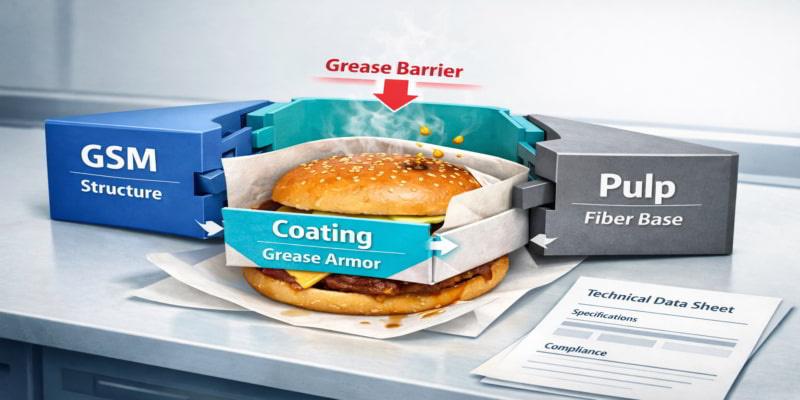
Knowing three specifications terms—GSM, coatings, and pulp—lets you order food packaging that actually protects your food.
- GSM Measures Weight, Not Grease Protection: A heavy paper without the right coating soaks through just as fast as a light one.
- Coatings Are Your Grease Armor: The barrier layer—not the paper weight—decides whether oil reaches the customer’s hands.
- Generic Labels Hide Real Differences: Two products called “wax paper” can perform completely differently under hot, greasy food.
- Always Request a Technical Data Sheet: Without documented specifications, you can’t prove compliance or reorder the same quality.
- Test Before You Commit: Samples that look fine on a desk often fail during busy service with real hold times.
Match your specifications to your menu conditions—then document everything.
Food service operators and procurement managers ordering packaging for hot or greasy items will gain confidence asking suppliers the right questions, preparing them for the detailed checklist and trial process that follows.
~ ~ ~ ~ ~ ~ ~ ~ ~ ~ ~ ~ ~ ~ ~ ~ ~ ~
Ordering food packaging paper shouldn’t feel like guessing. Yet for many operators, it does—you know your menu, but when a supplier asks for “specifications,” the conversation stalls. This is specification paralysis: knowing something is off, but not knowing which specification to ask for.
This guide translates three specifications terms—GSM, coatings, and pulp—into language you can use today. By the end, you’ll be able to request a Technical Data Sheet and run a basic sample trial with confidence.

Food grade packaging paper specifications define measurable performance and safety attributes—such as grammage (GSM), grease resistance (Kit Level), coating type, and fiber composition—so buyers can match packaging to real menu conditions and prove suitability during inspections. Relying on vague terminology—such as ‘wax paper’—obscures performance variances, which hides critical differences and leads to failures like grease soak-through and tearing.
Food Packaging Specifications in 60 Seconds
Five terms appear on nearly every supplier specification sheet:
GSM (Grammage): Paper weight measured in grams per square meter. Affects stiffness and feel—not grease resistance. When it matters: Choosing rigidity for trays, boxes, and wraps.
Barrier Treatment: A functional layer (wax, polymer, or aqueous dispersion) that dictates the sheet’s resistance to grease, moisture, and thermal transfer. When it matters: Menu items involving fat, steam, or extended hold times.
Pulp (Fiber Base): The raw material—virgin or recycled fibers, bleached or unbleached—forming the paper’s foundation. When it matters: Strength requirements and food-contact suitability.
Kit Level: A rating (1–12) based on TAPPI T 559 standards, indicating oil penetration resistance. The Kit test (TAPPI T 559) uses a series of reagents—mixtures of castor oil, toluene, and heptane—numbered 1 to 12. A higher Kit rating indicates better resistance to grease and oil penetration, which is critical for high-fat applications like fried foods. However, for baking parchment or long-term heat exposure, Kit level alone is insufficient; silicone-treated vegetable parchment is often required to provide both release properties and grease barriers during 15-minute+ oven hold times.
TDS (Technical Data Sheet): The primary document listing specifications, test methods, and compliance certifications. When it matters: Every order—this is your documented proof.
Why Specifications Matter (And What Can Go Wrong)
Specification failures show up in ways customers notice. Grease spots bleed through wrapping paper when barrier specifications are inadequate. Paper tears during handling. Containers go soggy. Beyond performance, compliance gaps pose a regulatory risk; inspectors may require a Declaration of Compliance (DoC) to verify the substrate meets 21 CFR or EU 1935/2004 standards.
Three misconceptions cause most ordering mistakes:
“Higher GSM means better performance.” GSM measures weight, not barrier function. A 60 GSM paper with proper coating can outperform an 80 GSM sheet without one.
“Wax paper works for everything.” Wax softens under heat and can transfer to food. For hot items, why generic wraps fail high-heat tests explains this failure pattern.
“The ‘Food Safe’ label is a baseline, not a performance guarantee.” Generic claims don’t specify which regulations the paper meets or conditions tested.
What Is GSM? (And What It Isn’t)
GSM stands for grams per square meter—a measurement of ‘grammage’ or mass per unit area. While ISO 536 is the international standard for determining grammage, North American suppliers often refer to TAPPI T 410 or use ‘Basis Weight’ (lbs/ream), which requires conversion to be compared accurately to GSM. Think of it like choosing tires: the wrong size fails under load, even if the rubber compound is fine. GSM tells you how much material is in the sheet, affecting stiffness and printability.
Here’s the critical point: GSM does not determine grease resistance. A heavy sheet without barrier treatment soaks through just as fast as a light one. The barrier comes from coating and verified test data, not paper weight. For matching GSM ranges to menu items, see food packaging paper GSM explained.
What Are Paper Coatings?
If GSM provides structure, coating provides armor. Coatings determine whether grease, moisture, or heat reaches the fiber underneath.
Common types serve different functions. Wax coatings offer moisture resistance but lower heat tolerance. Polymer coatings handle both grease and moisture at higher temperatures. Dispersion barriers—commonly used in greaseproof paper—provide grease resistance without a continuous film. The right choice depends on your food conditions—temperature, fat content, and hold time.
Not all coatings are approved for direct food contact under all conditions. A coating rated for cold sandwiches may fail with a hot panini. Regulatory compliance is governed by 21 CFR 176.170 (for components of paper/paperboard in contact with aqueous and fatty foods) and 21 CFR 176.180 (for dry foods). Additionally, modern operators must verify that coatings are PFAS-free, as many US states (like California and New York) and EU REACH updates have moved to ban ‘forever chemicals’ previously used for grease resistance. Ask which standards your supplier’s products meet.
Substrate Composition: Fiber and Pulp
Pulp is the fiber foundation of any paper product. Virgin pulp, sourced from wood, generally offers higher strength and cleaner composition. Recycled pulp reduces environmental impact but may carry trace contaminants affecting food-contact suitability for certain applications. Bleached pulp produces white paper; unbleached yields natural brown, commonly known as kraft paper.
These labels are not automatic indicators of quality. They are starting points for understanding the material base—the practical step is to confirm suitability through a TDS and appropriate documentation for the intended use.
For sustainability claims such as FSC certification, verify the certificate scope covers your specific product using the FSC Public Search database. The reputation risk of non-compliant food packaging paper extends beyond fines to customer trust.
Menu-to-Specification: A Simple 3-Step Translation Process

Step 1: Describe your food conditions. Quantify thermal and lipid profiles: Is the product 140°F (~60°C)? Is it high-lipid (fat) or high-moisture (steam)? Define the ‘hold time’—the duration the food remains in the primary packaging before consumption.
Step 2: Identify your barrier needs. High-fat, hot items generally need grease resistance—Kit Level 7 or higher is common for fried foods. Steamy items may require moisture barriers. Dry items typically need only basic protection.
Step 3: Choose structure and validate. Select a GSM range for the rigidity you need, confirm pulp type meets compliance requirements, then request samples. Run a kitchen trial under real conditions—peak hours, actual hold times—before committing to volume.
What to Ask Your Supplier
Use this checklist when requesting quotes. Suppliers who cannot answer these questions may not deliver consistent quality.
Supplier Specification Request Checklist:
- Technical Data Sheet (TDS) for the specific grade
- GSM / Basis Weight with tolerance range
- Coating type or barrier treatment description
- Pulp source type (virgin/recycled, bleached/unbleached)
- Food-contact compliance documentation
- Grease resistance test results (Kit Level) where applicable
- Samples for kitchen trial (50–100 sheets)
- Batch Consistency Protocol: Request the supplier’s internal tolerance levels for GSM and Kit Level variance across production runs — paper manufacturers with robust quality systems will readily provide this documentation.
When better specifications reduce double-wrapping waste, you’ll see the benefit in reduced material costs and faster service.
Common Mistakes to Avoid
Ordering by generic terms. Names like “wax paper” or “deli sheets” don’t specify GSM, coating, or grease resistance. Two products with identical names can perform very differently.
Skipping documentation requests. If a supplier cannot provide a TDS, you have no baseline for consistency or compliance verification.
Ignoring the trial step. Samples that look fine on a desk may fail during rush service. Test under real operating conditions before scaling orders.
Next Steps
Start building a “specification folder” for your operation. Save the TDS for each paper you order, note which menu items it serves, and document trial results. This becomes your reference for reorders and your evidence file during inspections.
To begin sourcing, find suppliers who can provide the technical documentation and samples your operation requires
Explore the PaperIndex Academy for deeper guides on matching specifications to menu categories. When ready to compare options, browse food packaging paper from verified food packaging paper suppliers and request technical data sheets before ordering.
Once you’ve compiled your specifications, submit your buying requirements to receive quotes from verified suppliers.
Disclaimer:
This article is for general educational information only..
Our Editorial Process:
Our expert team uses AI tools to help organize and structure our initial drafts. Every piece is then extensively rewritten, fact-checked, and enriched with first-hand insights and experiences by expert humans on our Insights Team to ensure accuracy and clarity.
About the PaperIndex Insights Team:
The PaperIndex Insights Team is our dedicated engine for synthesizing complex topics into clear, helpful guides. While our content is thoroughly reviewed for clarity and accuracy, it is for informational purposes and should not replace professional advice.