

📌 Key Takeaways
Single-track vetting leaves half your risk unmanaged—mills prove capability, exporters prove execution, and you need verifiable evidence of both before signing contracts.
- Manufacturer Evidence Anchors Specification Confidence: Test reports aligned to TAPPI methods (T 410, T 412, T 403), ISO certifications verified through IAF/ILAC networks, and FSC chain-of-custody prove a mill can consistently hold GSM, moisture, and burst strength tolerances before you evaluate price.
- Exporter Reliability Prevents Late-Stage Disruption: On-time delivery trends segmented by corridor, documentation accuracy rates above 95%, carrier agreements for your specific lanes, and CAPA closure speed reveal whether shipments will actually arrive with correct paperwork.
- The Joint Evidence Pack Eliminates Vetting Gaps: One structured template with seven fields (Entity, Doc Type, Owner, Date, Status, Verification Link, Renewal Cadence) consolidates mill capability and exporter performance into a single, quarterly-updated evidence file that travels with every RFQ.
- The Integration Score Converts Promises to Numbers: A 100-point model across six pillars (People, Process, Equipment, QA, Compliance, Logistics) with a 70-point pass band and zero-tolerance for QA or Compliance gaps transforms subjective supplier claims into objective, comparable risk ratings.
- To-Door Normalization Exposes Hidden Costs: Converting FOB, CFR, and DDP quotes to identical delivered terms using Incoterms® 2020 framework reveals true total cost and clarifies who owns customs risk, duty exposure, and final-mile delivery failures.
Integration beats fragmentation—evidence-based evaluation filters out suppliers who cannot document their capabilities and creates reusable procurement infrastructure that raises supply base quality across award cycles.
Procurement managers, category buyers, quality assurance leads, and logistics stakeholders sourcing kraft paper internationally will find below a complete risk-reduction framework, preparing them for the detailed evidence requirements, scoring mechanics, and normalization methods that follow.
The Integration Problem (And Why Single-Track Vetting Fails)

Most procurement teams evaluating kraft paper suppliers make a critical mistake: they vet manufacturing capability and export reliability as separate exercises. A mill passes the technical audit, gets added to the approved vendor list, then partners with an exporter the buyer has never assessed. Or the reverse happens—a logistics provider with strong on-time delivery scores arranges supply from a mill the buyer never validated.
This fragmented approach creates a dangerous gap. Manufacturer evidence defines what can be shipped without defects; exporter reliability operationalizes continuity across lanes, bookings, and paperwork. Buyers rarely succeed long-term without both elements verified in tandem before award decisions.
The stakes are substantial when sourcing internationally. A mill might control moisture content to specification but lack the process documentation to prove it. An exporter might promise competitive lead times on a new trade corridor without historical performance data to back the claim. When these capability and reliability questions remain unanswered until after contract signature, procurement teams inherit avoidable risk.
Manufacturer Evidence—Prove Capability Before Price
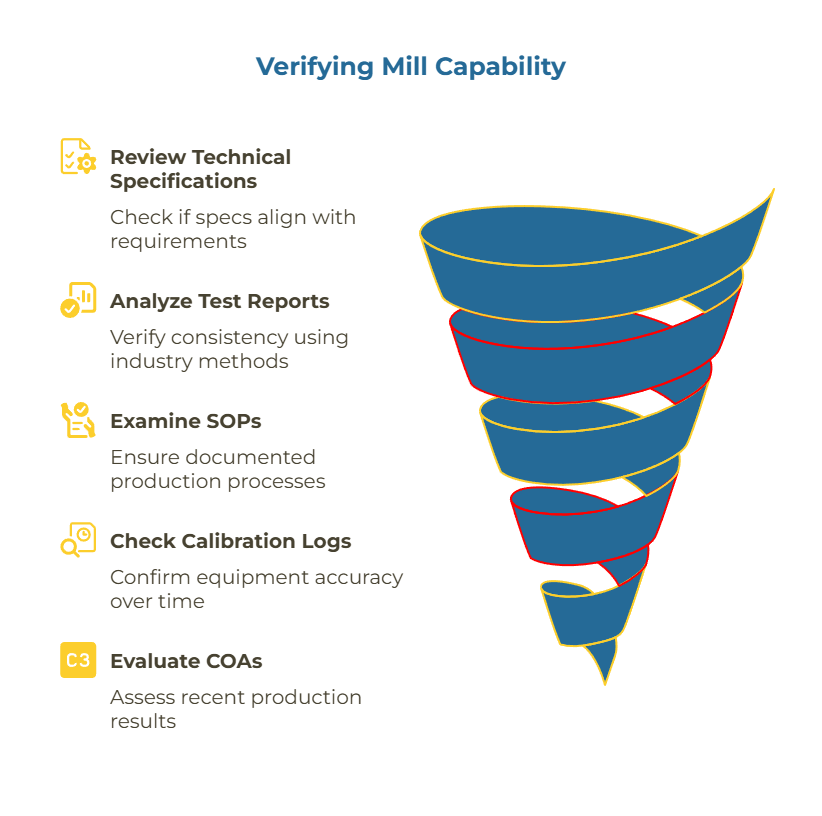
Before evaluating any commercial terms, procurement teams must establish that a mill can consistently produce kraft paper to specification. This requires specific artifacts that demonstrate control over the parameters that matter most: basis weight consistency, burst factor or tensile strength performance, and moisture management.
Documents That Actually Prove Capability
Technical specification sheets provide the starting point, but only when they map directly to your requirements. A mill should supply spec sheets showing the target range for GSM (grams per square meter), BF (burst factor) or BST (bursting strength), and moisture percentage—along with the tolerances they commit to maintaining. These numbers mean little without supporting evidence of how the mill maintains control.
Test reports should reference recognized industry methods to enable like-for-like comparison across suppliers. For kraft paper, procurement teams commonly request reports aligned to TAPPI test methods—for example, T 410 for grammage, T 412 for moisture content, and T 403 for burst strength. These standardized method identifiers help verify that different mills are testing the same properties under comparable conditions.
Request the Standard Operating Procedures (SOPs) that govern production. Quality mills document their mixing protocols, forming processes, pressing sequences, and drying controls in written procedures that operators follow consistently. Ask for the SOP list and sample procedures for the specific grade you’re sourcing.
Calibration and maintenance logs demonstrate that the equipment measuring these parameters stays accurate over time. Mills should provide records showing regular calibration of moisture meters, basis weight scales, and burst testers against known standards. Maintenance schedules for critical equipment—particularly dryers and calendars—reveal whether the mill prevents drift before it affects output.
Sample Certificates of Analysis (COAs) from recent production runs offer concrete proof. These documents should show actual test results for basis weight, moisture, and strength properties across multiple lot numbers. Look for consistency within the specified tolerances and verify that the testing frequency aligns with industry norms for the grade and end-use application.
Traceability systems connect finished rolls back to raw material batches and production dates. Mills with robust traceability can quickly isolate the source of any quality variation and demonstrate lot-to-lot consistency. This capability becomes critical when investigating discrepancies or managing product recalls in food-contact applications.
How to Validate Certifications
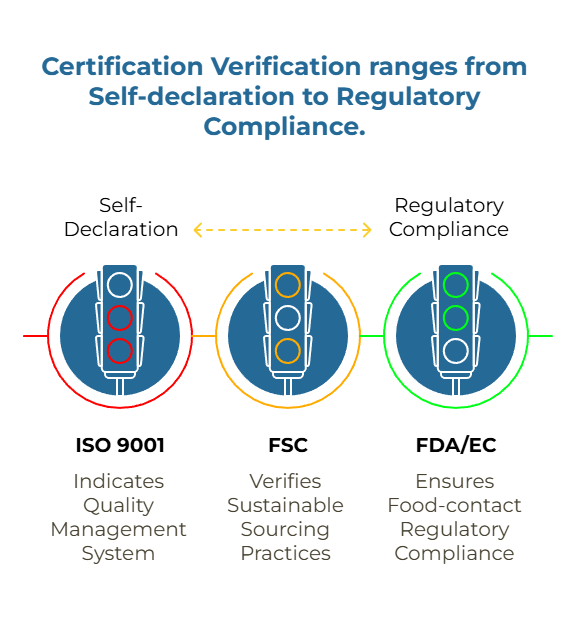
ISO 9001 certification indicates a quality management system is in place, but not all certifications carry equal weight. Verify claimed certifications through the issuing body’s public registry rather than accepting a certificate image alone. Certification bodies operate according to ISO/IEC 17021, the international standard that defines requirements for bodies certifying management systems. Check that the certification body itself is accredited by recognized accreditation organizations within the IAF (International Accreditation Forum) or ILAC (International Laboratory Accreditation Cooperation) networks.
For ISO certifications, contact the certification body directly to confirm current status and scope. The scope matters—a certificate might cover one facility or product line but not the specific grades you’re sourcing.
FSC (Forest Stewardship Council) chain-of-custody certification matters when sustainability is a procurement criterion. The FSC certificate database maintains a searchable registry of all certified operations. Enter the mill’s certificate code to verify it covers the grades and volumes you’re sourcing. Be aware that FSC certification applies to specific product lines, not necessarily the mill’s entire output.
For mills serving food-contact applications, regulatory compliance becomes mandatory evidence. In the United States, this means FDA compliance under 21 CFR Part 176, which governs components of paper and paperboard in contact with food. European markets require conformity with Framework Regulation (EC) No 1935/2004. These certifications should come with supporting documentation showing the mill uses only approved chemical additives and can demonstrate compliance with migration testing requirements. The specific regulatory framework varies by destination market and intended food contact scenario.
AQL in Practice (Illustrative)

Acceptable Quality Limit (AQL) sampling provides a statistical method for inbound acceptance testing. This illustrative example shows how procurement teams might apply AQL principles, though actual sampling plans should be designed for specific quality risks and lot sizes.
The widely referenced framework is ISO 2859-1, which covers acceptance sampling by attributes. Under a typical AQL approach, a buyer might inspect a statistically determined sample size from each incoming shipment rather than testing every roll. For instance, with an AQL of 1.5 for critical defects (those affecting food safety or structural integrity) and 4.0 for major defects (those affecting functionality), the sampling plan would define how many rolls to test and how many defects trigger rejection of the entire lot.
The value of AQL methodology lies in balancing inspection rigor against practical constraints. Testing every parameter on every roll proves prohibitively expensive for high-volume shipments, while testing too few units risks accepting substandard material. An AQL-based approach, when properly designed and consistently applied, gives procurement teams defendable acceptance criteria tied to their specific quality thresholds. Record results lot-by-lot to identify drift over time and trigger corrective action before problems escalate.
Exporter Reliability—Operational Continuity You Can Verify
A mill’s technical capability means little if the exporter handling the logistics cannot maintain consistent delivery performance. Exporters operationalize the supply relationship through their control of shipping lanes, carrier relationships, documentation accuracy, and exception management. These operational elements determine whether specification-compliant material actually arrives on time with correct paperwork.
Scoring Lanes, OTD, and Documentation Accuracy
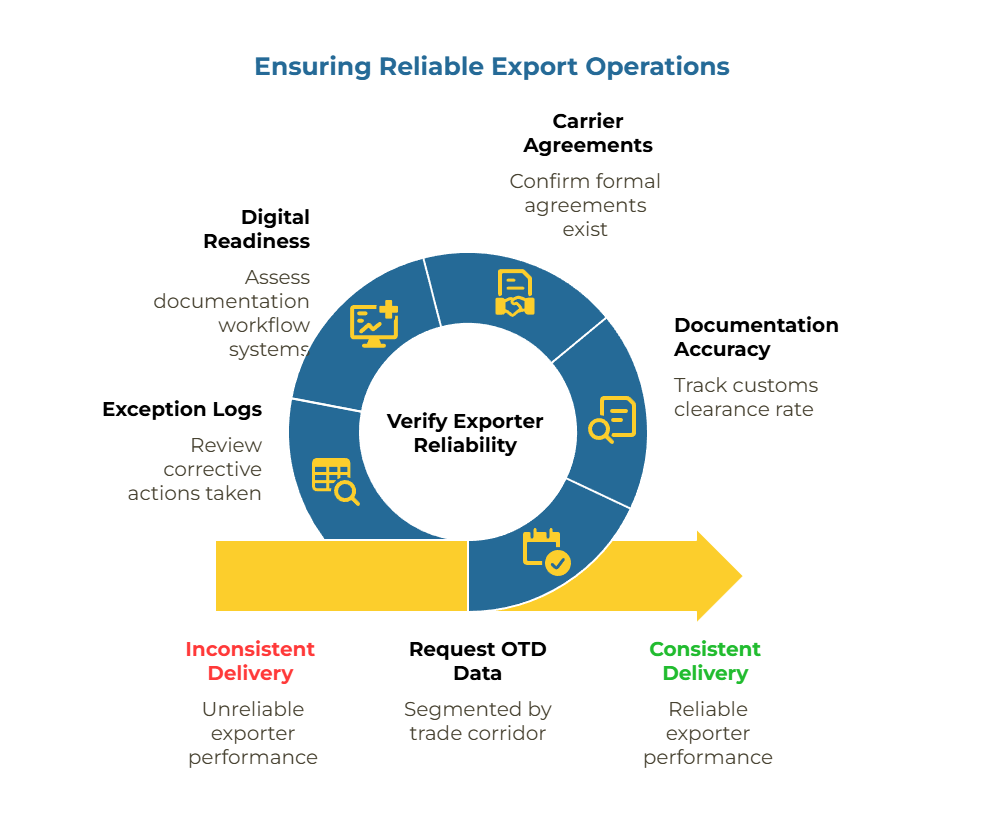
Request on-time delivery (OTD) data for the past four quarters, segmented by trade corridor. An exporter might show excellent performance on established Asian-to-North American routes while struggling with newer South American lanes. Ask for OTD percentages calculated against the originally promised delivery window, not revised estimates issued after shipment.
Documentation accuracy trends reveal an exporter’s operational maturity. The key documents—bills of lading (BL), commercial invoices (CI), and packing lists (PL)—must contain accurate descriptions, quantities, and values to clear customs without delays. Request data showing the percentage of shipments that cleared customs on first submission versus those requiring corrected documentation.
Carrier and freight forwarder agreements demonstrate the exporter’s booking capacity and rate stability. An exporter with volume commitments or contracted space can secure bookings during peak seasons when spot capacity becomes scarce. Ask to see evidence of these relationships—not specific rates, which remain confidential, but confirmation that formal agreements exist for your lanes and the duration of those commitments.
Digital documentation readiness affects speed and error rates. Exporters with ERP systems or EDI (Electronic Data Interchange) capabilities can generate shipping documents programmatically, reducing manual transcription errors. They can also provide shipment visibility through automated status updates. Ask what systems they use to manage the documentation workflow and whether they integrate with your procurement or logistics platforms.
Exception logs and Corrective and Preventive Action (CAPA) records show how exporters respond when problems occur. Every operation experiences occasional delays, documentation errors, or carrier issues. What matters is the speed and effectiveness of the response. Request examples of recent exceptions—anonymized if necessary—and the corrective actions taken. Look for systematic root-cause analysis rather than one-off fixes.
The Joint Evidence Pack
The most effective procurement teams consolidate manufacturer and exporter evidence into a single, structured pack that travels with each RFQ evaluation. This integration checklist transforms fragmented supplier claims into verifiable proof points you can score and compare.

Template Fields and Verification Workflow
The Joint Evidence Pack should function as a living document that captures all critical verification elements in one place. Each evidence item requires these fields to maintain accountability and enable periodic re-verification:
Integration Checklist + Joint Evidence Pack Template
| Entity | Doc Type | Owner | Date | Status | Verification Link | Renewal Cadence |
| Mill A | TAPPI T 410/T 412/T 403 test report | Quality Mgr | 2024-03-15 | Verified | Internal QA file link | Quarterly |
| Mill A | ISO 9001 Cert (scope: paper & board) | Compliance | 2024-11-20 | Current | IAF Registry verification | Annual |
| Mill A | FSC CoC certificate | Sustainability | 2023-08-10 | Verified | FSC database #12345 | Annual review |
| Exporter B | Q4 2024 OTD Report | Logistics | 2025-01-05 | Current | Internal dashboard | Quarterly |
| Exporter B | Carrier Agreement | Procurement | 2024-06-01 | Active | Contract DB (confidential) | 2-year term |
| Exporter B | Documentation Accuracy Trend | Compliance | 2025-01-05 | Current | Customs clearance log | Monthly |
The sample rows above illustrate how the pack creates accountability. Each document has a clear owner who maintains it, a date showing recency, a verification method that can be independently checked, and a defined renewal schedule so the evidence doesn’t become stale.
Building this pack requires coordination between your technical, quality, logistics, and compliance stakeholders. Assign ownership of each evidence category to the function best equipped to evaluate it. Your quality team verifies mill certifications and process documentation. Your logistics team validates exporter performance data and carrier relationships. Your compliance team checks regulatory certifications and customs documentation accuracy.
The verification link field deserves special attention. For public certifications like ISO or FSC, this should be the URL or registry number where anyone can confirm current status. For internal documents like COAs or performance reports, note the system where the original resides. For confidential items like carrier agreements, a reference to your contract management database suffices—the key is establishing that verification occurred and where the proof lives.
Update the pack quarterly as a minimum. Certifications expire, performance trends shift, and carrier agreements renew. Stale evidence creates false confidence. Schedule regular reviews where each document owner confirms their section remains current or flags items needing refresh. This discipline prevents the pack from becoming a one-time RFQ exercise that never reflects operational reality.
The Integration Score—One 100-Point View
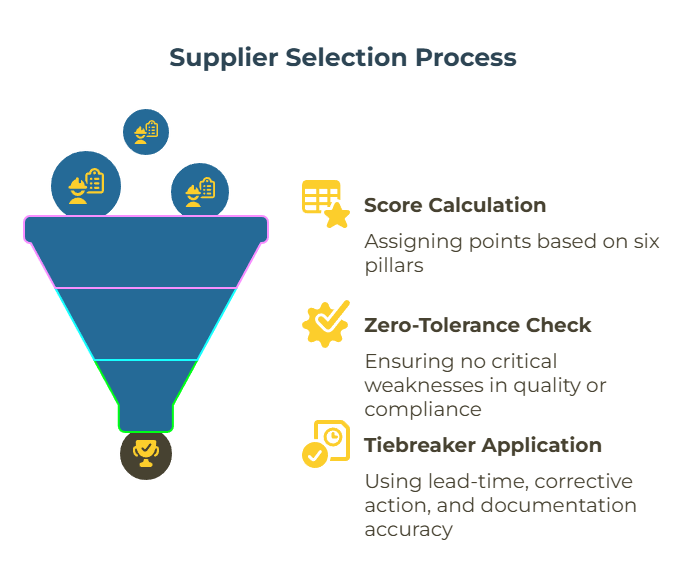
Once you’ve gathered manufacturer and exporter evidence, a structured scoring model enables objective comparison across suppliers. This framework translates qualitative proof points into quantitative ratings, creating a single view of total capability and reliability.
The scoring model distributes 100 points across six pillars that span the complete supply relationship:
Pillar Weights and Evaluation Focus
- People (10 points): Technical staff credentials, certifications held by key personnel, training programs, operator experience levels
- Process (15 points): Documented SOPs, process control methods, continuous improvement systems, quality management frameworks
- Equipment (10 points): Production machinery age and condition, maintenance programs, calibration systems, capacity utilization
- Quality Assurance (20 points): Testing protocols, COA consistency, traceability systems, non-conformance management, corrective action speed
- Compliance (20 points): Regulatory certifications, food-contact approvals where relevant, environmental permits, audit history
- Logistics (25 points): On-time delivery trends, documentation accuracy, carrier relationships, lane coverage, digital readiness
The weighting reflects risk priorities for international kraft paper procurement. Logistics receives the highest allocation because delivery failures and documentation errors cause the most frequent disruptions. Quality Assurance and Compliance tie for second priority—quality issues affect your end product, while compliance failures can halt shipments at customs.
Pass Band, Zero-Tolerance, and Tiebreakers
A passing score requires achieving 70 points or higher with absolutely zero points in either Quality Assurance or Compliance. This zero-tolerance rule prevents a supplier with strong logistics but weak quality controls from passing on aggregate score alone. Similarly, excellent manufacturing capability cannot compensate for compliance gaps that risk regulatory holds.
The zero-tolerance threshold addresses a common procurement trap: accepting suppliers who excel in some areas while showing critical weaknesses in others. A mill with modern equipment and good people might still lack the documented process controls needed for consistent output. An exporter with perfect on-time delivery might generate frequent customs delays due to documentation errors. The zero-tolerance rule forces you to address these fundamental gaps before award rather than managing them as ongoing problems.
When multiple suppliers achieve passing scores, apply these tiebreakers in sequence:
- Lead-time evidence: Suppliers who can document their lead time calculation methodology and show historical accuracy earn preference. Unreliable lead times force you to hold excess safety stock.
- Corrective action speed: Review the CAPA records. How quickly does the supplier move from problem identification to implemented solution? Faster CAPA closure indicates process maturity.
- Documentation accuracy trend: Compare the most recent quarter’s error rate to the four-quarter average. Improving trends signal operational discipline; deteriorating trends forecast future headaches.
This scoring framework does not replace procurement judgment—it structures it. The numbers reveal which suppliers have proven capability and reliability through verifiable evidence rather than marketing claims. Use the scores to narrow the competitive set to qualified suppliers, then apply your comparability-before-price discipline to make the final award decision.
Procurement Play: Normalizing to To-Door for Apples-to-Apples
Raw quotes from suppliers typically come at different Incoterms—one might quote FOB, another CFR, a third DDP. These varied pricing points make direct comparison impossible without normalization. The procurement play that resolves this confusion involves converting all quotes to a common delivered basis.
Incoterms define where responsibility and cost transfer from seller to buyer. The Incoterms® 2020 rules, published by the International Chamber of Commerce, provide the authoritative framework for international trade terms. Under FOB (Free On Board), the supplier’s obligation ends when goods cross the ship’s rail at the origin port. Under CFR (Cost and Freight), the supplier pays for main carriage to the destination port but not insurance. Under DDP (Delivered Duty Paid), the supplier handles everything through final delivery and customs clearance.
Converting these to a to-door basis requires calculating the incremental costs to move material from each supplier’s quoted Incoterm to your receiving dock. For an FOB quote, add ocean freight from origin to destination port, marine insurance, destination port fees, customs clearance, duty and taxes, and inland freight to your facility. For a CFR quote, add insurance and all destination charges. For a DDP quote, add only the final inland leg if that’s not already included.
This normalization reveals the true delivered cost for each supplier on identical terms. Without it, an apparently cheaper FOB quote might actually cost more than a higher CFR quote from a supplier using more efficient routing. The comparing quotes across Incoterms methodology provides the detailed calculation steps for this conversion.
The to-door normalization also exposes hidden risks. A supplier quoting DDP takes full responsibility for customs clearance and accepts the risk of duty rate changes or classification disputes. A supplier quoting FOB leaves those risks with you. When normalizing, assign a risk value to the responsibilities you’re assuming under each Incoterm. This transforms the comparison from simple cost to total cost of ownership, which includes both price and risk.
Build your normalization model using current spot rates for freight and verified duty rates from customs databases. Update these inputs quarterly as market conditions shift. The goal is not precision to the dollar but rather elimination of the structural incomparability that makes different Incoterms impossible to evaluate side-by-side. As covered in our guide on to-door comparability vs. ‘cheapest’, the lowest quoted price rarely represents the best value when delivery and risk costs remain hidden.
Compliance, Sustainability & Finance Touchpoints
The integration framework must account for stakeholder priorities beyond procurement’s direct control. Regulatory compliance, sustainability requirements, and financial risk management represent shared pillars that affect supplier selection but typically sit outside procurement’s sole authority.
Regulatory and Food-Grade Certifications
For kraft paper destined for food contact applications, regulatory compliance becomes non-negotiable. In the United States, mills must demonstrate FDA compliance under 21 CFR Part 176, which governs components of paper and paperboard in contact with food. European markets require conformity with Framework Regulation (EC) No 1935/2004. These regulations specify which chemical additives are permitted and mandate migration testing to ensure substances do not transfer to food at harmful levels.
Request the compliance documentation relevant to your destination market and application. Mills should provide declarations of conformity, testing reports from accredited laboratories, and lists of substances used in production. Verify that certifications cover the specific grades and basis weights you’re sourcing, not just a general mill certification.
Sustainability and ESG Signals
Sustainability requirements increasingly influence supplier selection, driven by corporate commitments or customer demands. Chain-of-custody certifications like FSC or PEFC (Programme for the Endorsement of Forest Certification) provide verifiable proof that fiber originates from responsibly managed forests. These certifications require annual audits and maintain public databases where buyers can verify claims.
Beyond forest certifications, some procurement teams track broader ESG (Environmental, Social, and Governance) factors such as carbon footprint disclosure, water usage reduction programs, or labor practice certifications. Industry associations like CEPI (Confederation of European Paper Industries) publish sustainability context and policy frameworks that can inform long-term vendor evaluation, though specific corporate requirements will vary.
The challenge lies in standardizing evidence across suppliers who participate in different frameworks. Focus on the certifications that your stakeholders recognize and that third parties audit rather than self-reported claims that resist verification.
Trade Finance and Payment Security
Finance teams care about payment terms and credit risk exposure. Letters of credit, documentary collections, and open account terms each carry different risk profiles. Coordinate with your finance function to understand their risk appetite for different payment mechanisms and supplier credit standings.
Some exporters offer extended payment terms but lack the financial stability to maintain consistent supply through market volatility. Others require upfront deposits that strain your working capital. The integration framework should flag payment term requirements during the evaluation phase so finance can assess feasibility before awarding. When using the one-page decision matrix to align stakeholder priorities, include payment terms as an explicit evaluation criterion alongside quality and delivery factors.
Frame these compliance, sustainability, and finance considerations as shared checkpoints rather than procurement’s independent judgment. Each function brings specialized expertise to evaluate evidence in their domain. The integration pack simply ensures that evidence gets captured systematically so the full stakeholder group can make an informed award decision.
Red Flags and Graceful Exits
Even with structured evidence gathering, certain signals should prompt immediate skepticism or disqualification. Recognizing these red flags early prevents investing further evaluation effort in suppliers unlikely to perform.
Non-Verifiable Certifications
When a supplier claims ISO 9001 or FSC certification but cannot provide a certificate number you can verify through public registries, assume the certification does not exist. Legitimate certifications are designed to be publicly verifiable—that’s the point. If a supplier deflects verification requests with vague promises to “send the certificate later,” move on. This pattern typically indicates either a lapsed certification or an outright fabrication.
The same logic applies to claimed food-grade compliance. A mill serving food-contact applications should readily provide compliance declarations and testing reports. Hesitation or inability to produce these documents on request suggests they lack the required approvals.
Recurring Specification Drift
Sample COAs that show consistent values outside the promised tolerances indicate process control problems. A mill might claim 80 GSM ±3% but show actual results ranging from 77 to 85 GSM across recent production lots. This drift signals that their process cannot hold the specification they quoted, which means you’ll inherit quality variation.
Pay particular attention to moisture content variation. Kraft paper moisture typically targets 6-8% depending on grade and application. COAs showing swings from 5% to 10% suggest inadequate dryer control or inconsistent raw material moisture. Since moisture affects weight and machine runnability, this variation creates problems in your receiving inspection and downstream converting operations.
Opaque Trade Lanes
Exporters who cannot or will not disclose which carriers they use for your lane or who refuse to share historical performance data on that specific corridor likely lack the routing experience they claim. Established exporters have defined carrier relationships and can show quarter-over-quarter performance trends. Vague assurances about “having multiple options” without supporting evidence suggest they’ll be learning on your volume.
Similarly, exporters who cannot explain their booking process during peak seasons or who admit they typically rely on spot market capacity raise risk flags. Spot bookings work when capacity is loose but fail precisely when you need reliability most—during seasonal peaks or market disruptions.
Promises Without Artifacts
Any supplier promise not backed by documentation should be treated as speculation. An exporter who promises 30-day lead times but shows no historical data proving they’ve achieved that target on your lane is guessing. A mill that claims they “can easily handle” your volume without showing available capacity or production planning data is expressing optimism, not commitment.
The integration framework’s value lies in converting promises to evidence. When suppliers cannot or will not provide the artifacts that demonstrate capability and reliability, assume the capability does not exist. Grant exceptions only when a supplier is newly serving a lane or grade and lacks history to share—but even then, require evidence of analogous performance on similar lanes or grades.
When red flags appear, consider a graceful exit rather than attempting to remediate fundamental gaps under time pressure. Onboarding a marginal supplier creates ongoing management burden and exposes your supply chain to avoidable disruptions. The opportunity cost of disqualifying a questionable supplier is simply re-running the RFQ to qualified alternatives—a minor delay compared to the downstream problems weak suppliers create.
Why Integration Beats Single-Track Vetting
Procurement teams that evaluate manufacturing capability and export reliability as independent workstreams make a structural error that persists across award cycles. The two elements form an integrated system where weakness in either component compromises total performance.
Manufacturer evidence enables specification confidence at award. You know the mill controls the parameters that matter for your application because you’ve verified their process documentation, equipment calibration, and historical COA consistency. This evidence prevents specification drift that forces rework or quality holds downstream.
Exporter reliability reduces late-stage delivery and documentation risk. You know the logistics provider can secure bookings, maintain on-time performance on your specific trade corridor, and generate accurate customs documentation because you’ve validated their performance data and carrier relationships. This evidence prevents the delays and customs holds that disrupt production schedules.
The Joint Evidence Pack and Integration Score de-risk end-to-end supply continuity across corridors. By consolidating all proof points into a structured evaluation, you eliminate the gaps that appear when manufacturing and logistics vetting proceed separately. A mill might pass a technical audit while their chosen exporter lacks lane experience. An exporter might show excellent OTD while their mill partner lacks process controls. Integration exposes these mismatches before award rather than discovering them mid-contract.
The framework also creates efficiency gains beyond risk reduction. Once built, the pack becomes reusable across RFQ cycles. Update the evidence quarterly rather than rebuilding from scratch for each sourcing event. Train your technical, quality, logistics, and compliance stakeholders to own their evidence domains. This distributed ownership ensures subject matter experts verify proof points rather than procurement attempting to judge all elements.
Most importantly, integration shifts supplier relationships from claims-based to evidence-based evaluation. Suppliers learn quickly that winning your business requires producing specific artifacts, not marketing promises. This evidence standard raises the quality of your supplier base by systematically filtering out those who cannot document their capabilities.
For deeper context on how this evidence-based approach supports driver-based benchmarks and systematic RFQ evaluation, explore the additional frameworks in PaperIndex Academy. The integration playbook complements these methodologies by ensuring you’re comparing qualified suppliers on comparable terms rather than choosing among options where fundamental capability questions remain unanswered.
Further Reading
These external resources provide authoritative standards and frameworks referenced throughout this playbook:
- FSC Certificate Search — Verify chain-of-custody certifications and confirm scope coverage for specific products
- ISO 2859-1: Acceptance Sampling by Attributes — Statistical framework for lot-based quality inspection
- TAPPI Test Methods Overview — Standardized methods for kraft paper testing (T 403, T 410, T 412)
- Incoterms® 2020 Rules — International Chamber of Commerce guidance on trade terms
- ISO Conformity Assessment (CASCO) — How certification and accreditation frameworks operate
- CEPI: Confederation of European Paper Industries — Industry sustainability context and policy frameworks
Disclaimer: This article provides general information about integrating manufacturer evidence and exporter reliability to de-risk international kraft paper supply for educational purposes. Individual circumstances vary based on trade corridor & ports, grade/spec (GSM, BF/BST, moisture), Incoterms & documentation, and regulatory context (e.g., food-contact). For guidance tailored to your procurement team’s risk and compliance thresholds, consult qualified logistics, compliance, and quality professionals.
Our Editorial Process
Our expert team uses AI tools to help organize and structure our initial drafts. Every piece is then extensively rewritten, fact-checked, and enriched with first-hand insights and experiences by expert humans on our Insights Team to ensure accuracy and clarity.
About the PaperIndex Insights Team
The PaperIndex Insights Team is our dedicated engine for synthesizing complex topics into clear, helpful guides. While our content is thoroughly reviewed for clarity and accuracy, it is for informational purposes and should not replace professional advice.