
📌 Key Takeaways
Suppliers demand 100% advance to manage risk, not to exploit buyers—understanding this opens the door to negotiation.
- Risk Reduction Unlocks Better Terms: Offering documentation, faster approvals, and volume commitments makes suppliers willing to accept staged payment structures like 30% deposit / 70% against proof of packing.
- Milestones Need Verification: Define exact triggers—commercial invoice, packing list, and dated photos of packed goods—so both parties know when the balance payment is due.
- Offer Choices, Not Demands: Presenting 2–3 staged options (30/70, 50/50, or trial-to-repeat structures) positions you as collaborative rather than adversarial.
- Trial Ladders Earn Trust: Starting with higher-security terms on a smaller first order, then graduating to better terms on repeat purchases, proves reliability without overexposing either side.
- Payment Terms Are Separate from Incoterms: Delivery obligations (FOB, CIF) don’t govern when you pay—keep payment milestones and shipment responsibilities distinct in contracts.
Terms are risk-allocation choices, not moral battles.
Procurement managers sourcing paper bags internationally will gain a repeatable negotiation framework here, preparing them for the detailed scripts and option menu that follow.
The proforma invoice lands in your inbox. You scan past the specs, past the unit price, straight to the bottom. Payment: 100% T/T in advance. Your stomach drops. That’s $47,000 tied up for 11 weeks before a single paper bag arrives at your warehouse.
You’ve found the right supplier. The samples passed inspection. The price works. But wiring the entire order value upfront? That puts your working capital in a chokehold—and leaves you with zero leverage if something goes wrong.
Here’s what most buyers miss: suppliers don’t demand 100% advance because they’re unreasonable. They demand it because they’re managing risk. And that insight is your opening. When you understand what’s driving the request, you can offer targeted tradeoffs that protect both sides—without arguing about price.
This guide gives you a repeatable negotiation script, a menu of staged payment structures, and the pre-call preparation that makes suppliers say yes.
Why Suppliers Push for 100% Advance

Before picking up the phone, understand what you’re really negotiating against.
A paper bag manufacturer looking at your first order sees a stack of risks: you’re an unknown buyer, possibly in a country where legal recourse is expensive or impossible. Custom printing means those bags can’t be resold if you disappear. Production slots get allocated based on confirmed orders—a cancellation leaves idle capacity. And somewhere in their history, a buyer probably did vanish after receiving goods on credit.
One hundred percent advance isn’t greed. It’s a risk response.
Requiring payment in advance is the least attractive option for the buyer, because it creates unfavorable cash flow. Thus, exporters who insist on this payment method as their sole manner of doing business may lose to competitors who offer more attractive payment terms.[1]
That tension—supplier security versus buyer cash flow—is exactly where negotiation happens. Your job isn’t to argue that their caution is wrong. Your job is to reduce the risk they’re responding to.
A note on Incoterms and payment terms: Incoterms® rules define the responsibilities of sellers and buyers for delivery obligations—who arranges transport, who bears risk during shipment, and who covers costs. Critically, Incoterms® do not determine where title (ownership) transfers; this must be explicitly defined in your sales contract.[1][2]. But Incoterms don’t govern payment timing or method. Payment milestones (like “against Bill of Lading”) are separate contract terms from delivery milestones (like FOB or CIF). Understanding how to calculate landed cost helps clarify which costs the supplier must cover before receiving payment—essential context when discussing deposit structures. Keep these distinct in your purchase orders and proforma invoices to avoid confusion during disputes.
Before You Negotiate: Define Your Target and Your “Give”

Walking into a negotiation without a clear target wastes everyone’s time.
Set your term target. What structure would actually help your cash flow? Some illustrative examples:
- 30% deposit, 70% against Bill of Lading (B/L)
- 50% deposit, 50% after goods arrive and pass inspection
- 100% advance on a small trial order, then staged terms on repeat orders
Identify what you can offer in return. Suppliers respond to risk reduction, not demands. Consider what you bring to the table:
- Faster internal approvals (a signed PO within 48 hours of quote acceptance)
- Cleaner specifications (complete artwork files, confirmed dimensions, no mid-production changes)
- Volume commitment or forecast visibility for the next two quarters
- A smaller first order to limit their exposure
- Documentation that establishes your credibility (business registration, trade references, bank letter)
The goal is a trade: you’re asking them to carry more risk in timing; you’re offering to reduce risk in other ways.
The 5-Step Negotiation Process
Step 1: Acknowledge Their Risk and Show Seriousness
Open by validating their position. This immediately separates you from buyers who simply demand better terms without understanding the supplier’s constraints.
Email script:
Thank you for the proforma invoice. We’re ready to proceed with this order and see this as the beginning of a longer relationship.
We understand that 100% advance is your standard for new buyers—and we respect that this protects you from the real risks of international trade. We’d like to propose a structure that addresses your concerns while helping us manage our working capital more effectively.
WhatsApp/short message:
PI received, thank you. We want to move forward. We understand 100% advance is standard for new accounts. Can we discuss a structure that works for both sides?
Step 2: Offer 2–3 Staged Options
Present alternatives, not ultimatums. Give the supplier choices rather than a single take-it-or-leave-it proposal.
Email script (continued):
We’d like to propose one of the following options:
Option A: 30% deposit upon PO confirmation, 70% against Proof of Shipment (Bill of Lading)—verified by a copy of the Bill of Lading (B/L), commercial invoice, and packing list.
Option B: 50% deposit upon PO confirmation, 50% upon arrival and inspection at destination (within 7 days of container arrival).
Option C: 100% advance for this first trial order of [smaller quantity], then 30/70 terms for subsequent orders based on our payment performance.
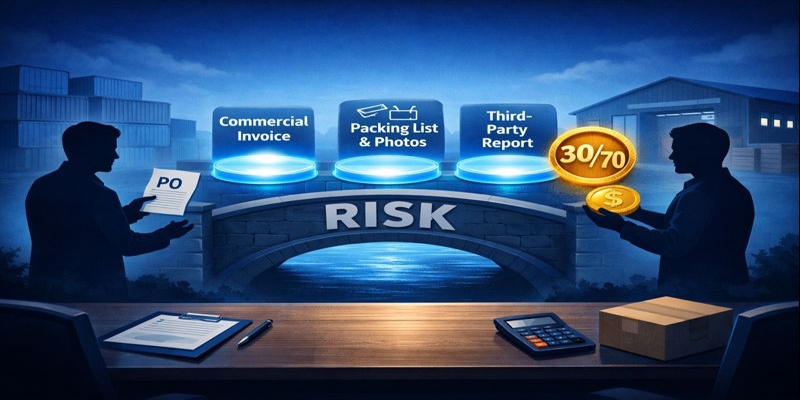
Defining the milestone matters. “Against B/L” works for standard shipments, but for custom orders where verification is critical, “finished goods packed and ready to dispatch” gives you proof of completion before final payment. The proof package—commercial invoice, packing list, and dated photos—turns a vague milestone into a verifiable checkpoint.
Step 3: Implement Third-Party Verification (The Safety Bridge)
Each option should come with something that makes the supplier’s risk feel smaller.
Email script (continued):
To support any of these options, we’re prepared to:
- Provide our company registration certificate and two trade references
- Issue a signed PO within 48 hours of your confirmation
- Confirm all artwork and specifications are final—no changes after production starts
- Share our quarterly forecast so you can plan production capacity
Step 4: Handle Common Objections
Expect pushback. Here are responses to the objections you’ll hear most often:
“It’s company policy.”
We understand policies exist for good reasons. Would a trial ladder work—first PO at higher security, say 50/50, then staged terms like 30/70 on repeat orders based on our payment performance? That way you can verify reliability before taking on larger exposure.
“We got burned before.”
That’s exactly why we’re offering trade references and documentation upfront. We’re also proposing a trial order approach so you can verify our payment behavior before taking on larger exposure.
“Bank charges eat into our margin on split payments.”
We’re happy to cover the additional bank fees for the second transfer, or consolidate to a single balance payment against the full shipping documentation.
“We need to purchase raw materials.”
A 30–50% deposit should cover your material costs. The balance against shipment ensures you’re paid before we take possession. Would that structure work for your cash requirements?
Step 5: Define the ‘Trigger’ Document and Transfer Mechanism
End with a clear ask: a revised proforma invoice that reflects the agreed terms.
Email script:
If Option A works for you, could you please issue a revised proforma invoice reflecting 30% deposit / 70% against finished goods packed and ready to dispatch? We’ll arrange the deposit transfer within 3 business days of receiving the revised PI.
Please also confirm the milestone: we’ll receive the commercial invoice, packing list, and dated photos before the balance is due, correct?
WhatsApp/SMS version:
Can the PI be revised to 30/70 (balance when packed/ready to dispatch + invoice/packing list + photos)? If yes, please send a revised PI and confirm the proof package. Deposit within 3 days.
Option Menu: Staged Terms That Replace 100% Advance
| Structure | When It Fits | Buyer Protection | Supplier Protection | What to Offer |
| 30/70 (Deposit / Proof of Packing) | Established suppliers, standard products, when verification before final payment is critical | Majority of payment held until proof of completion (invoice + packing list + photos) | Deposit covers materials; balance before shipment release | Clean specs, fast approvals, defined proof package |
| 30/70 (Deposit / B/L) | Standard products, trusted lanes, when speed matters more than pre-shipment verification | Majority of payment held until shipment proof | Deposit covers materials; balance before cargo release | Clean specs, fast approvals |
| 50/50 (Deposit / Arrival) | Higher-value orders, new relationships | Half payment protected until inspection | Significant upfront commitment | Trade references, smaller first order |
| 100% Trial → Staged Repeat | First-time suppliers | Full terms earned after performance | Zero risk on first order | Volume commitment on repeat orders |
| Letter of Credit (L/C) | Large orders, higher risk perception | Bank guarantees document compliance | Payment assured upon compliant docs | Willingness to cover L/C fees |
| Documentary Collection (D/P) | Moderate trust, lower bank fees | Documents held until payment | Title retained until payment clears | Faster inspection commitment |
A Letter of Credit provides formal bank-backed protection for larger orders. The importer’s bank commits to pay the exporter once compliant shipping documents are presented—shifting risk from both parties to the banking system.[1] Bank fees apply, but for orders where trust hasn’t been established, the cost may be worthwhile.
The primary advantage of staged terms is the preservation of working capital. While 100% advance requires a single, high-risk cash outflow at the PO stage, a 30/70 split allows you to retain 70% of the contract value until the supplier provides verifiable proof—such as photos or a Bill of Lading—that the goods exist and are ready for transit.
Red Flags: When the Security Logic Breaks
Beyond the “Title of Goods,” you must monitor for structural failures in the negotiation. Walk away or pause the order if you encounter:
- Refusal of Third-Party Inspection: If a supplier insists on “Proof of Packing” (photos) but refuses to allow a third-party inspector (like SGS or QIMA) to verify the contents before the 70% balance is wired, you are flying blind. Photos can be staged; a certified Inspection Report cannot.
- Inconsistent “Trigger” Documents: If the proforma invoice lists payment “Against B/L” but the supplier later pressures for payment “Against Packing List,” they are attempting to move the payment trigger forward in time before they have legally handed the goods to a carrier.
- Ambiguity Regarding Title Transfer: A legitimate supplier should have no issue with a “Transfer of Title” clause stating that ownership transfers fully to the buyer immediately upon receipt of the final payment. If they balk at this, or insist on retaining title after payment is made, they may be attempting to use your goods as collateral for their own financing.
- Escalating Pressure Without Data: Demands for faster payment with vague promises about “vessel space” that cannot be backed up by a Booking Note or a Shipping Schedule from a freight forwarder.
The “Golden Rule” of the Balance Payment
The 70% balance should never be triggered by a document the supplier creates themselves (like an internal invoice). It must be triggered by a document a third party creates—either an inspector’s “Pass” certificate or a carrier’s “Bill of Lading.” This ensures that by the time you are 100% out of pocket, the goods are either verified for quality or are legally in the custody of the shipping line
Pre-Call Checklist
Before your next payment terms conversation, confirm you have:
- ☐ Your target term structure written down (e.g., 30/70 against proof of packing)
- ☐ A fallback position if they reject your first proposal
- ☐ Company registration certificate ready to share
- ☐ Two trade references with contact details
- ☐ Internal approval to commit to the order (no “I need to check with my boss”)
- ☐ Final specifications confirmed—no pending artwork changes
- ☐ Quarterly volume forecast or commitment range
- ☐ Bank details for deposit transfer
- ☐ Clarity on who covers additional bank fees for split payments
- ☐ Defined milestone language and proof package list (e.g., “scanned commercial invoice, packing list, dated photos” vs. vague “shipment”)
Building Supplier Options
Payment terms improve when suppliers compete for your business. A single-source relationship gives you no leverage; a shortlist of three verified suppliers changes the dynamic entirely.
Sourcing platforms can accelerate your search—browse paper bag suppliers to start building that shortlist. If your specifications are finalized and you’re ready to request quotes from multiple verified suppliers, submit an RFQ to receive proposals you can compare side-by-side.
From there, the negotiation techniques in this guide apply regardless of where you found the supplier.
For deeper guidance on how payment terms affect your working capital cycle, see thePaperIndex Academy guide on payment terms design. The PaperIndex Academy offers additional resources on supplier verification, landed cost calculations, and international trade documentation.
The Bottom Line
Terms are not a moral issue. They are a risk-allocation design choice.
When a supplier asks for 100% advance, they’re telling you something: they don’t yet have enough confidence to share risk with you. Your response shouldn’t be to argue—it should be to systematically reduce the risks they’re worried about while proposing structures that protect your cash flow.
Acknowledge their position. Offer staged options. Attach risk reducers. Handle objections with solutions, not frustration. Close with a clear milestone and verifiable proof package.
That’s how you move from 100% advance to terms that work for both sides.
While this guide uses paper bags as the working example, the negotiation principles apply equally to kraft paper sourcing and other packaging materials where payment terms directly impact working capital.
[1]: U.S. International Trade Administration, “Methods of Payment,” Trade.gov.
[2]: U.S. International Trade Administration, “Know Your Incoterms®,” Trade.gov.
[3]: International Chamber of Commerce, “Incoterms® rules,” ICC.
Disclaimer: This article is for general educational purposes and does not constitute legal, financial, or tax advice. Payment terms and risk controls vary by supplier, country, and contract. For decisions that materially impact cash flow or legal exposure, consult qualified professional advisors.
Our Editorial Process:
Our expert team uses AI tools to help organize and structure our initial drafts. Every piece is then extensively rewritten, fact-checked, and enriched with first-hand insights and experiences by expert humans on our Insights Team to ensure accuracy and clarity.
About the PaperIndex Insights Team:
The PaperIndex Insights Team is our dedicated engine for synthesizing complex topics into clear, helpful guides. While our content is thoroughly reviewed for clarity and accuracy, it is for informational purposes and should not replace professional advice.