
📌 Key Takeaways
Compliance certificates describe what was tested in the past—not what actually arrives in each shipment today.
- Specs Must Be Testable: A requirement you cannot prove at the loading dock works like a wish, not a control.
- Map Every Promise to Proof: Each spec line needs a matching check with a clear owner, timing, and pass/fail decision.
- Certificates Alone Aren’t Enough: Suppliers can change ingredients, factories, or processes without updating their paperwork.
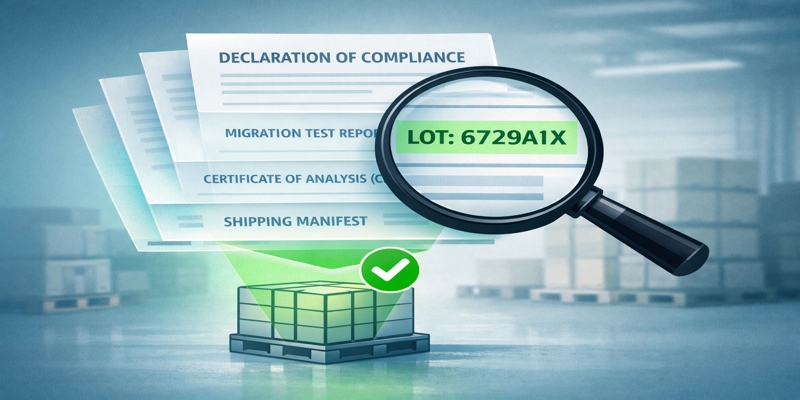
- Check Every Shipment: Match lot numbers to documents before signing—once you accept delivery, the risk is yours.
- Run Regular Reviews: Monthly or quarterly check-ins catch slow drift before auditors or customers find it first.
Paperwork that matches what actually ships—that’s real compliance.
Procurement, quality, and operations teams managing food-contact packaging will find a ready-to-use verification framework here, guiding them into the step-by-step implementation details that follow.
~ ~ ~ ~ ~ ~ ~ ~ ~ ~ ~ ~ ~ ~ ~ ~ ~ ~
An audit request arrives: “Please share your food-contact compliance evidence for this packaging paper.” The spec sheet is on file. The certificate looks official. Then the uncomfortable question surfaces: does this delivered lot match what was approved, or is the operation relying on paperwork while shipment reality has quietly shifted?
The Integrated Safety Model binds packaging specifications to verification gates—creating one control system where every spec line has a matching evidence type, owner, frequency, and change trigger.
The flow runs:
Spec → Evidence Gates → Order Controls → Shipment Checks → Drift Monitoring.
When specs and verification are designed together, compliance becomes a repeatable process rather than a paper exercise—a methodology also applied in sourcing frameworks for food packaging paper.
Why Specs and Verification Fail When Managed Separately
Specifications and verification protocols typically emerge from different functions at different times. Procurement drafts the spec to define requirements. Quality builds verification checklists to confirm what arrives. This functional disconnect, explored in Aligning Procurement & Quality: A Short Checklist to Approve a New Kraft Paper Supplier, creates handoff gaps that breed false confidence. The documents exist in parallel rather than in sequence—creating handoff gaps that breed false confidence.
Consider the common scenario: a spec states “food-grade coating suitable for direct contact with dry foods.” The verification file contains a Declaration of Compliance referencing a regulatory standard. Six months later, the supplier reformulated the coating. The certificate remains unchanged because nothing in the system triggered re-validation. The gap between approved spec and shipment reality widens invisibly.
A second failure mode is time lag. Declarations may remain unchanged while inputs (fibers, coatings, inks, adhesives) and processes evolve. Evidence stays constant; risk can change. The third failure mode is pressure at receiving: when the line is waiting, missing lot traceability or stale documents become “workarounds,” not gates.
Paperwork describes what was true at issuance, not what shipped last week. Without change triggers and lot-level traceability, compliance drift goes undetected until an audit finding, a customer complaint, or an incident forces the question.
The fix is not more paperwork. The fix is a spec-to-verification map that converts every specification requirement into a verification question with evidence type, frequency, and change-control triggers—a concept central to How to Verify Food Contact Compliance Beyond Certificates.
The Integrated Safety Model: End-to-End Flowchart
Think of this model as a blueprint paired with inspection gates. The blueprint defines what must be true. The inspection gates prove it remains true—at qualification, at order, at shipment, and over time.


Risk Assessment Foundations
- Owner: Procurement and QA jointly
- Frequency: Per new item; annual review for existing items
- Actions: Identify food-contact conditions (time, temperature, food type), determine regulatory scope by jurisdiction, classify risk tier based on exposure severity
- Decision Gate: Risk tier documented? Action: Verify risk documentation before advancing.
Specification Guardrails
- Owner: Procurement drafts; QA validates
- Frequency: Per new spec; per revision
- Actions: Write testable requirements (not descriptive language), attach test method reference for each critical parameter, define tolerances and acceptance criteria, specify traceability requirements, document change triggers requiring re-approval
- Decision Gate: Every critical line has a test method? Escalate to QA for method assignment if no. Approve and proceed if yes.
Supplier Validation
- Owner: Procurement collects; QA reviews
- Frequency: Per supplier; per product family
- Actions: Collect Declaration of Compliance naming applicable regulations, request test reports matching spec parameters, verify certificate scope covers use conditions, confirm supplier’s change notification commitment
- Decision Gate: Evidence pack complete and current? Stop and do not approve of the supplier if not. Approve and proceed to ordering if yes.
Procurement Controls
- Owner: Procurement issues PO; Supplier manages production
- Frequency: Per order
- Actions: Reference approved spec version on purchase order, require lot/batch traceability on shipping documents, obtain supplier confirmation of no unapproved changes since qualification
- Decision Gate: PO references current spec version? Stop and hold order if no. Approve and proceed if yes.
Receipt Verification
- Owner: Operations receives; QA reviews
- Frequency: Per lot; per shipment
- Actions: Match lot number to accompanying documentation, verify Certificate of Analysis against spec tolerances, conduct incoming checks per critical parameters, document deviations before releasing to production
- Decision Gate: Lot matches spec and documentation aligns? Stop, quarantine, and escalate if no. Approve and release to production if yes.
Lifecycle Governance
- Owner: QA governs; Procurement interfaces with supplier
- Frequency: Change-triggered; quarterly review; annual re-validation
- Actions: Monitor supplier change notifications, trigger re-qualification when inputs or processes change, refresh evidence packs on defined cadence, track supplier scorecard metrics
- Decision Gate: Evidence current and no unresolved changes? Stop and suspend approvals until re-validated if no. Approve and maintain approved status if yes.
Stage 1: Verifiable Specification Design
A specification that cannot be tested functions as a wish rather than a control—a principle foundational to The Quality Blueprint: Defining and Enforcing Corrugated Box Specs. The shift from descriptive to verifiable specs requires adding “verification hooks” to every critical requirement.
Two-lane qualification helps keep this efficient. Lane 1 makes the spec testable by defining method, acceptance rule, and traceability. Lane 2 defines the evidence needed to believe the spec holds over time. The lanes reconnect at every decision gate so approvals remain grounded in verifiable data.
What makes a spec line verifiable:
A test method reference transforms vague language into measurable criteria. Instead of “suitable for food contact,” a verifiable spec states compliance with applicable regulations as demonstrated by overall migration testing under conditions reflecting intended use. Adherence to Regulation (EC) No 1935/2004 (the Framework Regulation) and Regulation (EC) No 2023/2006 (Good Manufacturing Practice) provides the overarching legal basis in the EU. For specific material requirements, industry standards such as the BfR Recommendation XXXVI for paper and board are typically used to define migration limits. In the U.S., compliance is governed by FDA 21 CFR Part 176.170 (components of paper and paperboard in contact with aqueous and fatty foods) and FDA 21 CFR Part 176.180 (dry foods), which specify extractive limitations and authorized substances. Naming standard test methods is a widely used way to make supplier results comparable.
Tolerances and acceptance criteria replace subjective terms. Instead of “adequate barrier properties,” specify moisture vapor transmission rate with a maximum value and test method reference.
Traceability requirements ensure lot-level accountability. The spec should require the supplier to provide lot or batch numbers traceable to raw material inputs and production dates.
Change triggers define what requires re-approval: coating formulation changes, substrate supplier changes, manufacturing site relocations, or process modifications affecting food-contact layers.
When drafting any spec line, the practical test is straightforward: how would QA verify this requirement? If there is no answer, the spec is incomplete.
Stage 2: Protocol Mirroring
Once specs include verification hooks, the next step is building a mapping matrix that connects each requirement to its evidence, timing, owner, decision gate, and re-validation trigger. A strong protocol mirrors the spec line-by-line—the protocol is not a separate checklist but the spec translated into gates, an approach detailed in Structuring Your Compliance Audit Checklist for Packaging Suppliers.
Spec-to-Verification Mapping Matrix
| Spec Requirement | Verification Evidence | Gate Timing | Owner | Decision Gate | Re-validate When |
| Food-contact compliance (named regulation) | Declaration of Compliance citing regulation, scope, and use conditions | Pre-qualification | QA reviews; Procurement collects | Stop if scope not covered; Escalate if unclear; Approve when aligned | Regulation updates; supplier notifies formulation change |
| Migration limits | Test report under conditions matching intended use | Pre-qualification and annually | QA reviews | Stop on repeated failures; Escalate on adverse trends; Approve within tolerance | Use conditions change; supplier changes inputs |
| Barrier properties | Test report documenting Water Vapor Transmission Rate (WVTR) or Oxygen Transmission Rate (OTR) using standardized methods such as ASTM F1249 or ISO 15106. | Pre-qualification | QA reviews | Stop if unspecified; Escalate if changed; Approve when consistent | Substrate supplier change, coating formulation adjustment, or a shift in curing/drying process parameters that could affect polymer cross-linking. |
| Lot traceability | Lot number on Certificate of Analysis matches shipping documents | Per shipment | Operations verifies | Stop on mismatch; Escalate on gaps; Approve when matched | Ongoing control—no expiration |
| No unapproved changes | Supplier confirmation letter | Per order | Procurement obtains | Stop for unnotified change; Escalate for review; Approve when confirmed | Any supplier-initiated change notification |
| Documentation integrity | Version/expiry tracking; entity/scope consistency check | Periodic | Procurement + QA | Stop on scope/entity mismatch; Escalate on expiry; Approve when current | Defined refresh cadence |
Minimum evidence by risk tier:
For high-risk applications involving direct contact—particularly with fatty foods, infant formula, or high-temperature processing (e.g., dual-ovenable trays)—verification must include NIAS (Non-Intentionally Added Substances) screening and migration testing using food simulants that mimic the most severe intended use conditions.
Medium-risk applications with indirect contact or shorter exposure may rely on Declarations of Compliance with scope verification, test reports at qualification, and periodic incoming checks—approaches detailed in Food-Grade Certification Standards for Delivery Packaging Bags.
Lower-risk applications with minimal contact under ambient conditions generally require Declarations of Compliance, supplier confirmation of no changes, and spot-check incoming verification.
Risk tier classifications should reflect the specific food types, contact conditions, and regulatory requirements applicable to each use case. What constitutes “high risk” varies by jurisdiction and application—teams should confirm classifications with qualified food safety professionals.
Stage 3: Dynamic Change Control

Compliance drift occurs when the approved state diverges from the delivered state without detection. Change control catches divergence before it becomes a problem.
Changes that generally require re-approval:
Formulation changes to coatings, inks, or adhesives affect the food-contact surface directly. Substrate supplier changes introduce new materials into the supply chain. Manufacturing site relocations alter production conditions and quality systems. Process parameter modifications affecting food-contact layers may change migration characteristics even without formulation changes.
Re-validation frequency approaches:
Change-triggered re-qualification addresses known modifications before the next shipment. Periodic evidence refresh—commonly annual—addresses changes that suppliers may not report. Event-driven reviews respond to customer complaints, audit findings, or regulatory inquiries.
A practical contractual hook: include in supplier agreements a clause requiring written notification of changes within a defined timeframe before implementation, with buyer approval required for food-contact-critical changes. This shifts some responsibility for change detection to the supplier while maintaining buyer oversight.
The underlying principle is that verification data has a finite shelf-life relative to manufacturing cycles. A test report from two years ago describes materials and processes that may no longer reflect current production. For a broader supplier-verification framework built around decision gates and evidence levels, The Trust Protocol: A System for Supplier Verification & Risk Mitigation offers a useful companion approach.
Stage 4: Point-of-Entry Validation
Pre-qualification establishes capability. Shipment verification confirms the specific lot matches the approved spec. Without this final gate, compliance depends on trust that qualification conditions persist across every delivery.
Incoming verification aligned to critical spec lines:
Match the lot number on packaging to the lot number on the Certificate of Analysis. Confirm CoA values fall within spec tolerances. Verify shipping documents reference the current spec version. Conduct visual inspection for damage, contamination, or labeling errors. For high-risk items, dimensional or functional spot-checks per a defined sampling plan provide additional assurance.
The practical sequence is: match PO to spec version to documents to labels/lot IDs, screen for condition anomalies, then apply Stop / Escalate / Approve using pre-defined acceptance rules.Dock-level verification is a common control in packaging supply chains because signing acceptance transfers risk to the buyer—a critical concept explored further in How to Verify Corrugated Box Quality at the Dock.
Escalation rules:
Documentation mismatches warrant holding the lot and contacting the supplier for clarification before release—a protocol detailed in Invoice/Label Mismatches in Pharma Logistics: How to Catch Them Before They Trigger Quarantine. Out-of-tolerance CoA values require quarantine and escalation to QA for disposition. Visual defects should be documented with photographs and affected units quarantined.
The discipline is mandatory: physical conformance must mirror technical specifications at the point of transfer.
Stage 5: Drift Governance
Verification is not a one-time qualification event. Drift monitoring converts compliance into an operating rhythm with scorecards, periodic evidence refresh, and exception management—principles that align with Beyond the Certificate: A Governance Model for Pharmaceutical Packaging Compliance.
Scorecard metrics per supplier:
Track the percentage of shipments with complete documentation. Monitor deviation rates measuring lots requiring escalation or quarantine. Assess change notification compliance—whether suppliers notify before shipping when changes occur. Measure evidence freshness as days since the last test report or declaration update.
Periodic evidence refresh:
Quarterly reviews confirm no unacknowledged changes and spot-audit documentation completeness. Annual reviews request updated Declarations of Compliance and re-validate test reports for high-risk items.
Exception management:
Track open deviations by supplier and specification. Require root cause analysis and corrective action for repeat issues. Escalate chronic non-conformance to supplier review or exit decisions.
This operating rhythm transforms compliance from a static approval into ongoing governance. Use the scorecard to tighten the spec-to-verification map where drift appears.
Implementation Playbook: 30/60/90 Days
Days 1–30: Foundation
| Task | Owner | Deliverable |
| Classify risk tiers for top food-contact packaging items | QA + Procurement | Risk tier matrix |
| Audit existing specs for verification hooks | QA | Gap list per spec |
| Draft verification hooks template | QA | Standard spec addendum |
| Identify evidence gaps in current supplier files | Procurement | Evidence gap report |
| Pick the top three items and build the first spec-to-verification map | QA + Procurement | Initial mapping matrix with owners and frequencies |
Days 31–60: Activation
| Task | Owner | Deliverable |
| Build spec-to-verification mapping matrix for remaining priority items | QA + Procurement | Expanded mapping matrix |
| Define incoming verification checklist | Operations + QA | Checklist per risk tier |
| Communicate change notification requirements to suppliers | Procurement | Supplier acknowledgment letters |
| Embed spec version and change notice requirements into POs | Procurement | Updated PO template |
| Launch incoming checks for high-risk items | Operations | Verification log |
| Implement receiving gates and hold rules | Operations + QA | Documented hold-and-release logic |
Days 61–90: Operating Rhythm
| Task | Owner | Deliverable |
| Establish quarterly evidence review cadence | QA | Calendar and agenda template |
| Build supplier scorecard dashboard | Procurement + QA | Scorecard template |
| Conduct first drift monitoring review | QA | Exception report |
| Document audit-ready traceability for a high-exposure item (e.g., fatty-food contact paperboard) | QA | Traceability demonstration file |
| Publish drift scorecard and feed outcomes back into tighter gates | QA + Procurement | Continuous improvement log |
When resources are limited, prioritize high-risk items first. A verified control system on three critical food-grade kraft paper items delivers more risk reduction than a theoretical framework covering everything. A verified control system on three critical food-contact items delivers more risk reduction than a theoretical framework covering everything. For related workflow thinking on converting specs into defensible sourcing decisions, see From Specs to Sourcing: A Strategic Roadmap for Resilient Procurement.
Integrated Safety Checklist
Use this checklist to audit current state or validate new supplier setups:
- Every critical spec line has a named test method or evidence type
- Tolerances and acceptance criteria are defined numerically, not as “suitable” or “adequate”
- Traceability requirements specify lot coding and batch linkage
- Change triggers are documented in the specification
- Each critical spec line appears in the spec-to-verification map with a decision gate
- Evidence pack requirements exist by risk tier (not one-size-fits-all)
- Gates are explicit: Stop / Escalate / Approve, with named owners
- Supplier’s Declaration of Compliance names applicable regulations and use conditions
- Test reports match spec parameters and use conditions
- Certificate scope covers actual food types and exposure conditions
- Supplier has acknowledged change notification requirements in writing
- Purchase orders reference current spec version and change control terms
- Incoming verification checks lot-to-document match before acceptance
- Out-of-tolerance or mismatch findings trigger documented escalation
- Exceptions trigger hold-and-release logic, not ad-hoc workarounds
- Evidence packs have defined refresh cadence
- Supplier scorecard tracks deviation rate and documentation completeness
- Change-triggered re-qualification is defined and enforced
- Drift monitoring runs on a cadence and feeds back into tighter gates
Common Pitfalls and How to Avoid Them
Over-reliance on certificates. A Declaration of Compliance proves the supplier asserts compliance. It does not prove the shipment in your warehouse matches that declaration—a distinction explored in Fake FSC, PEFC, ISO Certificates vs. Real Ones: A Visual Spotter’s Guide. Certificates are necessary but not sufficient—treat them as signals, not shipment proof. Pair them with lot-level verification and change controls.
Specs without test methods. If the spec says “food-grade” without defining testable criteria, any supplier can claim conformance. Write method + acceptance + traceability, or the line cannot be gated. Add verification hooks during spec creation, not after problems surface.
No triggers for re-validation. Evidence becomes outdated. Test reports from years ago describe materials and processes that may have changed. Define refresh cadence and change triggers so evidence reflects current shipment reality and drift is caught before audits or incidents.
Treating verification as QA’s job alone. Verification touches Procurement (collecting evidence), Operations (incoming checks), and QA (governance). Shared ownership prevents gaps at functional handoffs—a theme developed in From Chaos to Compliance: A Strategic Framework for Enterprise Corrugated Box Sourcing for Pharmaceuticals.
Assuming suppliers will notify changes. Many do not—often because internal definitions of ‘material change’ differ from buyer expectations. Addressing this requires contract clauses that protect against off-spec deliveries with explicit change notification requirements. Specify what changes require notification and build incoming checks as a backup control.
Apply this model by building a spec-to-verification mapping matrix for your highest-risk packaging items this week. Document the spec, identify evidence gaps, and define the verification gates. Then standardize a one-page “verification hooks” addendum for every packaging specification going forward.
The Integrated Safety Model is not about generating more paperwork. It is about making the paperwork you already have accurately describe what arrives on your dock.
Disclaimer:
This article provides general, informational guidance on designing packaging specifications and verification protocols. Food-contact compliance obligations vary by jurisdiction, packaging construction, inks/coatings/adhesives, food type, and use conditions (time/temperature). Always confirm applicable regulatory requirements and testing expectations with qualified food safety/regulatory professionals and the relevant authorities.
Our Editorial Process:
Our expert team uses AI tools to help organize and structure our initial drafts. Every piece is then extensively rewritten, fact-checked, and enriched with first-hand insights and experiences by expert humans on our Insights Team to ensure accuracy and clarity.
About the PaperIndex Insights Team:
The PaperIndex Insights Team is our dedicated engine for synthesizing complex topics into clear, helpful guides. While our content is thoroughly reviewed for clarity and accuracy, it is for informational purposes and should not replace professional advice.