

📌 Key Takeaways
Kraft paper grade selection determines whether checkout bags fail publicly or quietly overspend on durability the store never needs.
- Grade Beats GSM Alone: Two bags at identical GSM perform differently because fiber quality and grade design—not just weight—determine actual strength.
- Match Grade to Duty First: Define the loads and failure risks each bag must survive, then select a grade family band before negotiating price within that band.
- Recycled Grades Span a Wide Range: High-quality recycled kraft handles many retail applications well, but performance varies significantly by formulation and manufacturing controls.
- Supplier Conversations Need Specifics: Sharing maximum bag weight, handle style, moisture exposure, and highest-risk failure scenarios produces better grade recommendations than requesting generic quotes.
- Trial Batches Reveal Truth: Frontline staff feedback from small test orders catches specification mismatches before large commitments lock in the wrong grade.
Grade clarity turns procurement from guesswork into risk management.
Retail buyers and store managers responsible for packaging decisions will gain a practical framework for specifying kraft grades confidently, preparing them for the detailed use-case mapping and supplier conversation guidance that follows.
Imagine the Friday before a holiday weekend. The checkout queue stretches to the back of the store. A customer hoists a paper bag from the counter, and the bottom gives way. Glass jars of pasta sauce roll across the floor, shattering near the entrance. The customer is embarrassed, staff scramble to clean up, and the line watches in uncomfortable silence.
Now picture the opposite problem. A boutique owner discovers she has been paying for bags engineered to carry canned goods and glass bottles when her heaviest items are folded sweaters and boxed scarves. For two years, she has quietly overspent on every single bag.
Both situations trace back to the same gap: nobody explained kraft paper grades in terms that made sense for retail.
A kraft paper grade is commercially defined by a specific recipe. It combines a particular fiber type, a specific manufacturing process, and a target performance level to produce paper suited for certain jobs. Think of it like choosing tires for different driving conditions. The same car needs one type of tire for smooth city streets and another for rough backcountry roads. The vehicle works either way, but mismatched tires mean wasted money or unnecessary risk.
For retailers, the checkout moment is when packaging becomes visible currency. If that currency fails, the transaction feels broken and the store’s competence comes into question. This guide offers a practical map from typical retail bag uses to sensible kraft grade bands, so specifications can be set with confidence and supplier conversations become more productive.
Kraft Paper Grades in Plain Language
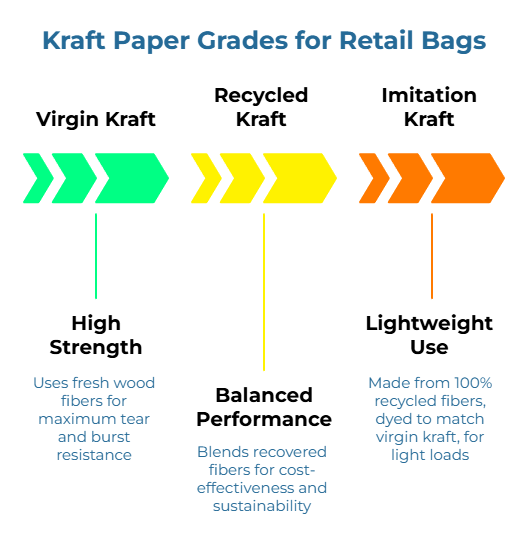
A “grade” is not a single number. It describes a combination of fiber source, processing method, and resulting performance characteristics. For retail paper bags, three grade families matter most.
Virgin kraft uses fresh wood fibers that have never been recycled. These long, intact fibers deliver high tear resistance and burst strength, making virgin kraft the go-to choice when bag failure would be costly or highly visible. The trade-off is typically a higher cost per unit, though fluctuations in the pulp versus recovered fiber markets can occasionally narrow this price gap.
Recycled kraft and recycled bag grades blend recovered fibers to achieve performance levels that work well for many retail applications. These grades cost less than virgin kraft and carry a stronger sustainability narrative, which resonates with environmentally conscious customers. Retailers navigating regional packaging regulations will find the guide to sustainable packaging compliance helpful for understanding certification requirements and regulatory obligations.. However, because the recycling process shortens fibers and reduces their bonding potential (a process known as hornification), structural quality varies significantly depending on the source material and processing. Performance spans a wide range, so recycled kraft is best treated as a band rather than a single “recycled = weak” or “recycled = strong” label.
Imitation kraft and light-duty recycled grades are made from 100% recycled fibers, often dyed to match the colour of virgin kraft. These papers possess lower specific strength (strength-to-weight ratio) than virgin equivalents, making them best suited for applications where load demands are modest—lightweight boutique items, promotional bags, or secondary uses where high structural strength is not required.
Many real-world bags combine elements from these families, sometimes using multi-ply constructions or virgin-recycled blends. But understanding these three categories provides enough foundation to make better sourcing decisions without becoming a paper technologist.
How Grade, GSM, and Strength Specs Translate to Real-World Durability
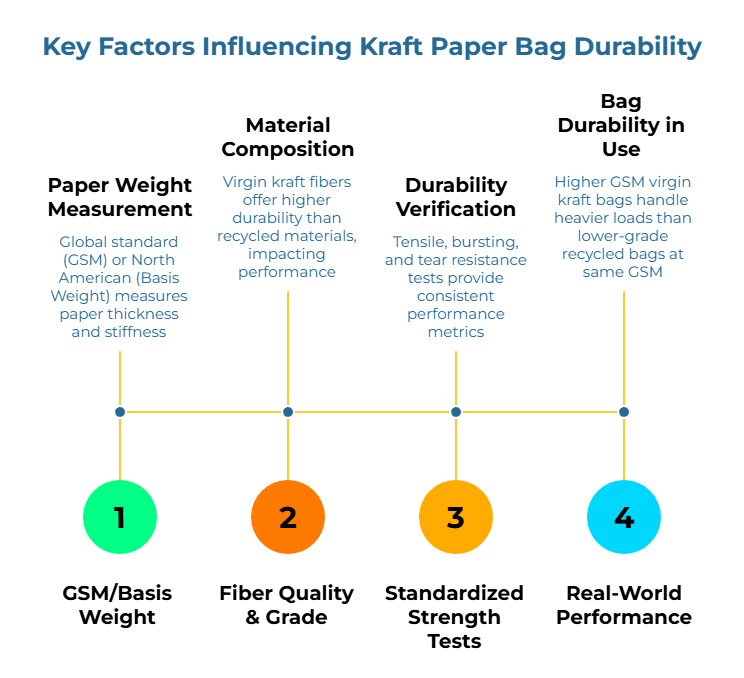
GSM stands for grams per square metre (the global standard), while North American markets often use Basis Weight (lbs/ream). Both measure paper weight and serve as a rough proxy for thickness and stiffness. Moving from a lower GSM to a higher one generally increases a bag’s ability to resist tearing and support weight.
GSM alone does not tell the whole story. Two bags at identical GSM can behave very differently if one uses virgin kraft fibers and the other uses lower-grade recycled material. Fiber quality and grade design determine how those grams translate into actual performance.
Behind the scenes, mills and converters rely on standardised strength tests to prove durability. Three metrics appear most often: tensile strength measures how much pulling force paper can withstand before breaking, bursting strength (or burst factor) measures resistance to rupture under pressure, and tear resistance indicates how well the paper resists propagation of a tear once started. For readers who want to understand how these metrics work in detail, the PaperIndex Academy’s guide on understanding GSM and burst factor for paper bag strength offers a deeper technical explanation. These numbers exist so performance can be compared consistently, even when materials look similar. Retailers do not need to interpret lab reports in detail, but asking suppliers for simple strength evidence helps verify that a proposed specification actually fits the intended use.
For example, an 80–90 GSM virgin kraft bag may comfortably handle mixed grocery loads that a lower-grade recycled paper at the same GSM would struggle to support. The GSM matches, but the grade makes the difference.
Match Typical Retail Bag Uses to Sensible Kraft Grade Bands
Rather than memorising specifications, start with the job the bag must do. The following use cases offer starting points, not rigid rules. Bag size, handle design, ply construction, and moisture exposure can shift the right choice. A small trial run before committing to large volumes reduces risk.
Light Boutique and Gift Items
These bags carry tissue paper, small accessories, or lightweight boxed gifts. Weight per bag rarely exceeds one to two kilograms, edges are soft, and moisture exposure is minimal. High-quality recycled kraft or imitation kraft in moderate GSM ranges typically handles these loads well, and the sustainability angle often aligns with boutique brand positioning. Trading down to lighter recycled grades can work here without significant risk.
Very large bags, rope handles, or high-volume weekend traffic can justify moving up a band for better handle and fold durability.
Folded Apparel and Shoe Boxes
Clothing stores and shoe retailers need bags that accommodate boxy shapes and moderate weight. Bags may be carried by handles for longer distances as customers continue shopping. A mid-range recycled kraft or a lighter virgin kraft in the 70–100 GSM band often suits this application.
Box corners and handle attachment points are frequent failure points, so bag construction deserves attention alongside grade selection. Strength is not only “paper thickness” but also grade quality and converting workmanship.
Mixed Everyday Groceries
Grocery bags face unpredictable loads: cans next to bread, milk cartons beside eggs. Weight can reach five to eight kilograms, and sharp edges from packaging corners stress the paper. Virgin kraft or high-quality recycled blends in higher GSM ranges provide the margin of safety this use case demands. This is not the place to trade down aggressively on grades.
Some grocery mixes can use strong recycled kraft successfully if the supplier can demonstrate performance and the store controls bag size and load expectations. Moisture from condensation on chilled items, high-density loads like tins and jars, and oversized bags increase risk quickly.
Heavy or Fragile Grocery Loads
Bottles, glass jars, and bulk items push bags to their limits. Condensation from chilled products adds moisture stress. Virgin kraft or reinforced multi-ply constructions at higher GSM ranges offer the best protection. This is the use case where under-specification tends to show up immediately—at the door, in the car park, or on the sidewalk.
Handle design and bottom reinforcement often matter as much as raw paper grade. Attempting to economise with weaker grades here invites the checkout disaster described at the start of this guide.
Low-Risk Secondary or Promotional Bags
Some bags serve secondary purposes: carrying brochures at a trade show, holding a small promotional item, or providing a backup option at checkout. Imitation kraft or standard recycled kraft grades suit these low-risk applications and keep costs down where durability matters less.
If a secondary bag becomes the store’s default “everything bag,” treat it like a core bag and specify accordingly.
Before committing to large orders, run a small trial batch. Ask frontline staff which bags hold up and which ones fail. Real-world feedback from actual store conditions beats any specification sheet.
For a more detailed breakdown of how paper properties map to applications, the kraft paper property–application match matrix provides an at-a-glance reference.
Paper Grade Comparison Table: Virgin vs Recycled for Retail Bags
Start with what the bag must carry and survive, then choose a grade band that fits, and optimize cost within that band. The following table summarises how the main kraft grade families compare across factors that matter to retailers.
| Paper Grade Family | Typical GSM Range | Relative Strength | Relative Cost | Sustainability Perception | Best-Fit Retail Uses |
| Virgin Kraft | 70–130 | High | Higher | Medium to High (when certified) | Heavy groceries, mixed loads, fragile items, reusable bags |
| Virgin/Recycled Blend or Reinforced Multi-Ply | 80–130 | High | Medium to High | Medium to High (depends on mix and certification) | Grocery formats needing extra safety without overbuilding |
| High-Quality Recycled Kraft (Bag-Grade) | 60–110 | Medium to High | Medium | High (when certified) | General retail, apparel, shoes, moderate grocery loads |
| Recycled Kraft (General Duty) | 50–100 | Medium | Lower to Medium | High | Light-to-moderate retail loads, standard carry distances |
| Imitation Kraft / Light-Duty Recycled | 50–90 | Low to Medium | Lower | High | Light boutique items, promotional bags, secondary uses |
Values represent general industry bands rather than mill-specific guarantees. Actual performance depends on specific supplier formulations, bag construction, and handle design. Certification from bodies such as FSC or PEFC strengthens sustainability claims regardless of grade family. When sourcing certified grades, kraft paper suppliers and kraft paper manufacturers directories help identify suppliers with verified certifications.
For sustainability-specific trade-offs between grade families, the PaperIndex Academy’s strategic guide to kraft paper grade selection and procurement provides deeper context.
How to Talk to Suppliers About Kraft Grades
Turning this framework into productive supplier conversations requires sharing the right information and asking focused questions. The goal is collaborative alignment, not an audit. The retailer defines the duty and service level; the supplier proposes grade options within that envelope.
Information to share upfront:
- Typical items per bag and the heaviest realistic bag (rough kilogram band is sufficient)
- Bag dimensions and whether bags are often overfilled
- Handle style (flat handle, twisted handle, rope) and whether customers typically reuse bags
- Moisture exposure (chilled items, rain seasonality, condensation at checkout)
- The two or three highest-risk failure scenarios (bottom splits, handle tear-out, side tears at corners)
Questions that force clarity:
- “Which grade family are you recommending for this use case, and what failure mode is it designed to prevent?”
- “What GSM band are you proposing, and how does it compare to what similar retailers use for similar loads?”
- “What simple strength metrics or evidence do you rely on to show this specification is adequate but not excessive?”
- “If the goal is a more sustainability-forward option, which recycled grade family works safely for which bag types, and where should virgin kraft remain the default?”
For retailers vetting new suppliers remotely, a structured remote audit checklist helps verify claims before committing to orders.
When a supplier can explain the recommendation in plain language and back it with consistent evidence, the risk of failure-driven complaints, returns, and emergency reordering drops materially. For international sourcing, verifying international paper bag suppliers through systematic checks adds another layer of protection.
Common Kraft Grade Mistakes Retailers Make
Buying purely on unit price. The lowest quote often hides costs that surface later: customer complaints, damaged goods, emergency reorders when bags fail mid-shipment. Understanding the hidden cost of unverified suppliers helps retailers recognize why apparent savings often break budgets. A slightly higher grade cost spread across thousands of transactions typically costs far less than one viral social media post showing groceries on the pavement. Grade selection is risk management as much as procurement.
Assuming more GSM always means safer. Adding GSM increases stiffness and weight, but beyond a certain point it adds cost without meaningful strength improvement. A well-designed 80 GSM virgin kraft bag may outperform a poorly constructed 100 GSM recycled bag. Past a threshold, design details—handles, bottom reinforcement, ply structure—drive outcomes more than raw paper weight.
Treating recycled kraft as universally weak—or universally sufficient. High-quality recycled grades handle many retail applications well, but not all recycled paper is equal. Specifying “recycled” without understanding the grade family invites inconsistency. Equally, assuming recycled cannot handle anything beyond lightweight items underestimates modern recycled kraft formulations. Match recycled options to the duty, not to a slogan.
Copying another retailer’s specification without checking fit. A small apparel shop copying a supermarket’s grocery spec may pay for durability it will never use. A neighbourhood grocery store copying a national chain’s bag spec may end up with bags engineered for volume and load profiles that do not match its own product mix. Specifications should reflect actual use, not borrowed assumptions.
The antidote to all four mistakes is the same: define the job the bag must do first, select a grade band that fits, then negotiate cost within that band. The comparison table above serves as a quick sanity check before finalising any specification.
From Confusion to Confident Kraft Grade Choices
The checkout queue keeps moving. The bag holds. The customer walks out satisfied, and the store’s competence never comes into question.
Reaching that outcome consistently does not require becoming a paper engineer. It requires a simple process: clarify the loads and conditions each bag type must survive, pick a grade family and GSM band that fits, validate the choice with a supplier who can provide straightforward evidence, and test a small batch before scaling up.
Choosing grades strategically does more than prevent embarrassing failures. It reduces the supply chain fragility that forces panic buying when a supplier stumbles or a specification proves inadequate. Building a sourcing strategy for reliable paper packaging extends this grade-level thinking to the broader supplier base. Retailers who understand their grade bands can switch suppliers more confidently and negotiate from a position of clarity rather than dependence.
Next step: List the three most common bag types the store uses. Decide which grade family each probably belongs in based on the mapping above. Use that list to reopen the conversation with current suppliers or to brief new ones.
For deeper technical understanding, explore the Academy’s resources on kraft paper grade selection and procurement and the broader sourcing strategy for reliable paper packaging. When grade requirements are clear,explore paper bag suppliers to find options that match.
Disclaimer: This content is provided for informational and educational purposes only and does not constitute professional procurement or technical advice. Specific grade selections should be validated with qualified suppliers based on actual use conditions.
Our Editorial Process:
Our expert team uses AI tools to help organize and structure our initial drafts. Every piece is then extensively rewritten, fact-checked, and enriched with first-hand insights and experiences by expert humans on our Insights Team to ensure accuracy and clarity.
About the PaperIndex Insights Team
The PaperIndex Insights Team is our dedicated engine for synthesizing complex topics into clear, helpful guides. While our content is thoroughly reviewed for clarity and accuracy, it is for informational purposes and should not replace professional advice.