
📌 Key Takeaways
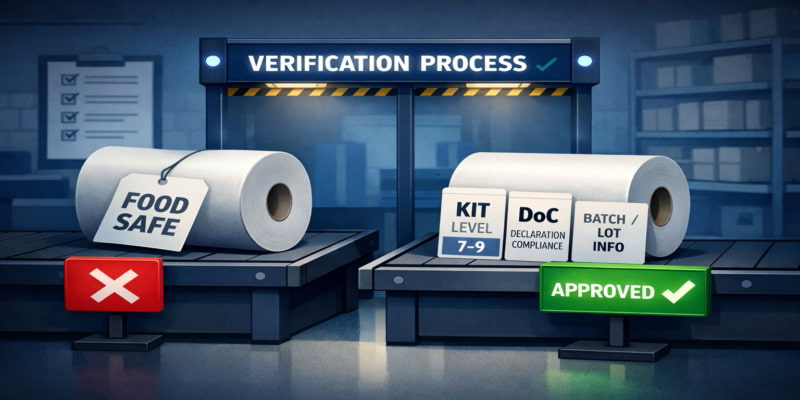
“Food safe” is a marketing phrase, not a safety guarantee—real protection comes from matching paper specifications to your actual menu conditions.
- Labels Don’t Equal Proof: A “food safe” claim without testing documents for your specific foods, temperatures, and hold times is just hope with better food packaging paper.
- Specification Drift Breaks Consistency: When suppliers quietly switch mills or ingredients, yesterday’s good paper becomes today’s grease-soaked wrapper—without warning.
- Ask Questions Suppliers Can’t Dodge: Request Kit level ratings, compliance certificates naming real standards, and batch traceability before you sample anything.
- Test Under Real Conditions: A five-minute grease spot test with your actual menu items reveals more than any supplier promise ever will.
- Document Before You Need It: Keep specification sheets, compliance letters, and test results in one folder per supplier—inspectors and future-you will thank you.
Match your specifications to your menu, not to a vague label.
Food service operators scaling locations or expanding menus will gain a repeatable sourcing process here, preparing them for the verification workflows that follow.
~ ~ ~ ~ ~ ~ ~ ~ ~ ~ ~ ~ ~ ~ ~ ~ ~ ~
The Moment ‘Food Safe’ Stops Being Reassuring
The rolls look fine. Then the first burger wrapper goes dark with grease in under two minutes. A sandwich liner turns limp. A customer notices an odd smell. You check the invoice. “Food safe” is printed right there. The supplier confirmed it. And yet here you are—mid-service, with wrappers bleeding through onto customers’ hands.
Most food service operators trust that label. It sounds official. It feels like protection. While ‘food safe’ is a common industry descriptor, it lacks a singular, globally unified regulatory definition; safety is instead determined by compliance with specific material-to-food-type migration limits—it’s often a marketing description that may or may not reflect testing for your specific use case.
That distinction matters when you’re scaling. One location with a flexible supplier relationship can absorb occasional paper failures. But the moment you add a second outlet, expand your menu to include greasier items, or face supply disruption that forces a quick supplier switch, vague labels become expensive problems. You can’t prove consistency. You can’t trace inputs. You can’t match performance to real menu conditions.
The standard advice—buy paper labeled ‘food safe’ from a decent supplier—works until it doesn’t. What’s needed is repeatability: paper that performs the same way, shipment after shipment, under real menu conditions—knowledge that resources like the PaperIndex Academy help operators develop. What’s needed is repeatability: paper that performs the same way, shipment after shipment, under real menu conditions. The better approach is specification-first sourcing, where you define intended use, demand documentation, and validate performance before standardizing any purchase.
Myth vs. Reality: What ‘Food Safe’ Actually Means for Paper
The myth: A “food safe” label means the paper is compliant and suitable for any food application.The reality: Suitability for food contact depends on three factors working together—not a label alone.

First, the materials matter. What pulp was used? Virgin fiber or recycled content? What coatings or additives were applied? Recycled paper can carry mineral oils and contaminants from previous uses, which is why regulatory frameworks treat it differently for direct food contact.
Second, intended-use conditions determine compliance. Paper tested for dry bakery items at room temperature may fail with hot, fatty fried foods. The U.S. FDA’s 21 CFR 176.170 covers paper components for aqueous and fatty foods, while 21 CFR 176.180 addresses dry food contact—different sections because different conditions create different risks. The European Commission’s food contact materials framework follows similar logic.
Third, documentation proves the paper was actually tested under conditions matching your use. A declaration of compliance should reference specific regulations, test conditions, and intended applications. Without documentation, “food safe” is an unverifiable claim.
Two papers can both carry a ‘food safe’ label. Only one might be appropriate for wrapping a hot, greasy sandwich held for 15 minutes before serving. This is why understanding food packaging paper specifications matters more than marketing claims.
Hidden Risks of Generic Food Packaging Paper
Generic food packaging paper—sourced without clear specifications—carries risks that never appear on invoices.
Unknown additives and coatings represent the first category of hidden risk. Fluorochemical coatings for grease resistance have different regulatory status than wax coatings. Recycled content may introduce substances from previous uses. Without a technical data sheet, you cannot verify what you’re putting in contact with food. Germany’s Federal Institute for Risk Assessment (BfR) publishes detailed recommendations for paper and board in food contact precisely because material composition matters.
Performance mismatch creates the second risk category. Grease resistance is measured using standardized Kit level ratings from 1-12. A paper rated Kit 4 might handle a dry sandwich but fail with fried chicken. For high-fat applications, purpose-manufactured greaseproof paper with documented Kit levels offers more predictable performance. If your supplier cannot tell you the Kit level—or doesn’t understand the question—you’re guessing at performance. Qualified greaseproof paper suppliers should be able to provide Kit level documentation as standard practice. The same applies to moisture resistance and temperature tolerance.
Batch-to-batch inconsistency emerges when suppliers source from whoever has inventory rather than maintaining consistent mill relationships. This is specification drift in action: Roll A performs fine, but Roll B, from a different mill with different inputs, fails under identical conditions. Without traceability, you cannot identify which batches to avoid or replicate.
Odor and taint transfer affects food quality even when paper is technically “safe.” Poor storage, certain recycled content, or incompatible coatings can transfer off-flavors to food. Customers notice. They don’t file regulatory complaints—they simply don’t return.
The biggest hidden risk is often not a single contaminant. It’s the lack of traceability and repeatable specifications, which turns each shipment into a new bet on performance.
What to Ask Instead: Specification-First Questions That Force Clarity
Shifting from label-first buying to specification-first verification means asking questions that generic suppliers often cannot answer. These questions align with the three decision criteria that matter: documentation and traceability, fit for intended use, and consistency.
On intended use: “What food types and conditions was this paper tested for?” The answer should specify: dry foods, moist foods, fatty foods, temperature ranges, and contact duration. A response like “all food applications” is a red flag, not reassurance.
On performance specifications: “What is the GSM range and grease resistance rating?” Papers described only by thickness or color lack actionable detail. GSM (grams per square meter) indicates weight and indirectly affects strength; Kit level indicates grease holdout performance.
On compliance documentation: “Can you provide a declaration of compliance referencing the applicable regulation and test conditions?” Legitimate suppliers provide documentation naming specific standards. Food grade kraft paper suppliers should be able to furnish declarations of compliance, technical data sheets, and test reports upon request. Certification bodies such as ISEGA (Germany) or ISO/IEC 17025 accredited laboratories test papers against FDA/EU standards to issue verifiable reports. Vague assurances are not documentation.
On traceability: “Can you trace this paper to its manufacturing source and batch?” If the supplier cannot provide mill origin and lot information, every shipment is an unknown variable.
On change notification: “Will you notify me before switching mills or formulations?” Suppliers who cannot commit to this are signaling that consistency is not guaranteed.
The 5-Point Red Flag Checklist for Generic Paper Offers
Use this checklist when evaluating any food packaging paper offer. Three or more red flags indicate risk levels most SME operations should avoid.
1. Missing traceability The supplier cannot name the manufacturing mill or provide batch/lot information. Legitimate food packaging paper mills maintain full traceability from production through shipment. Request instead: mill certificate of origin and batch traceability for every shipment.
2. No compliance documentation The “food safe” claim comes without a declaration referencing specific regulations or test standards. Request instead: written declaration of compliance citing applicable FDA CFR sections, EU framework regulations, or third-party test reports with named standards.
3. Unclear coatings or additives The supplier cannot explain what coatings are applied, whether the paper contains recycled content, or what migration testing has been performed. Request instead: technical data sheet listing coating type, recycled content percentage, and migration test results where applicable.
4. Wrong grease or moisture performance No Kit level rating is provided, or the rating doesn’t match your most demanding menu item. Request instead: Kit level documentation appropriate for your greasiest, hottest application—not your average one.
5. Inconsistent sourcing The supplier sources from multiple mills without standardization or advance notification of changes. Request instead: commitment to consistent sourcing with written notice before any mill or formulation change.
A Lightweight Sourcing Workflow for SME Operations

Specification-first sourcing does not require a procurement department. It requires a repeatable process.
Define your use cases first. List menu items by packaging demand: dry goods at room temperature, moist items, hot fatty foods. Each category may require different paper specifications. A systematic matrix matching specific menu items (e.g., high-fat, high-moisture) to corresponding paper grades provides the necessary framework for this categorization.
Request documentation before sampling. Ask for compliance declarations and specification sheets upfront. Suppliers who cannot provide documentation are not worth the time to test. This single gate eliminates most problematic food packaging paper suppliers early.
Sample and stress-test under real conditions. Test paper with your actual menu items, at your fryer temperatures, for your typical hold times. An operational spot test matching your maximum hold time—typically 15 to 30 minutes under warming lamps or in delivery bags—reveals whether paper performs as claimed under real-world stress. For more rigorous incoming inspection, establish a protocol that includes the 3M Kit Test (TAPPI T 559) for surface oil repellency, a standardized penetration test (like the Turpentine Test, TAPPI T 454) for actual grease bleed-through, and Cobb testing (TAPPI T 441) for water absorption.
Approve suppliers with documentation on file. Whether sourcing from greaseproof paper mills or distributors, maintain a folder for each approved supplier containing their specification sheet, compliance declaration, and your test results. This becomes your evidence trail for consistency and, if needed, for health inspections. The guide on three documents every food operator needs provides a starting framework.
Create a one-page specification sheet summarizing your requirements. This document travels with every RFQ you send. It forces apples-to-apples comparisons and signals to suppliers that you expect documentation, not just claims.
Re-verify when anything changes. New supplier? New menu item with different grease content? Supplier notifies you of a mill change? Re-run verification. The workflow only protects you if you maintain it.
Frequently Unasked Questions
Does recycled content affect food safety differently than virgin fiber?
Recycled paper can carry mineral oils, plasticizers, and ink residues from previous uses. For direct contact with fatty foods—which absorb contaminants more readily — virgin pulp or tested recycled grades with documented migration data present lower risk. The distinction matters most for hot, greasy applications with extended contact time. When recycled content is involved, traceability and proof become even more important than labels.
What about printed wrappers—are the inks included in compliance?
Inks on food-contact surfaces require their own compliance documentation. A paper may be food-safe while the ink printed on it is not tested for food contact. If your wrapping paper products are printed, confirm that ink compliance is addressed in the supplier’s documentation. The key question is whether the supplier’s documentation and intended-use scope covers the full structure used in the final application.
Are “grease-resistant” and “food safe” the same thing?
No. Grease resistance is a performance attribute. “Food safe” is a safety claim. A paper can be compliant for certain food-contact uses yet still fail operationally through grease bleed-through or sogginess. Reconciling regulatory attestation with functional performance benchmarks—such as Kit levels—is the operational imperative.
How does storage affect paper that was compliant when manufactured?
Paper absorbs odors and moisture. Storage near chemicals, cleaning supplies, or in humid conditions can compromise even properly certified material. A clean, dry, controlled storage environment reduces the chance that good paper performs badly in practice. When failures occur, storage conditions should be checked alongside material specifications. Proper storage—dry, away from contaminants, in original food packaging until use—is part of maintaining compliance.
What should I do if a supplier cannot provide documentation?
Find a different supplier. A supplier who cannot document compliance is asking you to accept a risk they are unwilling to verify. The global food packaging paper supplier market includes thousands of verified options; documentation capability is a reasonable minimum threshold. For guidance on evaluating suppliers beyond price, how to verify supplier capability offers a structured approach.
How do I keep supply stable without lowering safety standards?
Qualify backup suppliers before you need them. Run the same verification process on two or three food grade kraft paper suppliers so you have pre-approved alternatives when primary supply is disrupted. Rushing qualification during a supply crisis is how generic, unverified paper enters the operation.
Match Your Paper to Your Menu
“Food safe” sounds reassuring. But reassurance without documentation is hope with better marketing.
The shift is straightforward. Stop buying by label. Start buying by specification. Define what your menu actually demands—grease resistance levels, temperature tolerance, contact duration. Food packaging paper buyers increasingly recognize that specification-first sourcing reduces operational failures and compliance risk. Request documentation proving the paper was tested under matching conditions. Build a verification process you can repeat with every supplier and maintain when circumstances change.
That’s how you move from hoping each shipment works to verifying it does.
For buyers ready to connect with verified suppliers who can provide documentation and specifications, PaperIndex connects food service operators with suppliers worldwide. Find suppliers across multiple paper and food packaging paper categories through the platform’s global directory.
Browse categories like food packaging paper, greaseproof paper, or food grade kraft paper. for supplier discovery, start with food packaging paper suppliers.
As a neutral marketplace, PaperIndex is a connector, not an intermediary—facilitating direct relationships between buyers and suppliers without brokering deals, processing payments, or charging commissions on transactions.
For deeper verification workflows, these PaperIndex Academy resources provide useful starting points:
- Food-Grade Certification Standards for Delivery Packaging Bags
- Creating Your Mill Spec Sheet: A Guide for Converting Operations Managers
- The Compliance Shield: How to Audit Your Food Packaging Paper Suppliers for FDA & ISEGA Safety
Disclaimer:
This article provides general educational information about food packaging paper sourcing practices. Regulatory requirements vary by jurisdiction, food type, and application. PaperIndex does not provide legal, regulatory, or compliance advice. Verification of specific compliance requirements should be conducted with qualified professionals and relevant regulatory authorities for your operation and market.
Our Editorial Process:
Our expert team uses AI tools to help organize and structure our initial drafts. Every piece is then extensively rewritten, fact-checked, and enriched with first-hand insights and experiences by expert humans on our Insights Team to ensure accuracy and clarity.
About the PaperIndex Insights Team:
The PaperIndex Insights Team is our dedicated engine for synthesizing complex topics into clear, helpful guides. While our content is thoroughly reviewed for clarity and accuracy, it is for informational purposes and should not replace professional advice.