

📌 Key Takeaways
Stop debating price targets when the real problem is misaligned evaluation criteria between Finance and Logistics departments.
Six-Lens Scoring Eliminates Subjective Arguments: Weight spec match (25%), convertibility (20%), delivered logistics (20%), commercial terms (15%), timing (10%), and FX/localization (10%) on a 0-5 scale with a minimum 3.8 threshold for approval.
Document Every Decision with Four-Column Assumption Logs: Record the statement, evidence, owner, and date for each scored criterion to create audit-ready documentation that prevents disputes and enables consistent future evaluations.
Normalize Before You Compare: Establish spec-true comparability using standardized test methods and identical delivery terms before analyzing price differences, as hidden specification drift creates false savings that amplify during production.
Twenty Minutes Delivers Defensible Decisions: Anchor specs (5 min), check convertibility (5 min), lock logistics terms (4 min), tune commercial conditions (3 min), verify timing (2 min), and normalize FX/duties (1 min) for complete evaluation.
Shared Evidence Transforms Opinion Into Action: When both departments view identical documentation through weighted criteria, arguments shift from subjective preferences to objective decision-making based on measurable business impact.
Clear criteria, documented assumptions, and shared evidence create faster approvals that satisfy both financial predictability and operational requirements.
For global kraft paper procurement teams managing the tension between Finance’s cost targets and Logistics’ delivery complexities, these systematic evaluation methods provide the structure needed for confident, repeatable approval decisions.
Forklifts hum near the bay door as the shift changes. A pallet of kraft paper arrives with a different core ID sticker than the last lot, and the mill’s packing slip shows “KLB 125 gsm ±5%” in a font someone had to squint to read.
You need Finance to hit a cost target without triggering Logistics chaos. You also need a quick, defensible way to say “approve” or “not yet” on a proposed kraft paper price.
A one-page decision matrix solves this. It aligns Finance’s unit-cost goals with Logistics’ spec and delivery realities so approvals are faster, repeatable, and defensible.
Executive Summary
Procurement teams waste countless hours debating price targets because Finance wants predictable bands while Logistics demands normalized comparisons. This one-page decision matrix bridges that gap by combining driver-based benchmarks with to-door normalization. The result: shared approval thresholds, documented assumptions, and defensible quarterly targets that satisfy both departments’ core requirements.
The Quick Answer
A practical way to approve kraft paper price targets is to score each proposal across six lenses—spec match, convertibility, delivered logistics, commercial terms, timing window, and localization/FX—on a 0–5 scale, weight the lenses 25/20/20/15/10/10 respectively, and set a minimum composite score (e.g., ≥3.8/5) for approval. Document assumptions and references for each score to keep decisions auditable.
Why Finance and Logistics Disagree—and How to Reconcile
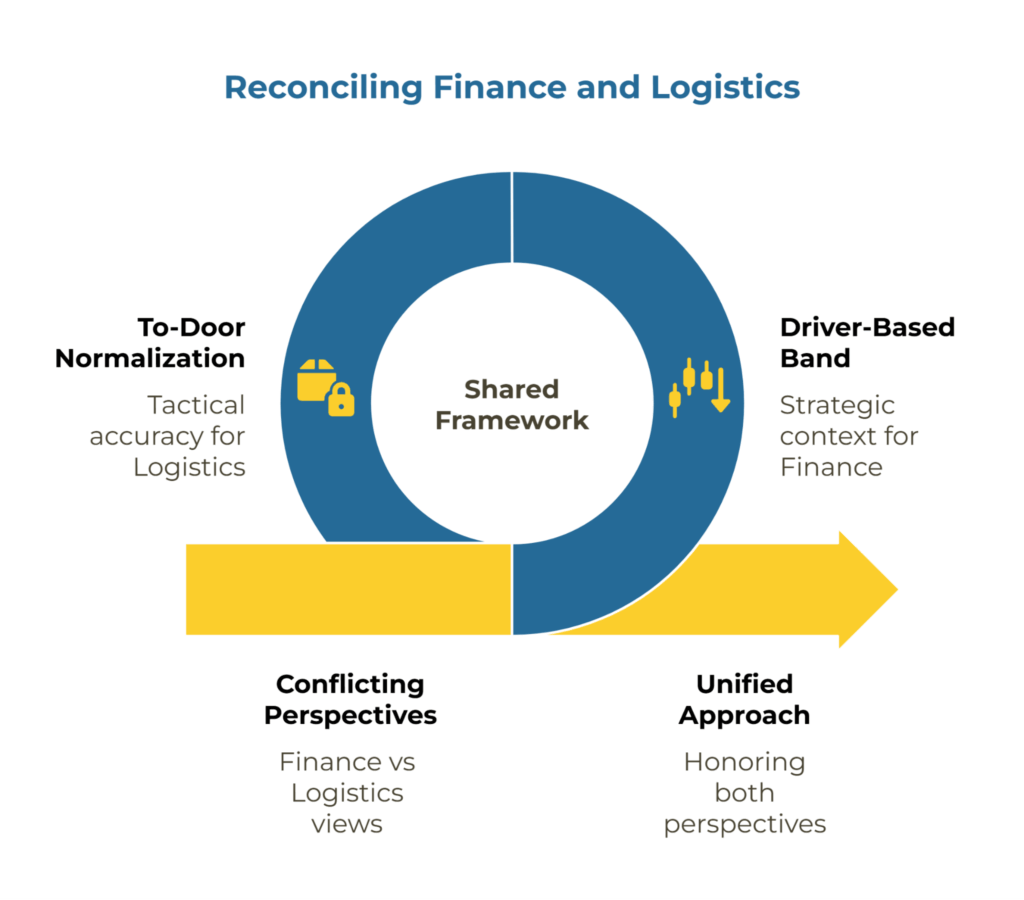
Picture the quarterly planning meeting. Finance presents a neat price band based on fiber costs and energy trends. Logistics counters with concerns about Incoterms inconsistencies and duty calculations. The procurement lead sits between them, knowing both perspectives matter but lacking a framework to merge them.
This tension stems from fundamentally different lenses. Finance views pricing through cost drivers—fiber availability, energy fluctuations, freight rates, and foreign exchange movements. They need predictable bands that account for market volatility without creating budget surprises.
Logistics approaches the same prices through delivery complexity. They see EXW quotes that exclude critical handling costs, CIF terms with unclear insurance coverage, and DDP prices that might shift dramatically once duty classifications change. Their priority: ensuring every quote reaches the same to-door comparison point.
Both departments are right. The solution isn’t choosing one approach over the other—it’s creating a shared framework that honors both perspectives. Think of it as two lenses focusing on one photograph. The driver-based band provides the strategic context Finance needs, while to-door normalization ensures the tactical accuracy Logistics demands.
The One-Page Decision Matrix
The matrix works because it establishes clear decision criteria before evaluation begins. Rather than subjective debates, it uses six weighted evaluation lenses that capture what both Finance and Logistics actually care about.
| Lens | What Finance Cares About | What Logistics Cares About | Typical Evidence |
| Spec Match (25%) | Paying for the spec actually quoted | Grade, basis weight, moisture, reel width, core, wrap, palletization | Mill COA; TAPPI test methods |
| Convertibility (20%) | Fewer run-time losses and scrap | Reel build, winding quality, caliper consistency, splice frequency | Plant trials; internal waste reports |
| Delivered Logistics (20%) | Predictable landed cost | Incoterm, freight mode, lead time reliability, damage rate | Named Incoterm from ICC Incoterms® 2020 and logistics performance history |
| Commercial Terms (15%) | Cash and risk profile | Payment terms, claims window, short-shipment policy, price validity | Contract exhibit; buyer T&Cs |
| Timing Window (10%) | Demand coverage, budget timing | Production slot, ship-by date, shelf-life vs. consumption | Mill schedule email; MRP snapshot |
| Localization & FX (10%) | Stable comparison basis | HS code consistency, FX rate basis, duties/VAT handling | HS code check via WCO; rate convention in file header |
Scoring Guide: 0–2 = material or process risk likely; 3 = acceptable with minor mitigations; 4–5 = strong fit with low operational friction.
Weight the scores, set your “approve” floor (typically 3.8/5), and record the assumption that supports each score. Finance sees all-in cost, Logistics sees “will it run,” and both view the same evidence—on one page.
How to Fill the Matrix: A 20-Minute Process
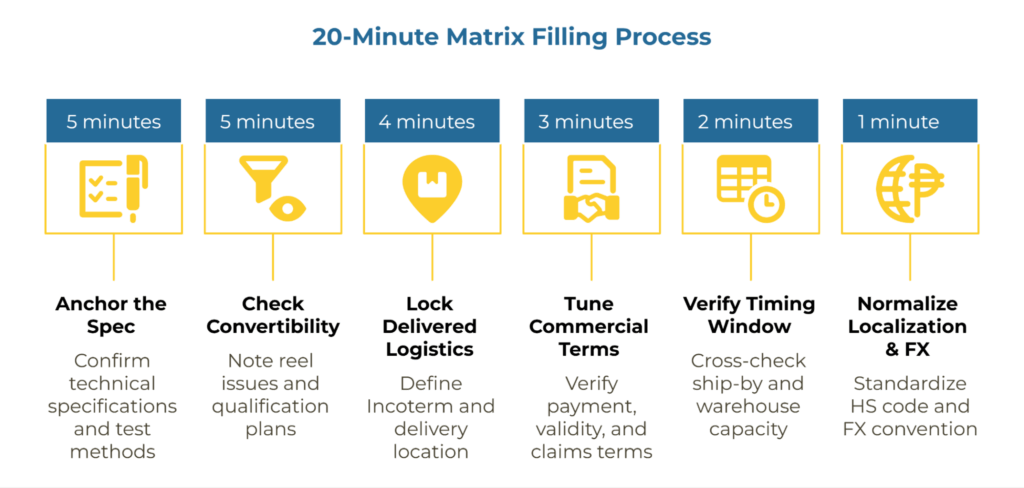
Anchor the Spec (5 minutes)
Confirm the exact kraft paper grade family and basis weight as ordered, plus moisture, reel width, core ID, wrapping, and pallet pattern. Cite the mill COA test method where relevant. Using recognized TAPPI methods keeps comparisons apples-to-apples and audit-ready.
Check Convertibility (5 minutes)
Note any known splice frequency, reel build issues, or caliper variation from prior lots. If a new kraft mill is proposed, log whether a trial was run or a short “qualification reel” is planned. This prevents “cheap roll, costly run” scenarios.
Lock Delivered Logistics (4 minutes)
Write the Incoterm and named place in the file header (for clarity, “FCA Kandla Port—Incoterms® 2020”). Incoterms allocate risk/costs differently; selecting and stating the version avoids costly misunderstandings, as emphasized by the ICC and major trade agencies.
Tune Commercial Terms (3 minutes)
Confirm payment terms, validity window, claims time, and short-shipment remedy. A price that expires before your MRP window is a phantom saving.
Verify Timing Window (2 minutes)
Cross-check the seller’s ship-by against your next consumption peak and warehouse capacity. Write the worst-case slip note (“+10 days moves into holiday congestion”).
Normalize Localization & FX (1 minute)
Use a single HS code reference and a declared FX convention (e.g., “ECB 5-day average prior to PO”). The HS framework is global and standardized to six digits under the WCO’s Harmonized System.
Then decide. Multiply, sum, and compare to your threshold.
The Assumption Log Template
Right below the matrix, attach an “Assumption Log” table with four columns: Statement, Evidence, Owner, Date. One line per scored lens. Short, factual, linkable.
Example entries:
-
- “Moisture 6.0–7.5% as per COA T-412 (TAPPI). Evidence: COA #PI-22491. Owner: QA. Date: [Current]”
- “CFR Nhava Sheva (Incoterms® 2020). Evidence: Quote rev.B. Owner: Logistics. Date: [Current]”
- “HS: 4804.11 (buyer to confirm with broker). Evidence: prior import entry. Owner: Trade Compliance. Date: [Current]”
That discipline is small overhead. It saves big rework when disputes arise or audits require documentation.
Real-World Application: When the Matrix Prevented Chaos
Consider a corrugated plant’s finance controller on the last day before budget lock. A sales push added an unexpected mix, but the lowest-priced kraft quote used EXW with a two-week production slip. Approving unit price alone risked late trucks and overtime at the dock.
The team ran the matrix, weighted “delivered logistics” higher for peak season, and chose the second-best unit price that shipped CFR with a fixed slot. Margin held—and the dock stayed calm.
The “Spec-True” Principle
Most Kraft paper RFQ chaos comes from comparing unlike specs. A 120 gsm claim with ±7% tolerance and frequent splices is not equivalent to a tighter spec at 125 gsm with controlled winding. Conversions amplify small differences.
The right move is simple: establish comparability before price. This means (1) normalize test methods using recognized standards like TAPPI, and (2) reject price deltas that come from hidden spec drift, not supplier efficiency.
Once spec is stable, price negotiation becomes clean. And faster.
For deeper insights into this approach, explore our guide on Comparability Before Price: The Spec-True Mindset that reduces RFQ complexity through systematic normalization.
Checklist: Before You Approve a Target
-
- All quotes converted to identical Incoterms (typically DDP or to-door equivalent)
- Single HS/HTS classification applied across all suppliers using WCO standards
- Consistent duty calculation method used
- Foreign exchange rates from same timestamp for all conversions
- Insurance coverage normalized to company standards
- Yield/specification differences adjusted using established factors per TAPPI test methods
- Driver-based price band established using current market data
- Assumption log completed with all normalization details
- Decision matrix filled with clear approval reasoning
- Sign-off obtained from both Finance and Logistics representatives
Mini Risk Table: Common Failure Modes and Fixes
| Risk | How It Shows Up | Mitigation |
| Duty misapplication | “Cheapest” CIF quote becomes expensive after proper duty calculation | Apply single HS/HTS code and duty method to all quotes |
| Insurance gaps | Missing coverage under EXW creates downstream liability | Add consistent insurance leg per Incoterms® 2020 guidelines |
| Yield/spec deltas | Lower basis weight supplier appears cheaper but requires higher consumption | Normalize all quotes to specification-true yield using standard test methods |
| FX timing differences | Quotes from different dates create artificial rate arbitrage | Use single FX timestamp recorded in assumption log |
| Handling cost omissions | Ex-works quotes missing destination handling and delivery | Add complete to-door legs consistently per ICC guidance |
Weighted Scoring: A Practical Baseline
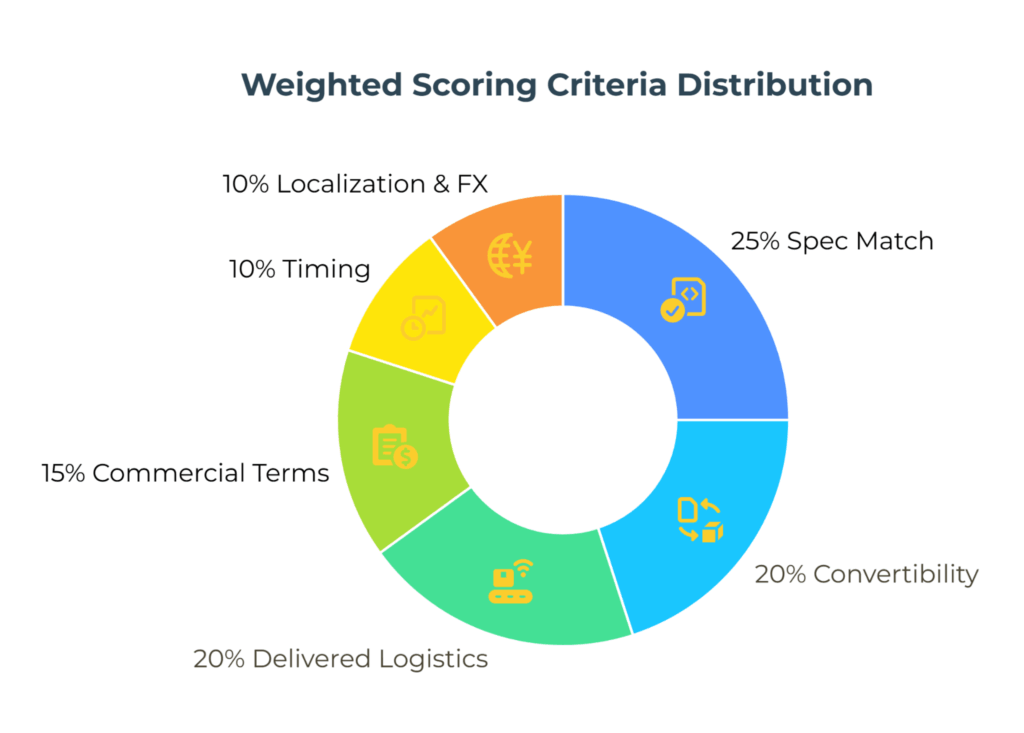
Spec Match (25%): Start high; deviations here create hidden cost throughout the supply chain.
Convertibility (20%): A small run-rate loss erases unit-price gains during production.
Delivered Logistics (20%): Incoterms and lead time reliability protect margin and operations.
Commercial Terms (15%): Cash cost and claim friction belong in the total cost calculation.
Timing (10%): Peak windows earn a premium or deserve a hedge against supply disruption.
Localization & FX (10%): Without consistent HS and FX treatment, comparisons wobble.
Set an approval floor. Many teams choose 3.8/5 in steady demand and 4.0+ in peak seasons. That threshold reflects policy, not dogma; adjust after a quarter of real outcomes.
When teams start logging assumptions, arguments move from opinion to evidence—fast.
FAQ
How should Incoterms be shown inside the approval file?
Write the rule and named place, followed by the edition year: “CIF Mumbai—Incoterms® 2020.” This matches ICC guidance and avoids version confusion, which trade authorities also flag in their advisories.
What about HS codes for kraft paper?
The HS is a global nomenclature standardized at six digits by the WCO; local tariffs often extend to more digits. Start with the WCO overview and validate with a customs broker for the final import tariff line.
How do I normalize EXW, FOB, CIF, and DDP to to-door fairly?
Start by identifying every cost component needed to reach your facility. EXW requires the most additions: inland freight to port, ocean freight, insurance, destination handling, and final delivery. FOB needs ocean freight, insurance, and destination costs. CIF usually needs only destination handling and delivery, while DDP requires verification that all components match your standards.
What belongs in an assumption log to prevent disputes later?
Document freight lanes and rates used, FX conversion timestamps, HS/HTS classifications applied, insurance coverage levels, duty calculation methods, and any yield adjustments. Include the date of analysis and signatures from Finance and Logistics representatives who validated the assumptions.
What thresholds determine Approve vs Defer in the decision matrix?
Quotes within the established driver band receive automatic approval. Those exceeding the band by more than 8% get deferred for additional analysis. The middle range (3-8% above band) requires documented justification but can be approved with proper reasoning logged in the matrix.
Glossary
Incoterms: International Commercial Terms that define buyer and seller responsibilities for delivery, risk transfer, and cost allocation in international trade transactions, standardized by the ICC.
HS/HTS: Harmonized System/Harmonized Tariff Schedule codes used globally to classify traded goods for customs and duty purposes, maintained by the World Customs Organization.
To-door normalization: The process of adjusting all quotes to reflect identical delivery conditions at the buyer’s facility, ensuring fair price comparisons.
Driver-based benchmark: A pricing reference built from underlying cost components (fiber, energy, freight, FX) rather than market quotes or historical averages.
Spec-True yield: The actual consumption rate of paper after accounting for specification differences, waste factors, and performance variations between suppliers.
Assumption log: A documented record of all normalization decisions, conversion factors, and analytical choices made during the price comparison process.
Make the Next Step Easy
When the matrix says “approve,” you still need reliable supply. Shortlist qualified kraft paper mills and trading companies that can meet your spec, delivery, and documentation requirements. Start with a focused supplier search and share the matrix template up front so quotes come back “spec-true.”
Access the Find Suppliers directory to expand your procurement options, or explore our Kraft Paper Suppliers category for specialized sourcing opportunities.
Closing Thought
Approvals feel risky when the price is clear but everything else is fuzzy. A one-page matrix sharpens the picture: stable spec, run-ready reels, predictable delivery, and terms that won’t bite later. Clear. Shared. Defensible.
About the PaperIndex Insights Team
The PaperIndex Insights Team synthesizes complex procurement topics into practical guidance for paper industry professionals. While thoroughly reviewed for accuracy, this content serves educational purposes and should complement, not replace, professional procurement advice.
Disclaimer: PaperIndex operates as a neutral, non-transactional marketplace connecting buyers and suppliers.All examples presented are illustrative and intended for educational purposes only.