

📌 Key Takeaways
Seasonal peaks don’t fail because of demand uncertainty—they fail because purchase orders are released too late to respect the full supplier cycle.
- Supplier Cycle Time Is Five Variables, Not One: Production lead time is only the first component; changeover batching, booking windows, transit variability, and receiving buffers each add calendar days that determine when material becomes usable inventory.
- Treat Transit as a Band, Not a Single Number: Ocean freight quotes represent optimistic scenarios; planning around pessimistic transit times (carrier quote plus 5 days) and rollover buffers (5 to 7 days for high-risk lanes) protects against the 15% to 20% rollover rates common during peak seasons.
- Work Backward from In-Stock Date, Not Forward from Forecast: The PO release date emerges by subtracting each cycle component sequentially—receiving buffer, transit with variability allowance, booking lead time, and production lead time adjusted for MOQ batching—from your target in-stock week.
- Buy Earlier Rather Than More: Forward buying is a timing decision, not a volume decision; releasing orders 10 to 14 weeks ahead (typical for international kraft paper during peak season) based on complete cycle mapping eliminates expediting without increasing carrying cost beyond necessary safety stock.
- Predictable Cadence Beats Reactive Urgency: A rolling 12-week release calendar with milestone confirmations (PO acknowledgment within 48 hours, production start notice, shipment tracking) transforms supplier relationships from transactional to collaborative, reducing rollover risk and protecting booking slots.
Prepared procurement teams hit launch dates while reactive teams pay expediting premiums. Procurement managers, sourcing specialists, and supply chain planners in packaging and converting operations will find the framework here, setting the stage for the detailed calculation method and cadence-building tactics that follow.
Peak demand sneaks up fast.
Forklifts beep across the warehouse floor. Booking slots for your preferred shipping lane vanish overnight. A vessel cutoff appears three weeks sooner than you planned. Meanwhile, your packaging lines sit idle, waiting for orders that are still chasing capacity already spoken for.
This scramble is avoidable. The solution is aligning forward buys to supplier cycle time—buying earlier rather than more. Convert your seasonal forecast into PO-release dates that respect production lead time, changeover cadence tied to minimum order quantities, booking windows, transit variability, and receiving buffers. Done well, you hit launch dates, reduce expediting costs, and build predictable supplier relationships.
Seasonal forward-buy timing in brief: Use your seasonal index to identify the peak in-stock week. Work backward through receiving buffers, transit time with variability allowance, booking lead time, and production lead time including MOQ batching. The result is your recommended PO-release date with clear rationale.
Why Forecast First, Then Forward Buy
Seasonality describes when demand concentrates. A seasonal index—expressed as “Week 38 shows 1.25× baseline demand”—points to the period that matters most for on-time availability. This recurring pattern differs fundamentally from promotional uplift, which is a temporary spike driven by a specific marketing event. Treat promotional demand separately so you don’t mis-time a large forward buy based on one-time activity.
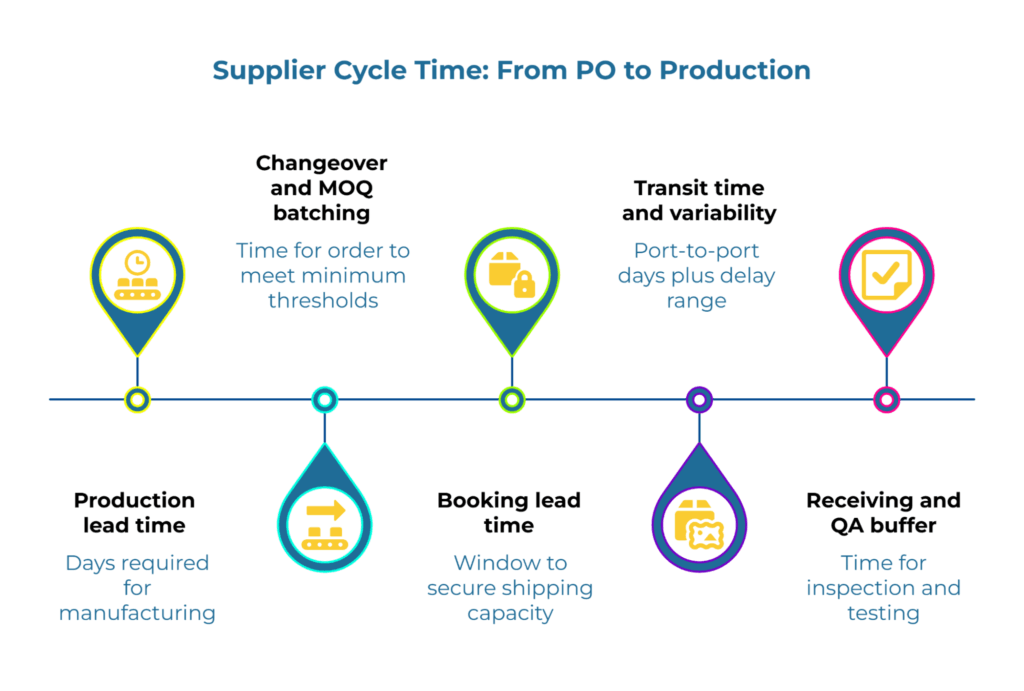
Supplier cycle time is the total calendar duration from PO release to material available for production use. It encompasses five distinct components:
- Production lead time – days required for the mill to manufacture your specification
- Changeover and MOQ batching – additional time if your order waits for a production campaign to meet minimum thresholds
- Booking lead time – window required to secure container or freight capacity on your shipping lane
- Transit time and variability – base port-to-port days plus the delay range for your lane and season
- Receiving and QA buffer – time your team needs to inspect, test, and clear material for use
Each component adds calendar days. Release a PO based only on production lead time and you’ve ignored four other variables that determine when material actually becomes usable. The result is late delivery, expediting fees, or a stockout that halts production.
Forward buying is fundamentally a timing decision. Buying more without adjusting the release date simply shifts inventory risk to the wrong side of the peak.
Map Your Seasonal Pattern Into a Lead-Time Window
Work from a seasonal baseline rather than a one-off forecast. Standard planning practice involves three steps:
Convert sales history into a seasonal index. Use two to three years of data to identify weeks when volume consistently peaks above your annual average. Express this as a ratio where 1.0 represents baseline demand and values above 1.0 indicate peak periods. If baseline monthly demand is 100 metric tons and November averages 140 metric tons, your November index is 1.4.
Choose a target in-stock week for peak availability. If your seasonal index shows a peak in Week 45, set your in-stock target for Week 44 to provide a one-week cushion before the surge hits.
Acknowledge forecast error as a window, not a point. Even well-constructed seasonal models carry margin for error, typically expressed as Mean Absolute Percentage Error (MAPE). A MAPE of 15% means your forecast could miss by ±15% on average. Where uncertainty is high, expand safety stock buffers rather than hard-coding a single date.
This step produces a clear target in-stock date that downstream teams use to backward-plan PO timing.
Translate Forecast to Supplier Cycle Time
The goal now is converting that target in-stock week into a PO-release week that respects how suppliers and logistics actually operate.
Production Lead Time, Changeovers & MOQs
Paper machines and sheeters run in campaigns. When grades or basis weights change, suppliers batch orders to reduce changeover costs. The practical effect is that MOQs and batching can extend effective lead time beyond a nominal figure.
For kraft paper and packaging grades, production lead time typically ranges from 21 to 35 days for established customers with standing specifications. New or custom grades may require 45 to 60 days for trials and quality validation. Your supplier quote should state this clearly. If it doesn’t, request written confirmation specifying “days from PO to ex-works availability.”
Treat lead time as the interval to the next feasible production slot for your specification, not just a calendar average. Helpful guardrails include sharing your likely monthly draw with the supplier early—this helps the mill sequence your runs sensibly. If MOQs force a larger make, plan a post-season drawdown that keeps inventory useful after the peak rather than creating dead stock.
Booking Windows & Lane Capacity
Export bookings tighten ahead of seasonal peaks. A supplier may ship ex-factory on time but miss a sailing if your freight request arrives after carrier cutoff or space release. Ocean freight booking windows vary by trade lane and season. High-volume Asia-Europe and Asia-North America lanes may require 10 to 14 days’ advance booking during peak shipping seasons (typically Q3 and Q4). Less-traveled lanes or slack periods can compress to 5 to 7 days.
Define a booking lead time for your lane and build it into planning. For coordination tactics and role clarity on who books what, see supplier-managed vs buyer-nominated forwarders.
Transit Variability Bands
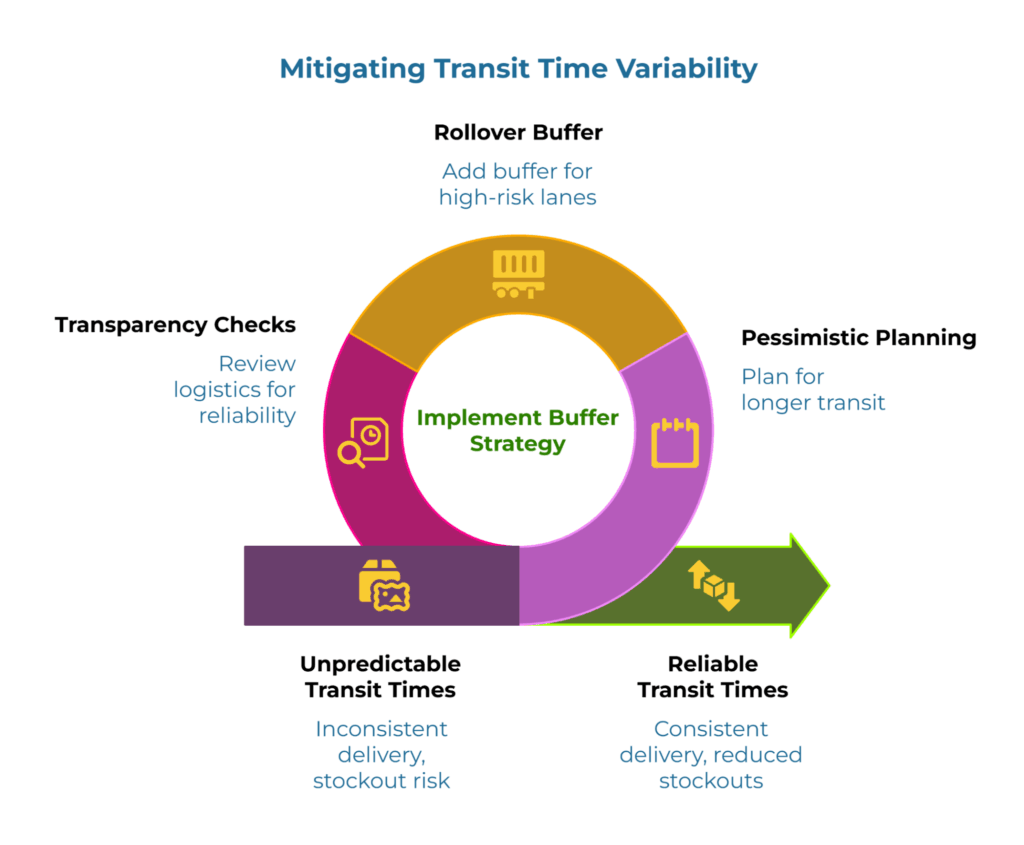
Treat transit as a band, not a single number. A standard Asia-to-Europe route might quote 30 days port-to-port, but realized range could be 28 to 38 days depending on weather, port efficiency, and customs clearance speed. Seasonal congestion, port rotations, and carrier schedule changes create spread.
Build your planning around the pessimistic transit scenario. If the carrier quotes 30 days, plan for 35. This buffer accounts for variability without assuming worst-case disaster. For domestic or short-haul trucking, apply the same principle: if quoted transit is 3 days, plan for 4.
Port congestion and rollover risk are real variables. A rollover occurs when your container is bumped from the scheduled sailing due to overbooking or operational delays. During peak season, rollover rates on certain lanes can reach 15% to 20%, effectively adding a week to transit time. Assume a rollover buffer of 5 to 7 days for high-risk lanes or peak periods.
Use a band that reflects typical variation for your lane and season, then allocate a receiving buffer sized to your tolerance for stockout risk. For exporter reliability signals and practical transparency checks, review logistics transparency over freight myths.
Receiving and Quality Assurance Buffer
Material doesn’t become usable inventory the moment it arrives at your dock. Your team needs time to inspect physical condition (damage, moisture levels), verify specifications against the PO (basis weight, burst strength, Cobb value), and run required quality tests.
For established suppliers with strong track records, a 3-day receiving buffer may suffice. For new suppliers or first-time orders, plan for 5 to 7 days to allow thorough inspection and potential rework if specifications don’t match. This buffer also protects you if the supplier’s lab report doesn’t align with your in-house testing—a scenario more common than most buyers expect.
Use the PO Release Date Mini-Calculator
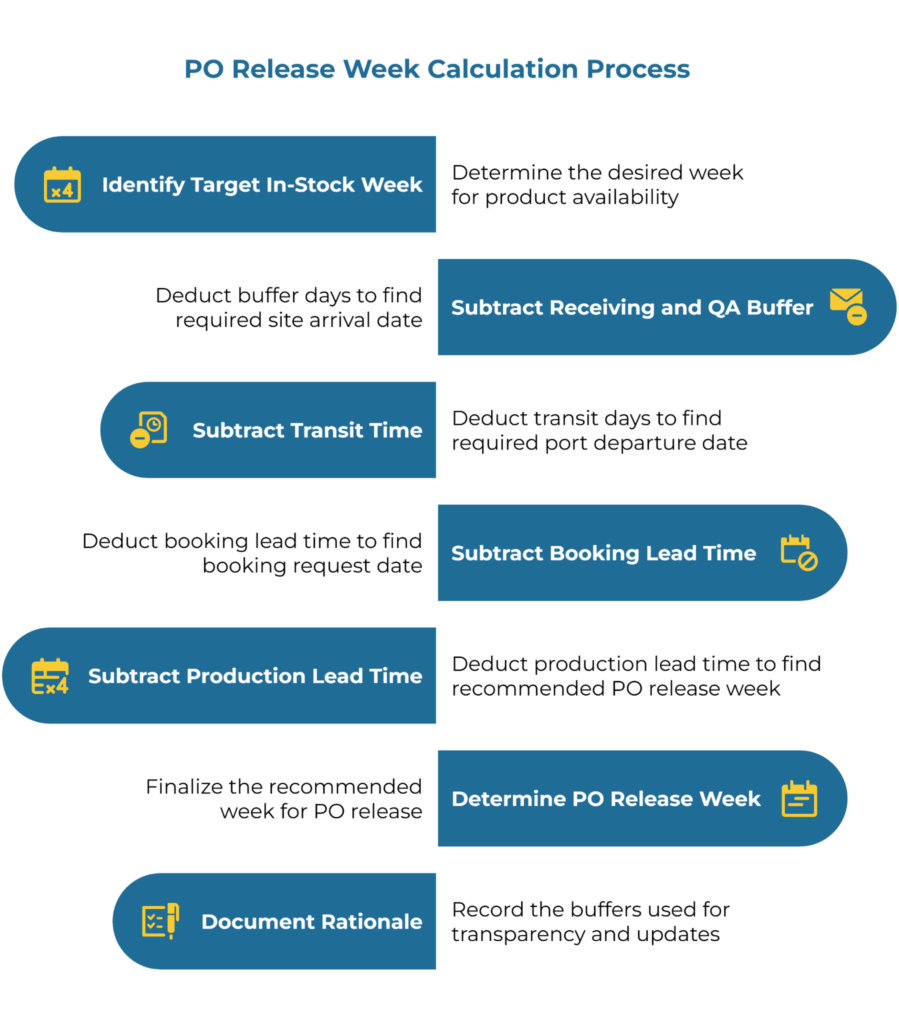
To simplify this multi-variable calculation, use the following framework:
Inputs:
- Target in-stock date (Week X)
- Seasonal peak week or index value
- Production lead time (days, to feasible slot)
- Changeover/MOQ cadence impact (days, if it shifts the slot)
- Booking lead time for your lane (days)
- Transit days with variability allowance
- Receiving and QA buffer (days)
Method:
Work backward from your target in-stock week:
- Subtract receiving and QA buffer → required site arrival date
- Subtract transit time (expected + variability allowance) → required port departure date
- Subtract booking lead time → booking request date
- Subtract production lead time (adjusted for changeover/MOQ cadence) → recommended PO-release week
Output:
- PO-release week/date
- One-line rationale listing exact buffers used, making the date easy to defend and update
Illustrative example (for method only):
Target in-stock: Week 38
Receiving buffer: 5 days
Transit: 22 days + 4 days variability allowance
Booking lead time: 10 days
Production lead time: 21 days (no cadence shift)
Recommended PO release: Week 33
Rationale: Back-planned from Week 38 using 5 + 26 + 10 + 21 days total.
Keep the calculator as a shared checklist so buyers, suppliers, and forwarders all see the same dates and buffers.
Build a Forward-Buy Cadence That Suppliers Accept
A single well-timed PO is valuable. A predictable release cadence that aligns with your supplier’s planning cycle is transformational.
12-Week Release Calendar & Confirmations
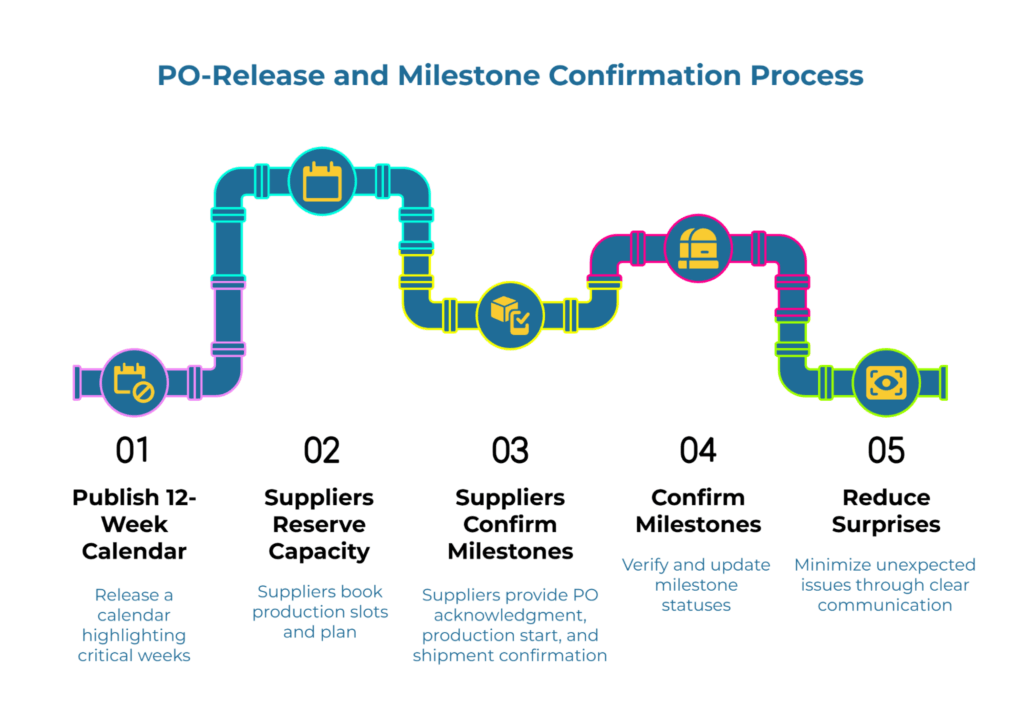
Publish a rolling 12-week PO-release calendar that highlights critical weeks around the seasonal peak. Include:
- Planned PO-release weeks and quantities
- Expected production slots (if already aligned)
- Booking request windows and milestones
- Risk indicators by week (traffic-light system works well)
This visibility allows suppliers to reserve production capacity, plan changeover schedules, and coordinate freight bookings. In return, ask for milestone confirmations: PO acknowledgment within 48 hours, production start notification, and shipment confirmation with tracking details.
Confirm each milestone as it happens. Replace ambiguity with short, dated updates. The confirmation loop reduces surprises on both sides.
Caps to Avoid Bullwhip
Forward buying for seasonal peaks creates over-ordering risk. If every buyer in a market forecasts 40% seasonal uplift and places advance orders accordingly, aggregate demand signals to suppliers may suggest 60% or 80% surge. Suppliers respond by adding capacity, which can create supply glut post-season when everyone’s inventory is full.
Set sensible caps that dampen over-ordering. Examples include limits on week-over-week increases tied to rolling consumption and requiring forward buys to pair with post-season draw plans. Cap your forward buy at forecast plus a defined safety stock percentage—typically 10% to 20% above seasonal index projection. The aim is protecting capacity without starving real demand.
Safety Stock Floors & Post-Season Drawdown
Safety stock is your buffer against forecast error and unexpected demand spikes. For seasonal items, calculate safety stock as a percentage of peak period forecast, adjusted by MAPE. If MAPE is 15% and peak forecast is 140 metric tons, safety stock target might be 21 metric tons (15% of 140).
Keep a floor that covers the variability band through the peak, then schedule a drawdown that returns inventory to baseline promptly after the season. Link drawdown to promotional calendars to avoid sudden stops. This prevents carrying excess inventory into the next cycle.
Visual Timeline
A simple one-line timeline clarifies the full cycle for your team:
Index Peak (Week 45) ← Buffer (Week 44 in-stock) ← Ship (Week 39) ← Receive & QA ← PO Release (Week 33)
Place the recommended PO-release week at the left edge so everyone sees how timing protects the peak.
Quality and Documentation That Reduce Rollovers
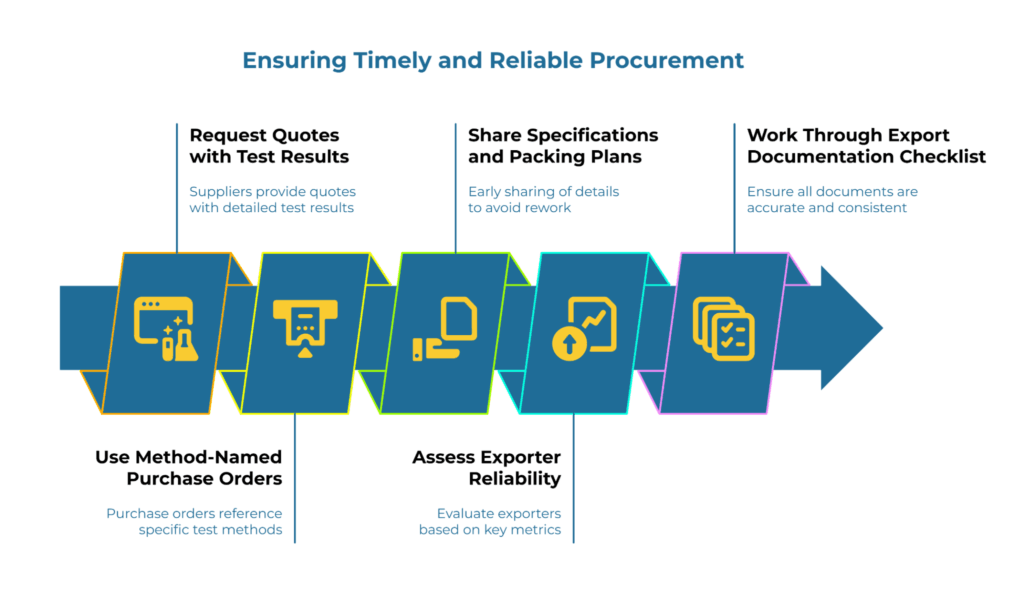
Even perfectly timed POs can fail if quality issues or documentation errors cause delays. Two practices significantly reduce this risk.
Method-named test results at quote time. When requesting quotes, require suppliers to attach recent lab test results that name the exact test method used (ISO 536 for basis weight, ISO 2758 for burst strength, ISO 287 for moisture content). This ensures you’re comparing specifications on the same measurement basis. Vague claims like “high burst strength” aren’t actionable; a result of “450 kPa per ISO 2758” is.
Use a method-named purchase order that references the timing logic. This encourages partners to protect the slot. Share specification details and packing plans early to avoid rework.
Exporter reliability scoring. If sourcing internationally through exporters, assess operational reliability using a simple scorecard. Key metrics include:
- On-time delivery rate (target: 95%+)
- Documentation accuracy (percentage of shipments with error-free Bill of Lading, Certificate of Origin, fumigation certificates)
- Rollover history on your destination lane
- Response time to inquiries
Exporters who score well on these metrics are significantly less likely to cause delays that disrupt your seasonal plan.
For smoother clearance and fewer delays, work through the export documentation checklist. Required documents typically include Bill of Lading, Certificate of Origin, and fumigation certificates. Each document must match exactly across all fields—discrepancies in Incoterms, consignee names, or HS codes trigger holds.
Frequently Asked Questions
Seasonal Index vs Promotional Uplift
A seasonal index expresses recurring demand patterns tied to calendar periods—holiday packaging, harvest seasons, back-to-school campaigns. These patterns repeat annually and can be modeled from historical data. Promotional uplift is a planned, time-boxed event driven by a specific marketing campaign. Build the seasonal plan first to set the backward-planned PO date, then layer promotions as additive demand.
Handling MOQ-Forced Over-Buys
MOQs sometimes force larger runs than needed. Two practical mitigations are common: schedule a post-season draw that keeps surplus moving in baseline months, or collaborate with the supplier to place your campaign near adjacent grades to reduce changeover time. The decision hinges on carrying cost versus cost of expediting or stockouts.
How Early Should Purchase Orders Be Released?
There’s no single answer—the calculator’s buffers determine the date. Use the framework to work backward from your target in-stock week through all supplier cycle components. For international kraft paper shipments during peak season, this typically results in 10- to 14-week advance PO release. In periods of tight booking capacity or lanes with wide transit spread, move releases earlier by increasing variability allowance or booking lead time. Label such adjustments explicitly so stakeholders see the trade-off between inventory days and on-time launch.
From Seasonal Spikes to Confident Launches
Seasonal peaks reward teams that plan with the calendar, not against it. When forward buys align to supplier cycle time, production slots are realistic, bookings land on time, and receiving buffers protect the final week that matters.
By working backward from your in-stock date through production lead time, changeover schedules, booking windows, transit variability, and receiving buffers, you transform seasonal forecasting from an analytical exercise into an actionable procurement plan. The calculator creates one source of truth. The cadence makes it stick. Together they turn seasonal volatility into predictable availability.
Start by mapping your next seasonal peak to a target in-stock date, then use the mini-calculator framework to determine your PO-release week. Share that timeline with your supplier, request milestone confirmations, and build a rolling release calendar that aligns with their planning cycle.
If you’re still lining up capacity for the season, find suppliers across 8,400+ product categories or submit your RFQ and receive quotes free from verified mills and exporters. For more procurement frameworks and international trading guidance, explore the PaperIndex Academy.
Resources
- PaperIndex Academy
- Supplier-Managed vs Buyer-Nominated Forwarders
- Logistics Transparency Over Freight Myths
- Export Documentation Checklist
Disclaimer: This article provides general information about seasonal forecasting and forward-buy timing for educational purposes. Individual circumstances vary based on forecast horizon and error, supplier production lead time, changeover/MOQ cadence, booking lead times and lane capacity, transit variability, and receiving/QA buffers. For guidance tailored to your procurement and launch-readiness plan, consult a qualified professional.
Our Editorial Process
Our expert team uses AI tools to help organize and structure our initial drafts. Every piece is then extensively rewritten, fact-checked, and enriched with first-hand insights and experiences by expert humans on our Insights Team to ensure accuracy and clarity.
About the PaperIndex Insights Team
The PaperIndex Insights Team is our dedicated engine for synthesizing complex topics into clear, helpful guides. While our content is thoroughly reviewed for clarity and accuracy, it is for informational purposes and should not replace professional advice.