

📌 Key Takeaways
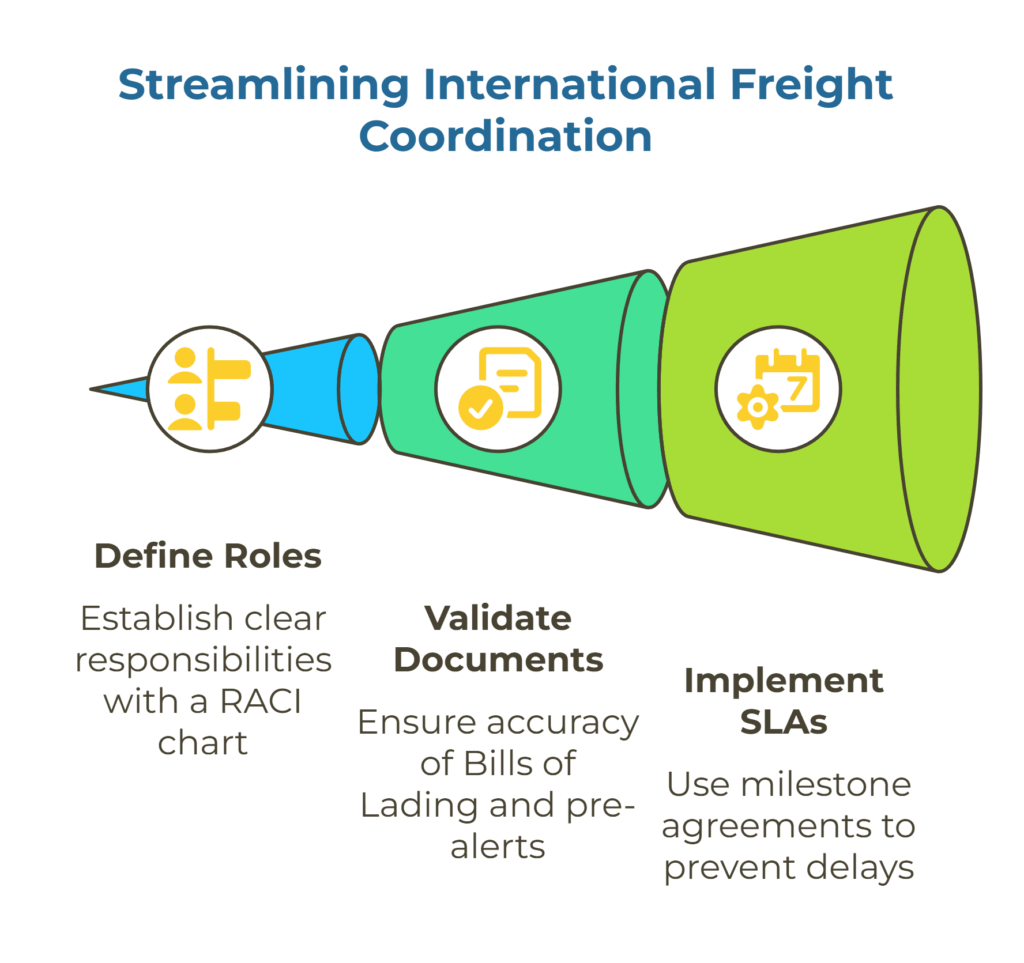
Freight coordination for kraft paper becomes predictable when you lock down who does what before the first container moves.
- Model Selection Drives Visibility: Supplier-managed freight simplifies coordination for routine lanes with proven documentation quality, while buyer-nominated forwarders deliver tighter cost control and real-time tracking for complex compliance scenarios.
- RACI Charts Prevent Document Failures: Clear responsibility assignments for booking, Shipping Instructions, draft BL review, VGM filing, and pre-alerts eliminate the consignee mismatches and missing certificates that trigger bank rejections and customs holds.
- Incoterms® Set Cost Split, Not Coordination Level: CFR and CIF require the seller to arrange carriage, but buyers must still validate draft Bills of Lading and insurance certificates—FOB and FCA shift booking control to buyers while sellers remain accountable for export documentation and timely cargo handover.
- Hidden Fees Live in the Details: Accessorial charges—origin THC, BAF, PSS, destination handling, demurrage, and detention—can add 20-40% to base freight rates, making itemized breakdowns and free-time monitoring essential for accurate landed-cost forecasting.
- Milestone SLAs Stop Rollovers and Surprises: Pre-alerts 72 hours before cut-off, draft BLs within 24 hours of gate-in, and arrival notices 5 days before free-time expiration create the buffer needed to catch errors while correction is still possible.
Prepared coordination = zero-drama customs clearance and predictable delivery windows.
Kraft paper procurement managers, export coordinators, and freight forwarders will find a practical roadmap here, preparing them for the detailed decision matrices, RACI tables, and swimlane workflows that follow.
Choose supplier-managed freight when the lane is routine, the supplier’s documentation quality is proven, and simple Incoterms® suffice. Choose a buyer-nominated forwarder when you need tighter cost control, direct shipment visibility, or complex compliance coordination. Lock roles with a RACI chart, validate draft Bills of Lading and pre-alerts early, and use milestone service-level agreements to prevent origin rollovers and destination surprises.
The shipment clears customs, but your buyer’s bank rejects the documents. The freight forwarder you assumed was handling insurance never issued a certificate. Your container sits at the port, racking up demurrage charges while you scramble to fix a single mismatched consignee name on the Bill of Lading.
These scenarios aren’t rare. They’re the direct result of unclear freight coordination—specifically, confusion about who controls the booking, who drafts which documents, and who pays for what. When you’re moving kraft paper internationally, choosing between supplier-managed freight and a buyer-nominated forwarder isn’t just about price. It’s about control, visibility, and preventing the kind of document mismatches and surprise charges that derail shipments and damage relationships.
This guide walks you through the decision itself, then shows you exactly how to coordinate the handoffs so nothing falls through the cracks.
The Two Models in 90 Seconds
At its core, the choice comes down to who arranges the ocean or air freight leg.
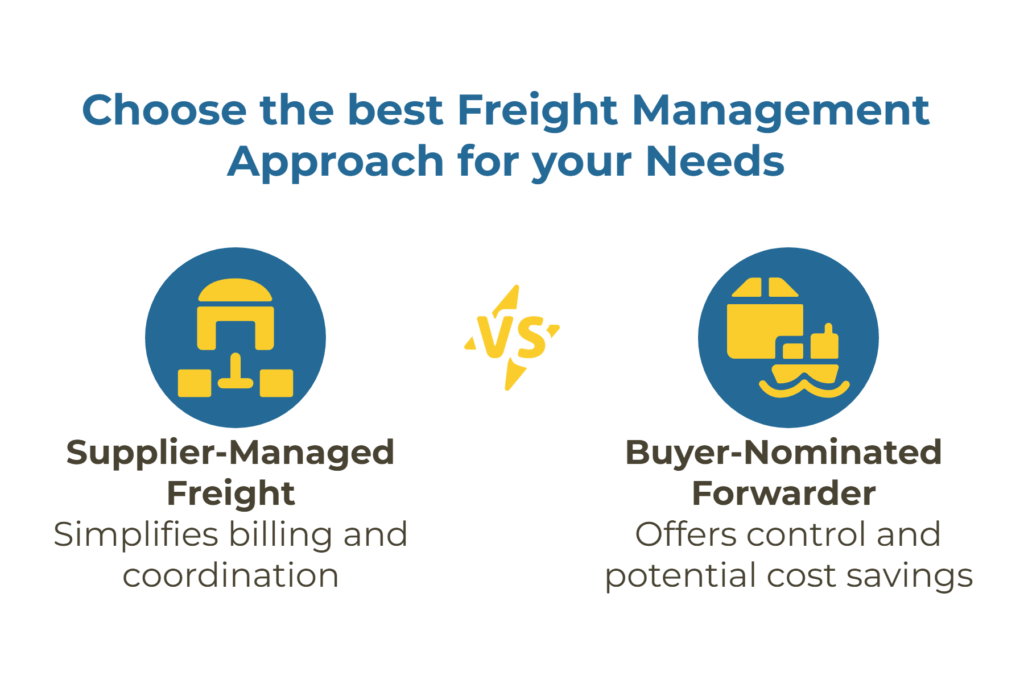
Supplier-managed freight means the seller (the kraft paper mill or exporter) selects and books the freight forwarder. This is typical under Incoterms® 2020 rules like CFR, CIF, CPT, and CIP, where the seller is responsible for arranging carriage to the named destination. The buyer receives a single commercial invoice that includes the product cost and freight as a bundled figure. The seller coordinates with their chosen forwarder to issue the draft Bill of Lading, arrange certificates of origin and fumigation, and handle the shipping instructions.
Buyer-nominated forwarder means the buyer selects the freight forwarder and instructs the seller to hand over the cargo to that specific party. This is common under FCA, FOB, or EXW terms, especially when the buyer has negotiated volume rates with a forwarder, needs the cargo routed through a specific hub for consolidation, or wants direct control over the shipping timeline and documentation. Freight is typically “collect” (charged at destination), and the buyer manages the forwarder relationship directly.
The Incoterm you choose sets the default expectation for who pays for freight and when risk transfers from seller to buyer. But it doesn’t eliminate the need for tight operational coordination. A CIF shipment still requires the buyer to review the draft BL for accuracy. An FOB shipment still requires the supplier to meet the forwarder’s container yard cut-off and provide a complete Shipping Instruction on time. The model you choose determines the structure of accountability, but both sides need to stay engaged to prevent errors.
Decision Matrix: When to Choose Which
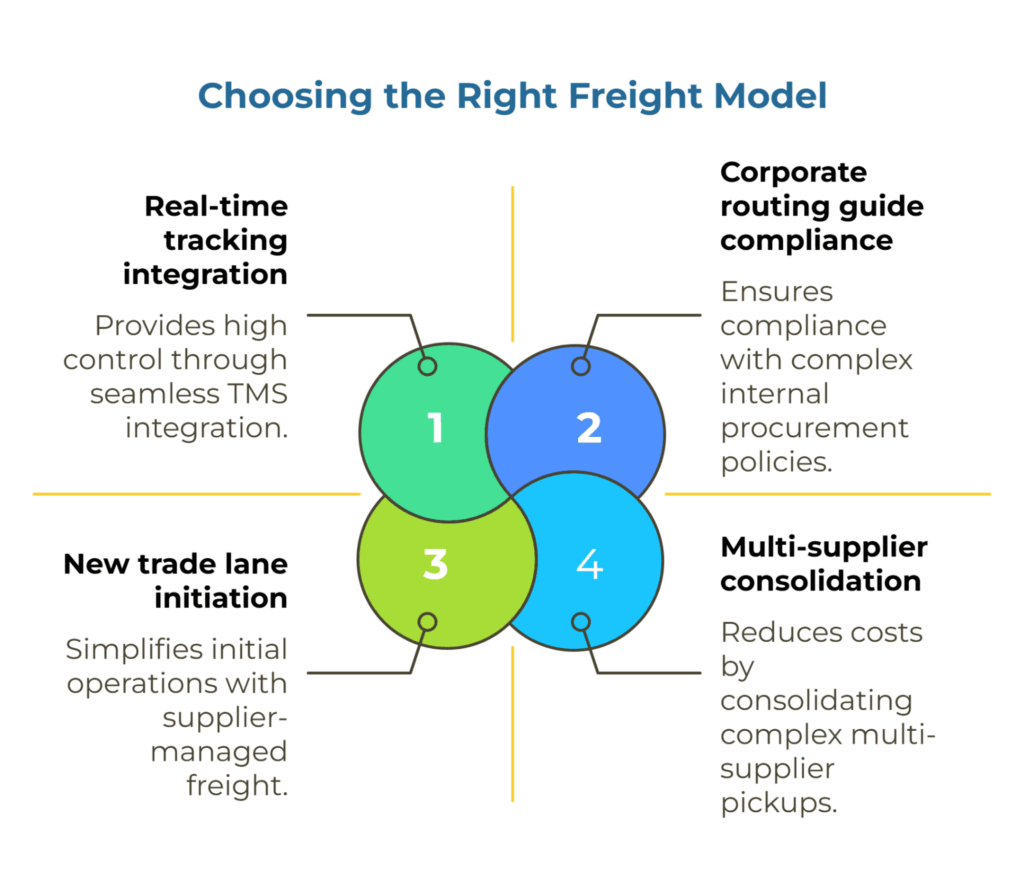
Choosing the right model isn’t about preference—it’s about matching the model to your operational reality. Here’s a practical framework:
| Situation | Choose | Why | Watch-outs | Mitigations |
| New trade lane; low initial volume | Supplier-managed | Supplier has existing forwarder relationships and better freight rates for their volume | Hidden accessorial charges; lack of shipment visibility | Request itemized freight breakdown; require pre-alerts with tracking details |
| Multi-supplier consolidation into one container | Buyer-nominated | Single forwarder coordinates pickups from multiple mills, reducing drayage costs | Supplier resistance to unfamiliar forwarder; delayed pickups | Share forwarder contact details early; confirm container availability and cut-offs in writing |
| Corporate routing guide or preferred carrier contracts | Buyer-nominated | Compliance with internal procurement policy; leverage existing volume discounts | Forwarder may not service supplier’s origin port | Verify forwarder’s network coverage before finalizing; budget for inland trucking if needed |
| Supplier offers extended payment terms tied to freight | Supplier-managed | Bundled invoice simplifies letter of credit or financing arrangements | Less transparency on actual freight cost vs markup | Request separate line items for product and freight on the invoice |
| High compliance sensitivity (FDA, fumigation, phytosanitary) | Buyer-nominated | Direct control over forwarder ensures correct certificates and filing procedures | Supplier may lack experience with buyer’s market requirements | Provide supplier with detailed compliance checklist; pre-approve certificate formats |
| Need real-time tracking and shipment exception alerts | Buyer-nominated | Buyer’s forwarder integrates with buyer’s TMS or provides direct API access | Supplier may not proactively share container numbers or booking confirmations | Establish SLA requiring supplier to share booking reference within 24 hours of gate-in |
Most kraft paper buyers and exporters operate in a mix of both models depending on the customer, the lane, and the shipment size. The key is making the choice explicit at the quotation stage so both parties understand their responsibilities from day one.
RACI: Who Does What

Confusion about responsibilities is the primary cause of document errors and missed deadlines. A RACI chart—Responsible, Accountable, Consulted, Informed—clarifies who owns each task.
Core Freight and Documentation Tasks
| Task | Supplier-Managed Freight | Buyer-Nominated Forwarder |
| Book ocean/air freight | Supplier’s forwarder (R); Supplier (A) | Buyer’s forwarder (R); Buyer (A) |
| Provide Shipping Instruction (SI) | Supplier (R, A); Forwarder (C) | Supplier (R, A); Buyer’s forwarder (C) |
| Draft Bill of Lading review | Buyer (R); Supplier (A for accuracy) | Buyer (R); Supplier (C for shipper details) |
| Commercial invoice and packing list | Supplier (R, A) | Supplier (R, A) |
| Certificate of Origin (COO) | Supplier (R, A); Chamber of Commerce (C) | Supplier (R, A); Chamber of Commerce (C) |
| Fumigation certificate | Supplier (R, A); Certified fumigator (C) | Supplier (R, A); Certified fumigator (C) |
| Verified Gross Mass (VGM) filing | Supplier’s forwarder (R); Supplier (A) | Buyer’s forwarder (R); Supplier provides weight (C) |
| eBL or paper BL issuance | Supplier’s forwarder (R); Carrier (A) | Buyer’s forwarder (R); Carrier (A) |
| Pre-alert to buyer | Supplier (R, A); Forwarder (C) | Buyer’s forwarder (R); Buyer (A) |
| Arrival notice and DO release | Consignee/Buyer (R, A); Destination agent (C) | Consignee/Buyer (R, A); Buyer’s forwarder (C) |
VGM (Verified Gross Mass) is a mandatory safety requirement under the International Maritime Organization’s SOLAS regulations. The shipper is responsible for providing accurate container weight using either Method 1 (weighing the packed container) or Method 2 (weighing all contents and adding tare weight). Without a verified VGM submission, the container will not be loaded onto the vessel.
Common failure points:
- Consignee vs Notify Party mismatch: If the buyer is the consignee on the BL but the customs broker is listed as Notify Party, and those names don’t match the letter of credit exactly, banks may reject documents.
- HS code errors: Supplier lists a generic HS code; buyer’s customs broker needs a specific 10-digit code for import clearance. Result: clearance delays and potential fines.
- Weight discrepancies: Packing list shows net weight; VGM declaration includes container tare weight. If these don’t reconcile, the terminal may refuse gate-out.
The solution is a shared responsibility matrix agreed upon before the first shipment, with clear escalation paths when deadlines are missed.
Incoterms® Cheat Sheet for This Decision
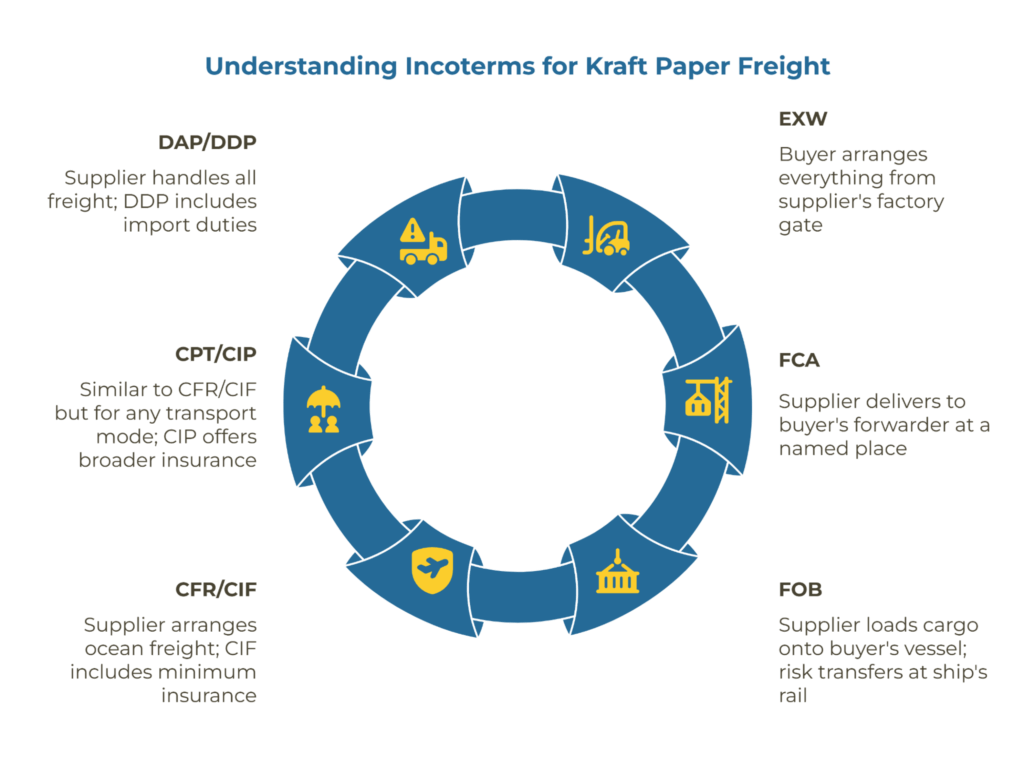
Incoterms® 2020 provides a common language for cost and risk allocation, but they don’t dictate how tightly you need to coordinate. Here’s how the most common terms align with each freight model:
- EXW (Ex Works): Buyer arranges everything from the supplier’s factory gate. Buyer-nominated forwarder handles export formalities. Rarely used for international kraft paper due to export compliance burden on buyers.
- FCA (Free Carrier): Supplier delivers to buyer’s nominated forwarder at a named place (often the supplier’s factory or a container yard). The buyer controls freight. This is increasingly preferred over FOB for container shipments because it clarifies the handover point more precisely.
- FOB (Free on Board): Supplier loads the cargo onto the vessel nominated by the buyer. Buyer-nominated forwarder books the ocean leg. Risk transfers when goods pass the ship’s rail. Still widely used but less precise than FCA for container freight.
- CFR (Cost and Freight) / CIF (Cost, Insurance, and Freight): Supplier arranges and pays for ocean freight to the named destination port. Under CIF, suppliers also arrange minimum insurance coverage—typically Institute Cargo Clauses C, which covers only major perils like vessel sinking, fire, or collision, but not routine handling damage. Supplier-managed model. The buyer should still verify the insurance certificate matches the cargo value and coverage terms.
- CPT (Carriage Paid To) / CIP (Carriage and Insurance Paid To): Similar to CFR/CIF but applies to any mode of transport, not just ocean. Under CIP, the supplier must provide broader Institute Cargo Clauses A coverage, which protects against all risks except those specifically excluded—a significant upgrade from CIF’s more limited Clause C protection. Supplier-managed model. Always verify the policy details and claims procedures.
- DAP (Delivered at Place) / DDP (Delivered Duty Paid): Supplier handles all freight and, under DDP, also pays import duties and taxes. Supplier-managed model with maximum seller responsibility. Rare for kraft paper exports unless the supplier has a local entity in the destination country.
Key BL sensitivities by Incoterm:
- Under FOB/FCA, the BL’s “Freight Prepaid” or “Freight Collect” box must show Collect. Under CFR/CIF/CPT/CIP, it must show Prepaid. A mismatch can cause customs or bank document rejection.
- The “Notify Party” field should always include the buyer’s customs broker or the buyer themselves, regardless of the Incoterm, to ensure timely arrival notices.
For authoritative definitions and the latest updates to international trade terms, consult the International Chamber of Commerce’s official Incoterms® 2020 rules.
Cost Transparency and Hidden Fees
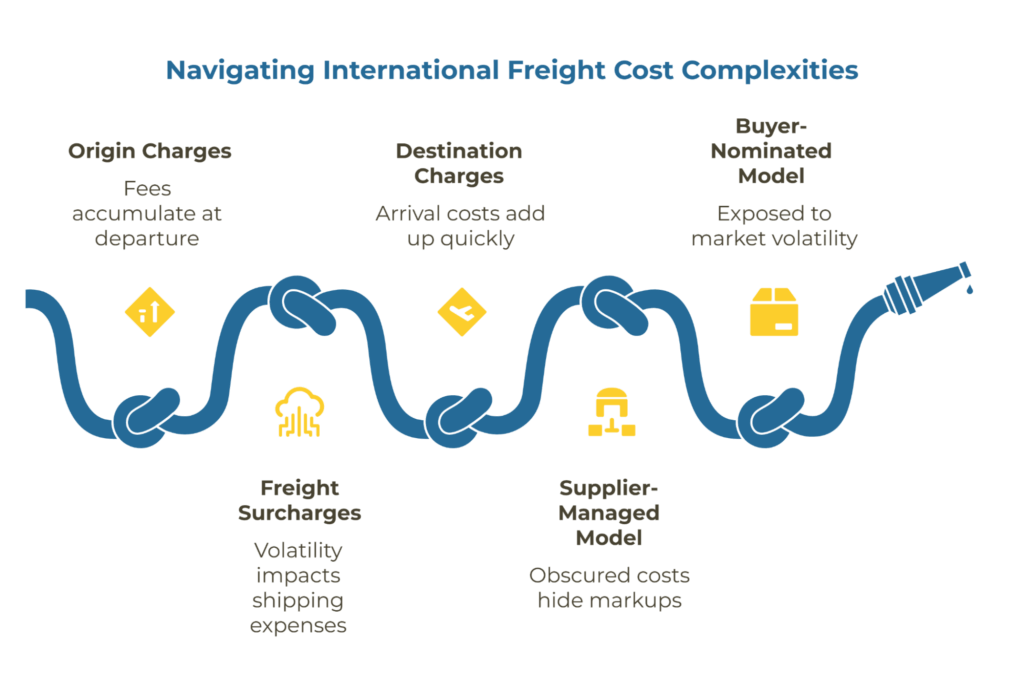
One of the most common frustrations in international freight is the gap between the quoted rate and the final invoice. Understanding where costs hide helps you negotiate better terms and avoid surprises.
Ocean/air base rates are just the starting point. Accessorial charges add up quickly:
- Origin charges: THC (Terminal Handling Charge), documentation fees, VGM filing, gate-in fees, seal fees, customs clearance at origin
- Freight surcharges: BAF (Bunker Adjustment Factor), CAF (Currency Adjustment Factor), PSS (Peak Season Surcharge), GRI (General Rate Increase), war risk surcharge
- Destination charges: Destination THC, ENS/AMS filing (advance manifest), DO (Delivery Order) fee, customs examination fees, demurrage (container storage at port), detention (container storage after pickup), per-diem charges if you hold the container beyond free time
Visibility by model:
In a supplier-managed model, the supplier’s commercial invoice typically bundles the product cost and freight into one figure. You won’t see a detailed breakdown of accessorial charges unless you specifically request it. This can obscure markups. Ask for an itemized freight breakdown as a condition of the PO.
In a buyer-nominated model, you receive invoices directly from your forwarder, giving you full transparency into each charge. However, you’re also exposed to market volatility—if the forwarder faces an unexpected PSS or equipment shortage surcharge, you pay it.
Tactics to avoid duplicate or surprise charges:
- Clarify “all-in” vs “base rate” at quotation stage. If a supplier quotes CIF, confirm whether the price includes destination THC or just ocean freight to the port.
- Set a freight cost cap in the PO for supplier-managed shipments, with any overages requiring buyer approval.
- Require advance notice of surcharges. Your forwarder should notify you of any PSS or GRI at least 7 days before the sailing, giving you time to adjust or delay the shipment.
- Monitor free time allowances at destination. The U.S. Federal Maritime Commission provides interpretive guidance on reasonable demurrage and detention practices. Typical free time for demurrage is 5-7 days; for detention, 3-5 days. Plan your pickup and devanning schedule accordingly.
For kraft paper shipments, where the cargo is relatively bulky but not perishable, demurrage and detention are often the largest hidden cost.
Document Workflows: Two Swimlanes
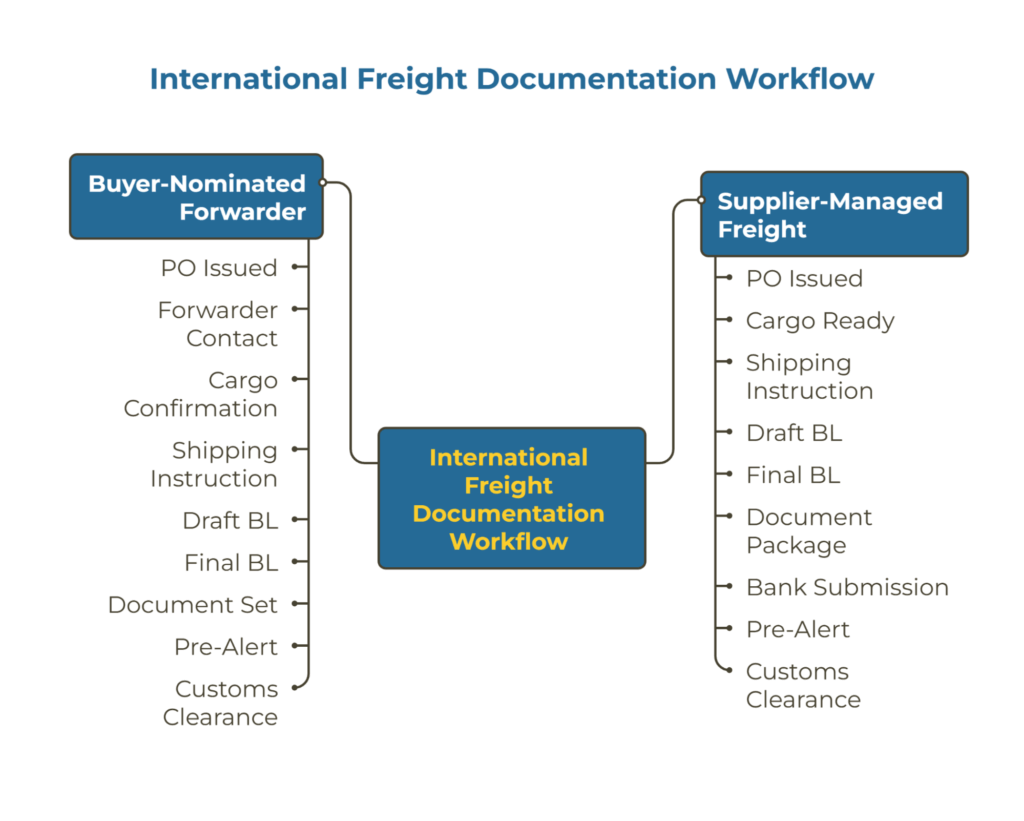
Proper document flow prevents bank rejections, customs delays, and shipment holds. Below are two simplified swimlane workflows—one for each model. These workflows align with standards maintained by the International Federation of Freight Forwarders Associations (FIATA) for international freight documentation.
Workflow A: Supplier-Managed Freight (CIF/CFR/CPT/CIP)
- PO issued (Buyer) → Specifies product, quantity, price (including freight), delivery Incoterm and named place, required documents (BL, COO, fumigation cert, packing list, invoice)
- Cargo ready (Supplier) → Supplier notifies their forwarder; forwarder provides booking confirmation and CY cut-off date
- Supplier drafts Shipping Instruction (Supplier) → Sends SI to forwarder with shipper details, consignee (buyer or “To Order”), notify party, HS code, cargo description, gross/net weight, number of packages
- Forwarder drafts BL (Supplier’s Forwarder) → Sends draft BL to supplier for review
- Supplier reviews and forwards draft BL to buyer (Supplier → Buyer) → Buyer checks consignee name, address, HS code, freight terms (Prepaid), and Incoterm accuracy
- Buyer approves or requests corrections (Buyer → Supplier) → Supplier relays corrections to forwarder
- Forwarder issues final BL (Supplier’s Forwarder) → eBL or paper BL released; supplier receives original
- Supplier sends document package to buyer (Supplier → Buyer) → Commercial invoice, packing list, original BL (or eBL access), COO, fumigation cert, insurance certificate (if CIF/CIP)
- Buyer submits docs to bank (Buyer) → For LC or documentary collection; bank checks for compliance
- Forwarder issues pre-alert to consignee (Supplier’s Forwarder → Buyer) → ETA, container number, seal number, vessel/voyage details
- Cargo arrives; buyer arranges customs clearance and pickup (Buyer) → Buyer’s customs broker files entry; buyer pays destination charges and picks up cargo
Document freeze point: Once the forwarder issues the final BL, no changes are possible without a BL amendment (costly and time-consuming). Lock down all details before this point.
Workflow B: Buyer-Nominated Forwarder (FCA/FOB/EXW)
- PO issued (Buyer) → Specifies product, Incoterm, buyer’s forwarder contact details, required handover point (e.g., FCA supplier’s factory)
- Buyer’s forwarder contacts supplier (Buyer’s Forwarder → Supplier) → Provides booking details, container pickup date, CY cut-off
- Supplier confirms cargo ready date (Supplier → Buyer’s Forwarder) → Supplier loads container or delivers cargo to CY
- Supplier drafts Shipping Instruction (Supplier → Buyer’s Forwarder) → Sends SI with shipper details, cargo description, weights, HS code
- Forwarder drafts BL (Buyer’s Forwarder → Buyer) → Sends draft BL to buyer for review
- Buyer reviews draft BL (Buyer) → Checks consignee, freight terms (Collect), notify party; confirms with supplier if shipper details are correct
- Buyer approves; forwarder issues final BL (Buyer’s Forwarder → Buyer) → Buyer receives original BL or eBL access
- Supplier sends supporting docs to buyer (Supplier → Buyer) → Commercial invoice, packing list, COO, fumigation cert (originals or certified copies)
- Buyer compiles full document set (Buyer) → Combines BL from forwarder with commercial docs from supplier; submits to bank if LC
- Forwarder issues pre-alert (Buyer’s Forwarder → Buyer) → ETA, container number, seal number, vessel details
- Cargo arrives; buyer arranges clearance (Buyer) → Buyer’s customs broker files entry; buyer pays freight invoice (collect) and destination charges; picks up cargo
Pre-alert package contents (both models):
- Container number and seal number
- Vessel name and voyage number
- ETD (Estimated Time of Departure) and ETA
- Port of loading and port of discharge
- BL number or booking reference
- Cargo description and HS code
- Gross weight and number of packages
- Any special handling instructions (e.g., temperature monitoring for coated grades)
Send this package at least 3-5 days before vessel arrival to give the buyer time to arrange clearance and coordinate inland transport.
Accuracy checklist for all documents:
- Shipper and consignee names match exactly (including legal entity suffix: Ltd., Inc., LLC)
- Addresses include street, city, postal code, country
- HS codes are complete (6-digit minimum; 8-10 digits for import clearance)
- Weights match across invoice, packing list, BL, and VGM (within reasonable tolerance for packaging variance)
- Number of packages and package type (rolls, pallets, cartons) are consistent
- Incoterm and named place are stated clearly (e.g., “CIF Hamburg, Germany, Incoterms® 2020”)
- Freight terms on BL match the Incoterm (Prepaid for CIF/CFR/CPT/CIP; Collect for FOB/FCA)
A single typo in the consignee name can trigger a bank rejection and delay payment by a week or more.
Risk Scenarios and Preventive Controls
Even with clear workflows, things go wrong. Here are the most common failure modes and how to prevent them.
Scenario 1: Late Shipping Instruction Causes Rollover
Situation: Supplier submits the SI 24 hours before the CY cut-off. Forwarder needs 48 hours to process, generate the draft BL, and get carrier approval. Result: cargo misses the sailing and rolls to the next available vessel (often 7-14 days later for smaller lanes).
Control: Establish an SLA requiring the supplier to submit a complete SI at least 72 hours before CY cut-off. Include this requirement in the PO terms.
Scenario 2: Shipper/Consignee Mismatch Blocks Bank Documents
Situation: The Letter of Credit specifies the consignee as “ABC Manufacturing Ltd.” but the BL shows “ABC Manufacturing Limited.” The bank rejects the documents as non-compliant.
Control: Before the first shipment, exchange a signed “company name confirmation” document that spells out the exact legal name, address, and contact details for both shipper and consignee. Use this as the master reference for all future SIs. Store it in a shared folder accessible to both the supplier and the forwarder.
Scenario 3: Wrong Freight Terms on BL
Situation: The PO specifies FOB (buyer pays freight), but the forwarder mistakenly issues the BL with “Freight Prepaid.” Customs questions the discrepancy, and the shipment is held for verification.
Control: Include a “freight terms verification” step in the draft BL review. The buyer’s reviewer must confirm the “Prepaid/Collect” box matches the Incoterm in the PO. Flag any mismatch immediately and request a corrected draft before the forwarder releases the original.
Scenario 4: Invalid or Late Certificate of Origin/Fumigation
Situation: The buyer’s customs broker discovers the COO wasn’t stamped by the chamber of commerce, or the fumigation certificate lists the wrong treatment method (heat treatment vs methyl bromide). Cargo is held pending re-certification.
Control: Require the supplier to send scanned copies of the COO and fumigation certificate as soon as they’re issued—before the cargo sails. The buyer’s customs broker can review them for compliance and flag issues while there’s still time to re-issue the documents.
Scenario 5: Insurance Gap Under CIF/CIP
Situation: The supplier provides a CIF quote but only insures for 110% of invoice value with Institute Cargo Clauses C (minimal coverage). A container is damaged in transit; the claim is denied because the damage resulted from rough handling—not covered under Clause C.
Control: If your PO specifies CIF or CIP, explicitly state the required insurance coverage level in the PO terms (e.g., “Institute Cargo Clauses A, 110% of CIF value”). Request a copy of the insurance certificate before shipment. If the coverage is insufficient, arrange your own buyer’s contingent insurance policy to fill the gap.
Scenario 6: Demurrage and Detention Exposure
Situation: Cargo arrives on a Friday. The buyer’s warehouse is closed on weekends. Free demurrage expires on Tuesday (5 days); the buyer doesn’t pick up the container until Wednesday. Result: 1 day of demurrage at $100/day, plus mounting detention charges if the empty container isn’t returned within the detention-free period.
Control: Track the vessel ETA and calculate the last free day. Schedule container pickup and devanning 1-2 days before the free period expires. If delays are unavoidable, request a free time extension from the shipping line in writing before the deadline.
KPIs and SLAs
To manage freight coordination effectively, you need measurable targets. Here are the key performance indicators and service-level agreements that matter:
Performance Metrics
- First-pass document accuracy: Target ≥95%. Measure the percentage of draft BLs, invoices, and certificates that require zero corrections before final issuance.
- On-time gate-in: Target 100%. Measure whether cargo arrives at the CY within the forwarder’s specified window, preventing rollovers.
- Demurrage and detention days per shipment: Target 0 days. Track average D&D days; investigate any shipment exceeding 1 day.
- Freight cost variance vs quote: Target ≤5%. Measure actual freight invoice vs the original quotation; flag variances for root cause analysis.
- On-time, in-full (OTIF) delivery: Target ≥95%. Measure shipments arriving within the agreed ETA window with zero quantity shortages.
- Claims rate: Target ≤1% of shipment value. Track cargo damage or loss claims as a percentage of total shipment value.
Milestone SLA Timings
| Milestone | Target Timing |
| Pre-alert issued | ≥72 hours before CY cut-off (supplier-managed) or before factory pickup (buyer-nominated) |
| Draft BL provided | Within 24 hours of cargo gate-in |
| Final BL/eBL available | Within 48 hours of on-board confirmation |
| Destination arrival notice | ≥5 days before free-time starts |
These targets represent planning benchmarks. Actual performance varies by terminal, carrier, and trade lane. Codify lane-specific SLAs in your standard operating procedures and review them with suppliers and forwarders quarterly.
Establish these KPIs jointly with your key suppliers and forwarders. Review performance quarterly and adjust SLAs as trade lanes mature.
Illustrative Examples
Example 1: New lane, small order → Supplier-managed makes sense
A European converter is sourcing 1 x 20′ container of virgin kraft linerboard from a mill in Southeast Asia for the first time. Volume is low (22 tons), and the buyer has no existing forwarder relationships in that region. The supplier offers a CIF Hamburg price that includes freight and insurance. The buyer accepts, but requests an itemized freight breakdown showing ocean freight, origin THC, and insurance separately. The buyer also asks for pre-alert details (container number, ETA, BL scans) to be sent 5 days before arrival. The supplier’s forwarder handles all bookings and documentation. The buyer focuses on reviewing the draft BL for accuracy and ensuring the consignee name matches their bank’s LC exactly. Result: smooth first shipment; buyer avoids the complexity of coordinating an unfamiliar origin.
Example 2: Multi-supplier consolidation → Buyer-nominated for control
A North American packaging company sources kraft paper from three different mills in the same country to fill a 40′ HC container. Each mill produces a different grade (bleached kraft, brown kraft, and kraft linerboard). The buyer nominates a single freight forwarder to coordinate pickups from all three mills, consolidate the cargo, and issue one BL covering all three shipments. The buyer negotiates an FCA Incoterm with each mill (delivery to the forwarder’s CFS facility). The buyer’s forwarder provides a shared booking reference and coordinates staggered pickup dates. Each mill submits its own Shipping Instruction; the forwarder consolidates the data and issues a single master BL with the buyer as consignee. Result: reduced per-unit freight cost through consolidation, direct visibility into all pickups, and simplified customs clearance with one BL instead of three.
Frequently Asked Questions
Can I use my own forwarder under CIF?
Under CIF, the seller is contractually obligated to arrange carriage to the named port of destination and provide proof of that arrangement through a Bill of Lading showing freight prepaid. Using your own forwarder conflicts with the fundamental structure of CIF as defined in Incoterms® 2020. If you need control over the freight arrangement, renegotiate the transaction under FCA or FOB terms instead. That way, roles are clear from the start, and there’s no confusion about who controls the booking or bears the responsibility for carriage arrangements.
Who insures under CIP/CIF—and what should I verify?
Under both CIF and CIP, the seller is responsible for arranging insurance for the buyer’s benefit. However, the coverage levels differ significantly. CIF requires only minimum coverage under Institute Cargo Clauses C, which protects against major perils like vessel sinking, fire, or collision—but excludes routine handling damage, theft, or pilferage. CIP requires broader Institute Cargo Clauses A coverage, which protects against all risks except those specifically excluded in the policy.
Before the cargo sails, request a copy of the insurance certificate and verify:
- The insured value (should be at least 110% of the invoice amount to cover freight and profit margin)
- The coverage type (Clauses A, B, or C)
- The policy period (warehouse to warehouse, not just port to port)
- The claims contact and notification requirements
If the coverage is insufficient for your risk tolerance, purchase your own buyer’s contingent cargo insurance policy to fill the gap.
How do I prevent destination surprise charges?
Destination surprise charges—unexpected THC, documentation fees, or customs examination costs—are a common frustration. Here’s how to minimize them:
- Clarify “CIF” or “CFR” scope at quotation. Ask the supplier: “Does your CIF price include destination THC, or just ocean freight to the port?” Some suppliers interpret CIF as covering only the ocean freight, leaving the buyer to pay destination terminal handling.
- Request an “all-in” CIF or CFR quote that includes destination THC, so there’s no ambiguity.
- Review the forwarder’s tariff before confirming the booking. Most forwarders publish a standard tariff of destination charges on their website or can provide it upon request.
- Use a trusted customs broker who can give you an upfront estimate of duties, taxes, and clearance fees based on the HS code and cargo value.
- Monitor the shipment proactively. Don’t wait for an arrival notice. Track the vessel yourself and contact the destination agent 2-3 days before arrival to confirm the charges and arrange for payment.
What if the supplier refuses a buyer-nominated forwarder?
This happens occasionally, especially if the supplier has an exclusive relationship with a specific forwarder or if the buyer’s nominated forwarder doesn’t service the supplier’s origin port. Here are your options:
- Negotiate a compromise with Incoterm. Instead of EXW or FCA (which require the supplier to hand over cargo to your forwarder at their facility), propose FOB (where the supplier loads the cargo onto your forwarder’s nominated vessel at the port). This reduces the supplier’s inland coordination burden.
- Offer to cover any incremental costs. If the supplier’s hesitation is about unfamiliar processes or extra coordination effort, offer to reimburse them for any additional inland trucking or documentation fees associated with using your forwarder.
- Provide detailed forwarder contact information and an introduction. Sometimes resistance stems from uncertainty. Facilitate a direct introduction between the supplier’s export coordinator and your forwarder’s origin agent. Share the forwarder’s container depot address, cut-off times, and contact details upfront.
- Fall back to supplier-managed freight for the first shipment, then revisit. If this is a new relationship and the supplier is uncomfortable with the change, accept their forwarder for the trial order. Once trust is established, propose switching to a buyer-nominated model for future shipments, demonstrating the benefits (cost savings, visibility, consolidation opportunities).
References and Standards
For further guidance on international trade terms, freight documentation, and industry-specific technical standards, consult these authoritative resources:
- Incoterms® 2020: Official international commercial terms framework, International Chamber of Commerce
- SOLAS VGM Requirements: Verified Gross Mass regulations under maritime safety rules, International Maritime Organization
- Demurrage & Detention: U.S. interpretive guidance on reasonable billing practices, Federal Maritime Commission
- Freight Documentation Standards: Best practices for Bills of Lading and international freight forwarding, FIATA
- Packaging & Marking Standards: Industry standards catalog, ISO
- Paper Technical Standards: Testing and grade specifications for kraft paper products, TAPPI
Looking to connect with qualified kraft paper suppliers or post an RFQ to reach exporters? Explore the PaperIndex Academy for more freight coordination and international trade resources, or browse kraft paper buyers seeking your products.
Disclaimer: This guide is educational and non-promotional. PaperIndex does not broker transactions or sell market-intelligence products.
Our Editorial Process
Our expert team uses AI tools to help organize and structure our initial drafts. Every piece is then extensively rewritten, fact-checked, and enriched with first-hand insights and experiences by expert humans on our Insights Team to ensure accuracy and clarity.
About the PaperIndex Insights Team
The PaperIndex Insights Team is our dedicated engine for synthesizing complex topics into clear, helpful guides. While our content is thoroughly reviewed for clarity and accuracy, it is for informational purposes and should not replace professional advice.