

📌 Key Takeaways
Comparing supplier quotes on price alone hides the packaging and moisture protection costs that determine whether paper arrives usable or damaged.
- Normalize to To-Door Costs: Convert all quotes to the same delivery basis—including freight, insurance, and duties—before comparing unit prices.
- Define Packaging Tiers Upfront: Establish baseline, reinforced, and premium protection standards, then require suppliers to quote at your specified tier.
- Model Expected Damage Rates: A quote lacking adequate protection carries higher damage probability—build that 5-8% cargo loss into your comparison math.
- Specify Moisture Barriers by Route: Long transit times and tropical lanes require vapor barriers and desiccants; matching protection to route risk prevents container rain losses.
- Embed Standards in Contracts: Reference packaging tiers, moisture requirements, and verification evidence in purchase orders so both parties understand “acceptable” before shipment.
The cheapest quote becomes the most expensive when damage costs surface after arrival.
Small importers managing paper procurement will gain a systematic framework for risk-adjusted supplier evaluation, preparing them for the detailed normalization methods and contract clauses that follow.
The cheapest quote rarely stays cheap.
Picture this: a container arrives at your warehouse. You’ve saved $15 per ton compared to another supplier’s offer. But as the doors swing open, the smell hits first—damp, musty. Three rolls in the front row show water staining. Two more have crushed edges from inadequate corner protection. That $15 saving just evaporated, replaced by rejection costs, emergency sourcing, and a difficult conversation with your customer.
For small importers managing tight margins, this scenario isn’t hypothetical. It’s the predictable result of comparing supplier quotes on price alone while ignoring the packaging and protection standards that determine whether paper arrives ready to use or ready for a claim.
This article shows you how to benchmark quotes on a to-door, risk-adjusted basis so you never trade cheap pricing for expensive damage.
Why “Cheapest Quote Wins” Backfires for Paper Cargo
A supplier quote typically shows a clean number: price per ton, delivery terms, payment conditions. What it often hides matters more.
Line-item pricing frequently excludes or minimizes three critical cost drivers. First, packaging materials and build quality—the corner boards, stretch wrapping, pallet construction, and blocking or bracing that protect rolls and sheets during weeks of transit. Second, moisture protection measures such as vapor barriers, desiccants, and waterproof wrapping that defend against container rain and humidity. Third, stowage quality and verification, meaning how cargo is loaded, secured, and documented before the container doors seal.
When any of these drivers falls short, the hidden costs surface quickly. Rejections force you to refuse delivery entirely, tying up working capital while you scramble for alternatives. Stock that’s damaged but usable often sells only at steep discounts, eroding margins you planned on. Extra handling adds labor costs as your team sorts, inspects, and segregates affected material. Administrative time accumulates through claims documentation, supplier disputes, and insurance paperwork. And production downtime hits hardest when your converting line sits idle waiting for replacement stock that meets specification.
The pattern repeats across the industry. Industry guidance from marine insurers such as TT Club regularly highlights poor packing and securing as a major root cause of containerised cargo damage and loss, rather than rare “act of God” events.
What Are Driver-Based Benchmarks for Packaging?
Before comparing quotes effectively, a shared vocabulary helps.
Key Terms to Understand
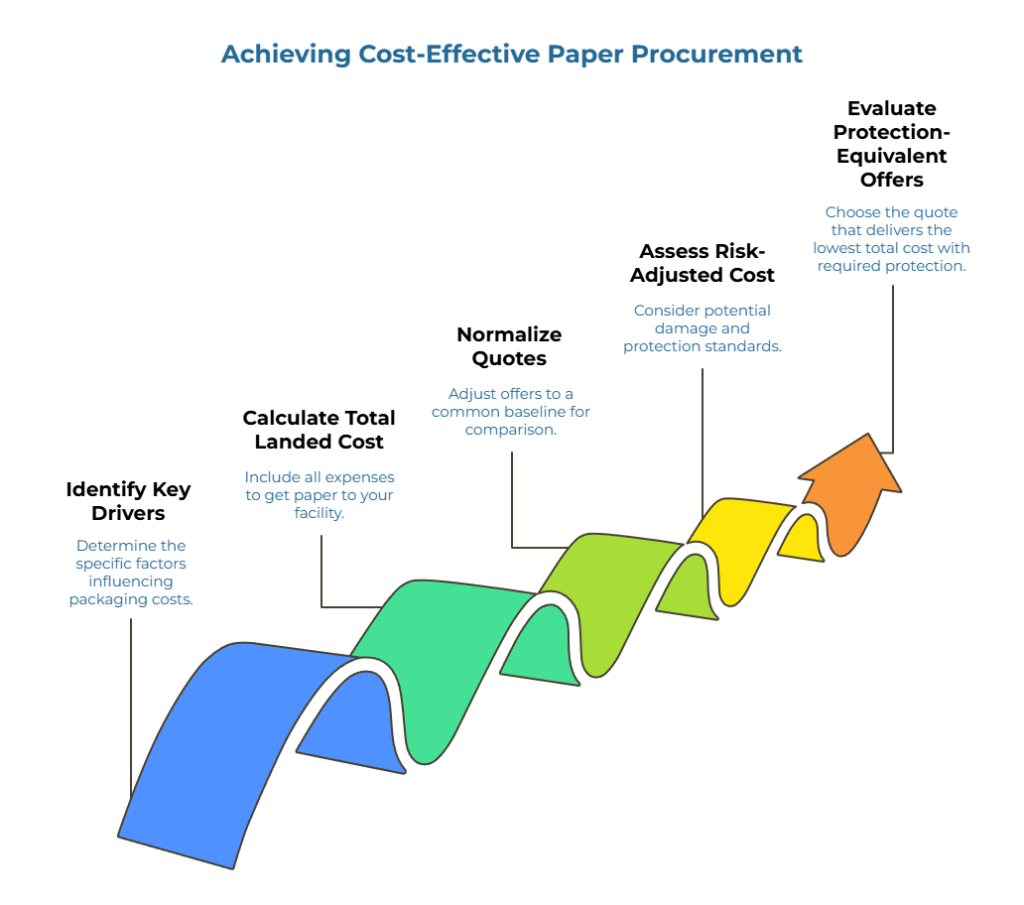
A driver-based benchmark identifies the specific factors—drivers—that influence total cost, then sets minimum standards for each before price comparison begins. For paper shipments, the key drivers are packaging specification level, moisture barrier level, stowage verification practices, and supplier process maturity.
Total landed cost captures everything required to get usable paper to your facility: unit price, freight, insurance, duties, handling, and any losses or quality deductions along the way. External guidance from logistics providers such as DHL consistently frames total landed cost as including product, shipping, duties, insurance, and other fees, not just the supplier’s base price.
Quote normalization is the process of adjusting different supplier offers to the same baseline so genuine comparison becomes possible. A $600/ton CIF quote and a $550/ton EXW quote aren’t comparable until you’ve added the freight, insurance, and handling costs the EXW price excludes.
Risk-adjusted cost adds one more layer: the probable cost of damage given a supplier’s protection standards. A quote with weak packaging isn’t truly cheaper if you’ll lose 5% of every shipment to moisture or crushing.
The benchmark approach shifts your evaluation method. Instead of asking “which quote has the lowest price,” you ask “which quote delivers the lowest total cost at my required protection standard.” You stop comparing apples to oranges and start comparing protection-equivalent offers.
Step-by-Step: Normalize Quotes to a To-Door Basis
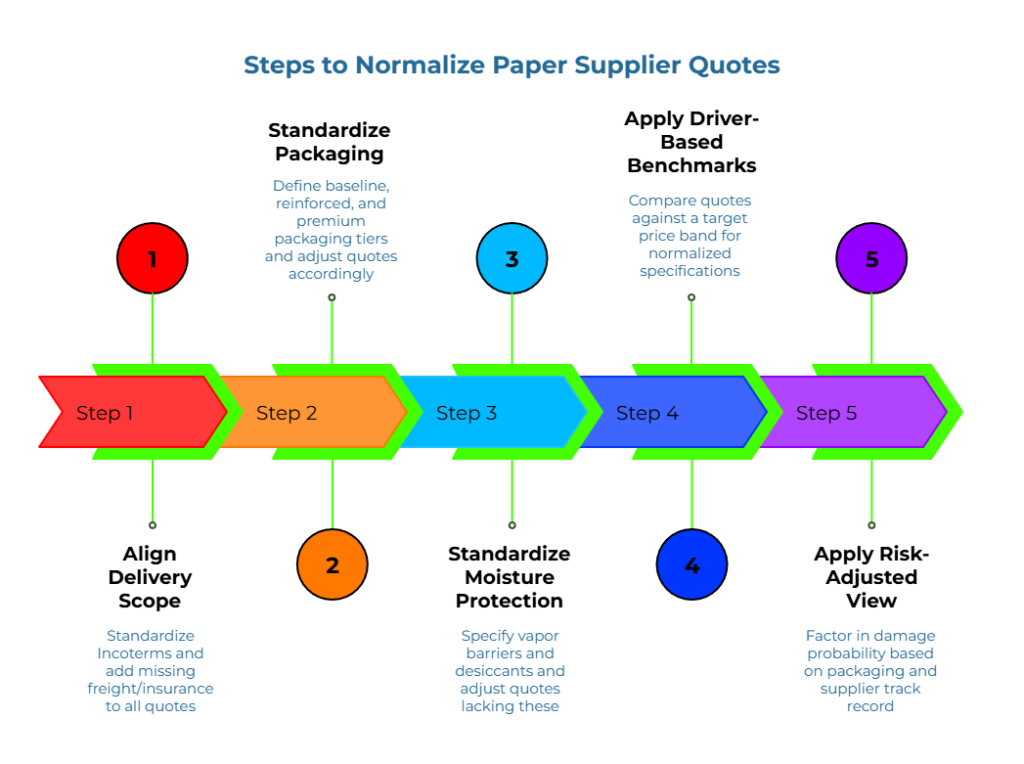
Turning this concept into practice requires a systematic process. Work through these five steps with every quote you evaluate.
Step 1: Align Delivery Scope
Different Incoterms shift responsibility for freight, insurance, and risk at different points. An EXW (Ex Works) quote leaves nearly everything to you. A CIF (Cost, Insurance, Freight) quote bundles more, but the insurance coverage may be minimal. A DDP (Delivered Duty Paid) quote includes almost everything.
Before comparing prices, identify what each quote includes and add estimates for anything missing. If Supplier A quotes EXW and Supplier B quotes CIF, you need to add freight and insurance estimates to Supplier A’s price before the numbers mean anything side by side. The International Chamber of Commerce’s Incoterms rules are the global reference for who pays for what and where risk transfers. For a deeper treatment of this normalization process, the guide on why to-door comparability beats “cheapest quote” thinking walks through the mechanics in detail.
Step 2: Standardize Packaging Specifications
Create three clear tiers against which you’ll evaluate every supplier’s offering.
Baseline protection represents the minimum acceptable standard: single-layer stretch wrap, standard pallets, basic corner boards, no supplemental moisture barrier. This level may suffice for short, temperate routes with low handling intensity.
Reinforced protection adds meaningful upgrades: multi-layer wrapping, reinforced corner boards, moisture-resistant outer wrap, and documented stowage protocols. This suits most international routes.
Premium protection includes everything above plus desiccants or active moisture control, photographic load verification, and enhanced blocking and bracing. High-value cargo or challenging routes (long transit, tropical humidity, multiple handling points) warrant this level.
Beyond physical materials, consider supplier process maturity: documented standard operating procedures for packing, quality checks before container closure, and corrective-action discipline when issues arise.
When a supplier quotes a price, determine which tier their standard packaging matches. If they quote baseline but you need reinforced, either request a revised quote at the higher spec or add an estimated upgrade cost yourself.
Step 3: Standardize Moisture Protection Level
Moisture damage remains one of the most common causes of paper cargo claims. Container rain—condensation that forms inside containers during temperature swings—can drench cargo that was perfectly dry at loading.
Specify what moisture protection you require: vapor barrier liners, desiccant quantity per container, or both. Quotes that omit these protections need adjustment. Industry data and supply chain analysis consistently show that packaging materials constitute a variable but critical component of a product’s final landed cost, often varying widely between bulk raw materials and finished goods. Even within that range, a modest uplift for better moisture barriers can have a disproportionate impact on damage prevention. The International Cargo Handling Coordination Association provides guidance on moisture management practices that can inform your specifications.
Step 4: Apply Driver-Based Benchmarks
Now create your comparison framework. Define a target driver band—for example, “price per ton at reinforced protection level, with specified moisture barrier, CIF your nearest port.”
Any quote that doesn’t meet this band needs adjustment before it enters your comparison. Quotes exceeding the band (premium protection when you only need reinforced) might be trimmed. Quotes falling short must be penalized or upgraded.
As a foundational principle for this process: normalize every quote to a single to-door basis—align Incoterms, freight, insurance, duties, and FX—then award within a driver-based price band.
Step 5: Apply a Risk-Adjusted View
The final step accounts for damage probability. A quote lacking adequate drivers carries higher damage risk. Rather than hoping for the best, build that risk into your comparison.
If historical data or supplier track record suggests a 5% damage rate with baseline packaging versus 1% with reinforced, model that difference. On a $100,000 shipment, that’s the difference between $5,000 expected loss and $1,000 expected loss. The “cheap” quote suddenly looks expensive.
The Quote Normalization Table
The following comparison illustrates how these principles work in practice. The numbers are illustrative—your actual figures will vary based on cargo value, route, and supplier specifics.
| Factor | Cheap Quote | Secure Quote |
| Unit Price (USD/ton) | $580 | $595 |
| Delivery Terms | FOB origin | FOB origin |
| Packaging Level | Baseline | Reinforced |
| Moisture Protection | None specified | Vapor barrier + desiccants |
| Stowage Verification | No documentation | Photo checklist provided |
| Estimated Freight & Insurance | $45/ton | $45/ton |
| Normalized To-Door Price | $625/ton | $640/ton |
| Expected Damage Rate (scenario) | 6% | 1% |
| Damage Cost on $50,000 shipment | $3,000 | $500 |
| Risk-Adjusted Total Cost | $628/ton + $3,000 damage | $640/ton + $500 damage |
On a typical 80-ton container valued at roughly $50,000, the “cheap” quote at $625/ton normalized costs $50,000 plus an expected $3,000 in damage—total $53,000. The “secure” quote at $640/ton costs $51,200 plus $500 expected damage—total $51,700.
The secure quote wins by $1,300 despite a higher line-item price. The 1-2% premium on packaging and protection avoids a much larger loss.
To use this framework yourself, replace the illustrative figures with your actual supplier quotes, route-specific freight estimates, and damage rates based on your experience or supplier track records.
How to Use Driver-Based Benchmarks in Supplier Negotiations
These benchmarks work best when suppliers know your standards before they quote.
Structure your RFQ to specify required packaging and moisture drivers upfront. State clearly: “Please quote for reinforced packaging tier including vapor barrier and minimum 500g desiccant per container. Quotes at lower protection levels will not be evaluated.” This filters out suppliers who compete only on price by cutting corners.
When you receive a quote that undercuts competitors but omits drivers, push back directly. A response like “We can consider your price once your packaging specification meets our reinforced tier standard—please revise and resubmit” keeps the door open while holding the line.
This approach protects both parties. Suppliers who invest in proper protection don’t lose business to competitors who externalize damage costs onto buyers. Buyers avoid the false economy of cheap quotes that generate expensive problems. Expectations align before the order ships, reducing disputes after arrival.
Common Mistakes When Comparing Quotes
Even with good intentions, several traps catch unwary buyers.
Accepting “seaworthy packing” without written specifications. The term sounds reassuring but carries no standard definition. One supplier’s seaworthy might mean heavy-duty wrapping and corner protection. Another’s might mean whatever keeps cargo from falling off the pallet. Always require written specifications detailing materials, methods, and moisture protection. If a supplier can’t provide them, that tells you something important.
Comparing EXW price from one supplier with CIF from another. These aren’t comparable figures. The EXW quote excludes freight, insurance, and export handling that the CIF quote includes. Before any price comparison, normalize all quotes to the same delivery basis—ideally your door. The practical guide to comparing quotes across Incoterms provides a detailed normalization method.
Ignoring moisture route risk. A shipment from Northern Europe to the US East Coast faces different humidity challenges than one from Southeast Asia to the Middle East through tropical waters. Long transit times and multiple climate zones multiply condensation risk. External reports on cargo damage from sources such as UK P&I repeatedly highlight the role of moisture in degradation of hygroscopic goods such as paper. Match your moisture protection requirements to your actual routes, not to some generic standard.
Assuming insurance will fully cover losses. Insurance may reimburse cargo value, but it won’t cover the administrative time spent on claims, the expedited freight to source replacement stock, the customer relationship damaged by late delivery, or the production time lost waiting. Industry discussions on cargo claims from marine insurers such as TT Club show that many incidents are linked to preventable packing and handling issues. Prevention costs less than recovery.
Next Steps: Embedding Benchmarks into Your Contracts
Driver-based benchmarks deliver the most value when they become standard operating procedure rather than one-time exercises.
Consider adding contract language that references your packaging standard by tier, your moisture barrier expectations including specific materials or methods, and your verification evidence requirements such as loading photos and pre-seal checklists. When these expectations appear in writing before the first order ships, both parties understand exactly what “acceptable” means.
For readers wanting to go deeper on related topics, the PaperIndex Academy offers guides covering the complete journey from warehouse to warehouse, including technical specifications for COBB values and moisture barriers. When you’re ready to connect with suppliers who treat packaging standards as seriously as you do, the supplier directory lets you evaluate options based on capability, not just price.
Paper protection during shipping transit isn’t just a technical topic—it’s a financial decision tool. Driver-based benchmarks turn vague worry about damage into specific numbers you can compare, negotiate, and contract around. The cheapest quote stops winning when you measure what actually matters.
Disclaimer
This article provides educational guidance on supplier quote evaluation and is not intended as legal, insurance, or financial advice. Specific outcomes will vary based on individual circumstances, routes, and supplier relationships. Readers should consult appropriate professionals for decisions affecting their specific situations.
Our Editorial Process
Our expert team uses AI tools to help organize and structure our initial drafts. Every piece is then extensively rewritten, fact-checked, and enriched with first-hand insights and experiences by expert humans on our Insights Team to ensure accuracy and clarity.
About the PaperIndex Insights Team
The PaperIndex Insights Team is our dedicated engine for synthesizing complex topics into clear, helpful guides. While our content is thoroughly reviewed for clarity and accuracy, it is for informational purposes and should not replace professional advice.