
📌 Key Takeaways
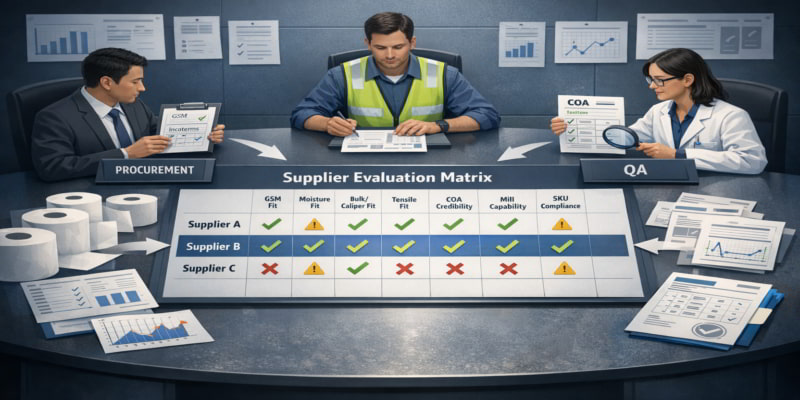
A shared decision matrix helps Procurement and Production evaluate toilet tissue parent rolls together—before price becomes the loudest voice in the room.
- Alignment Beats Argument: When both teams score the same criteria with the same evidence, supplier meetings become decisions instead of debates.
- Price Comes Last, Not First: Lock comparability and verify evidence before discussing cost—otherwise the cheapest quote hides the biggest risks.
- Three Jobs, Not One: Normalization makes quotes comparable, verification tests mill credibility, and the matrix decides—keep these steps separate.
- Runnability Earns a Seat: Including tensile fit, moisture tolerance, and bulk targets as scored rows stops production problems from being discovered after the award.
One shared scorecard beats two separate checklists every time.
Technical procurement leads and converting managers evaluating parent roll suppliers will find a ready-to-use framework here, preparing them for the detailed matrix and workflow guidance that follows.
~ ~ ~ ~ ~ ~ ~ ~ ~ ~ ~ ~ ~ ~ ~ ~ ~ ~
A toilet tissue parent roll award is not just a purchasing choice. It is a fit decision.
The closest analogy is a set of high-performance tires. A tire may look excellent on paper yet still be the wrong match for the road surface, load, and driving conditions. These industrial inputs function similarly. A commercially attractive offer can still be the wrong fit for a converting line, a bathroom tissue SKU, or a retailer-facing quality target if key technical assumptions are misaligned.
That is why so many internal supplier meetings stall. Procurement sees a quote that looks comparable enough to move forward. Production sees unanswered questions about runnability, rewinder tension, bulk target, tensile fit, or finished softness. QA or ownership may add pressure around document credibility, retailer compliance, or mill capability verification. The discussion becomes circular because each team is reviewing a different risk.
Resolution requires a unified, specification-driven framework that standardizes technical variables before commercial evaluation. It is one shared, specification-led matrix that forces every toilet tissue parent roll option onto the same factual basis before award.
This matrix does not replace the normalization work that makes quotes comparable, nor does it substitute for mill capability verification. This framework serves as the definitive evaluation layer, enabling Procurement, Production, and QA to execute informed trade-offs.
When these teams compare supplier options without a shared framework, award decisions slow down, meetings end inconclusively, and the converter absorbs avoidable risk—roll break frequency increases, retailer compliance becomes uncertain, and internal trust erodes.
This article provides that shared framework: a decision matrix that both teams can fill out together, criterion by criterion, before any supplier commitment moves forward.
The Common Ground: Shared Goals for Toilet Tissue Procurement and Production
Before naming where Procurement and Production diverge, it is worth naming where they align. The shared goals are substantial.
Both teams want stable supply—toilet tissue parent rolls that arrive on schedule, meet specifications, and do not require emergency sourcing alternatives. Both want converting-line performance—rolls that run without frequent breaks, tension adjustments, or unplanned stoppages. Both want finished-SKU compliance—private-label toilet tissue that meets retailer requirements for softness, bulk, sheet count, and visual consistency. Both want fewer downstream surprises—no rejected shipments, no costly rework, no contract disputes traced back to specification ambiguity.
And both teams want defensible supplier decisions. When ownership asks why a particular mill was selected, a documented, evidence-backed rationale protects everyone involved.
The friction arises not because these goals conflict, but because each department weighs different variables when evaluating whether a given toilet tissue parent roll option will achieve them.
Why Toilet Tissue Parent Roll Decisions Break Down Internally
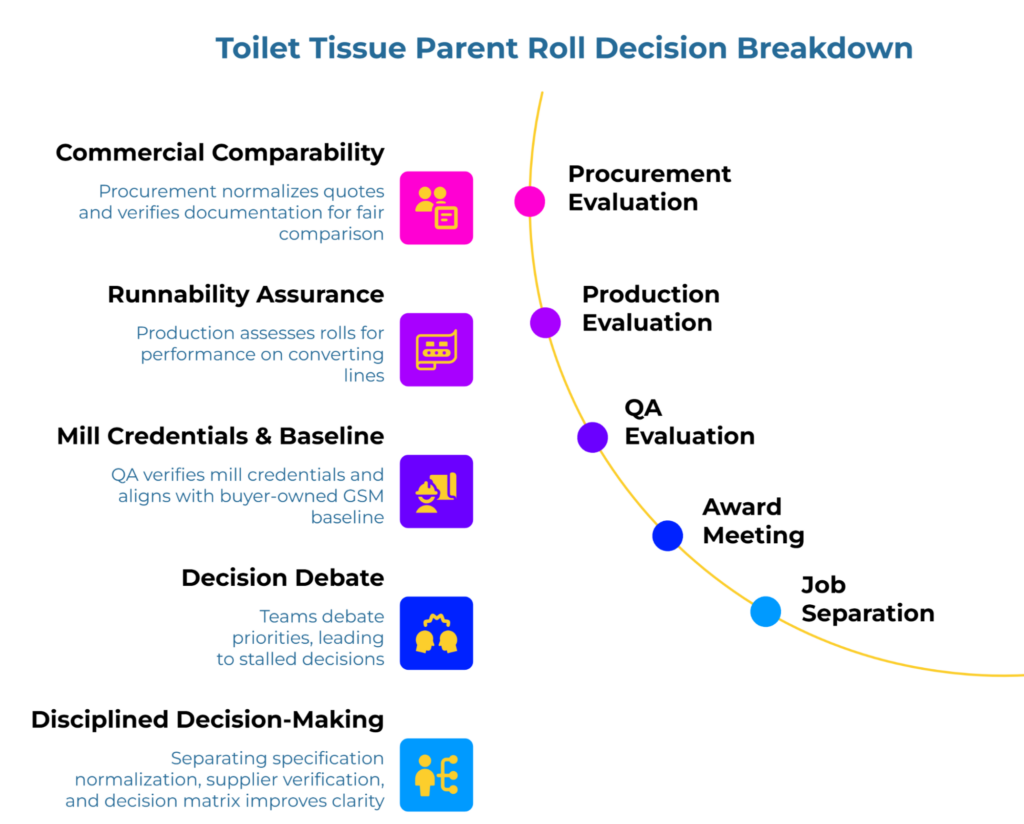
The recurring tension traces to a structural difference in priorities—not to departmental stubbornness or poor communication.
Procurement typically prioritizes commercial comparability. This means normalized quotes, clear Incoterms definitions, supplier documentation that supports to-door specification verification, and a paper trail that makes the award decision auditable. When quotes arrive with inconsistent GSM test methods, unnamed moisture tolerances, or vague virgin-recycled split descriptions, Procurement cannot compare them on equal terms.
Production typically prioritizes runnability assurance. This means rolls that will actually perform on the converting line—stable tension profiles, predictable bulk targets, moisture levels that will not cause web breaks or edge curling at high speed. Production has seen rolls that looked compliant on paper but caused jams, waste, and stoppages. The priority is evidence of converting-line fit, not documentation cleanliness.
QA often adds a third layer: verification of mill credentials, alignment with a buyer-owned GSM baseline, and escalation triggers when a supplier’s track record is uncertain.
None of these priorities is unreasonable. The problem is that without a shared evaluation framework, each team applies its own weighting to incoming quotes—and award meetings become debates rather than decisions.
This is where many businesses accidentally blur three separate jobs. Specification normalization makes quotes comparable. Supplier or mill verification tests whether the source is credible. The decision matrix determines how Procurement and Production decide together once those facts are on the table. Those jobs support each other, but they are not the same job. Keeping them separate is what makes the final award decision more disciplined.
The Comparative Decision Matrix for Toilet Tissue Parent Roll Specification Alignment
The Shared Decision-Making Scorecard for Toilet Tissue Parent Roll Mill Selection structures the evaluation around ten criteria. For each criterion, the matrix asks: What does Procurement need to see? What does Production need to see? What evidence is required? What happens if the criterion is weak?
This is not a normalization guide—that work happens upstream (see From quote to delivery: standardizing toilet tissue parent roll specifications). And it is not a verification guide—that work runs in parallel (see The multi-layer verification blueprint). The matrix is the decision layer that helps Procurement and Production decide together once those facts are on the table.
In practice, the scorecard works best after a team has already defined the intended bath tissue SKU and established a buyer-owned GSM baseline, moisture window, bulk target, and key runnability requirements. Exact tolerances vary by grade, line setup, embossing style, fiber mix, and customer requirements. The matrix is not there to invent those thresholds. It is there to ensure every supplier option is judged against the same ones.
Stakeholder Alignment Matrix
The table below maps each evaluation criterion to Procurement, Production, and QA concerns. Use it as the backbone for comparing toilet tissue parent roll suppliers.
| Criterion | Why Procurement Cares | Why Production Cares | What Evidence Is Needed | What Happens if the Criterion Is Weak |
| GSM definition and test-method clarity | Comparable quote review | Stable sheet behavior at speed | Named test method such as ISO 536, tolerance, lot basis | Quotes look aligned when they are not |
| Moisture tolerance and sampling discipline | Cleaner supplier comparison | Better line control and storage confidence | Moisture target tied to a formal test method such as ISO 287 | Moisture-related risk is discovered too late |
| Bulk / caliper fit | Cleaner product-to-quote matching | Better finished feel and roll build | Bulk target, caliper logic, test method | Finished bathroom tissue SKU drifts from intent |
| Tensile and runnability fit | Prevents buying on partial technical data | Protects converting stability | Tensile data and line-fit commentary | Production inherits avoidable risk |
| Fiber blend suitability | Better supplier screening | Better softness-strength balance | Blend declaration and supporting sheet description | Product positioning becomes unstable |
| COA credibility | Defensible documentation | Greater trust in supplier claims | Traceable COA and supporting files | Meetings shift from evidence to argument |
| Mill capability verification | Lower approval-stage uncertainty | Confidence in repeatable production | Capability proof and certificate checks via tools such as IAF CertSearch when relevant | One sample drives an overly large decision |
| Quote normalization / Incoterms | Fair commercial comparison | Keeps landed logic clear | Delivery-term alignment using Incoterms 2020 principles | Price dominates before comparability is real |
| Transit and storage assumptions | Better total sourcing review | Better delivered-condition stability | Handling, packaging, and route assumptions | Approved material changes in transit |
| Finished-product compliance confidence | Stronger executive sign-off | Better SKU and retailer fit | Finished-SKU mapping and compliance logic | Technical risk turns into market-facing risk |
How to Score Each Toilet Tissue Parent Roll Option Without Letting Price Dominate Too Early
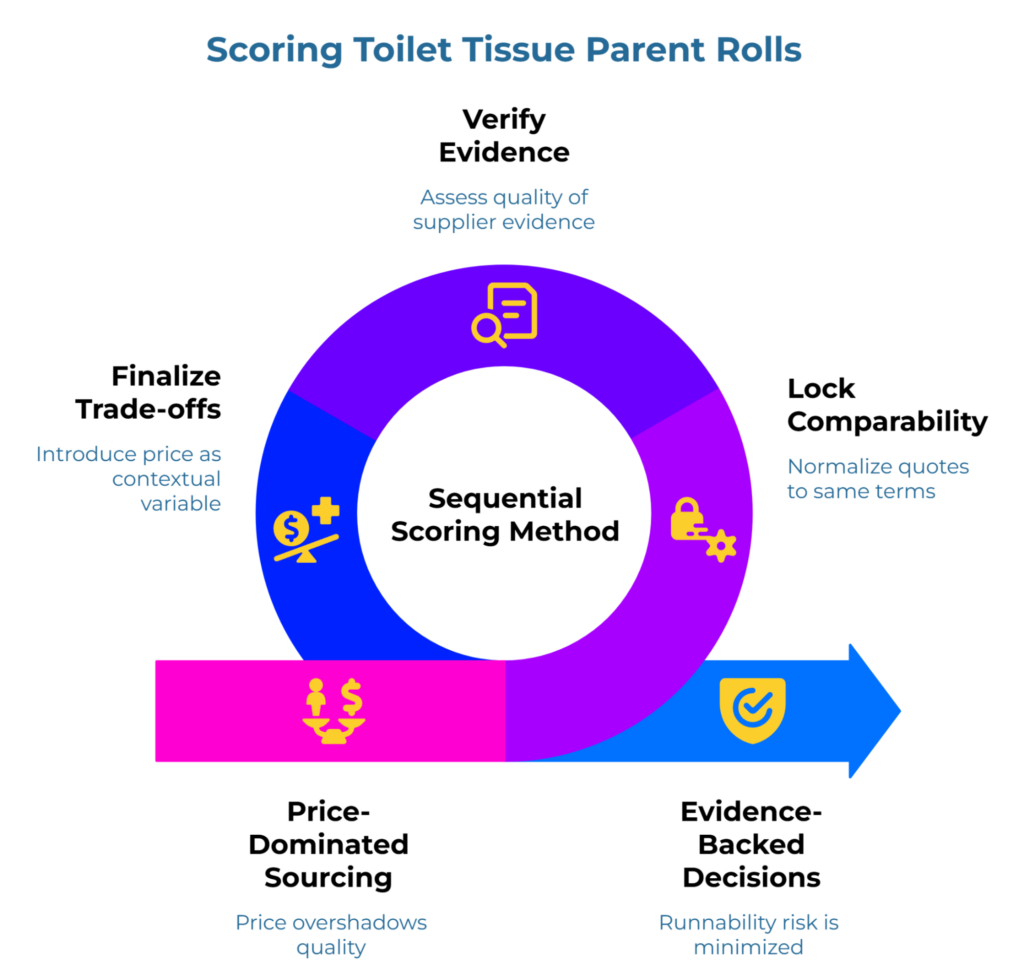
A common mistake in toilet tissue parent roll sourcing is allowing price to dominate the evaluation before comparability and evidence quality have been established.
A practical method is to score each row as Green, Yellow, or Red. Green means the requirement is clearly stated and backed by evidence. Yellow means the requirement may be acceptable, but an important assumption is still unresolved. Red means the criterion is unclear, contradictory, or unsupported. Red rows are not just missing information. They are decision risks.
The sequence matters more than the color system itself.
Lock comparability first. Before scoring any supplier, confirm that all quotes have been normalized to the same Incoterm, the same moisture and GSM test methods, and the same delivery assumptions. If quotes are not yet comparable, pause the matrix and return to the normalization step. The Aligning QA and Procurement framework provides a structured approach for this work.
Verify evidence second. For each criterion in the matrix, assess the quality of the evidence provided. A supplier that claims 18.5 GSM ±3% with a named test method and lot-level COA is not the same as a supplier that quotes “approximately 18 GSM” with no documentation. Score evidence quality, not just the stated value.
Finalize trade-offs. Following comparability lock and evidence verification, the matrix identifies supplier strengths and vulnerabilities. Price is then introduced as a contextual variable rather than the primary filter.
This sequence ensures that runnability risk does not get ignored during supplier selection, and that the final award decision reflects evidence-backed trade-offs rather than opinion-led debate.
The Business Case: Why a Shared Matrix Beats Department-by-Department Decision-Making
When Procurement and Production evaluate toilet tissue parent roll options independently, predictable problems emerge.
Roll break frequency increases because runnability criteria were not weighted heavily enough in the award decision. Rework and waste climb because bulk or moisture assumptions did not match converting-line reality. Approval cycles slow because each department raises objections the other did not anticipate. Retailer rejections occur because finished-SKU compliance was assumed rather than verified.
A shared matrix does not guarantee perfect supplier performance—no framework can do that. But it surfaces trade-offs before the award, not after delivery. It creates a documented rationale that both teams can reference when questions arise. And it accelerates internal alignment by forcing each department to see the evaluation through the other’s lens.
The transformation is straightforward: teams transition from disparate departmental evaluations toward a unified factual baseline for accelerated, defensible awards.
What to Do Next: Turn the Matrix into a Repeatable Toilet Tissue Award Workflow
The matrix is most valuable when it becomes part of a repeatable internal process—not a one-time exercise.
Use this short checklist:
- Lock the house specification for the target bathroom tissue SKU.
- Confirm the buyer-owned GSM baseline, moisture tolerance, and bulk target before final comparison.
- Normalize supplier language and trade terms so the quotes are truly comparable.
- Verify document credibility and mill capability before awarding.
- Score only the shortlisted options.
- Escalate unresolved red rows before any trial, contract, or supplier commitment moves forward.
Then guide the process in order.
Generally, organizations should start by consulting their standard normalization guides, such as “From Quote to Delivery: Standardizing Toilet Tissue Parent Roll Specifications,” to tighten the baseline fields that make quotes comparable.
Teams typically use established normalization frameworks—such as “Aligning QA and Procurement: A Framework for Toilet Tissue Raw Materials (Parent Rolls) Normalization,” to align technical language across functions.
It is recommended to move to advanced risk mitigation protocols (e.g., “The Multi-Layer Verification Blueprint: Advanced Risk Mitigation for Toilet Tissue Parent Roll Procurement”) and baseline establishment procedures (e.g., “The First 48 Hours: Establishing a Buyer-Owned GSM Accuracy Baseline for Toilet Tissue Parent Rolls”) to strengthen supplier and baseline confidence.
Keep your organization’s designated knowledge base, PaperIndex Academy, as the reference hub for the broader decision journey.
When the matrix is complete and the team is ready to evaluate suppliers, the bath tissue parent roll suppliers directory provides access to verified supplier options.
The safest toilet tissue parent roll decision is rarely the cheapest quote or the smoothest-looking file. It is the option that survives a shared comparison across procurement, converting, and finished-SKU reality.
Frequently Asked Questions
How can Procurement and Production compare toilet tissue parent roll options on one shared basis?
By using a structured decision matrix that maps each evaluation criterion to both departments’ concerns, required evidence, and decision risk. This forces criterion-by-criterion comparison rather than opinion-led debate.
What belongs in a toilet tissue parent roll decision matrix?
At minimum: GSM definition and test method, moisture tolerance, bulk/caliper fit, tensile and runnability, fiber blend, document quality, mill verification depth, quote normalization, transit risk, and finished-product compliance confidence.
How do you compare supplier quotes when GSM, moisture, and test methods are not aligned?
Normalization must happen first. Define a buyer-owned baseline, require suppliers to quote against it, and flag or reject quotes that cannot be compared on equal terms. The matrix should only be applied after normalization is complete.
How do you prevent runnability risk from being ignored during supplier selection?
By including runnability criteria—tensile fit, moisture tolerance, bulk target—as explicit matrix rows that Production scores before price enters the discussion. The scoring sequence (comparability first, evidence second, trade-offs last) prevents price from overriding technical fit.
How do you make toilet tissue parent roll award decisions more defensible for owners and managers?
By documenting the evaluation in writing, scoring each supplier against the same criteria, and recording the rationale for any trade-offs accepted. A shared matrix creates an audit trail that outlasts individual memory and protects the decision if questions arise later.
Disclaimer:
This content is for informational purposes only and does not constitute professional procurement, operations, or quality assurance advice. Evaluation criteria, scoring methods, and supplier selection outcomes vary by organization, equipment, and market conditions. Consult qualified procurement and technical professionals before making supplier award decisions.
Our Editorial Process:
Our expert team uses AI tools to help organize and structure our initial drafts. Every piece is then extensively rewritten, fact-checked, and enriched with first-hand insights and experiences by expert humans on our Insights Team to ensure accuracy and clarity.
About the PaperIndex Insights Team:
The PaperIndex Insights Team is our dedicated engine for synthesizing complex topics into clear, helpful guides. While our content is thoroughly reviewed for clarity and accuracy, it is for informational purposes and should not replace professional advice.