

📌 Key Takeaways
A mill spec sheet prevents quote mismatches by translating requirements into test-method-defined, tolerance-bound specifications that every supplier interprets identically.
- Three Elements Eliminate Disputes: Every specification requires a target value, an explicit tolerance range, and a named test method—gaps in any element invite interpretation conflicts.
- Test Methods Create Comparability: Referencing ISO 536 for basis weight or ISO 2758 for burst strength establishes the exact measurement procedure, making quotes comparable across suppliers.
- Version Control Prevents Drift: Requiring suppliers to quote specific spec sheet revision numbers ensures all parties work from identical requirements and surfaces outdated assumptions.
- Conditioning Standards Enable Verification: Paper properties shift with humidity, so requiring ISO 187 conditioning and reporting test atmosphere ensures results align across locations and shipments.
- Send Specs Before Quotes: Distributing the spec sheet before requesting pricing allows suppliers to confirm capability and ask clarifying questions, surfacing gaps before they become delivery problems.
Spec sheets define acceptance criteria, not aspirations.
Packaging converters managing multi-supplier sourcing programs will gain a systematic framework here, preparing them for the implementation template that follows.
The quote lands in the inbox. Three suppliers, three wildly different interpretations of the same requirement. One quotes virgin kraft at a premium. Another offers recycled boards at half the weight. The third asks for clarification on six separate line items.
This happens when specifications leave room for interpretation. Each supplier fills the gaps with their own assumptions, and what arrives at the converting line rarely matches what was expected. The production team scrambles. Disputes follow.
A mill spec sheet eliminates that ambiguity. It is a standardized document that translates internal requirements into test-method-defined, tolerance-bound specifications—language every supplier must interpret identically. With a properly constructed spec sheet, procurement can benchmark disparate bids against a singular technical baseline, incoming material can be verified against objective criteria, and disputes have clear resolution paths.
This guide provides a step-by-step method for building that document, along with a ready-to-use template.
Key Terms Before You Start
Mill spec sheet: A technical document listing every requirement a supplier must meet, including target values, acceptable variation ranges, and the specific test methods used to verify compliance.
Test method: The standardized procedure used to measure a property. ISO 536 for basis weight, ISO 2758 (or ISO 2759 for board) for burst strength, ISO 287 for moisture content. Naming the method removes ambiguity about how values are determined—it provides the “common language” that makes quotes comparable across suppliers.
Tolerance: The acceptable range of deviation from a target—expressed as ±3% or a defined band like 6.0–8.0%. Without stated tolerances, any variation becomes a potential dispute.
Conditioning: The controlled environment (typically 23°C and 50% relative humidity per ISO 187) where samples must stabilize before testing. Paper properties shift with moisture content, so conditioning ensures results are comparable across suppliers and shipments.
What a Mill Spec Sheet Does (and What It Is Not)
A spec sheet serves one primary function: comparability. It converts “what the operation needs” into external language that suppliers cannot misinterpret. When every vendor receives identical parameters with defined tolerances and named test methods, their quotes reflect the same baseline. Incoming material can then be objectively verified against documented criteria.
This document is not a product brochure listing ideal characteristics. It is not a wish list of preferred attributes or a negotiation tool. A spec sheet is a technical contract baseline. If a property matters enough to reject material over, it belongs on the sheet—with a measurable target, an acceptable range, and a referenced test method.
Step-by-Step: Build Your Mill Spec Sheet
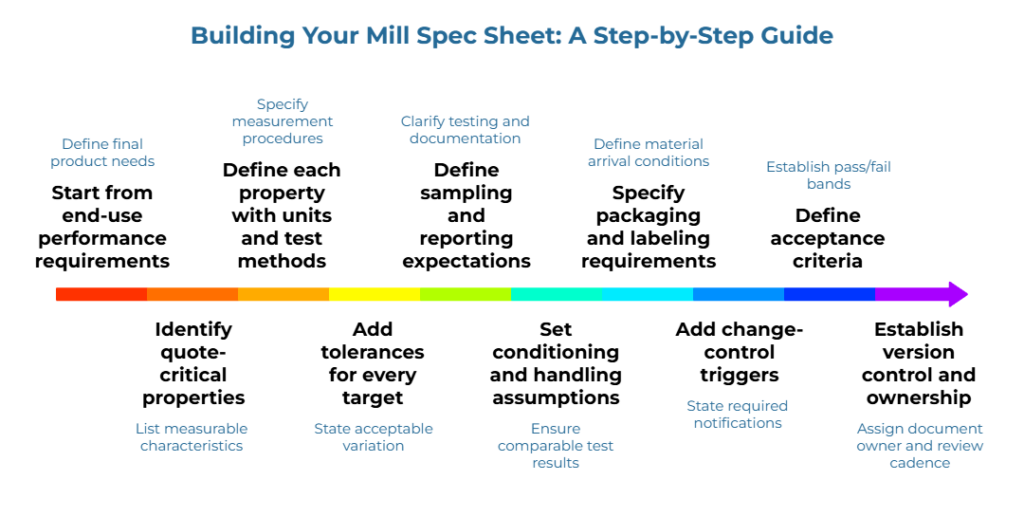
1. Start from end-use performance requirements. Before listing paper properties, define what the final product must achieve. If corrugated boxes must survive a specific stacking load or kraft paper must run on a particular converting line without tearing, those performance demands dictate the specification. Work backward from the finished product.
2. Identify quote-critical properties. List every measurable characteristic that suppliers must address in their pricing. Common fields include basis weight, caliper (thickness), moisture content, burst or tensile strength, Cobb value for sizing, and certification requirements such as FSC or PEFC chain of custody.
3. Define each property with units and test methods. Specify basis weight as “80 g/m² per ISO 536“—not simply “80 gsm.” Include the complete test method reference. This single addition eliminates most interpretation disputes because it establishes the exact measurement procedure every supplier must follow.
4. Add tolerances for every target. State acceptable variation explicitly. Basis weight might be 80 g/m² ±3%. Moisture content might fall within a 6.0–8.0% band. A target without a tolerance invites dispute the moment measured values deviate even slightly.
5. Define sampling and reporting expectations. Specify how many samples per lot require testing and what documentation accompanies each shipment. Define what constitutes a “lot”—this seemingly minor detail prevents confusion when verifying compliance. Clarify whether supplier-tested results suffice, whether third-party lab verification is required, or whether both are expected. Reference the applicable sampling standard where one exists.
6. Set conditioning and handling assumptions. Paper tested at different humidity levels yields different results. Reference ISO 187 for conditioning requirements: typically 23°C, 50% relative humidity, with a minimum equilibration period. Require that conditioning atmosphere and test conditions appear on all reports. This ensures test results are comparable regardless of where or when testing occurs.
7. Specify packaging and labeling requirements. Define how material must arrive. Reel dimensions, core inner diameter, pallet configuration, protective wrapping specifications, and labeling content all belong here. Include batch identification and traceability marking requirements.
8. Add change-control triggers. State which changes require advance notification: raw material source changes, manufacturing process modifications, test method updates, or production site relocations. This prevents surprise variation from undisclosed supplier-side decisions.
9. Define acceptance criteria. Establish clear pass/fail bands. Specify what happens when material falls outside tolerance—outright rejection, concession request with documentation, or alternative remediation. Remove ambiguity from the disposition process.
10. Establish version control and ownership. Assign a document owner. Include a version number and issue date. Define the review cadence—annual review is common practice. Specifications become outdated; a formal schedule ensures alignment with actual production requirements.
Mill Spec Sheet Template
The table below provides a starting structure. Example values are illustrative; actual targets and tolerances depend on specific converting requirements and supplier capabilities.
| Parameter | Target | Tolerance | Test Method | Sampling/Notes |
| Basis Weight | 80 g/m² | ±3% | ISO 536 | 5 samples per lot; define lot size |
| Moisture Content | 7.0% | 6.0–8.0% | ISO 287 | Test before converting; report conditioning |
| Caliper (Thickness) | 0.12 mm | ±5% | ISO 534 | Average of 10 readings |
| Burst Strength | 280 kPa | Minimum | ISO 2758 (paper) / ISO 2759 (Board) | COA required |
| Cobb Value (Sizing) | 30 g/m² | Max 35 g/m² | ISO 535 (60 sec) | Wire side tested |
| Tensile Strength (MD) | 4.5 kN/m | Minimum | ISO 1924-2 | MD and CD if critical |
| Ring Crush (RCT) | 1.8 kN/m | Minimum | ISO 12192 | Containerboard only |
| Edge Crush (ECT) | — | — | ISO 3037 / TAPPI T 811 | If applicable; TAPPI T 839 alternate |
| Conditioning | 23°C / 50% RH | Per standard | ISO 187 | Min 4 hours (paper) / 24+ hours (board); record on reports |
| Certification | FSC Mix | Required | Chain of custody | Verify scope on invoice |
| Reel Width | 1000 mm | ±5 mm | Physical measurement | Core ID: 76 mm |
| Document Version | [version v1.0 / [YYYY-MM-DD]] | — | — | Review annually |
Spec Sheet Completeness Checklist
Before issuing the document to suppliers, verify each item:
- Every property includes a target value with units
- Every target has an explicit tolerance or acceptable range
- Every measurable property references a specific test method
- Conditioning requirements are stated
- Sampling requirements are defined, including lot definition
- Reporting expectations are clear
- Packaging and labeling requirements are documented
- Change-control notification triggers are specified
- Pass/fail acceptance criteria are unambiguous
- Document version, date, and owner are recorded
- Units are consistent throughout
Common Mistakes That Cause Disputes
Test methods eliminate interpretation disputes—but only when they’re actually included. Stating “burst strength 280 kPa” without referencing ISO 2758 or TAPPI T 403 leaves room for alternative procedures that yield different results. The fix: always include the complete test method reference.
Absence of Tolerance Limits. A target of 80 g/m² without a stated tolerance means any deviation could trigger disagreement. The fix: define acceptable variation explicitly, whether ±2%, ±5%, or a specific range.
Mixed units. Combining metric and imperial measurements creates conversion confusion and increases error risk. The fix: standardize on one system—metric is generally preferred for international suppliers.
Undefined conditioning requirements. Paper tested at different humidity levels produces different results. Without referencing ISO 187 conditioning standards, supplier and buyer test results may never align. The fix: specify conditioning environment, equilibration time, and require these details on all test reports.
“Equivalent” language without equivalence rules. Phrases like “or equivalent” without defining qualification criteria invite substitution disputes. The fix: if alternatives are acceptable, list them explicitly with the criteria they must meet—or remove the language entirely.
Missing version and date control. Without a version number and revision date, confirming both parties work from the same document becomes impossible. The fix: include version control as a standard field and establish a review schedule.
How to Use the Spec Sheet with Suppliers
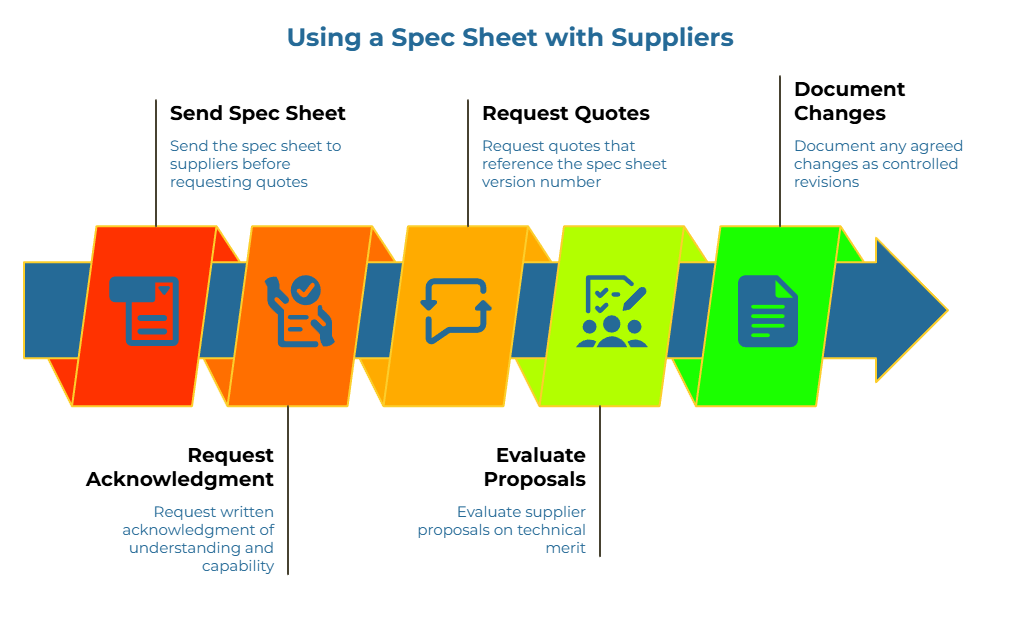
The sequence matters. Send the spec sheet before requesting quotes—not alongside them. This allows suppliers to review requirements, confirm capability, and ask clarifying questions before committing to pricing.
Request written acknowledgment that suppliers understand and can meet each specification. This surfaces capability gaps before they become delivery problems. A supplier who cannot meet a tolerance should say so upfront rather than shipping non-conforming material.
Once capability is confirmed, request quotes that explicitly reference the spec sheet version number. All quotes then reflect identical requirements, making comparison straightforward and reducing post-award disputes.
Keep discussions evidence-based. If a supplier proposes different methods or adjusted targets, evaluate the proposal on technical merit and document any agreed changes as a controlled revision. The spec sheet is a technical document, not a negotiation lever. When suppliers understand that specifications reflect actual production requirements rather than arbitrary demands, the relationship starts on a foundation of mutual technical understanding.
From Vague Requirements to Verified Quality
A properly constructed mill spec sheet transforms sourcing from interpretation guesswork into objective comparison. Every parameter has a target, a tolerance, and a test method. Quotes become comparable. Incoming material can be verified against documented criteria. Disputes have clear resolution paths because acceptance criteria are defined before material ships.
Start with the template above. Adapt targets and tolerances to your specific converting requirements. Issue the spec to suppliers before requesting quotes.
For guidance on verifying incoming material against your specifications, explore the testing protocols guide in the PaperIndex Academy. For a deeper look at spec sheet development for converting operations, see the guide for converting operations managers.
Disclaimer: This guide is for educational purposes. Specific tolerances, test methods, and acceptance criteria should be determined based on production requirements and supplier capabilities.
Our Editorial Process:
Our expert team uses AI tools to help organize and structure our initial drafts. Every piece is then extensively rewritten, fact-checked, and enriched with first-hand insights and experiences by expert humans on our Insights Team to ensure accuracy and clarity.
About the PaperIndex Insights Team:
The PaperIndex Insights Team is our dedicated engine for synthesizing complex topics into clear, helpful guides. While our content is thoroughly reviewed for clarity and accuracy, it is for informational purposes and should not replace professional advice.