

📌 Key Takeaways
Scattered bag specifications across emails and spreadsheets create incomparable supplier quotes and field failures—standardized spec sheets eliminate interpretation gaps.
- Three Jobs Define Success: Spec sheets must enable quote comparability, establish clear acceptance criteria, and survive staff turnover without institutional knowledge.
- Bag Families Beat SKU Sprawl: Standardizing three to six bag families with use-case blocks reduces documentation overhead while maintaining coverage for multiple products.
- Quote-Critical vs. Preferences: Separating non-negotiable fields (dimensions, construction, handle type, print coverage) from nice-to-haves forces suppliers to quote identical specifications.
- Version Control Prevents Chaos: Simple naming conventions, single role ownership, and mandatory revision references in quotes stop silent spec drift.
- Integration Drives Adoption: Attaching spec sheets to every RFQ and PO, requiring assumption confirmation, and treating samples as alignment checkpoints makes documentation operational.
Spec sheets are risk-control tools: they reduce the assumption surface area that destroys quote comparability.
Procurement and operations teams managing paper bag sourcing will gain immediately usable frameworks here, preparing them for the template and implementation checklist that follows.
If a bag spec is an email thread, the business is not buying paper bags—it is buying interpretation.
Interpretation is where misquotes happen. The procurement lead pulls dimensions from a spreadsheet. The ops manager references an old artwork file. Marketing insists on a finish that was discussed in Slack three months ago. And the supplier? They fill in the gaps with their own assumptions — assumptions that differ from the next supplier’s quote, making comparison nearly impossible.
This is how bags fail in the field. This is how teams end up in blame loops instead of solving problems.
The fix isn’t complicated. A small, standardized library of internal spec sheets—documents your team can maintain and your suppliers can quote without guessing—transforms scattered requirements into repeatable, comparable sourcing decisions.
Why Spec Sheets Fail Inside Growing Teams
Most spec sheet failures aren’t about missing information. They’re about scattered information.
The source-of-truth problem shows up early. Requirements live in email threads, Slack messages, spreadsheets, and artwork files. No single document captures what the bag must actually do. When someone needs to send an RFQ, they cobble together details from three or four places—and inevitably miss something.
Stakeholder mismatch makes it worse. Procurement optimizes for cost comparability. Operations cares about durability and handling. Marketing focuses on brand finish and print quality. Without a shared document, each stakeholder emphasizes different details, and suppliers receive conflicting signals about what matters most.
Then there’s the assumption gap. When specs are incomplete, suppliers fill in the blanks. One supplier assumes a standard bottom fold; another quotes a reinforced construction. One includes basic flexographic printing; another prices for higher-coverage offset. The resulting quotes vary significantly in price, but because the underlying construction differs, they are not economically comparable.
A spec sheet is a risk-control tool: it reduces the “assumption surface area” in quoting and production. Understanding why paper bags tear during delivery often reveals that the root cause was a spec that never captured what the bag needed to survive.
What an Internal Paper Bag Spec Sheet Must Do
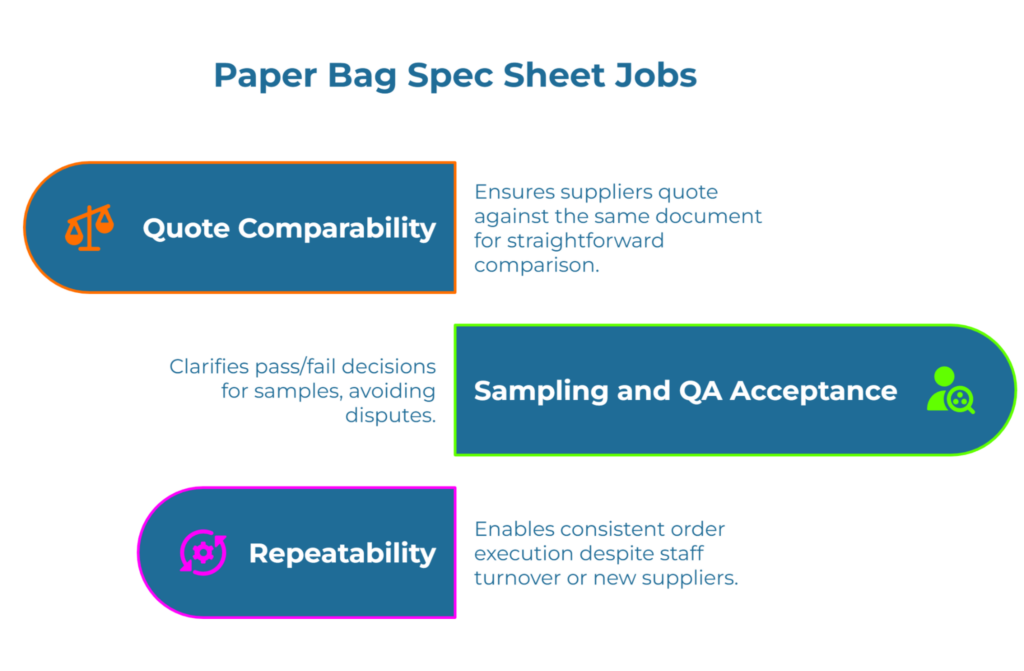
A useful spec sheet serves three jobs, and all three matter equally.
Quote comparability comes first. When every supplier quotes against the same document—same dimensions, same construction details, same finish requirements—comparison becomes straightforward. Without this, procurement teams spend hours normalizing quotes that were never truly comparable.
Sampling and QA acceptance is the second job. A spec sheet should make pass/fail decisions clear. When samples arrive, the team needs to know exactly what to check and what tolerances apply. Vague specs lead to vague acceptance criteria, which leads to disputes later.
Repeatability is the third job. Staff turnover happens. Backup suppliers get added. New team members need to execute orders without institutional knowledge. A spec sheet that lives in someone’s head isn’t a spec sheet—it’s a liability.
Core Definitions
Three terms anchor this framework:
- Bag family: A standardized bag type designed to cover a cluster of similar products or routes, reducing SKU sprawl. Defining clear bag families prevents the specification chaos that contributes to supply chain fragility, especially for growing retail operations managing multiple packaging SKUs.
- Quote-critical field: A detail that materially changes manufacturability or cost (size, ply count, handle type, print coverage).
- Acceptance criteria: Pass/fail expectations for samples and production, including tolerances.
Start with Bag Families and Use-Case Notes
The instinct is to create a spec sheet for every SKU. Resist it.
Instead, define bag families—standardized bag types designed to cover multiple similar products or delivery routes. A growth-stage e-commerce operation might need only three to six families: a small retail bag for lightweight items, a medium delivery bag for standard orders, a reinforced bag for heavier or fragile products, and perhaps a branded presentation bag for premium shipments. Teams building their first sourcing program for wholesale paper bags often start with this three-to-six family structure.
Each family gets one spec sheet. This reduces SKU sprawl and keeps the documentation manageable.
The use-case block is what makes a spec sheet more than a list of dimensions. In one to five lines, capture what the bag must survive: the load range it needs to handle, expected moisture exposure, handling intensity during transit, typical carry distance, and any stacking or storage requirements. This context helps suppliers understand why certain specs exist—and helps your team remember what trade-offs are acceptable.
For example, a delivery bag for meal kits faces different stresses than a retail shopping bag. The meal kit bag encounters moisture, temperature variation, and rough handling during last-mile delivery. The retail bag needs to look good and survive a short walk to the car. Same basic product category, very different use-case requirements.
The Minimum Fields Suppliers Need to Quote Accurately
Not every detail affects the quote equally. But certain fields, if left ambiguous, guarantee misaligned pricing.
Identifiers and governance establish document control. Include bag family ID, spec name, revision number, effective date, owner (by role), approvers, and status (Draft, Approved, or Retired). These aren’t exciting, but they prevent the wrong version from circulating.
Dimensions and tolerances define the physical envelope. Specify length, width, gusset depth, and acceptable variance. Use metric as primary with imperial in parentheses where helpful—for instance, 320 × 200 × 100 mm (12.6 × 7.9 × 3.9 in) ± 3 mm. Tolerances matter because bags outside spec may not fit packaging workflows or branded displays. This drives material usage, converting steps, tooling, and packing configuration.
Construction details determine durability and material consumption. Note paper type, ply count, and GSM (grams per square meter). Keep in mind this is a bag spec, not a paper-sourcing spec—you’re specifying what the finished bag requires, not purchasing raw materials separately. For teams who source kraft paper and convert it into bags, see kraft paper for making paper bags: a strategic guide to grade selection and procurement. Include bottom construction (flat, square, or pinch), seam style, and any reinforcements. These specifications define both durability and raw material consumption, directly affecting failure risk.
Understanding the relationship between virgin and recycled kraft paper grades helps teams specify ply count and GSM based on actual load requirements rather than industry defaults.
Handles require precision because handle failures are among the most common bag complaints. Specify type (twisted paper, flat tape, die-cut, rope), material, attachment method (glued, riveted, reinforced patch), and load rating expectations. Handle choice affects converting complexity and performance under load, making this quote-critical for handled bags.
Printing and finishing significantly impact both cost and lead time. Document ink coverage percentage, print locations, number of colors, artwork file references, and color matching expectations (Pantone references if applicable). Note coatings or laminations that affect manufacturing. Print and finish requirements drive setup complexity, yield, and lead time variability. Higher print coverage and specialty finishes substantially affect pricing, so these details are genuinely quote-critical.
Functional requirements must be stated as requirements for confirmation, not guaranteed claims. If the bag requires moisture resistance, specify it as a requirement for suppliers to confirm—not as a guaranteed claim. Same for food-contact compliance: state the requirement and ask suppliers to confirm their capability and relevant certifications. When sustainability certifications matter, reference standards like FSC Chain of Custody or PEFC Chain of Custody so suppliers understand what documentation you expect. For comprehensive verification steps, see avoiding greenwashing: how to verify supplier sustainability claims. For teams thinking systematically about packaging requirements and their environmental context, consider referencing standards such as ISO 18602 (Optimization of the packaging system) or the broader ISO 18600 family of standards (ISO 18601–18606). These constraints narrow the supplier pool and may require specific documentation.
Packing and logistics affect landed cost and warehouse handling more than teams expect. Define pack count per carton, carton dimensions, palletization requirements, and labeling specifications. These details directly affect landed cost calculations through freight efficiency and warehouse handling. Packaging and quantity assumptions affect freight efficiency, warehouse handling, and unit economics, making these details quote-critical.
Acceptance criteria prevent disputes by defining what gets checked at sampling and receiving. Specify dimensional tolerances, print registration tolerances, visual defect standards, and sampling expectations. Sampling and inspection approaches vary by organization and order profile, but the concept is widely used; an ISO overview such as ISO 2859-1 can be a helpful reference point for framing sampling plans. Define what constitutes a pass, a conditional acceptance, and a rejection.
Make It Usable: Separate Quote-Critical Fields from Preferences
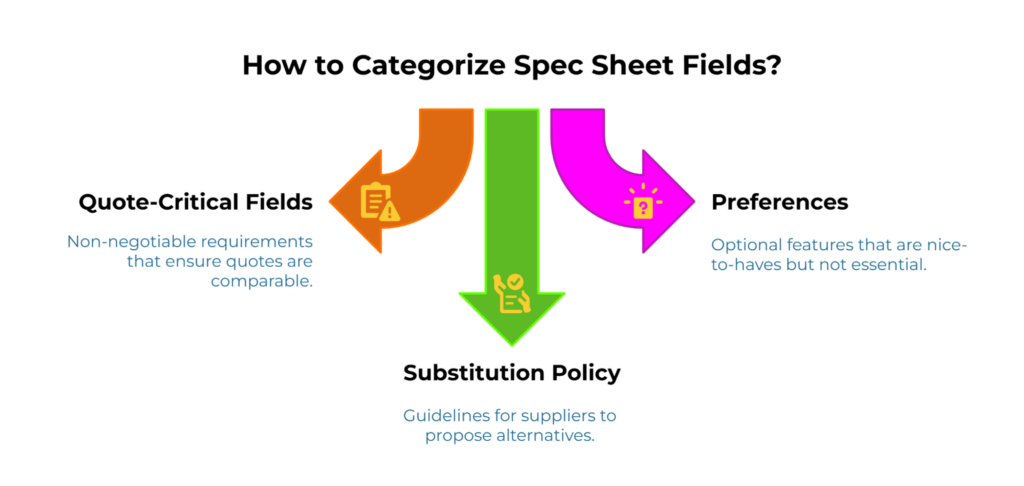
This distinction is where spec sheets become genuinely useful.
Quote-critical fields are non-negotiable. If a supplier can’t meet them exactly, they shouldn’t quote—or they need to flag the deviation explicitly. Dimensions, construction, handle type, and print coverage typically fall here. These are the fields where variation means the quotes aren’t comparable.
Preferences are nice-to-haves. Maybe you prefer a particular shade of kraft paper, or you’d like reinforced corners if the price difference is minimal. These go in a separate block, clearly labeled as optional.
Substitution policy bridges the two. Some specs allow supplier alternatives—a different handle attachment method that achieves the same load rating, for instance. Define what suppliers may propose as substitutions, and clarify how approval works. Does the procurement lead approve in writing? Is there a price threshold below which substitutions are auto-approved?
This framework helps how paper bag requirements drive supplier selection because it forces clarity about what actually matters versus what’s merely preferred.
Version Control That People Actually Follow
Elaborate version control systems get abandoned. Simple ones get used.
Naming convention: Use a format like [BagFamilyID]-[SpecName]-v[X.X]. For example, DEL-MED-v2.1 for the medium delivery bag, version 2.1. Keep it short enough to include in email subjects and PO references.
Single owner: Assign one role (not one person) as the spec owner—typically Procurement or Ops. The owner approves changes. For specs affecting brand presentation, add Marketing as a required reviewer.
Revision log: Track what changed, when, why, and who approved it. This doesn’t need to be elaborate—a simple table at the bottom of the spec sheet works. The point is to answer “why did this change?” six months later without archaeology.
Supplier confirmation: Require suppliers to reference the spec revision in their quotes. A quote that says “per your spec” without a version number is a quote against an unknown target. Make revision confirmation a standard part of RFQ responses.
How to Roll Spec Sheets into RFQs, POs, and Supplier Onboarding
A spec sheet that exists but isn’t used is just documentation theater.
Attach to every RFQ. The spec sheet, use-case notes, and reference photos (if available) go with every request for quotation. When sourcing internationally, combine spec sheets with your international supplier verification checklist. Don’t make suppliers hunt through email threads. When reaching out to paper bag suppliers, a complete spec package signals professionalism and reduces back-and-forth.
Require explicit assumption confirmation. Ask suppliers to confirm key assumptions in writing: “Please confirm your quote is based on [Spec ID] revision [X.X] and note any deviations.” This surfaces misalignment before orders are placed, not after bags arrive.
Treat samples as spec alignment checkpoints. Sampling isn’t just quality inspection—it’s verification that the supplier interpreted the spec correctly. Check samples against the acceptance criteria in the spec sheet, not against a vague sense of “good enough.”
Repeat orders: Re-confirm the active revision. Specs evolve. A repeat order placed against an outdated revision causes confusion. Make revision confirmation part of the PO process.
Before onboarding new international suppliers, consider using a verification checklist to verify international paper bag suppliers and reduce sourcing risk.
A Simple Maintenance Loop
Spec sheets aren’t write-once documents, but they shouldn’t require constant attention either.
Update triggers: Revise specs after field failures, new channel launches, route changes, or material/finish changes driven by supplier feedback or cost optimization.
Review cadence: A quarterly light check confirms specs are still accurate. An annual deeper review identifies families that can be consolidated or retired.
Retire unused families: Old specs that no longer match active products create confusion. Mark them as Retired and archive them. A clean library is a usable library.
Paper Bag Spec Sheet Template
The template below incorporates principles from our guides on wholesale paper bag sourcing verification and supplier capability verification.
Header
| Field | Value |
|---|---|
| Bag Family ID | [e.g., DEL-MED] |
| Spec Name | [e.g., Medium Delivery Bag] |
| Revision | [e.g., v2.1] |
| Effective Date | [MM/DD/YYYY] |
| Owner (Role) | [e.g., Procurement Lead] |
| Approvers | [e.g., Ops Manager, Brand Lead] |
| Status | Draft / Approved / Retired |
Use-Case Block
| Element | Description |
|---|---|
| Load Range | [e.g., 2–5 kg (4.4–11 lb)] |
| Moisture Exposure | [e.g., Moderate—meal delivery, condensation possible] |
| Handling Intensity | [e.g., High—multiple handoffs, last-mile transit] |
| Delivery/Route Notes | [e.g., Urban delivery, 15–45 min transit, stacked in vehicle] |
Quote-Critical Block (Must Match)
| Field | Specification |
|---|---|
| Dimensions (L × W × G) | [e.g., 320 × 200 × 100 mm ± 3 mm] |
| Paper/Construction | [1-ply, 80 GSM brown kraft, square bottom] |
| Reinforcements | [e.g., Reinforced bottom fold] |
| Handle Type | [e.g., Twisted paper, glued with reinforcement patch] |
| [e.g., 2-color flexo, 40% coverage, front panel only] | |
| Packing | [e.g., 250 pcs/carton, palletized] |
Preferences/Options Block
| Preference | Notes |
|---|---|
| [e.g., Natural kraft tone variation acceptable] | [Approval not required] |
| [e.g., Alternative handle attachment if load-tested equivalent] | [Requires Procurement approval] |
Acceptance Criteria Block
| Check | Tolerance/Standard |
|---|---|
| Dimensions | ± 3 mm |
| Print Registration | ± 1.5 mm |
| Color Match | Within Pantone tolerance or approved sample |
| Visual Defects | No tears, stains, or delamination |
| Sampling | [e.g., General Inspection Level II, AQL 2.5] |
Revision Log
| Rev | Date | Summary | Reason | Approved By |
|---|---|---|---|---|
| v2.1 | [Date] | Increased GSM from 70 to 80 | Field failures with heavier loads | [Role] |
| v2.0 | [Date] | Added reinforcement patch | Handle detachment complaints | [Role] |
Notes:
- Acronyms should be defined once (e.g., MOQ = Minimum Order Quantity; QA/QC = Quality Assurance/Quality Control; OTIF = On Time In Full).
- If a field is unknown, mark it as “TBD” and define the decision owner. Unknown fields should not be silently inferred by suppliers.
RFQ Summary Row
For quick reference in RFQ documents, use this single-line format:
[Bag Family ID]-[Rev] | [Dimensions] | [Construction shorthand] | [Handle] | [Print/Finish] | [Order assumptions]
Example: DEL-MED-v2.1 | 320×200×100mm | 1-ply 80GSM kraft, sq btm | Twisted paper w/patch | 2c flexo 40% front | Est. 50,000 pcs/yr, 4-wk lead time
Frequently Asked Questions
What fields are truly quote-critical on a paper bag spec sheet?
Dimensions, construction (ply, GSM, bottom style), handle type and attachment, and print coverage percentage are the fields that most directly affect manufacturability and price. Ambiguity in any of these makes quotes incomparable.
How detailed should tolerances be for paper bag dimensions and print?
Dimensional tolerances of ± 2–3 mm are typical for most applications. Print registration tolerances of ± 1–2 mm are generally reasonable for standard flexographic work. Tighter tolerances increase cost, so specify only what the use case genuinely requires.
How do you prevent suppliers from quoting different assumptions?
Require suppliers to reference the spec revision in their quote and explicitly confirm key assumptions in writing. This approach is part of a broader supplier verification methodology that ensures quote comparability. A quote that doesn’t reference a specific spec version is a quote against unknown criteria.
How often should paper bag specs be updated?
Update after field failures, new channel launches, or significant supplier feedback. A light quarterly check and an annual review typically suffice for most organizations. Avoid changing specs without documented reasons.
Should you give suppliers freedom to propose substitutions?
Yes, within defined limits. Create a preferences block for acceptable alternatives and specify how substitution approval works. This allows suppliers to offer cost-saving or performance-improving options without undermining quote comparability.
Finding Suppliers and Next Steps
Once spec sheets are standardized, comparing suppliers becomes dramatically simpler, enabling systematic qualification from discovery through pilot orders. Platforms like PaperIndex allow buyers to discover and connect with paper bag suppliers globally, using standardized specs to request comparable quotes.
Disclaimer: This article is for educational purposes only and provides general information. Packaging requirements and supplier capabilities vary by use case, market, and region.
Our Editorial Process:
Our expert team uses AI tools to help organize and structure our initial drafts. Every piece is then extensively rewritten, fact-checked, and enriched with first-hand insights and experiences by expert humans on our Insights Team to ensure accuracy and clarity.
About the PaperIndex Insights Team:
The PaperIndex Insights Team is our dedicated engine for synthesizing complex topics into clear, helpful guides. While our content is thoroughly reviewed for clarity and accuracy, it is for informational purposes and should not replace professional advice.