
📌 Key Takeaways
Kit Level is a 1–12 grease resistance rating that replaces vague “greaseproof” labels with measurable, comparable specs.
- Numbers Beat Labels: “Greaseproof” is marketing—Kit Level is proof, tested against standard oil mixtures to show exactly how much grease paper can block.
- Match the Menu, Not the Maximum: Cookies need Kit 1–4, burgers need Kit 5–8, fried chicken needs Kit 9–12—over-specifying wastes money, under-specifying stains packaging.
- Grease and Steam Are Different Problems: Kit Level measures oil resistance only—soggy food comes from trapped moisture, which requires ventilation or different barriers.
- Heavy Paper Doesn’t Mean Greaseproof: A thick 80 GSM sheet without proper treatment lets grease through faster than a lighter 60 GSM sheet with the right coating.
- Test Before You Order: A five-minute hold test with actual food catches failures before production-scale mistakes—wrap it, wait, and check for stain-through.
Specify the number, skip the guesswork.
Food service operators and packaging buyers seeking reliable grease barriers will find the measurement framework here, preparing them for the supplier comparison process that follows.
~ ~ ~ ~ ~ ~ ~ ~ ~ ~ ~ ~ ~ ~ ~ ~ ~ ~
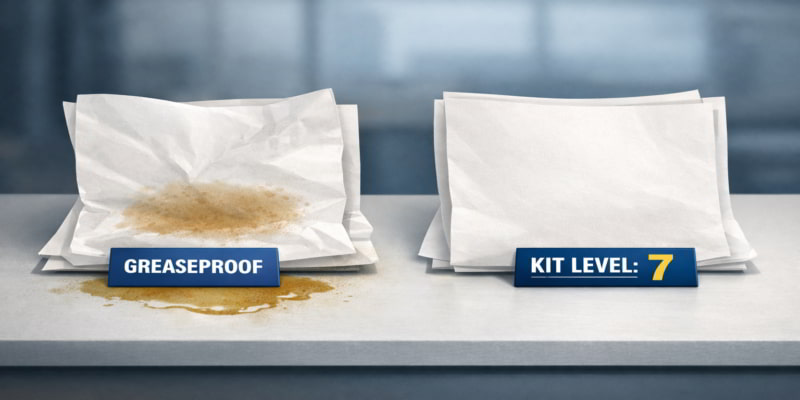
Grease stains are a small technical failure with an outsized brand effect. A wrap turns translucent, a bag leaves an oily shadow, and customers read that as “not clean” or “not food safe”—even when the food is perfectly fine. One reason this happens is that “greaseproof” is often used as a label, not a measurable specification.
The burger wrapper looked fine leaving the line. But when the customer unwrapped it, oil had crept through, leaving a dark stain. They glanced at it, then at your logo. The wrapper was labeled “greaseproof,” but that label never specified how greaseproof, or for how long.
This is why Kit Level exists. Think of it like SPF for sunscreen: a higher number means stronger protection against a specific threat. With Kit Level, you can compare food packaging paper options objectively and stop relying on vague claims.
Kit Level (Kit Rating)—Simple Definition
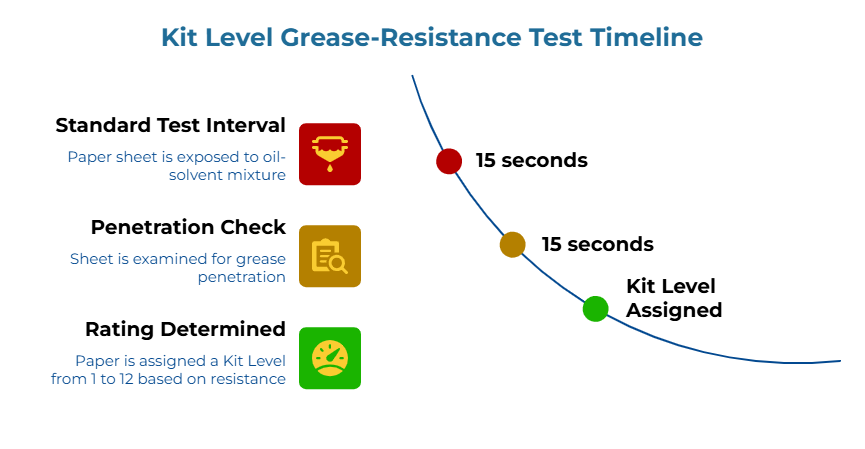
A Kit Level is a standardized grease-resistance rating for paper indicating the highest degree of aggressiveness from progressively more aggressive oil-solvent mixtures that the sheet can resist for a standard, fixed interval (typically 15 seconds) without penetration (TAPPI T 559 cm-12). The scale runs 1 to 12; higher numbers indicate resistance to liquids with lower surface tension.
This rating exists for comparability. Instead of trusting marketing terms like “greaseproof,” a stated Kit Level lets you compare options using the same measuring stick. The test method — TAPPI T 559 — is recognized globally, transforming subjective claims into verifiable specifications.
What the 1–12 Numbers Mean in Plain English
At Kit 1–4, paper generally resists mildly aggressive oils with higher surface tension—suitable for dry, low-fat items (Smithers: Grease Resistance & Kit Rating). Kit 5–8 handles moderate grease under normal serving conditions. Kit 9–12 resists aggressive, hot grease over extended hold times.
Illustrative ranges:
- Cookies, pastries, dry baked goods: Kit 1–4
- Burgers, sandwiches with cheese: Kit 5–8
- Fried chicken, fries: Kit 9–12
These are starting points, not absolute rules. Your requirement depends on actual menu conditions—temperature, pressure, and hold time all change the outcome. For detailed matching guidance, see the Menu-Match Matrix for food packaging paper.
How a Kit Level Is Determined
The test uses oil-solvent mixtures numbered 1–12, each more aggressive than the last. A lab applies each mixture to the paper surface and observes penetration within a set timeframe. The Kit Level is the highest-numbered mixture the paper resists without soaking through.
What this test tells you: How well the grease barrier holds under controlled, comparable conditions.
What it doesn’t tell you: How paper performs against steam or moisture. Kit Level measures grease resistance only—not moisture management.
If packaging goes soggy from trapped steam, the solution is ventilation or moisture barriers, not higher Kit Level. See poly-coated vs. uncoated: choosing the right barrier for guidance.
Where Kit Level Fits on a Spec Sheet
Kit Level appears alongside GSM (paper weight), Cobb value (water absorption), and coating type. Each addresses different performance dimensions.
GSM indicates weight and stiffness—but heavy paper without barrier treatment still lets grease through. For a deeper understanding of how paper weight relates to menu items, see food packaging paper GSM explained. Coating type describes the method, not the measured result. Kit Level quantifies grease-blocking performance specifically.
Heavier paper provides physical durability, but the Kit rating remains the primary metric for grease penetration.
How to Use Kit Level (The Buyer’s Mental Model)
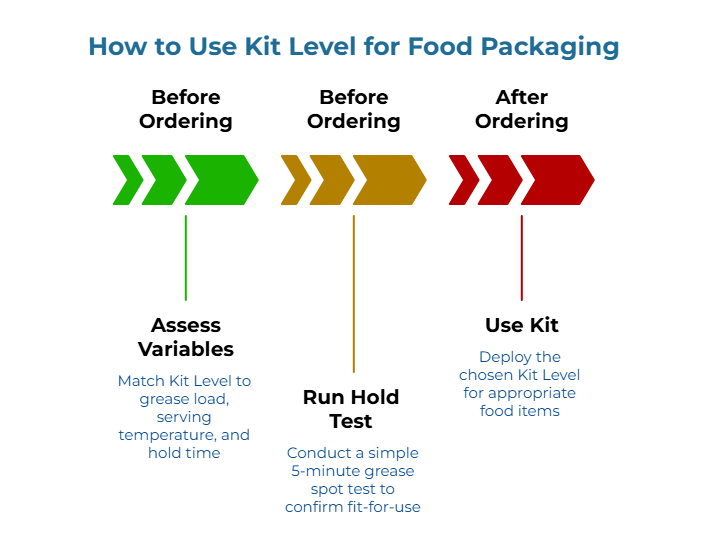
Match Kit Level to three variables: grease load, serving temperature, and hold time.
A bakery wrapping cookies faces low grease at moderate temperatures—Kit 3–5 typically suffices. A burger operation encounters moderate grease served warm—Kit 6–8 addresses most standard items. Fried chicken operations deal with high grease, high heat, and delivery hold times—Kit 9–12 becomes necessary.
The goal is fit-for-use, not maximizing. Kit 12 for dry cookies wastes money. Kit 4 for fried chicken fails in service.
Before committing to orders, run a simple hold test. For a step-by-step approach, see a simple 5-minute grease spot test to check your food packaging paper supply.
Day-to-Day Example: A shift lead notices burger wrap stain-through at lunch. Rather than guessing, they request samples with stated Kit Levels and run a short hold test—wrapping a burger, waiting the typical customer wait time, checking for penetration. Ten minutes of validation prevents production-scale mistakes.
Common Misconceptions
“Greaseproof” means it has a Kit Level. Not necessarily. “Greaseproof” is marketing, not a measured spec. Always ask for the number. Learn more about why ‘food safe’ isn’t enough and the hidden risks of generic labels.
Higher GSM means better grease resistance. GSM measures weight, not barrier performance. A 60 GSM paper with proper treatment can outperform untreated 80 GSM paper.
Mistaking grease resistance for moisture barriers. Sogginess is typically caused by water vapor; Kit ratings do not measure hydro-resistance (Cobb value).
Wax coatings equal greaseproof treatments. Wax softens under heat, reducing effectiveness above approximately 150°F (~65°C). See the wax paper trap for details.
Heat affects grease resistance. High temperatures can change surface behavior and lower oil viscosity, making penetration more likely.
Flat lab tests predict real-world performance. Flat tests aren’t folds. Creases can create weak points that compromise the barrier where paper bends during wrapping or handling.
Three Purchasing Approaches Compared
| Approach | What It Sounds Like | Common Outcome |
| Buy “greaseproof” by label only | “Send the greaseproof wrap.” | Performance varies; failures feel random |
| Buy heavier GSM and hope | “Let’s go thicker.” | Better feel sometimes; grease can still wick |
| Specify Kit Level + validate | “Quote Kit X and send samples.” | Cleaner comparisons; fewer surprises |
Business Impact: Specified and validated Kit Levels support reliability without heavy process—fewer re-wraps, reduced customer-visible failures, clearer supplier conversations, and fewer mystery failures from vague labels or silent substitutions.
Technical Note: Kit Level is a standardized grease-resistance metric based on progressively aggressive test mixtures and a pass/fail endpoint, commonly measured using TAPPI T 559. Pair with GSM, Cobb value, and coating type for complete performance characterization. For guidance on selecting the right coating, see poly vs. wax vs. greaseproof: choosing the right coating for food-grade paper menus. Grease resistance and moisture management are distinct properties requiring separate specifications.
Frequently Asked Questions
What does Kit Level measure?
Resistance to oil/grease penetration using standardized test mixtures.
Is higher always better?
No—match to conditions rather than defaulting to maximum. The best choice is the lowest Kit that consistently prevents stain-through under real conditions.
Does it measure steam resistance?
No. Moisture problems require different solutions.
Is “greaseproof” the same as kit-rated?
Not always. “Greaseproof” is often a generic label, while Kit Level is a comparable rating tied to a standardized test. Request the specific number.
Typical ranges?
Bakery: Kit 1–4. Burgers: Kit 5–8. Fried foods: Kit 9–12. Actual needs vary by conditions.
Name the Spec, Compare with Confidence
Kit Level is the 1–12 scale measuring grease resistance—like SPF for oil and fat. Now that you can name this spec, use it: request Kit Levels in quotes, run hold tests before ordering, and build decisions on verified performance.
Ready to compare food packaging paper suppliers using measurable specs? Start with a stated Kit Level.
Disclaimer:
This article provides educational information. Requirements vary by food type and conditions. Verify supplier claims through test results.
Our Editorial Process:
Our expert team uses AI tools to help organize and structure our initial drafts. Every piece is then extensively rewritten, fact-checked, and enriched with first-hand insights and experiences by expert humans on our Insights Team to ensure accuracy and clarity.
About the PaperIndex Insights Team:
The PaperIndex Insights Team is our dedicated engine for synthesizing complex topics into clear, helpful guides. While our content is thoroughly reviewed for clarity and accuracy, it is for informational purposes and should not replace professional advice.