

📌 Key Takeaways
Volatile kraft paper prices don’t have to erode your margins when you replace reactive guesswork with pre-planned decision corridors.
- Four Signals Create Your Early Warning System: Track pulp benchmarks, energy surcharges, freight rates, and foreign exchange weekly on a normalized to-door basis to spot cost pressure before it hits your orders.
- Budget Bands Replace Fixed Targets: A floor-to-ceiling corridor (for example, −3% to +5% around your baseline) gives you room to absorb natural price movement while defining clear action thresholds that protect your 2–3% margin.
- Three Pre-Planned Scenarios Eliminate Emergency Meetings: When freight surges 30%, when pulp moves 5–8% quarterly, or when currency drops 8% during demand declines, your playbook already defines the owner, the action, and the KPI—turning disruption into routine adjustment.
- Light Index Linkage Balances Stability with Flexibility: Keeping 80–90% of volume on fixed quotes while linking just 10–20% to neutral benchmarks absorbs spikes without over-engineering your system or losing negotiating leverage.
- Weekly 45-Minute Reviews Beat Crisis Management: A simple sales and operations execution rhythm checks gate dates, validates band positions, logs trigger hits, and assigns next actions—preventing last-minute scrambles when you need to place urgent orders.
Guardrails beat guesses every time. Procurement and sourcing managers at SMB packaging converters will find a practical framework here, preparing them for the detailed implementation guidance that follows.
Price volatility doesn’t have to mean margin loss.
Procurement teams at packaging converters face a familiar challenge: kraft paper prices shift with freight surges, pulp index movements, and currency swings—often within the same quarter. Leadership expects you to “catch the dips” and protect margin, but without dedicated analysts or heavy business intelligence systems, the task feels like guesswork.
It doesn’t have to be. Budget bands combined with light index linkage and three pre-planned scenarios turn reactive fire-drills into confident, pre-decided actions. This approach is designed to protect 2–3% margin by turning reactive fire-drills into confident, pre-decided actions, all without requiring sophisticated forecasting tools or constant market monitoring.
The Four Signals That Drive Your Scenarios
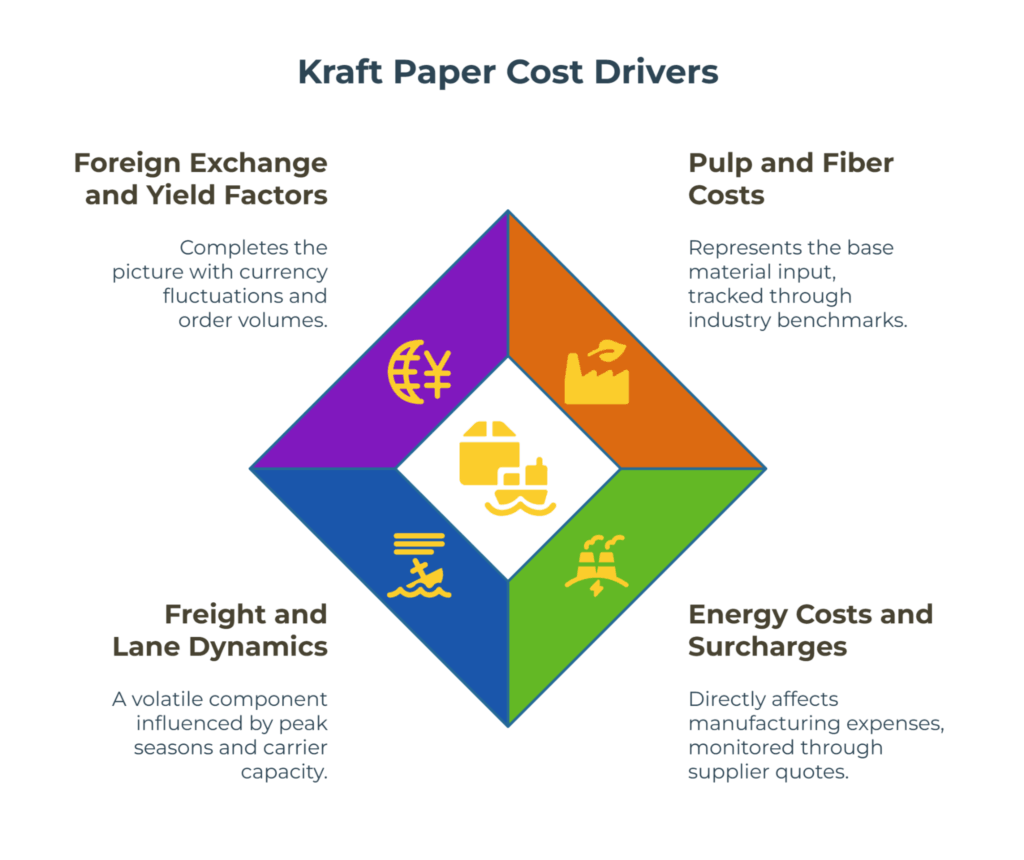
Normalize first. Before tracking anything, establish a single point of comparison by converting all quotes to the same to-door basis using consistent Incoterms and specifications. This foundational discipline prevents false comparisons that waste hours of analysis.
Effective scenario planning starts with tracking the right inputs. Four primary drivers influence kraft paper landed costs, and monitoring them weekly provides the foundation for your decision framework.
Pulp and fiber costs represent the base material input. When reference pulp benchmarks shift—typically tracked through publicly available indices from commercial organizations or industry publications—they signal potential pressure on base paper costs. Significant quarterly movements in these benchmarks are a key leading indicator that often precedes supplier requests for price adjustments.
Energy costs and surcharges affect manufacturing expenses directly. Mills factor energy into their production costs, and significant regional energy price changes eventually flow through to paper pricing. Watch for “fuel” or “energy” line items in supplier quotes and track their frequency and magnitude.
Freight and lane dynamics represent a significant and highly volatile component of your landed cost. Ocean freight rates can spike 30% or more during peak season surcharges (PSS) or general rate increases (GRI). Container availability, port congestion, and carrier capacity all influence the final delivered price. This variability makes freight the most volatile component in many supply chains, as detailed in freight scenarios that flip kraft paper supplier rankings.
Foreign exchange and yield factors complete the picture. When your supplier’s currency strengthens against your local currency by 8% or more, the price you pay increases even if their base price remains stable. Simultaneously, changes in order volumes affect per-unit economics through setup costs and minimum order quantities.
The critical discipline is normalizing all inputs to a single to-door basis before making comparisons. An EXW quote from one supplier and a CIF quote from another cannot be compared directly. Convert everything to your receiving dock using consistent Incoterms® 2020 and actual freight costs, as explained in the landed-cost framework for kraft paper. For practical implementation guidance, the ICC provides detailed checklists for each term.
Keep specifications method-named using recognized standards—ISO 536 for basis weight (grammage), ISO 2758 for bursting strength, ISO 287 for moisture content determination, and TAPPI T 410 for grammage—so that every comparison is spec-true. This prevents “price” debates that are actually specification misalignments.
Build 90-Day Budget Bands in 30 Minutes

Budget bands establish acceptable price corridors rather than fixed targets. This approach acknowledges that prices will move while giving you clear boundaries for decision-making.
Start by defining your corridor. Based on current to-door quotes from qualified suppliers, establish a floor and a ceiling that protects your target margin. For illustrative purposes, if your current baseline is $800 per metric ton delivered, your corridor might range from $776 (−3%) to $840 (+5%). These percentage guardrails are examples only; your actual corridor should reflect your specific margin requirements and supply base capabilities.
Set clear thresholds for each driver. A freight surge trigger might be a 30% increase from your baseline lane rate. A pulp index trigger could be a 5–8% quarterly movement. An FX trigger might activate at an 8% depreciation in your currency against your supplier’s currency. Document these thresholds explicitly so everyone understands when action is required.
Allocate your volume between fixed-price and index-linked tranches. Consider keeping 80–90% of your volume on fixed quotes valid for 90 days, with the remaining 10–20% loosely linked to neutral, publicly available benchmarks. This split provides stability while maintaining some flexibility to capture favorable movements without over-engineering your system.
The goal is not to predict prices but to pre-decide responses. When a trigger hits, you’ll know exactly which action to take without emergency meetings or rushed analysis.
Important note: The percentages and price figures mentioned here are illustrative examples for demonstrating the framework. Actual thresholds and bands should be established based on your specific margin requirements, supply base capabilities, and risk tolerance.
The 3 What-Ifs That Protect 2–3% Margin
Pre-planned scenarios convert potential disruptions into routine procedures. Each scenario includes a specific trigger, pre-agreed action, clear owner, and measurable KPI.
Freight Surge Flips Supplier Rankings

Trigger: Your baseline ocean freight rate increases by 30% due to PSS or GRI announcements.
Why this matters: Freight represents 20–35% of kraft paper landed cost. A significant rate increase can completely reverse your supplier rankings. The vendor who appeared most competitive at baseline freight rates may become the most expensive when rates spike.
Pre-agreed action: Re-normalize all standing quotes to current to-door totals using the new freight rates. Shift 10–20% of your volume to your index-linked tranche or explore alternate shipping lanes if available. Keep all adjusted quotes within your pre-established band corridor.
Owner: Procurement leads the re-normalization; Finance approves volume shifts that affect budget allocation.
KPI: Delta between revised to-door costs and your band ceiling. Track the percentage of volume that remains within the corridor after adjustment.
Margin protection: This prevents lane shock from erasing 1–2% margin when logistics—not paper price—is the culprit.
The freight scenario requires the most frequent monitoring during volatile periods. Weekly checks during peak season ensure you’re not surprised by rate changes that fundamentally alter your supply economics.
Pulp and Energy Driver Uptick Hits Base Paper
Trigger: Reference pulp or energy benchmarks show a 5–8% quarter-over-quarter increase.
Why this matters: These are the primary manufacturing cost inputs for kraft paper mills. When they move significantly, suppliers typically request price adjustments through formal or informal mechanisms.
Pre-agreed action: Invoke your contract’s change-control window as outlined in change control in paper contracts. Review the magnitude of the benchmark movement and apply your banded corridor adjustment. If the requested increase keeps quotes within your ceiling, approve it. If it breaches the ceiling, temporarily adjust the index-linked portion of your volume or negotiate phased implementation. Log all adjustments with supporting evidence for your quarterly business review (QBR).
Owner: Procurement manages the change-control process; Finance validates margin impact before approval.
KPI: Percentage of quotes remaining within the corridor after adjustment. Track variance between supplier request and trigger evidence. Target: 90% or higher staying in-band.
Margin protection: Early, documented adjustment avoids lagged jumps that compress margin for a full quarter.
This scenario benefits from longer lead times than freight spikes. Pulp and energy movements are typically visible weeks before they appear in paper quotes, giving you time to validate the magnitude and prepare your response.
FX Depreciation Combined with Demand Dip
Trigger: Your local currency weakens by 8% or more against your supplier’s currency while your order volumes decline by 10–15%.
Why this matters: This double-impact scenario is particularly challenging. The currency movement increases your costs while lower volumes remove your negotiating leverage and can inflate per-unit costs through higher setup frequencies.
Pre-agreed action: Hold your band floor aggressively. Consolidate SKUs to maintain order volumes where possible. Enforce minimum order quantities and minimum-run logic strictly to prevent setup cost inflation from eroding margins through operational inefficiency. Shift to weekly cadence reviews until FX stabilizes.
Owner: Procurement leads SKU consolidation strategy; Operations enforces MOQ discipline at order entry.
KPI: Setup rate per ton and OTIF (On-Time-In-Full) delivery performance. Band adherence percentage. All three should remain stable despite volume changes.
Margin protection: SKU and run-length discipline offsets FX pressure and avoids hidden conversion cost creep that can silently consume 1–2% margin.
This scenario requires the tightest cross-functional coordination. Operations must understand that SKU proliferation during low-demand periods directly threatens margin through increased setup costs.
Implementation rule: Fix specs first, then lanes, then scenarios. Always normalize quotes to to-door before comparing or acting on any trigger.
Compact Scenario Reference
| Scenario | Trigger (illustrative) | Pre-agreed Action | Owner | KPI | Review |
| Freight surge flips rankings | Ocean freight +30% vs baseline | Re-normalize; shift 10–20% to index-linked/alternate lane | Procurement | To-door delta vs band | Weekly |
| Pulp/energy uptick | Benchmark +5–8% q/q | Invoke change-control; temporary band adjust; QBR log | Procurement + Finance | Quotes within corridor | Weekly + QBR |
| FX depreciation + demand dip | FX −8% and demand −10–15% | Hold band floor; SKU consolidation; enforce MOQ/min-run | Procurement + Ops | Setup rate; OTIF | Weekly until stable |
Save this table as your quick-reference guide during weekly reviews.
Light Index Linkage without Over-Engineering
Index linkage provides flexibility without requiring sophisticated tracking systems. The approach is intentionally light to match SMB capabilities.
Linking a portion of your volume to neutral, publicly available benchmarks allows some price adjustment capability while maintaining the simplicity of your framework. Consider linking 10–20% of your volume to established pulp or paper indices published by recognized industry sources. This modest allocation absorbs spikes while preserving fixed-price stability for the majority of your book.
The critical risk to avoid is mis-linkage. Ensure the index you reference actually correlates with your supplier’s cost structure. Don’t link a southern kraft index to a northern recycled grade, and don’t tie an energy surcharge to an unrelated commodity basket. A mismatch creates disputes rather than reducing them. Verify the relationship before committing to the linkage.
Implement a quarterly business review cadence to assess whether the index linkage is delivering the intended benefit. Re-size the linked tranche and adjust thresholds at each QBR. Between reviews, keep weekly checks light—just confirm the index hasn’t moved beyond your pre-agreed adjustment corridor.
Remember that index linkage is a tool for managing existing supplier relationships, not a replacement for competitive quoting. Maintain discipline around specifications and method-named testing requirements as detailed in kraft paper RFQ fields that change the quote.
Weekly Cadence Beats Fire-Drills
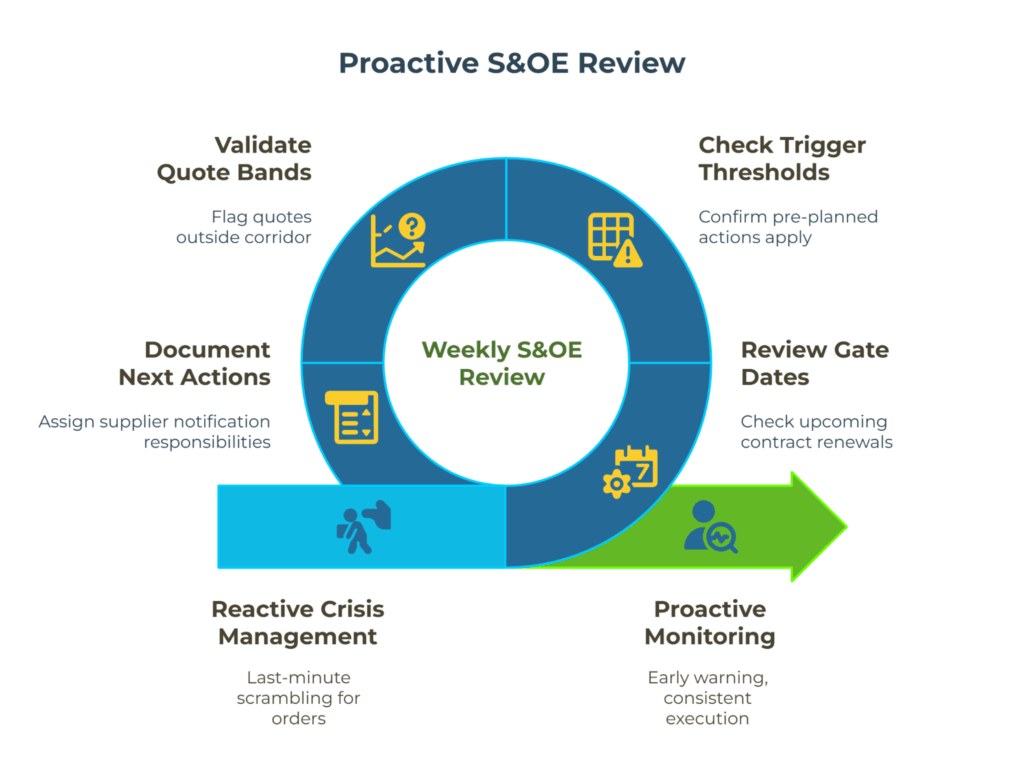
A 45-minute weekly sales and operations execution (S&OE) review transforms reactive crisis management into proactive monitoring.
Structure your weekly review around four questions:
Are we approaching any gate dates? Review upcoming contract renewals, quote expiration dates, and planned order releases.
Has any trigger threshold been reached? Check your four signal drivers against your documented thresholds. If a trigger has been activated, confirm everyone understands which pre-planned action applies.
Are current quotes within our bands? Validate that standing quotes remain within your corridor. Flag any that have drifted outside and note the driver responsible.
What are our next actions? Document specific next steps with clear owners and due dates. Assign supplier notification responsibilities if actions require external communication.
This rhythm prevents the scenario where you discover a freight spike or supplier price change only when placing an urgent order. The discipline of weekly checks creates early warning rather than last-minute scrambling.
A simple spreadsheet tracking signal movements, band limits, and trigger status provides sufficient infrastructure for most SMB operations. Sophisticated software is not required—consistency in executing the review matters far more than the tools used.
3-Scenario Worksheet for Your Team
Create a fillable worksheet that captures your entire framework in one living document:
Baseline to-door cost: Your current normalized cost per metric ton delivered to your dock
Floor and ceiling: Your corridor boundaries (e.g., −3% / +5%)
Three triggers with evidence links: Document each trigger threshold with hyperlinks to public benchmark sources or supplier communications
Fixed vs index-linked split: Your percentage allocation (e.g., 85% fixed / 15% linked)
Owners and review dates: Clear accountability with specific calendar dates for QBR and weekly checks
Keep this worksheet in your weekly meeting folder so it evolves as conditions change. Update it immediately when triggers activate or when QBR adjustments are approved. This single document becomes your operational playbook.
Copy-Ready Email to Finance and Operations
When a trigger activates, clear communication prevents confusion and delays. Use this template structure to notify stakeholders:
Subject: Kraft Paper Scenario Trigger: [Scenario Name] – Action Required
Context: Our 90-day to-door band is [floor] to [ceiling] (illustrative).
Trigger: [Specific driver that activated, e.g., “Ocean freight LAX-to-Singapore increased 32% due to PSS implementation”] hit on 2026.
Decision (pre-agreed): [The pre-agreed response from your playbook, e.g., “Re-normalize all standing quotes to current freight; shift 15% volume to index-linked tranche”]
Expected impact: Keeps us within band with an estimated [delta cost] over the next [N] weeks (illustrative figures).
Margin protection: [Brief statement on how the action maintains target margin]
Next review: [Date] in the weekly S&OE; logged for QBR roll-up.
This format ensures everyone understands what changed, why the action was taken, and when the situation will be reassessed. It eliminates the back-and-forth emails that typically consume hours during price disruptions.
Balanced Value for Buyers and Suppliers
For buyers: Method-named specifications and to-door normalization prevent false “cheaper” quotes that create rework. Bands and scenarios convert executive pressure to “catch dips” into a clear, defensible plan that protects margin while maintaining supply continuity.
For suppliers: Evidence-first, unitized quotes aligned to kraft paper buyer bands reduce quote rework and increase win probability. Transparently identifying what is fixed-price versus pass-through builds trust and positions you as a strategic partner rather than a transactional vendor.
Guardrails always beat guesses. Budget bands combined with pre-planned what-ifs and weekly cadence convert kraft paper price volatility from a crisis generator into a managed process. The framework protects 2–3% margin without requiring dedicated analysts or complex systems.
The discipline is straightforward: track four signals, maintain your corridor, execute pre-decided actions when triggers hit, and review weekly. Steadier quotes and improved OTIF follow naturally from this structure. The method is light, defensible, and repeatable—and it scales as your operation grows.
Ready to implement this framework? Set your bands and what-ifs, then request method-named, to-door quotes from brown packaging paper suppliers on PaperIndex. For suppliers, stand out by delivering evidence-first, unitized quotes aligned to buyer bands and cadence.
Disclaimer: This article is for educational purposes only; all scenario numbers and thresholds are illustrative examples. Actual implementation should be based on your specific supply chain requirements, margin objectives, and supplier capabilities. For technical specifications, refer to ISO 536 (basis weight), ISO 2758 (bursting strength), ISO 287 (moisture content), and TAPPI T 410 (grammage) when establishing quality parameters with suppliers.
For additional guidance on kraft paper sourcing strategy, explore the PaperIndex Academy and review price without context is noise for foundational principles on spec-first procurement.
Our Editorial Process
Our expert team uses AI tools to help organize and structure our initial drafts. Every piece is then extensively rewritten, fact-checked, and enriched with first-hand insights and experiences by expert humans on our Insights Team to ensure accuracy and clarity.
About the PaperIndex Insights Team
The PaperIndex Insights Team is our dedicated engine for synthesizing complex topics into clear, helpful guides. While our content is thoroughly reviewed for clarity and accuracy, it is for informational purposes and should not replace professional advice.