
📌 Key Takeaways
Grease stains on food wrappers make customers judge your brand as cheap and careless—before they even taste the food.
- Stains Signal Poor Hygiene: Customers see oil bleeding through paper and instantly think “unclean,” even when the food inside is perfectly safe.
- Match Paper to Your Greasiest Item: A wrapper that works for pastries will fail with fried chicken—choose packaging based on your menu’s toughest challenge.
- Heat and Wait Time Make It Worse: Paper that looks fine at handoff can fail after 10 minutes under a heat lamp or stacked in a delivery bag.
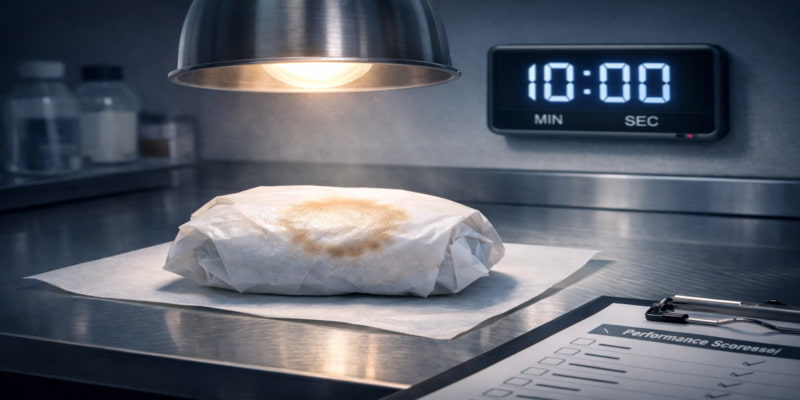
- Test Before You Buy: Wrap your greasiest item, wait 10 minutes under real conditions, then check if hands stay clean and the paper holds its shape.
- Labels Don’t Guarantee Performance: “Grease-resistant” describes a category, not a promise that a specific paper will work for your specific menu.
The right wrapper protects the premium image you’ve built everywhere else.
Food service operators and procurement teams sourcing packaging will find a practical scorecard and supplier questions here, preparing them for the detailed testing protocols that follow.
~ ~ ~ ~ ~ ~ ~ ~ ~ ~ ~ ~ ~ ~ ~ ~ ~ ~
A customer pulls their burger from the delivery bag—oil bleeding through the paper onto their fingers before the first bite. What should have been a photo-worthy meal becomes a messy disappointment, and that greasy wrapper just told a story about the brand. Not a good one.v
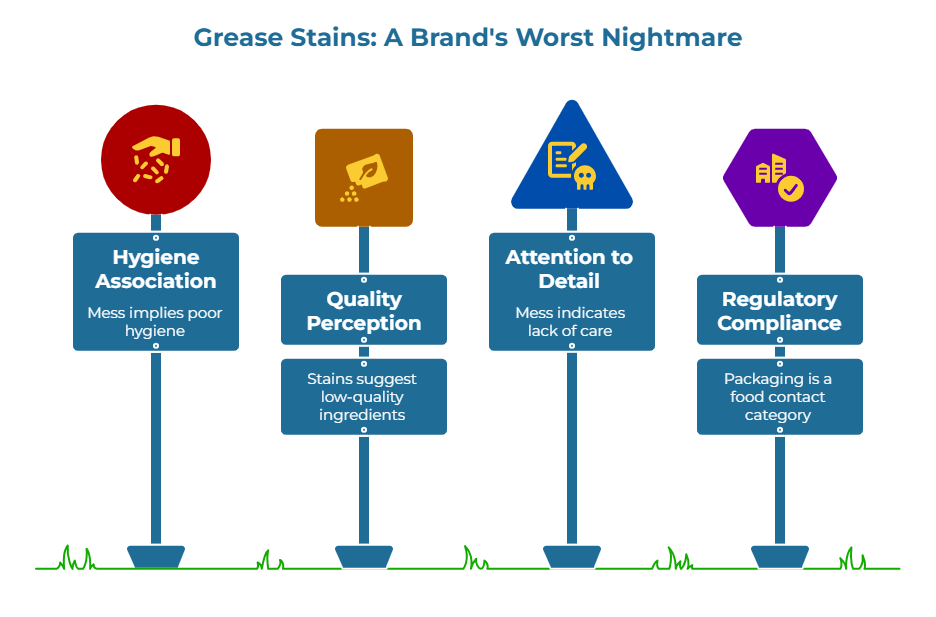
Grease stains on food packaging directly shape how customers perceive a brand’s quality and cleanliness. When oil bleeds through a wrapper, customers unconsciously associate the mess with poor hygiene, lower-quality ingredients, and lack of attention to detail. This perception gap can undermine even excellent food, making a premium meal feel cheap before it’s tasted. Packaging isn’t just containment—it’s the first physical handshake between a food business and its customer, which is why understanding food packaging paper specifications matters for brand protection.
Food packaging also sits within a regulatory context as a “food contact” category in many markets. For background on how regulators frame food-contact materials, see the FDA’s overview of food contact substances and the U.S. eCFR section on paper and paperboard components. These links explain the regulatory framing; they are not a substitute for supplier documentation.
The problem is entirely preventable. Understanding why stains trigger negative perceptions—and learning how to audit current packaging against actual menu demands—puts operators back in control of the message their wrappers send.
The Psychology of Saturation: Perception vs. Reality
Most food service operators assume customers expect some grease with fried food. They don’t. What customers actually expect is contained grease—evidence that someone thought about their experience beyond the food itself.
The Cleanliness Cue Effect
Humans make hygiene judgments almost instantly based on visual cues. A clean, dry wrapper signals that the kitchen handles food carefully. A saturated, oily wrapper triggers the opposite response—even when the food inside is perfectly safe and delicious.
This reaction isn’t about logic. It’s instinct. The same customer who happily eats fried chicken will feel uncomfortable when their hands get greasy before they’ve taken a bite. The stain becomes evidence of something uncontrolled, and uncontrolled reads as unclean.
What Customers Infer in Three Seconds
In the fleeting moments between receiving an order and opening it—typically within just a few seconds—customers form rapid, lasting impressions. Handling quality comes into question first—if grease can’t be kept off the wrapper, what else might be getting cut? Excessive oil suggests over-oiled cooking or lower-grade ingredients. A messy wrapper makes premium pricing feel unjustified. Furthermore, visible oil saturation acts as a ‘visual deterrent’ for organic social advocacy, rendering the meal unphotogenic.
These visual assessments occur before the first bite; by then, the brand’s value proposition has already been downgraded.
Where the Stains Come From (It’s Usually a Specification Mismatch)
Grease stains rarely indicate bad paper or bad food. They typically signal a mismatch between what the menu demands and what the packaging can handle.
Menu Aggression
Different menu items attack packaging with different intensity. A light croissant barely challenges a basic wrapper. Fried chicken with rendered fat? That’s an aggressive assault on paper that wasn’t designed for it.
Think of menu items on a spectrum: dry baked goods on one end, high-fat fried items on the other. Packaging needs to match the most aggressive item it will hold—not the average, which is why the Menu-Match Matrix for food packaging paper helps operators classify items systematically.
Heat, Hold-Time, and Stacking
Three factors accelerate stain breakthrough. Heat lowers the viscosity of fats, keeping them liquid and highly mobile, which allows oil to rapidly penetrate paper fibers through capillary action. Hold-time gives that oil more opportunity to migrate through the material. Stacking adds pressure that forces oil deeper and faster.
A wrapper that performs fine for immediate service may fail completely when food sits under a heat lamp for 8 minutes, then gets stacked in a delivery bag. The paper didn’t change—the conditions did.
The Common Trap
Many operators select packaging by reading labels or choosing the lowest-cost option that seems adequate. Neither approach accounts for actual performance under specific service conditions.
A wrapper labeled ‘grease-resistant’ might handle moderate grease loads perfectly while failing completely with a signature fried sandwich. The label describes a category, not a guarantee for any particular menu—a limitation explored in depth in why ‘food safe’ isn’t enough.
The Hierarchy of Material Performance
When customers encounter well-chosen packaging, they notice specific qualities—even if they can’t articulate them. A dry outer surface means hands stay clean and the wrapper feels intentional rather than compromised. Opacity and brightness signal quality; translucent spots signal saturation and failure. Structural integrity—paper that holds its shape—suggests care, while paper that goes limp suggests cheap materials. Print clarity reinforces professionalism; blotchy, oil-distorted printing undermines it.
Each element contributes to an overall impression. Premium perception isn’t about one factor. It’s about none of them failing.
The Brand Impact Scorecard
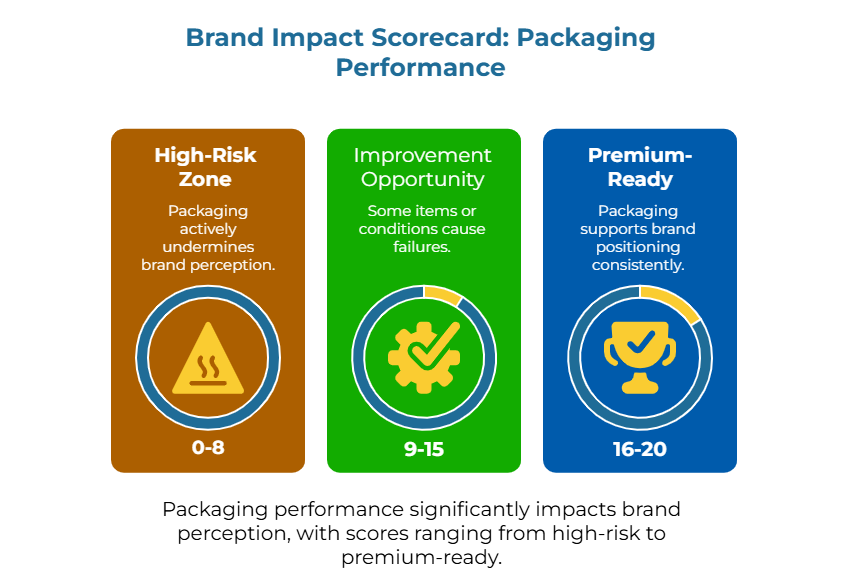
This self-assessment tool helps evaluate current packaging performance. Score each criterion based on the highest-grease menu items, using actual service conditions rather than ideal scenarios.
| Criterion | 0 (Frequent Issue) | 1 (Occasional) | 2 (Consistent) |
| Outer surface stays dry after 10 minutes | |||
| No visible oil halo on front side | |||
| Customer hands stay clean (touch test) | |||
| Wrapper maintains stiffness and structure | |||
| Printed branding stays crisp (no blotchy look) | |||
| Stains contained at folds and seams | |||
| Performance holds under heat lamp or hot holding | |||
| Works for top 3 greasiest menu items | |||
| Presentation remains photo-ready | |||
| Structural Integrity under Compression (Simulated delivery test: zero oil transfer to secondary surfaces) |
Scoring interpretation:
- 0–8 points indicates a high-risk zone where packaging is actively undermining brand perception. Prioritize upgrades immediately.
- 9–15 points represents an improvement opportunity. Some items or conditions are causing failures, so target specific weak points.
- 16–20 points means packaging is premium-ready and supports brand positioning consistently.
The fastest wins come from focusing first on whichever criterion scored lowest. A single zero often indicates a specific mismatch that can be fixed quickly. In many operations, the quickest improvements come from validating performance at the 10-minute mark, improving seam and fold control, and testing stacking pressure in a closed bag.
Fixes That Improve Perception Without a Full Packaging Redesign
Targeted adjustments can deliver noticeable improvement without overhauling everything at once.
Quick Operational Fixes
Selective double-wrapping reserves extra protection for the highest-grease items only—not everything. For a more sustainable approach, see Portion Control via Packaging to understand how better specifications can eliminate this workaround entirely. This controls the problem without doubling costs across the board. Reducing hold times helps too; even great packaging degrades with extended heat exposure, so tightening timing protects both food quality and wrapper appearance.
Adjusting stacking practices makes a difference. Lighter items on top of heavier ones prevents pressure from accelerating grease migration downward. For items that release steam, ensuring packaging allows moisture escape prevents trapped condensation from mixing with grease and accelerating saturation. A small venting habit—or a packaging format that reduces steam trapping—can improve outside dryness for hot items.
The Upgrade Path
When operational fixes aren’t enough, a structured approach prevents wasted effort. Request sample quantities from suppliers and test them against actual menu items under real service conditions—not ideal ones. A simple 5-minute grease spot test can reveal performance gaps at receiving before problems reach customers. Test after heat lamp time. Test after delivery transit. Once a paper is identified that handles the menu properly, standardize it rather than letting cost pressure push things back to something inadequate. Document what worked so future orders match the specification.
Technical Note: How to Ask Suppliers for Grease Resistance Proof
Laboratory testing isn’t necessary to verify claims. Ask suppliers directly whether they can provide samples rated for high-grease applications. Request any available test documentation—even simplified summaries help establish baseline expectations. Ask about the grease resistance approach (barrier coatings, fiber treatments) and which food types the paper is designed for. Ask how they maintain consistency across batches—process controls, QC checks, and what changes trigger requalification. A supplier who can’t answer these questions clearly may not understand their own product’s limitations. For a structured approach to supplier evaluation, the compliance shield audit framework provides verification gates beyond simple Q&A. Industry test methods like TAPPI T 559 (the Kit Test) provide standardized ways to measure grease resistance—detailed in our guide to food packaging paper Kit Levels 1–12—and suppliers should be familiar with how their products perform against such benchmarks.
Consensus Kit: Making the Case for Better Packaging
Comparison Overview
| Wrapper Type | Stain Control | Heat Behavior | Brand Feel | Typical Best Use |
| Generic wax-style wrap | Low to moderate | Wax can soften and transfer | Basic | Light items, sandwiches |
| Grease-resistant paper | Moderate to high | Stable | Professional | Burgers, moderate-fat items |
| Poly-coated or laminated wrap | High | Very stable | Premium | Fried foods, high-fat items |
For a detailed comparison of coating technologies and their performance characteristics, see Poly vs. Wax vs. Greaseproof: Choosing the Right Coating.
Addressing Common Objections
Cost concerns are legitimate but incomplete. The per-unit difference between basic and grease-resistant paper often disappears when accounting for rewraps, customer complaints, and lost photo-sharing opportunities. Calculate the full picture before comparing prices alone.
Availability is rarely the barrier it appears to be. Grease-resistant options are widely available across global markets. This is a sourcing question, not a scarcity problem.
The PFAS-Free Mandate: Navigating Sustainability. Many grease-resistant papers use fiber treatments rather than plastic coatings, and recyclable or compostable options designed specifically for grease resistance exist. Understanding the migration risks of recycled vs. virgin pulp helps operators navigate these material choices safely. Ask suppliers about their available options.
Business Impact
When packaging matches menu demands, operators typically notice several practical improvements. Complaints about messy orders reaching staff decrease. Rewrapping and remaking when presentation fails before handoff becomes less frequent—addressing what the failure of generic sourcing identifies as specification mismatch at its root. Photo-readiness for customer-generated social content improves. Furthermore, the incidence of negative feedback citing unappealing presentation or ‘messy’ handling is significantly mitigated.
These aren’t abstract benefits. They’re the practical outcomes of eliminating a friction point that was undermining the experience being created everywhere else in the operation.
A day-to-day example: A café adds a new fried breakfast sandwich to the menu. Within weeks, staff notice the standard wrappers showing visible oil spots—and they’ve started double-wrapping everything “just in case.” After testing two grease-resistant alternatives against the new sandwich under actual morning rush conditions, they identify one that holds up. Staff stop double-wrapping. Presentation improves. The per-wrapper cost increased slightly, but material waste dropped and customer-facing quality went up.
Premium Presentation Is Preventable
Greasy wrappers aren’t inevitable. They signal that packaging specifications don’t match menu demands—a mismatch that can be identified and fixed.
Start with the scorecard. Find the lowest scores. Test targeted solutions against actual menu items under real conditions. The gap between ‘messy’ and ‘premium’ is often smaller than operators expect, and closing it protects the quality perception built into everything else. For operators ready to match specifications to menu demands systematically, stop serving soggy food provides the operational guide to GSM and Kit Level selection.
For operators exploring packaging options, the PaperIndex Academy offers educational guides on topics like food packaging paper kit levels and choosing the right coating for different menu types. To browse food packaging paper options, greaseproof paper listings, or connect with greaseproof paper suppliers globally, explore the PaperIndex directory.
Frequently Asked Questions
Why do grease stains make packaging look cheap?
Grease stains trigger instinctive hygiene judgments. A saturated wrapper signals something uncontrolled—and uncontrolled reads as unclean. Customers associate visible oil with poor handling, lower-quality ingredients, and lack of attention to detail, regardless of actual food quality.
What type of paper helps reduce grease stains?
Papers with grease-resistant treatments—either barrier coatings or fiber treatments—prevent oil migration. The choice between poly-coated vs. uncoated greaseproof depends on whether moisture or grease is the primary challenge. Options range from treated greaseproof papers for moderate applications to poly-coated wraps for high-fat fried items. The right choice depends on menu grease intensity and service conditions.
How can a small restaurant test wrapper performance quickly?
Wrap the greasiest menu item, let it sit under actual holding conditions for 10 to 15 minutes, then check the outer surface. Is it dry? Are hands clean when picking it up? Does the paper hold its shape? This simple test reveals real-world performance faster than any product label.
Disclaimer:
This content is provided for general informational and educational purposes. PaperIndex is a neutral B2B marketplace connecting buyers and suppliers directly; it does not participate in transactions, broker deals, or provide market intelligence products.
Our Editorial Process:
Our expert team uses AI tools to help organize and structure our initial drafts. Every piece is then extensively rewritten, fact-checked, and enriched with first-hand insights and experiences by expert humans on our Insights Team to ensure accuracy and clarity.
About the PaperIndex Insights Team:
The PaperIndex Insights Team is our dedicated engine for synthesizing complex topics into clear, helpful guides. While our content is thoroughly reviewed for clarity and accuracy, it is for informational purposes and should not replace professional advice.