

📌 Key Takeaways
Most corrugated box problems trace back to what happened after delivery — and documenting warehouse conditions before reordering turns guesswork into a fact-based conversation with suppliers.
- Document Storage Before Reordering: Record where boxes were stored, how long they sat, what they looked like, and how they were handled — this connects failures to causes instead of assumptions.
- Separate Box Condition From Warehouse Condition: Keep notes on the storage environment, the box’s physical state, and how it performed during use as three distinct records so one bad pallet doesn’t trigger unnecessary specification changes.
- Track Inventory Age and Rotation: Log received dates, first-use dates, and any rotation exceptions — older stock in a good spot may outperform newer stock stored near a dock door.
- Match Your Response to the Evidence: Repeat the order when conditions are stable, hold and inspect when signs are unclear, and escalate to the supplier only when patterns repeat across batches, zones, or dates.
- Skip the Automatic Upgrade: Requesting heavier board without documented evidence risks added cost while leaving the real problem — storage, handling, or a changed use case — unsolved.
Document first, decide second — a one-page warehouse record turns reactive complaints into productive supplier conversations.
Procurement teams and warehouse managers responsible for corrugated box reorders will gain a clear documentation framework here, preparing them for the detailed field-by-field guidance that follows.
~ ~ ~ ~ ~ ~ ~ ~ ~ ~ ~ ~ ~ ~ ~ ~ ~ ~
Complaints about corrugated boxes that softened after delivery, warped on the rack, or crushed under stacking loads rarely come with a clear explanation. The purchasing record shows what was ordered, but it cannot reveal whether the problem started with the supplied box, the storage zone, pallet condition, handling steps, inventory age, or a changed use case.
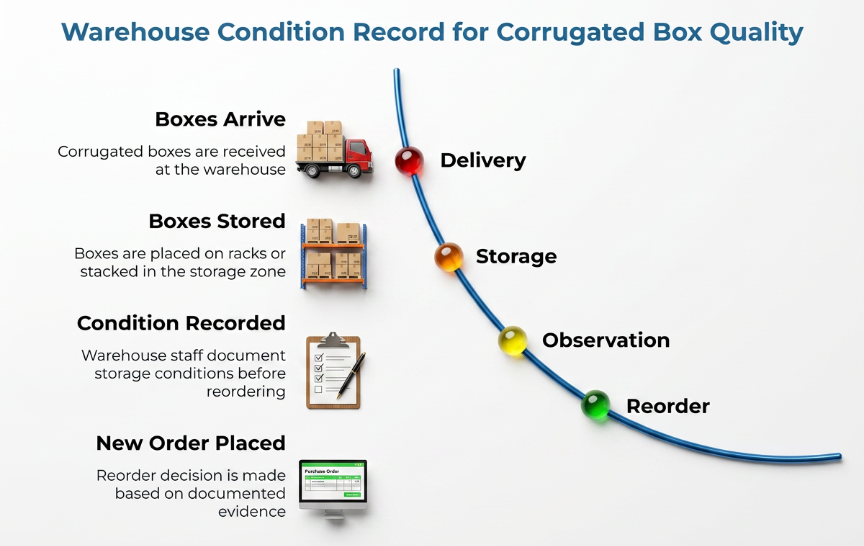
Most buyers respond by reordering the same specification or requesting something stronger. Both steps skip the question that matters most: what happened to these boxes between arrival and failure? Documenting storage conditions before the next order creates the evidence needed to answer that question — so the reorder decision and any supplier conversation that follows start with facts rather than assumptions.
A practical reorder starts with a short warehouse condition record.
The Role of Warehouse Documentation in Reordering
Corrugated box performance may be affected by several factors after delivery: moisture exposure, handling damage, compression, opened bundles, long dwell time, or a use environment that differs from the original buying assumptions. A box that performs well in a climate-controlled interior bay may soften near a dock door exposed to seasonal moisture — a pattern explored in more detail in how warehouse teams can spot humidity risk areas in corrugated box storage zones. These are generally accepted packaging and warehouse management considerations, but the exact impact depends on box type, storage conditions, product load, handling, and quality requirements.
Therefore, buyers must document conditions before making purchasing decisions. Without a storage record, supplier conversations can become vague: “the boxes are weak” or “the cartons are failing.” With a record, the conversation becomes more useful: where the stock was stored, what visible signs appeared, when the issue was noticed, and whether the same issue appeared across pallets, dates, or warehouse zones.
For broader technical context, the Fibre Box Association publishes recommended practices for storage and handling of corrugated packaging materials, but buyers should still confirm the relevance of any guidance with their own supplier or qualified packaging professional.
Essential Warehouse Documentation Fields
| Documentation area | What to record | Why it matters | Who should provide it | When to escalate |
| Storage zone | Dock, aisle, racking bay, overflow area, interior zone, or other internal label | Connects box condition to location so patterns become visible | Warehouse team | Similar boxes perform differently by zone |
| Time in storage | Received date, first-use date, and approximate storage duration | Adds reorder timing context | Procurement / warehouse | Storage duration exceeds typical use cycle, or older and newer stock behave differently |
| Pallet and floor condition | Pallet condition, floor contact, restacking, or damaged support | Separates storage exposure from support or handling issues | Warehouse team | Pallets are wet, damaged, unstable, or frequently moved |
| Visible moisture clues | Waviness, stains, softened panels, odor, damaged wrap, condensation on wrap, or unusual surface appearance | Flags stock that may need inspection — does not confirm damage on its own | Warehouse / quality | Similar signs appear across several pallets or deliveries |
| Bundle protection | Torn wrap, opened bundles, removed covers, or exposed cartons | Shows whether stock protection changed during storage | Warehouse team | Opened or exposed bundles enter normal use |
| Stock rotation method | FIFO, condition-first exception, or no formal rotation | Explains condition differences between older and newer stock | Warehouse team | Older stock consistently shows more damage than recent deliveries |
| Handling history | Moves, restacking, clamp/forklift contact, crushed corners, or opened bundles | Separates box condition from internal handling damage | Warehouse team | Damage follows a repeated internal movement step |
| Use context | Product packed, stacking, transport, fulfillment route, or internal transfer | Links observed performance to actual use | Operations | Use conditions have changed since the last order |
| Supplier Clarifications | What needs clarification before the next order | Converts observations into action | Procurement | Repeat issues need supplier guidance or review |
If the concern starts at receiving, buyers can also use a dock-level process to check corrugated box deliveries for humidity exposure before stock enters storage.
Key Information for Purchasing Teams
To streamline procurement workflows, warehouse teams should log basic operational facts missing from order history logs.
A standard handoff covers five key areas:
- Where was the stock stored?
- How long was it stored before use?
- What visible condition was noticed?
- What handling steps occurred before use?
- Did the issue repeat across zones, pallets, or dates?
While this documentation does not prove the root cause alone, it establishes a factual baseline. That distinction is important: visible waviness, staining, or soft panels may indicate the need for inspection, but they do not automatically prove moisture damage, supplier fault, or specification failure.
Document Box Condition Separately From Warehouse Condition
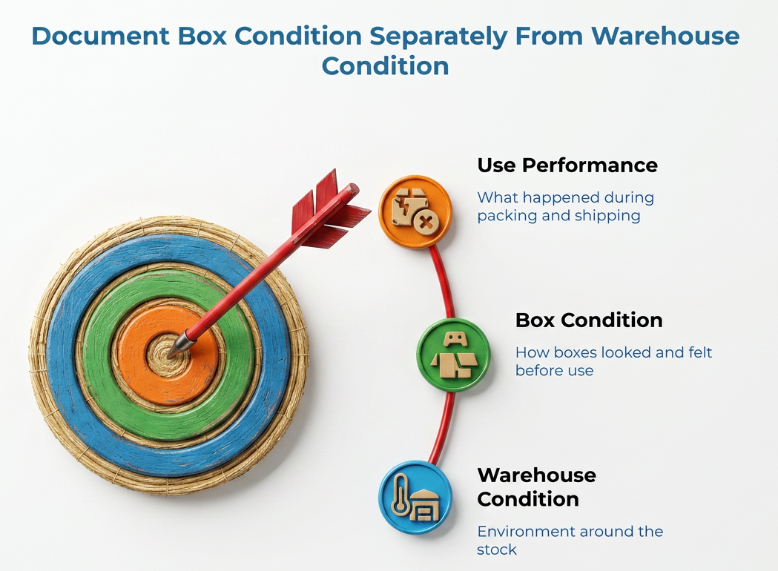
Buyers should separate three kinds of evidence:
Warehouse condition is the environment around the stock: storage zone, pallet condition, floor contact, wrapping condition, exposure clues, and storage duration.
Box condition is what the boxes looked or felt like before use: crushed corners, warped panels, visible stains, softened areas, torn bundles, or unusual odor. Photo documentation is practical — a time-stamped image of a softened panel next to a firm one from the same delivery communicates more to a supplier than a written complaint. Where available, include batch numbers or purchase order references.
Use performance is what happened during packing, stacking, internal movement, or dispatch: poor closing, crushing, deformation, or inconsistent behavior.
Keeping these separate prevents overreaction. One damaged pallet may point to a storage or handling exception. Repeated issues across multiple pallets, dates, and storage zones may justify a supplier discussion or specification review. A softened box may still function for a light product packed the same day. A box that looks fine may fail under stacking loads it was not designed for. Documenting condition and use-case performance separately gives the buyer a clearer picture when deciding.
Buyers who need a more structured receiving or inspection process can also review how to verify corrugated box quality at the dock.
Add Inventory Age, Rotation, and Use Context
Inventory age is context, not proof. Older stock may remain usable if properly protected. A newer box may need inspection if it was stored in a poor location, opened early, or handled roughly.
Record the received date, first-use date, and whether normal rotation was followed. If the warehouse uses first-in, first-out but made an exception because a pallet looked exposed or damaged, record that exception — a situation covered in depth in the guide to corrugated box storage for slow-moving packaging stock. Where no formal rotation exists, note that as well — it explains why older and newer stock may show different condition patterns.
Usage context should stay practical. Note the product packed, general load type, stacking situation, internal transfer steps, and when the problem appeared. Identifying exactly when a failure occurs helps buyers isolate environmental factors from material defects.
Internal handling steps also matter. Boxes moved multiple times by forklift, restacked by hand, or stored temporarily on the floor may show damage patterns unrelated to the specification or storage environment. Recording these steps separates handling damage from storage degradation.
Example: if boxes stored near a dock door show waviness while boxes from the same delivery stored in a dry interior zone perform normally, the buyer should document the zone difference before changing the box specification.
Repeat, Hold, or Review: A Reorder Decision Framework
Repeat the same order when the record shows consistency
Repeating the same order may be reasonable when current stock performed consistently, storage conditions were controlled enough for the buyer’s use, visible condition issues were absent or minor, and product or handling requirements have not changed. Documenting a successful outcome is equally useful; it confirms the current specification still fits.
If historical data reflects zero deviation, altering the material grade introduces unnecessary variables.
Hold and inspect when storage or handling evidence is unclear
Hold and inspect when boxes show visible waviness, staining, softened panels, crushed corners, torn wrap, unusual odor, or unclear handling history — symptoms that can also help triage whether damage came from storage, suppliers, or handling. This path is useful when the issue appears limited to certain pallets or storage zones.
The aim is to avoid turning one poorly stored or mishandled batch into a full specification change. One damaged pallet does not prove the current specification is wrong.
Ask for supplier guidance when patterns repeat
Supplier guidance becomes more useful when the buyer can show repeat patterns. Escalation may be appropriate when similar issues appear across several batches, the same symptoms continue after better storage controls, or the product load, stacking, transport, or fulfillment route has changed.
At that point, the discussion can shift from “Should the box be stronger?” to “Does the current specification still fit the actual storage and use conditions?” — a question that also depends on understanding how humidity changes corrugated box stack planning.
For buyers ready to go deeper into failure-mode diagnosis, it may be useful to understand how teams can translate physical failures into corrugated box specifications, while still confirming any technical changes with the supplier or a qualified packaging professional.
Avoid an immediate upgrade when the evidence is incomplete
Over-specification based on incomplete evidence can add cost and create new issues if the upgraded box does not match the actual use case. Requesting a heavier board grade when the real cause was storage placement, handling damage, or a one-time incident wastes the cost difference and may leave the underlying problem unresolved.
An immediate upgrade is premature when the only evidence is a single incident, a vague complaint, or an assumption that stronger material will solve the problem. The storage record, condition observations, and usage context should point to a clear specification gap before the buyer commits to a change.
Supplier Questions to Ask After the Storage Record Is Ready
Once the storage record is complete, procurement can ask more useful supplier questions:
- What storage conditions do you recommend for this box type?
- Which specific visual defects should trigger an inspection before use?
- Are there handling, stacking, or storage practices the buyer should avoid?
- What documentation helps you diagnose a complaint?
- If operational demands have evolved, which technical specifications or performance metrics require evaluation?
- When should moisture-resistant options or specification changes be evaluated rather than assumed?
- What information should be included before the next order discussion?
Formal testing or standards may apply to some applications, but buyers should avoid casually naming a method. Recognized industry resources such as FEFCO’s corrugated testing methods and ISO packaging conditioning standards can provide useful reference points, but the applicable method and scope should be confirmed by the supplier or a qualified packaging professional before being used in specifications or complaints.
After documentation is complete, buyers may also review corrugated box supplier options with clearer storage and usage requirements in hand.
Common Diagnostic Pitfalls in Material Evaluation
| Avoid this conclusion | Use this safer interpretation |
| “The supplier is at fault.” | “Document storage, handling, visible condition, and use context before assigning cause.” |
| “A stronger box will solve it.” | “Review whether the current specification still fits the use case.” |
| “Humidity signs prove technical failure.” | “Visible signs may justify inspection, but cause and impact require confirmation.” |
| “One damaged pallet means the whole order is wrong.” | “Check whether the issue repeats across pallets, zones, or dates.” |
| “The warehouse owns the problem.” | “Warehouse, quality, operations, and procurement each hold part of the evidence.” |
| “Reorder from the last PO — nothing has changed.” | “Confirm whether storage conditions or usage requirements have changed since the last order.” |
Frequently Asked Questions
What should packaging buyers document before reordering corrugated boxes?
Buyers should document the storage zone, storage duration, pallet condition, visible box condition, wrap or bundle status, handling history, stock rotation method, usage context, and supplier questions that need clarification. These fields help connect the reorder decision to what happened between delivery and use.
What should be photographed before reordering corrugated boxes?
Photograph visible condition differences between zones, softened panels alongside unaffected ones from the same delivery, the storage environment including dock proximity or floor contact, and the condition of stretch wrap or bundling. Include a date reference in each photo so the evidence is traceable.
What should be sent to the supplier before asking for changes?
Send a short evidence pack: order or delivery reference, affected quantity, storage zone, received date, first-use date, visible symptoms, photos, handling notes, product/use context, and whether the issue repeated. This does not need to be complex; it needs to be specific.
Does humidity exposure mean corrugated boxes must be rejected?
Not automatically. Whether affected boxes remain usable depends on severity, the buyer’s packing requirements, and quality expectations. Visible moisture clues may require inspection or hold status, but rejection depends on the box condition, use case, and professional or supplier guidance. A hold-and-inspect decision is often more appropriate than outright rejection until the evidence is reviewed.
Should buyers ask for moisture-resistant corrugated boxes?
They can ask whether a review is warranted, but they should not assume moisture-resistant material is the correct answer. Storage conditions, application requirements, handling history, and supplier guidance should be reviewed first. Requesting an upgrade without documented evidence risks adding cost without solving the problem.
How much storage history is enough before contacting a supplier?
Even one well-documented cycle — receiving through storage to use — provides a useful starting point. Two to three cycles strengthen the evidence by showing whether conditions are consistent or variable. The key is detail, not volume.
Should purchasing or warehouse teams own the documentation?
Procurement should own the reorder decision. Warehouse teams should provide storage and handling evidence. Quality teams should assess whether stock needs inspection or release control. Operations should explain how the boxes are actually used.
Conclusion
A corrugated box reorder should not depend only on the previous SKU, last quantity, or strongest complaint. When boxes soften, warp, crush, or perform inconsistently, the first step is to document storage and use conditions clearly enough for the next decision.
Before placing the next order, build a one-page warehouse condition record and use it to guide supplier questions. The result is a calmer, more factual conversation about whether to repeat the order, hold and inspect current stock, or review the specification.
Disclaimer:
This article is for general informational purposes only and does not constitute compliance, safety, technical, or professional advice. Requirements, risks, and best practices may vary by context, jurisdiction, system, provider, or use case. Confirm important decisions with the appropriate qualified professional, authority, supplier, or technical expert.
Our Editorial Process:
Our expert team uses AI tools to help organize and structure our initial drafts. Every piece is then extensively rewritten, fact-checked, and enriched with first-hand insights and experiences by expert humans on our Insights Team to ensure accuracy and clarity.
About the PaperIndex Insights Team:
The PaperIndex Insights Team is our dedicated engine for synthesizing complex topics into clear, helpful guides. While our content is thoroughly reviewed for clarity and accuracy, it is for informational purposes and should not replace professional advice.