

📌 Key Takeaways
A simple dock checklist turns a humidity-suspect corrugated box delivery into a structured, documented decision — no lab equipment needed.
- Inspect Before You Store: Soft panels, wavy sides, musty smells, and water stains on corrugated boxes all suggest moisture exposure that deserves a closer look before anything enters inventory.
- Bottom Layers Hide the Worst: Cartons resting on the pallet absorb moisture from contact surfaces first, so always check the lowest tier even when the top looks fine.
- Document at the Dock, Not Later: Photos, delivery details, and condition notes captured before handling carry far more weight than records put together from memory days afterward.
- Separate First, Decide After: Moving suspect cartons into a hold area before they mix with good stock prevents the far bigger headache of sorting them out later.
- One Soft Box Is Not the Whole Story: Isolated damage may affect a few cartons, not the full delivery — inspect the scope and escalate based on patterns, not a single surface impression.
Document early, separate fast, and let evidence — not assumptions — guide the next step.
Warehouse teams, packaging buyers, and quality managers handling corrugated box deliveries will gain a repeatable receiving workflow here, preparing them for the detailed inspection guide that follows.
~ ~ ~ ~ ~ ~ ~ ~ ~ ~ ~ ~ ~ ~ ~ ~ ~ ~
A pallet of corrugated boxes rolls off the truck. Most cartons look square and firm, but a handful on the lower tier feel slightly soft. One side panel has a faint wave. Near the stretch wrap, there is a musty smell that was not there on the last shipment.
The checklist below covers visual and physical checks receiving staff can perform without lab equipment, explains when to separate or escalate, and provides a documentation framework that supports supplier conversations later. It does not replace supplier specifications, formal quality testing, or internal QA procedures; rather it gives teams a structured first pass when something looks off.
Before using the checklist, align on a few working terms:
| Term | Practical Meaning at Receiving |
| Corrugated box | A paper-based packaging box made from corrugated board, typically used for shipping, storage, or product protection. |
| Humidity exposure | Possible exposure to moisture in air, damp surfaces, condensation, wet handling areas, or humid transit conditions. |
| Receiving inspection | The first dock-level check before goods are accepted into storage or released for use. |
| Quarantine / hold area | A clearly identified place where questionable stock is kept separate until reviewed. |
| Supplier escalation | A documented discussion with the supplier or supplier representative when delivery conditions need clarification. |
Quick Receiving Checklist for Corrugated Boxes With Possible Humidity Exposure
Use this table at the dock before cartons are moved into warehouse inventory.
| Check | What to Look For | Why It Matters | Recommended Next Step | Evidence / Verification Note |
| Outer wrap and pallet condition | Condensation, water marks, torn or loose stretch wrap, pooled moisture on the pallet base | Damaged or saturated wrap may indicate exposure during transit or staging | Photograph the pallet before unwrapping; note wrap condition on the delivery record | Visual assessment only; does not confirm board-level moisture content |
| Surface dampness or staining | Wet spots, tide marks, discolouration, or water stains on carton faces | Surface moisture may suggest direct humidity or water contact | Separate stained or visibly damp cartons; record affected quantity and pallet position | Surface appearance alone does not confirm whether structural properties have changed |
| Waviness, bulging, or loss of shape | Wavy panels, bowed sides, bulging faces, or cartons that no longer sit square | Distortion may suggest the board has absorbed moisture | Compare affected cartons against unaffected cartons from the same delivery | Distortion indicates possible moisture uptake but does not measure performance loss |
| Softened panels or crushed corners | Panels that flex easily under light hand pressure; compressed corners or creased edges | Softening may indicate reduced board stiffness | Note severity and whether the issue is isolated or widespread | Tactile assessment; confirmed stiffness loss requires verified testing methods |
| Board surface and edges | Fuzzy edges, delamination, loosened layers, unusual softness, scuffed damp areas, or damaged corners | These signs may affect packaging integrity or justify further review | Hold visibly affected cartons if internal procedures allow | Keep the observation qualitative unless formal test results are available |
| Musty or damp odour | Smell near the pallet or inside the wrap suggesting prolonged damp conditions | Odour can indicate sustained moisture exposure over a longer period | Flag the pallet for quality review; include the observation in receiving records | Odour supports a pattern of exposure but is not a measurable test result |
| Bottom layers and pallet-contact areas | Dampness, compression marks, or staining where cartons rest on the pallet or floor | Bottom tiers absorb moisture from contact surfaces and are the most likely exposure point | Inspect bottom-layer cartons even when top layers appear unaffected | Lower-tier exposure is a widely recognised risk area in corrugated handling |
| Lot and pallet consistency | Variation in condition across pallets, lots, or sections of the same delivery | Inconsistent condition may indicate localised exposure, not a full-delivery issue | Record which pallets or lots are affected to support traceability | Useful for isolating the scope; supplier communication depends on clear lot-level records |
| Delivery documentation | Delivery date, carrier details, supplier paperwork, lot or batch identifiers, pallet IDs | Without contemporaneous records, tracing what arrived and when becomes difficult | Capture this information before handling, restacking, or moving boxes | General receiving best practice; no technical verification required |
| Initial hold decision | Dampness, distortion, odour, staining, delamination, or inconsistent pallet condition | Suspect stock should not disappear into normal inventory before review | Move questionable stock to a hold area and label it clearly | Final use, release, or rejection should follow supplier specs and internal QA procedures |
This checklist is a practical receiving tool, not a pass/fail testing protocol. Any interpretation of structural performance — such as compression strength, edge crush resistance, or adhesive integrity — should be confirmed through verified testing methods or supplier specifications.
Normal Transit Wear vs. Humidity Warning Signs
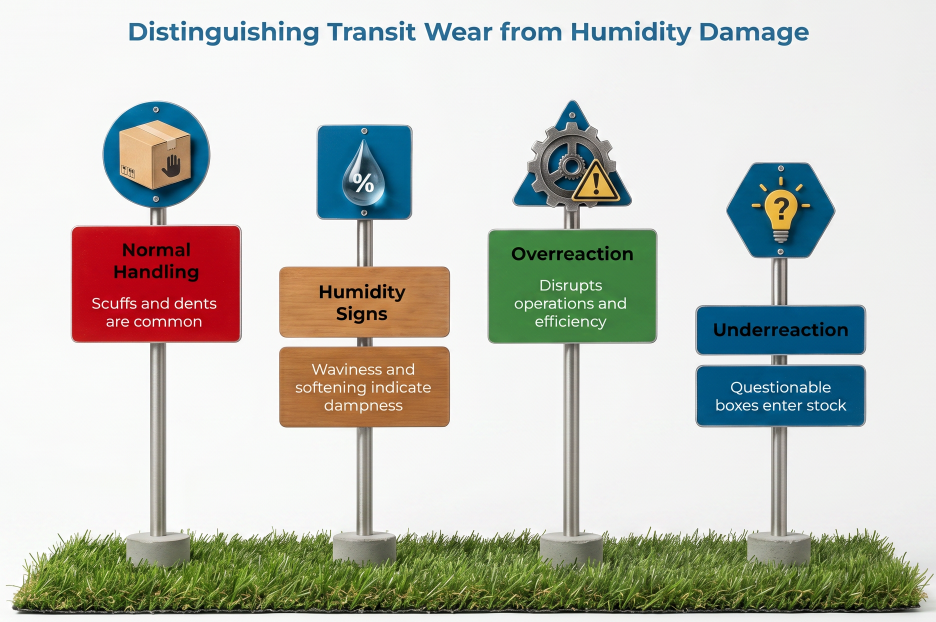
Not every mark on a corrugated box points to humidity exposure. Light scuffs, minor corner rubs, strap marks, and small dents on outer cartons can happen during normal handling. These observations still deserve attention, but they may not justify separating the full delivery.
Humidity warning signs look different because they suggest the board itself may have been exposed to damp conditions. Look for patterns such as waviness across multiple cartons, softened panels, water marks, musty odour, staining near the pallet base, delamination, or one pallet face that looks materially different from the rest.
The distinction matters because overreaction can disrupt operations, while underreaction can move questionable boxes into usable stock. A practical receiving team does not decide based on one surface-level mark. It checks the pattern, compares affected and unaffected cartons, documents the condition, and then decides whether review is needed.
What Humidity Exposure Can Change Before Boxes Reach Storage
Corrugated boxes rely on the structure of the fluted medium, the adhesive bonds between layers, and the rigidity of the liner panels. When corrugated boards absorb humidity — from rain, condensation, extended staging in humid conditions, or a damp truck bed — those structural characteristics can shift.
The effects may include decreased structural rigidity, visible warping, softened edges, and compromised pallet stability. Industry bodies such as the Fibre Box Association, testing standards organizations like TAPPI and ASTM, and international frameworks from ISO have published guidance confirming that humidity is a recognised variable in corrugated packaging performance, though the specific impact varies by board composition, exposure duration, flute profile, and storage conditions.
A box that feels dry on the surface may still carry absorbed moisture from earlier exposure — a dynamic explored in depth in the article, Why standard corrugated boxes fail: the physics of heavy-duty shipping. Visible condition is a useful screening tool, but it does not measure what is happening inside the board structure.
How to Decide Whether to Store, Separate, or Escalate the Delivery
Not every suspect delivery needs the same response. Whether warning signs are isolated to one pallet or spread across several matters more than any single carton.
| Condition Observed | Suggested Action | Documentation Needed | Who to Involve |
| No warning signs; cartons firm, dry, and consistent | Store normally per standard receiving procedure | Standard delivery record | Receiving team |
| Minor isolated scuffing or handling wear without moisture signs | Inspect quickly, then store if acceptable under normal procedure | Receiving note if needed | Warehouse lead |
| Minor dampness, slight waviness, or isolated soft spots on a small number of cartons | Separate affected cartons; store unaffected stock normally | Photos, affected quantity, pallet/lot IDs, severity notes | Warehouse manager; notify packaging buyer |
| Widespread dampness, distortion, odour, staining, or softening across multiple pallets | Hold the full delivery for review before storage | Full photo set, delivery details, lot/batch records, condition notes | Quality manager; packaging buyer; supplier contact |
| Boxes intended for food-adjacent, regulated, or high-sensitivity use | Involve quality or compliance team before storing or using any affected cartons | All receiving records plus applicable quality or compliance documentation | Quality or compliance team before any use |
For food-adjacent or regulated packaging applications — including those requiring food packaging paper compliance — handling and acceptance requirements may vary by use case and jurisdiction. Confirm them with the quality or compliance team rather than relying on general guidance.
What to Document Before Moving Corrugated Boxes Into Storage
Documentation captured at receiving carries far more weight than notes assembled from memory days later. When a delivery raises questions, capture these metrics before handling or relocation:
- Full pallet photos before unwrapping, showing overall condition and wrap integrity.
- Close-up photos of damp spots, stains, crushed corners, softened panels, warped cartons, delamination, torn wrap, or pallet-contact areas.
- Delivery details: date, time, carrier name, and vehicle or trailer number where available.
- Supplier paperwork: purchase order reference, lot or batch identifiers, and pallet IDs.
- Affected scope: which pallets, which layers, and how many cartons.
- Condition assessment: whether the issue appears isolated or widespread, and its severity.
- Storage decision: what was stored normally, what was separated, and who made the call.
A hypothetical contemporaneous note might read: “Delivery received 14 May, PO 2024-0892, Supplier X, 12 pallets. Pallets 3 and 7 show damp staining on bottom-tier cartons and slight waviness on side panels. Photographed before handling. Affected cartons separated to hold the area. Warehouse manager notified packaging buyer for supplier follow-up.” Adapt the format to match existing receiving records. When a supplier asks for evidence later, this is the material that makes the conversation productive.
What Not to Assume From a Humidity-Suspect Delivery
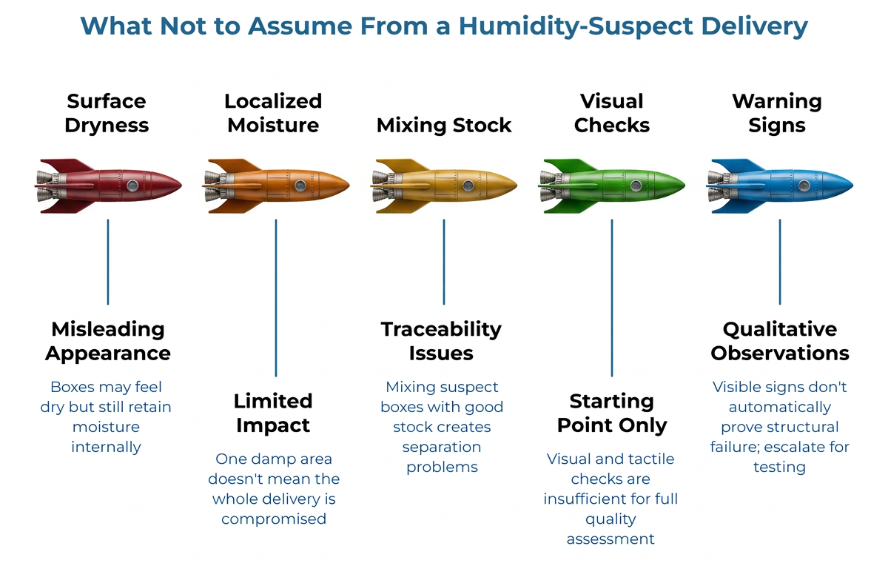
A few common assumptions can create problems regardless of which direction they lean.
Surface dryness does not mean the boxes are suitable for all uses. Corrugated boards can absorb and retain moisture even when the outer surface feels dry. Document the condition and let the quality process determine suitability, particularly for regulated applications.
One damp area does not mean the entire delivery is compromised. Localised moisture on a lower pallet tier may affect a handful of cartons without extending to the rest. Inspect the scope before making a full-delivery decision.
Mixing suspect stock into general inventory before inspection creates traceability problems. Once questionable cartons are shelved alongside confirmed-good stock, separating them later is far more disruptive than pausing at receiving.
Visual and tactile checks are a starting point, not a conclusion. A dock inspection does not measure compression strength, adhesive integrity, or board moisture content — for a structured testing protocol that goes beyond visual checks, see how to verify corrugated box quality at the dock. When deeper evaluation is warranted, escalate to the quality team or request verified test data from the supplier.
Visible warning signs do not prove structural failure. Use cautious, qualitative language when recording observations unless formal testing or supplier criteria support a stronger conclusion. This is especially important when boxes support food-adjacent, regulated, export, customer-facing, or high-value product workflows — in those cases, the receiving check should trigger quality review rather than replace it. Teams sourcing corrugated packaging for pharmaceutical applications, for instance, should consult a compliance-first sourcing framework before releasing suspect stock.
When to Discuss the Delivery With Your Supplier or Quality Team
A single soft carton may not justify a supplier call. But certain patterns should prompt a conversation.
Escalation is generally warranted when warning signs appear across multiple pallets or lots, when the same issue recurs on consecutive deliveries, when damage severity is high — visible delamination, strong odour, or widespread staining — or when the boxes are intended for a critical or food-adjacent packaging use. Teams without clear internal acceptance criteria — a gap that a specification-first sourcing framework can help close — should also escalate rather than improvise.
Share photos, delivery records, lot identifiers, and condition notes. The discussion should clarify the next safe step and improve future delivery expectations — not start with blame before the facts are clear. Useful questions to raise include what inspection or hold criteria should apply to the delivery, whether the affected pallet should remain separated before use, whether supplier specifications cover receiving condition, wrapping, handling, or storage, whether future deliveries need different pallet protection or transport conditions, and whether the packaging use requires quality or compliance review before release.
If corrugated box acceptance criteria do not yet exist internally, this may prompt developing them. Resources on verifying corrugated box quality at the dock and defining enforceable corrugated box specifications can help build that foundation, and understanding why recurring damage often traces to sourcing gaps may sharpen the right questions to ask.
Frequently Asked Questions
How Can You Tell if Corrugated Boxes Were Exposed to Humidity During Delivery?
Look for visible dampness, water stains, panel waviness, softened surfaces, musty odour, delamination, and inconsistent condition across pallets. These signs suggest possible humidity contact and warrant closer inspection — they do not, on their own, confirm structural compromise. Further evaluation or supplier input may be needed.
Should Damp Corrugated Boxes Be Rejected Immediately?
Not automatically. The appropriate response depends on severity, scope, intended application, and any applicable internal QA or supplier acceptance criteria. Inspect, document, separate if warranted, and consult internal procedures before making a final decision.
What Should Warehouse Teams Do Before Storing Suspect Corrugated Boxes?
Check conditions at the dock using the receiving checklist above, photograph the delivery before handling, record delivery details and lot identifiers, compare affected cartons with unaffected stock, and hold questionable boxes for review. Align with the packaging buyer or quality manager before moving suspect cartons into general storage.
What Should Warehouse Teams Do If They Do Not Have Moisture Meters or Lab Tools?
Visual, tactile, and documentation checks serve as an effective first screen. Warehouse teams can photograph the condition, compare cartons side by side, record pallet and lot details, and hold suspect stock for review. If technical performance needs to be confirmed, the issue should move to QA, supplier guidance, or a formal testing procedure. The absence of lab equipment does not prevent a structured receiving inspection — it means the inspection stays qualitative, and technical conclusions are left to those with the right tools and criteria.
Does Humidity Always Ruin Corrugated Boxes?
Humidity exposure does not automatically render every box unusable. The actual effect depends on the extent and duration of exposure, board composition, intended use, and internal quality requirements. A structured receiving check helps the team avoid both overreaction — rejecting stock that may be perfectly serviceable — and blind acceptance, where questionable cartons enter inventory without review.
Can Humidity Exposure Affect Corrugated Box Strength?
Moisture and humidity exposure may affect the stiffness, shape, and structural performance of corrugated boards. The extent depends on board composition, flute profile, exposure duration, and ambient conditions. Quantified effects should be confirmed through verified testing methods — such as those referenced in TAPPI or ASTM standards — or supplier specifications, rather than assumed from visual inspection.
Turn a Suspect Delivery Into a Controlled Receiving Process
Receiving teams do not need laboratory equipment or specialised training to handle a humidity-suspect delivery responsibly. A short checklist, a camera, a few minutes of documentation, and a clear escalation path turn uncertainty into a defensible process.
Inspect before assuming. Document before handling. Separate before mixing. Escalate based on evidence rather than a single surface impression. The goal is to give packaging buyers, warehouse managers, and quality teams a shared, repeatable workflow that protects inventory quality and supports the next conversation with confidence.
Before moving suspect boxes into storage, document the delivery condition and align with the warehouse team, quality manager, or supplier contact on the appropriate next step.
For sourcing guidance, PaperIndex also lists corrugated boxes and corrugated box suppliers. Use supplier discovery only after your internal quality and specification requirements are clear.
Disclaimer:
This article provides general educational guidance for corrugated box receiving inspection. It is not a substitute for supplier specifications, formal quality testing, or regulated packaging requirements. Confirm specific acceptance criteria and compliance obligations with the relevant quality team, supplier, or professional authority.
Our Editorial Process:
Our expert team uses AI tools to help organize and structure our initial drafts. Every piece is then extensively rewritten, fact-checked, and enriched with first-hand insights and experiences by expert humans on our Insights Team to ensure accuracy and clarity.
About the PaperIndex Insights Team:
The PaperIndex Insights Team is our dedicated engine for synthesizing complex topics into clear, helpful guides. While our content is thoroughly reviewed for clarity and accuracy, it is for informational purposes and should not replace professional advice.